

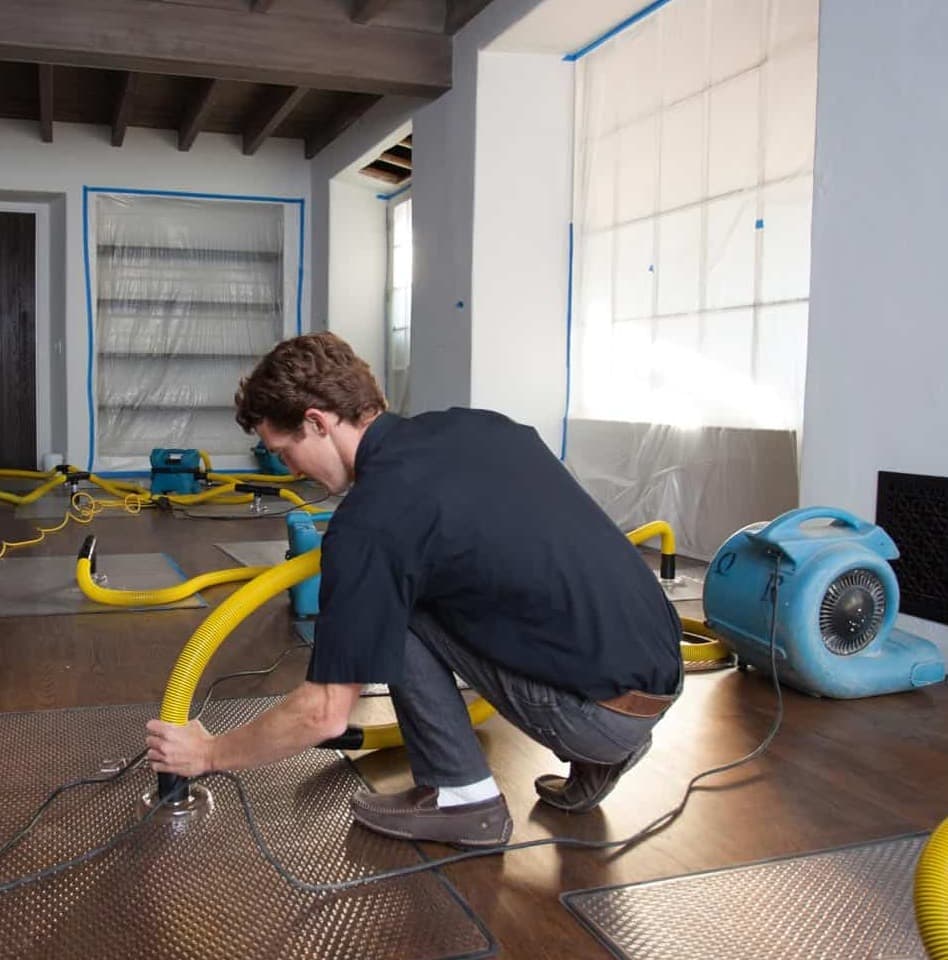
If your basement is flooded, stay out of the water, cut power only from a dry spot, stop the source if you can reach it, and call Prime Restoration at (586) 277-1069, 24/7 and ready to dispatch now. Photograph everything, then call your insurer. If you smell gas, leave and call 911. If sewage came up a drain, Michigan law gives you 45 days to send the city written notice.
The first-hour list for a flooded basement in Michigan
- Stay out of the water. Do not step in if it touches an outlet, a cord, the panel or an appliance. Keep children and pets upstairs.
- Smell gas? Leave. Walk outside, call 911, then call the gas utility from outside: DTE Energy at 800-947-5000 or Consumers Energy at 800-477-5050.
- Cut the power from a dry spot. If the main panel is upstairs or in a dry room, switch off the main breaker. If the panel is in the wet basement, call DTE at 800-477-4747 or Consumers Energy at 800-477-5050 and wait.
- Stop the source. Close the main water valve or the water heater valve if you can reach it from dry floor. A failed sump pump or a street backup has no valve, so move to the next step.
- Call Prime Restoration at (586) 277-1069. The line is open 24/7. Prime tells you what is safe to do before the crew arrives and helps get a plumber or electrician out when the source needs one.
- Photograph and video the water line, the source and every wet item. Do this before you move anything.
- Call your insurer. Say "water damage from a sump pump failure" or "water came up the floor drain". Do not open with the word "flood".
- Lift what you can. Move electronics, papers, photos and boxes to dry shelves upstairs. Leave drains and standing water alone until a professional says the water is safe to handle.
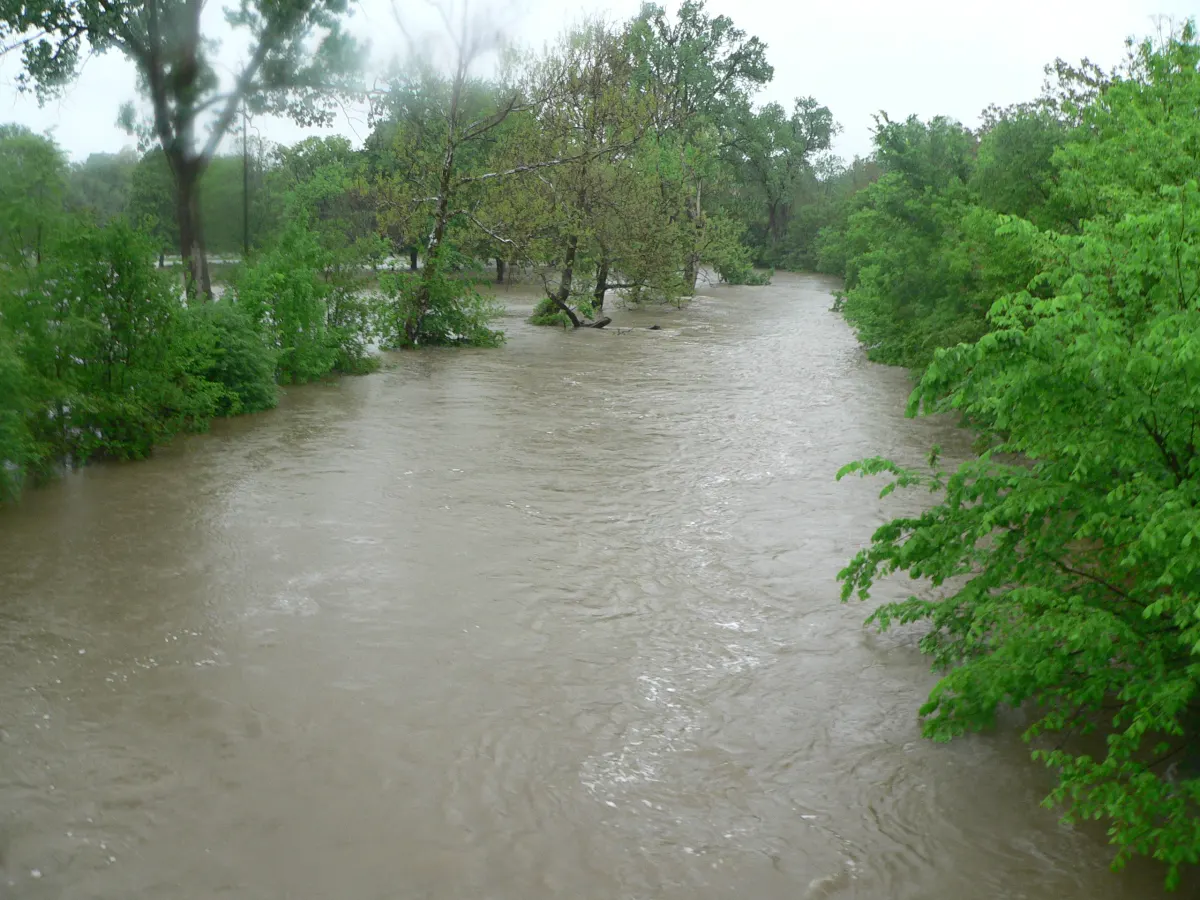
Huron River in flood at Riverside Park, Ypsilanti, Michigan, May 2011. Photo by Cmadler, CC BY-SA 3.0, via Wikimedia Commons.
What should I do first when my basement floods?
Check three hazards in this order: electricity, gas and the water itself. Each one can hurt you faster than the damage can hurt the house. The order of the first-hour list above follows that rule.
Electricity comes first because water carries current to anything plugged in, wired in or standing in it. If you can reach the main breaker without stepping through water, switch it off. If the panel is below the waterline, do not wade to it. DTE Energy takes electrical emergencies at 800-477-4747. Consumers Energy takes them at 800-477-5050. A licensed electrician can also check the panel after the water drops.
Gas comes second. Furnaces and water heaters sit in most Michigan basements, and moving water can shift them and strain the gas lines. The smell of rotten eggs or a hissing sound means leave now. Call 911 from outside, then DTE at 800-947-5000 or Consumers Energy at 800-477-5050. Consumers Energy's flood safety sheet says it cannot re-light appliances that went under flood water and that a qualified contractor should inspect them first.
The water comes third. Look at where it enters. Water rising from the floor drain points to a sewer backup. Water at the sump pit points to the pump. Water at a wall or window well points to rain or groundwater. A wet ceiling below a bathroom points to a supply line. The source decides who pays and how the crew protects itself, so write down what you see before anything moves.
Is it safe to walk into a flooded basement?
No, not until the power is off and you know what is in the water. Stay out when the water touches an outlet, a cord, an appliance or the panel, when it is deep or moving, when it smells like sewage, or when you smell gas.
Floodwater can hold germs, chemicals and sharp debris, and a basement can hide a step down into deeper water. Basement walls also carry the load of saturated soil outside. The American Red Cross says to pump a flooded basement down gradually, about one-third of the water per day, because water pumped out fast can let soil pressure collapse the walls (Red Cross disaster cleanup guide). A gas-powered pump or generator belongs outside, far from doors and windows, because it makes carbon monoxide.
If the water is clean, shallow and the power is confirmed off, wear rubber boots and gloves and move belongings out. If you are not sure, wait for the crew. Prime Restoration at (586) 277-1069 will tell you which case you are in over the phone.
Who do I call when my basement floods in Michigan?
Call Prime Restoration first, at (586) 277-1069, unless someone is in danger or you smell gas. Prime is a family water damage restoration business since 1988, IICRC certified, holds Michigan Residential Builder License #262500492, and has 186 Google reviews at 5.0 stars. It answers 24/7 and is ready to dispatch now from offices in Sterling Heights, Birmingham, Troy, Macomb, Shelby Township, Rochester Hills, West Bloomfield, Ann Arbor and Grosse Pointe Park.
Use this order for the calls:
- 911 for a gas smell, a shock, a person in danger or a structural problem.
- The utility, DTE or Consumers Energy, for gas or a panel you cannot reach safely.
- Prime Restoration for water removal, drying, sewage cleanup, mold remediation and the photo record your insurer wants. One call starts the work and Prime helps get the plumber or electrician out when the source needs one.
- Your insurance company or agent, the same day. Tell the claims line which restoration company is on the job.
- Your city or township public works office, when sewage came up a drain and the street may hold a blocked main. Ask for the written-notice instructions. The law below requires them to give you those.
Calling a plumber first is the common mistake. A plumber fixes the pipe or the pump. Hours of standing water in the basement is a separate job, and mold can start in 24 to 48 hours. Prime handles that job and works with the plumber on the same day.
What kind of water is it? A table for the five common sources
The source sets the safety gear, the insurance path and the price band. Find your row, then call (586) 277-1069.
| Water source | How to tell | First action | Who usually pays | What Prime does |
|---|---|---|---|---|
| Burst supply line or water heater | Clear water, a hiss or drip, a wet ceiling or wall near a pipe | Close the main or heater valve from dry floor, then switch off power to the area | Standard homeowners policy, usually, after the deductible. The carrier decides | Extracts the water, sets Dri-Eaz LGR 7000XLi dehumidifiers and Dri-Eaz Velo Pro air movers, logs moisture readings, bills the insurer directly |
| Sump pump failure or power outage | Water at the pit, pump silent or running without lowering the level, storm outage | Check the breaker and the discharge line, move items up, call for pumping | Usually only a sump overflow or water backup endorsement | Pumps and extracts, removes wet drywall and pad, dries the slab and walls, documents the pit for your adjuster |
| Sewer or drain backup | Gray or brown water, odor, water rising from the floor drain or toilet | Keep everyone out, do not run water upstairs, call for sewage cleanup | Sewer backup endorsement, or the city under Public Act 222 when a public sewer defect is proven | Cleans and disinfects as contaminated water (Category 3), removes porous materials, dries the structure |
| Rain or groundwater through the wall or floor | Seepage at the wall-floor joint, wet window wells, water after rain only | Clear gutters and window wells, grade away from the house, start drying | Often excluded by a standard policy. Read yours and ask the agent | Extracts, dries, treats the surfaces and sends photos for the claim file |
| Overland flood or river overflow | Water entering windows and doors from outside, a flood warning in your area | Stay out, leave if told to, call the utility, call for pumping when safe | A separate federal flood policy (NFIP), when you have one | Extracts, removes silt and contaminated materials, dries and treats the structure |
Insurance outcomes depend on the policy wording, the cause and the carrier. This table shows the usual pattern, and your insurer makes the decision.
My sump pump failed and the basement flooded. What now?
Treat it as groundwater. Switch off power to the area from a dry spot, call Prime at (586) 277-1069, and photograph the pit, the pump and the water line before anything moves. Groundwater is gray water (Category 2) in the restoration trade, so it needs more than a mop and a fan.
Check the cause while you wait, from dry floor. Is the breaker tripped, or is the pump on a GFCI outlet that tripped? Did the storm cut your power? Is the float stuck? Is the discharge pipe outside frozen or blocked by a downspout bend? A pump that runs and cannot lower the level is undersized or clogged. A pump that sits silent has no power or a dead motor. Tell the plumber which one you saw.
DTE Energy's flood advice lists a working sump pump with a battery backup as the first basement protection step (DTE, Staying safe while dealing with flooding). A storm that knocks out power takes the pump with it. A battery backup keeps the pit working during the outage.
On insurance, the Michigan Department of Insurance and Financial Services says water and sewer back-up is not automatically covered under a homeowners or renters policy (DIFS severe weather notice). Progressive says sump pump overflows typically are not covered unless you add the optional water back-up and sump pump overflow coverage (Progressive Answers). Pull out your declarations page and look for "water backup" or "sump overflow". If you find it, report the claim the same day. If you do not, report it anyway and let the carrier decide. Prime documents the loss either way.
Why is there water in my basement after rain?
Because rain water has a path into the foundation, and heavy rain overloads that path. The usual paths are gutters and downspouts that empty near the wall, soil that slopes toward the house, full window wells, a cracked wall or a floor joint, a clogged foundation drain, and a sump pit that cannot keep up. In older Michigan neighborhoods a sewer lateral that backs up during the same rain can add water from a drain.
Use these clues to sort it out:
- Water at a window well or a wall that is wet on the outside points to grading, gutters or the well.
- Water at the joint where the wall meets the floor points to groundwater pressure under the slab.
- Water at the floor drain with an odor points to the sewer and not to the roof.
- Water that shows up an hour after the rain stops points to saturated soil, since the ground needs time to drain.
The worst Southeast Michigan rain days show how fast this goes wrong. The National Weather Service says 4 to 6 inches fell over about four hours on August 11, 2014, with the worst flooding in Macomb, southern Oakland and the counties to their south (NWS Detroit/Pontiac). On June 25 and 26, 2021 the same office reported widespread 3 to 5 inches with localized 6 to 8 inches, and a gauge in Grosse Pointe Park read 8.19 inches (NWS Detroit/Pontiac). No residential drain system is built for that.
After a rain event, walk the outside first. Clear the downspouts, check that the extensions carry water at least several feet from the wall, and lift leaves out of the window wells. Then call Prime at (586) 277-1069 for drying, because a basement that stays damp for 24 to 48 hours can grow mold.
What do I do when sewage backs up into my basement?
Keep everyone out, stop using water in the house, call Prime at (586) 277-1069, and send your city or township written notice within 45 days of discovering the damage. Sewage is contaminated water (Category 3). The U.S. Environmental Protection Agency tells homeowners to call a professional who has experience with contaminated water when damage comes from sewage (EPA, Mold cleanup in your home).
Michigan's governmental sewer backup law is Public Act 222 of 2001, MCL 691.1416 to 691.1419. These are the parts that matter on day one:
- 45 days. You must notify the governmental agency in writing within 45 days after you discovered the damage, or should have discovered it.
- Short notice. The notice lists your name, address and telephone number, the address of the affected property, the date you discovered the damage and a brief description of the claim.
- Who gets it. The notice goes to the person the agency designates. If you first contact the agency, it must give you the notice rules and the name and address of that person.
- What you must prove. The sewer had a defect, the agency knew or in the exercise of reasonable diligence should have known about it, and the agency had the legal authority to fix it and failed to take reasonable steps in a reasonable time (MCL 691.1417).
- Waiting period. If you and the agency do not agree on payment within 45 days after the agency receives your notice, you may sue, but not before then.
- Cooperation. You may not unreasonably refuse the agency's request to inspect the damaged property.
The law also defines a "substantial proximate cause" as 50 percent or more of the cause (MCL 691.1416). A backup caused by roots in your own service lead is a different case from a collapsed public main. Photographs of the drain, the water line and the street are the evidence for either case. Prime keeps that record while the crew works.
This is general information, not legal advice. A lawyer can read the statute against your facts. The 45-day clock runs from discovery, so send the notice first and think about the rest after.
Does homeowners insurance cover a flooded basement in Michigan?
It depends on the water source and your endorsements. A sudden burst supply line or water heater failure is usually covered by a standard homeowners policy. A sewer or drain backup or a sump pump overflow needs a water backup endorsement. Rising or surface flood water falls under a separate National Flood Insurance Program (NFIP) policy. Your carrier makes the final decision.
The Michigan Department of Insurance and Financial Services says flood damage is typically not covered unless you bought federal flood insurance, and that water and sewer backup is not automatically covered under a homeowners or renters policy (DIFS severe weather notice). A later DIFS notice tells homeowners not to describe the loss as a flood when they file, because a sewer backup or a failing sump pump may be covered. DIFS answers insurance questions at 877-999-6442, 8 a.m. to 5 p.m., Monday to Friday.
Three habits help your claim:
- Report the cause in plain words and let the adjuster choose the coverage.
- Photograph and video the water line, the source and each damaged item before you throw anything out. Keep samples of flooring or drywall if the adjuster asks.
- Keep the restoration invoice, moisture logs and equipment records. Prime sends these to the adjuster and bills insurers directly when a claim applies.
For a longer read on claims, see Prime's guides on whether insurance covers water damage in Michigan, filing a water damage claim and flood insurance claims. Call Prime at (586) 277-1069 and the team can start the documentation while you talk to your agent.
What does Michigan flood data show about basements?
Basements take most of the damage. In FEMA's public record of NFIP flood insurance claims, 6,450 of the 7,467 Michigan claims that report a basement field (86 percent) were for a basement or an enclosure below grade. The table below pulls the insured claims filed for four recent Michigan storm days.
| Storm days (date of loss) | NFIP claims, statewide | Macomb | Oakland | Washtenaw | Claims for a basement or enclosure | Median paid per claim |
|---|---|---|---|---|---|---|
| August 11-12, 2014 | 548 | 89 | 36 | 0 | 479 | $6,270 |
| June 25-26, 2021 | 163 | 5 | 16 | 6 | 149 | $7,947 |
| August 24-25, 2023 | 161 | 19 | 27 | 5 | 62 | $15,229 |
Source: FEMA OpenFEMA NfipClaims, API v3, Michigan, pulled November 4, 2026 (14,954 Michigan claims, dates of loss 1978 to September 3, 2026). Median paid is building plus contents, paid claims only (388, 138 and 124 claims). Limits: NFIP pays flood claims only, on federal flood policies. Few Michigan homeowners hold one, so these counts are a floor and do not measure how many basements flooded. The August 2023 storm days match the DIFS notice of August 25, 2023 on that week's flooding.
The gap between those counts and the real damage is the useful part. After the June 25-26, 2021 storm, FEMA declared DR-4607 on July 15, 2021 and opened household aid in several Metro Detroit counties, among them Macomb, Oakland and Washtenaw. FEMA's public records show how many households asked for help and how many were approved:
| County | NFIP flood claims, June 25-26, 2021 | Owner households registered with FEMA | Owner households approved | Total approved | Average approved per household |
|---|---|---|---|---|---|
| Macomb | 5 | 1,247 | 552 | $2,307,751 | $4,181 |
| Oakland | 16 | 1,297 | 463 | $1,604,195 | $3,465 |
| Washtenaw | 6 | 573 | 170 | $850,977 | $5,006 |
Sources: OpenFEMA DisasterDeclarationsSummaries (DR-4607, declared July 15, 2021, incident June 25-26) and OpenFEMA HousingAssistanceOwners, summed by county from the registration rows, pulled November 4, 2026. Averages are total approved divided by approved households. FEMA registration is by home address and covers every kind of storm damage, not only basements.
In Macomb County, 552 homeowners won FEMA aid for that storm while only 5 insured flood claims carried a loss date on June 25 or 26. Most flooded Michigan basements are paid for out of pocket, by a backup endorsement or by a disaster program that exists only in a declared disaster. That is why the endorsement check in the insurance section above is worth ten minutes this week.
How fast does mold grow after a basement flood?
Mold can start within 24 to 48 hours on wet materials. The EPA says to dry water-damaged areas and items within 24 to 48 hours to prevent mold growth, and that mold will not grow without water or moisture (EPA, A brief guide to mold, moisture and your home).
That clock starts when the water arrives, not when you notice it. Drywall, insulation, carpet and carpet pad hold water and take the longest to dry. The EPA says porous materials such as carpet may have to be thrown away if they become moldy, because mold fills the empty spaces and is hard to remove. If sewage was involved, discard the porous materials that touched it.
Call Prime Restoration at (586) 277-1069 on the same day. The crew extracts the water, removes materials that cannot dry, and sets Dri-Eaz LGR 7000XLi dehumidifiers and Dri-Eaz Velo Pro air movers. If mold shows, Prime's mold remediation team takes over under the same company and the same license. See mold remediation in Michigan and the guide to preventing mold after water damage.
How long does a flooded basement take to dry?
Most basements need several days of professional drying, and a severe flood can take longer. The crew measures the job in readings, not in days. The goal is for each wet material to reach the moisture level of the same material in an unaffected part of your home.
Four things set the timeline: how long the water sat, how much water came in, the type of finish (a finished basement with drywall, insulation and carpet takes longer than bare concrete), and the weather. A humid August day slows drying. A cold February day with the furnace running dries differently. The crew checks the readings each visit and removes the equipment only when the readings reach the goal.
The Red Cross rule on pumping applies here too. The team removes the water in stages, a third per day when the water is deep, and starts drying as the floor appears. Do not turn the basement into a sauna with a space heater. Leave the equipment to the crew.
What does basement flood cleanup cost in Michigan?
Prime's published planning bands, which also drive the cost calculator, are $1,200 to $4,500 for clean water (Category 1), $2,500 to $7,500 for gray water (Category 2) and $4,500 to $15,000 or more for contaminated water or sewage (Category 3). The size of the area, how long the water sat and whether the basement is finished move the number inside each band.
| Water type | Typical source | Planning band |
|---|---|---|
| Clean water (Category 1) | Supply line, water heater | $1,200 to $4,500 |
| Gray water (Category 2) | Sump pump failure, groundwater | $2,500 to $7,500 |
| Contaminated water (Category 3) | Sewer backup, storm floodwater | $4,500 to $15,000 or more |
These are planning ranges, not a quote. Prime confirms the number on site and bills your insurer directly when a claim applies. For county detail, read the Oakland County basement flood cleanup cost page, the Macomb County page, and Prime's statewide water damage cost guide.
What should I not do when my basement floods?
Do not walk into water that touches electrical equipment, do not flip switches while you smell gas, and do not wait to call. The rest of the list is short.
- Do not plug in a wet-dry vacuum, a fan or a heater while you stand on a wet floor.
- Do not run a gas-powered pump or generator inside the house or the garage.
- Do not pump the basement dry in one go when the soil outside is soaked.
- Do not run the dishwasher, washer or showers when sewage is coming up a drain.
- Do not relight or run a furnace or water heater that sat in water.
- Do not throw away wet items before you photograph them.
- Do not tell the insurer the loss was a flood before you know the cause.
- Do not mix bleach with ammonia products, and do not scrub sewage-soaked walls without gloves, boots and a respirator.
- Do not sign a contract with a door knocker after a storm. The state insurance department warns that after a storm, fraudsters and unscrupulous solicitors may offer to inspect or repair damage.
Find your city: Prime's basement flood pages
These Prime pages cover the basement flood companies, local drainage and the nearest office for each city, and each answers "who do I call when my basement floods" for that city.
- Royal Oak basement flood cleanup
- Troy basement flood cleanup
- Birmingham basement flood cleanup
- Bloomfield Hills basement flood cleanup
- West Bloomfield basement flood cleanup
- Novi basement flood cleanup
- Rochester Hills basement flood cleanup
- Sterling Heights basement flood cleanup
- Shelby Township basement flood cleanup
- Macomb Township basement flood cleanup
- Grosse Pointe basement flood cleanup
- Grosse Pointe Woods basement flood cleanup
- Harper Woods basement flood cleanup
County pages: basement flooding in Oakland County, basement flooding in Macomb County and the flooded basement guide for Macomb County. For sewage, see emergency sewage backup help and the Oakland and Macomb sewer backup cost pages. For the storm itself, read the sump pump failure storm guide.
Not on the list? Call Prime Restoration at (586) 277-1069. The line is open 24/7 and the team is ready to dispatch now across Metro Detroit and Ann Arbor.
Frequently asked questions
Do I shut off the power if my basement is flooded?
Yes, but only from a dry spot. If the breaker panel is upstairs or in a dry room, switch off the main breaker. If the panel sits in the wet basement, or the water is near it, stay out and call your electric utility. DTE Energy takes electrical emergencies at 800-477-4747 and Consumers Energy takes them at 800-477-5050. Then call Prime Restoration at (586) 277-1069.
What should I do if I smell gas in a flooded basement?
Leave the house at once, do not flip switches. From outside, call 911 first and then the gas utility: DTE at 800-947-5000 or Consumers Energy at 800-477-5050. Floodwater can shift furnaces and water heaters and strain gas piping. Consumers Energy says appliances that went under water need inspection by a qualified contractor before use.
Does FEMA pay for a flooded basement in Michigan?
Only after a federal disaster declaration, and then only for the counties named. After the June 25-26, 2021 flooding, FEMA declared DR-4607 on July 15, 2021 and opened household aid in several Metro Detroit counties, among them Macomb, Oakland and Washtenaw. FEMA records show 552 Macomb homeowners, 463 Oakland homeowners and 170 Washtenaw homeowners were approved. Ordinary basement floods get no FEMA money, so your policy and any endorsements matter.
Who pays when the city sewer backs up into my basement?
Your insurer pays only if you carry a sewer and drain backup endorsement. The city pays only when you prove the claim under Public Act 222 of 2001 (MCL 691.1416 to 691.1419): a defect in the public sewer, which the city knew or should have known about and failed to fix. You must send written notice within 45 days of discovering the damage. Call Prime Restoration at (586) 277-1069 to start the cleanup and the photo record.
My sump pump lost power in a storm and the basement flooded. Is that covered?
Usually only when your policy has a sump pump overflow or water backup endorsement. The Michigan Department of Insurance and Financial Services says water and sewer back-up is not automatically covered by a homeowners or renters policy, and insurers such as Progressive sell sump pump overflow cover as an optional endorsement. Tell the insurer what happened in plain words: power outage, pump stopped, water came up through the pit. Your carrier makes the coverage decision.
Why does DIFS say not to call it a flood when I report the claim?
Because "flood" has a narrow meaning in insurance. DIFS tells Michigan homeowners that water damage can come from storm rain intrusion, a sewer backup or a failing sump pump, and those causes may be covered. Describe what you saw, such as water rising from the floor drain or the pit overflowing. Let the adjuster pick the cause code. Prime Restoration documents the loss for your adjuster. Call (586) 277-1069.
Can I run the furnace or water heater after the basement floods?
Not until a qualified contractor inspects them. Consumers Energy says it cannot re-light a furnace, stove, dryer or water heater that went under flood water, and it will reconnect service at your request once the appliances pass inspection. Keep the unit off. Gas controls and electronics that sat in water can fail without warning.
How much water can I pump out of my flooded basement at once?
About one-third of the water each day. The American Red Cross warns that pumping a basement dry too fast, while the soil outside is still saturated, can push the walls inward and collapse them. Pump with the equipment outside the house, and call a professional first when the water is deep or may hold sewage. Prime Restoration at (586) 277-1069 pumps and extracts in the right sequence.
Is it safe to stay in the house while the basement is wet?
Often yes for clean water above a dry first floor, once power and gas are safe. Leave if the water holds sewage, if you smell gas, if the foundation shows new cracks or if the furnace sat in water. Wet materials can grow mold after 24 to 48 hours, so start drying the same day. Prime Restoration can start within hours at (586) 277-1069.
I rent. Who do I call when the basement floods?
Call your landlord or property manager in writing the same hour, then call your renters insurer for your own belongings. The landlord policy covers the building, not your property. Take photos of everything you own that got wet. A restoration company can document the loss for both sides. Prime Restoration answers 24/7 at (586) 277-1069.
Tags
24/7 Emergency Response
Need Professional Restoration Now?
Call now and speak directly with our trained restoration team. On-site within 25 minutes.
(586) 277-1069