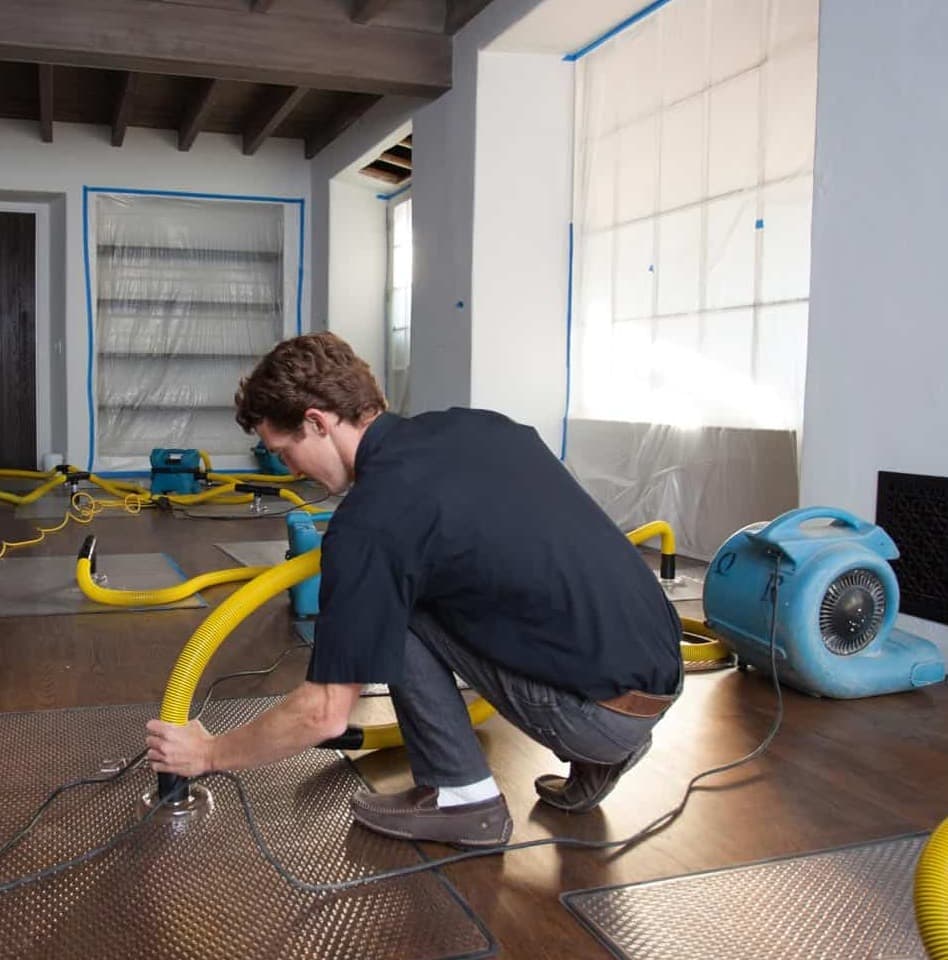
One storm. Two halves of Clinton Township. Two completely different jobs. South of Cass Avenue it is a Category 3 backup through a block foundation. Around Partridge Creek it is an engineered subfloor that has to be dried in place. Free inspection and a written scope.
This page is published by Prime Restoration, a Michigan licensed residential builder dispatching from Sterling Heights. It covers what actually fails in Clinton Township rather than what fails generally. Last updated 2026-07-31.
What is specific to this city
Clinton Township is not one housing market, and the split runs almost exactly along Cass Avenue. That line decides what fails, what has to come out, and what the job costs.
South of Cass and along the Moravian Drive corridor sits a large inventory of 1950s and 1960s ranches and small Cape Cods. Those homes commonly retain original galvanized supply lines, cast-iron drain stacks, and unfinished basements on block foundations. That combination is why Category 2 and Category 3 losses are frequent here rather than occasional.
North and east, around Partridge Creek and Hall Road, the stock turns over to two-story colonials with finished walkout basements, engineered subfloors and luxury vinyl plank. Those materials do not fail the same way and they do not dry on the same timeline. Engineered subfloor holds moisture in the webbing long after the surface reads dry, which is why a plank floor that looks fine can still be sitting on a wet cavity.
There is a third pocket worth naming: the 1980s split-levels near Harrington Elementary and along Romeo Plank, built over wood-frame crawl spaces. On those, the work is cavity drying and moisture mapping under the floor system, and the visible room is often the least of it.
What this city has been through
| Area | Where | Housing stock | What tends to fail | What that means for scope |
|---|---|---|---|---|
| South of Cass Avenue | Moravian Drive corridor and the older grid | 1950s-60s ranches and Cape Cods | Galvanized supply lines, cast-iron drain stacks, block foundations. Backups and supply failures both. | Category 2 and 3 are the norm here, not the exception. Unfinished basements limit what is lost but the water is often contaminated. |
| Partridge Creek / Hall Road | North and east, newer build-out | Two-story colonials, finished walkouts | Engineered subfloor and luxury vinyl plank holding moisture the surface does not show. | Structured drying chambers and continuous monitoring. The floor reading dry means very little on its own. |
| Harrington / Romeo Plank | Central pockets | 1980s split-levels on wood-frame crawl spaces | Crawl-space wetting under the floor system, usually found late. | Cavity drying and moisture mapping beneath the floor. The visible room is the smallest part of the scope. |
What the meter cannot see
The most expensive avoidable outcome in the newer half of this township is not a big loss. It is a small one closed too early, because every assembly in a post-1995 home is designed to resist moisture from the top and therefore traps it underneath. A surface reading at dry standard on any of the five below tells you almost nothing on its own. This is the section to hold whoever you hire to.
Engineered I-joists
What it hides: The OSB web between the flanges wicks and holds water well after the subfloor surface reads dry. Nothing about the room tells you.
How it has to be read: Surface readings on the subfloor are close to meaningless on their own. You need penetrating readings into the web, or a thermal scan that shows the joist bays as a pattern rather than a spot.
What goes wrong: Engineered lumber loses strength when the web stays saturated, and the failure mode is structural rather than cosmetic. This is the assembly most worth being pedantic about.
Luxury vinyl plank over underlayment
What it hides: The wear layer is effectively a vapour barrier. Water gets under the seams, then cannot get back out through the surface it came through.
How it has to be read: A meter on top of LVP tells you about the LVP. The plank has to come up in the affected area, or you are drying a lid.
What goes wrong: It looks perfect for weeks, then cups, releases adhesive, or produces an odour with no visible source.
OSB subfloor with T&G edges
What it hides: Edge swell at the tongue-and-groove joints, which does not flatten back out once it has happened.
How it has to be read: Readings taken at the panel field will run lower than readings taken at the joints. Take both.
What goes wrong: Permanent ridging telegraphs through any finished floor put back over it, so a save decision made on optimistic readings costs the floor twice.
Finished walkout lower level
What it hides: Insulated stud cavities behind finished drywall. The room can be dry and the cavity soaked.
How it has to be read: Non-invasive scanning to find the wet band, then small inspection openings to confirm. Guessing at the height of the water line is how too much or too little comes out.
What goes wrong: The single most common origin of a mould call six weeks after a job that everyone thought went well.
Block foundation, older grid
What it hides: Water inside the block cores, which drains and evaporates far more slowly than the slab.
How it has to be read: Readings at the bottom plate and into the block, not just the floor. The wall is the long pole in this stock.
What goes wrong: A basement declared dry on floor readings while the cores are still giving moisture back to the room air.
The loss nobody checks
The 1980s split-levels through the central pockets near Harrington and Romeo Plank sit on wood-frame crawl spaces, and this is the loss homeowners here let sit longest — not because they ignore it, but because there is nothing to ignore. The living space gives no signal at all. Almost nothing written for homeowners covers it, so here is the whole thing.
Why it goes unnoticed
Nothing in the living space changes. There is no stain, no sound and no visible water, because the wetting is happening under the floor system rather than in the room. Most of these are found by smell, in a season change, long after the event.
Why it does not dry itself
A crawl space is a closed, cool, poorly ventilated volume with an earth floor. It has almost no capacity to shed moisture on its own, and in a wood-frame crawl the framing above stays in contact with that air continuously.
What is actually at risk
The floor system, not the crawl. Joists, rim board, sill and subfloor sit directly above it, and those are structural. Insulation between the joists holds water and stops giving useful readings, which is why it usually comes out rather than being dried.
How it gets dried
Standing water removed, saturated insulation removed, then the volume itself dried and dehumidified as a sealed space rather than blown at with fans. Moisture mapping is done into the framing from below, and the job ends on those readings.
What keeps it from repeating
A properly lapped and sealed vapour barrier over the earth floor, and a look at where the water entered — grading, a downspout discharging next to a vent, or a crawl that sits below the surrounding grade. The barrier is not optional in this stock.
When to just look
After any event that put water anywhere on the lot, and once a year regardless. It is a torch and ten minutes. The cost difference between finding this early and finding it as an odour is the largest gap in any loss type we handle.
What moves the number
Typical ranges for this kind of work are published on our service pages, but the number for YOUR job comes from readings rather than from a phone call. What is publishable here is the list of things that actually move it, roughly in order of how much they move it here. If a contractor’s number changes after they arrive, one of these is the reason, and you are entitled to be told which.
Finished versus unfinished lower level
The largest single swing in this township, and it maps almost exactly onto which half of it you are in. An unfinished block basement south of Cass can take contaminated water and still be a contained scope. A finished walkout near Hall Road takes clean water and loses flooring, base, drywall and cavity insulation.
Water category
A sanitary backup carries containment, antimicrobial treatment and removal of porous material before anyone assesses finishes. It changes the job before the material does.
Whether an engineered floor system is involved
Engineered joists and LVP extend the drying step and require penetrating readings rather than surface ones. They also raise the cost of getting the save-or-remove decision wrong.
Crawl-space access
A crawl with a small hatch and low clearance is slower per square foot for every step, from extraction to insulation removal to equipment placement. Access is a real line, not an excuse.
How long it sat
Category escalates with time and so does the removal list. On a crawl space or a cavity, this is usually the difference between drying and rebuilding.
Sequence
Drying ends on a reading, not on a date, so none of this is a promise about hours. It is the order the steps have to happen in, and the one place it differs from a textbook sequence is that the moisture map here has to include the assemblies that hide it before anyone decides what comes out.
Hour 0
Stop the source, then photograph
If it is a lateral or a surcharge, that is a plumber or the county drain, not a restoration decision. Wide and close shots, timestamped, before anything moves.
Day 0
Map the moisture, including where you cannot see
Readings against a dry standard from an unaffected part of the same house, plus the assemblies that hide it: joist webs, under LVP, stud cavities, block cores, and the crawl if there is one. Free, and written down.
Days 1–2
Removal, scoped by the readings
On a sanitary backup, containment goes up first. Porous material in the affected area comes out. On a clean-water loss in a finished walkout, the goal is the smallest opening that lets the cavity dry.
Days 2–5
Structured drying with daily logs
Engineered systems and block cores both run longer than a slab-and-drywall job. The equipment comes out on a reading, not on a date, and you should be shown the readings.
Then
Rebuild
Flooring, base, drywall and insulation sequenced after the cavity is at dry standard — not alongside it.
Stopping the second one
Homes here that take water once often take it again, because the cause is usually infrastructure or grade rather than an accident. Each measure below is listed with what it does not cover, which is the part normally left out — and the reason people who spent money on one of these still ended up wet.
Camera the lateral before anything else
What it does: Tells you whether the backup was the system or your own line. Clay and cast-iron laterals in the older grid crack, belly and take roots, and a house that backs up when neighbours do not usually has a line problem rather than a street problem.
What it does not do: Do anything about a genuine street surcharge, which affects the whole block at once. The camera is what tells you which of the two you have.
Who does it: A licensed plumber. Do this before buying any hardware, because the answer changes what you should buy.
Backwater valve
What it does: Closes when flow reverses so a surcharging sanitary main cannot come back through the floor drain.
What it does not do: Help with groundwater, a failed sump, or a supply line letting go upstairs. It solves exactly one of the ways this township floods.
Who does it: A licensed plumber, after the camera.
Sump pump with backup power
What it does: Keeps the pit clearing when the power goes out, which in the storms that cause these events is the same hour the pump is needed most.
What it does not do: Matter at all in a home with no drain tile feeding the pit. Confirm the pit is actually fed before spending on redundancy.
Who does it: Plumber to install, you to test. Pour a bucket in twice a year and watch the full cycle with the breaker off.
Sealed vapour barrier in the crawl space
What it does: Cuts off the continuous supply of ground moisture into the floor system. In the split-level stock this is the highest-return measure on the list.
What it does not do: Fix an active water entry. If water is arriving, the barrier traps it rather than solving it, so entry gets addressed first.
Who does it: A contractor for a proper lapped and sealed install. A sheet of poly laid loose is not this.
Downspouts and grading
What it does: Moves roof discharge well away from the wall and re-establishes fall. Cheap, and it removes a large share of what would otherwise sit against a block foundation or drain into a crawl vent.
What it does not do: Address a sanitary backup at all.
Who does it: Homeowner or landscaper. Check where every downspout actually terminates, not where it appears to.
Get contents off the lower-level floor
What it does: Costs nothing and decides how much of a preventable event actually hurts. Six inches of elevation covers most backups.
What it does not do: Prevent anything. It changes the consequences, which is worth doing anyway.
Who does it: You, this weekend.
Calendar
The two halves of this township do not fail in the same season. The older grid loses supply lines in deep winter and takes sanitary backups in summer storms; the crawl-space stock takes its worst wetting in the thaw, when nobody is thinking about water. Knowing which window you are in is most of what makes prevention cheap instead of theoretical.
| Window | What fails | Why here | Do this in advance |
|---|---|---|---|
| Late winter into spring | Saturated and still-frozen ground, thaw on top of it | Meltwater cannot percolate through frozen soil, so it runs along the surface to the lowest opening and sits against foundations. This is the season that wets crawl spaces in the split-level stock, and it is also when a sump that has not run since October gets asked to run continuously. | Test the sump and its backup before the first thaw, not after. Walk the lot and find where snow is piled against the house or over a crawl vent. |
| Late spring into summer | Convective storms and sanitary surcharge | The events that produced the worst losses in this township — August 2014, June and July 2021 — were high-volume rain in a short window rather than long steady rain. A system at capacity sends water backward, and in the older grid south of Cass that is a Category 3 event from the first minute. | Have the lateral cameraed in a dry month rather than during a backup. Keep the lower-level floor clear of anything that matters. |
| Autumn | Blocked drainage and the first heating cycle | Leaf litter blocks gutters, window wells and yard drains, which turns an ordinary rain into standing water against the wall. It is also when the first furnace run of the season reveals a condensate line or humidifier connection that has been dripping quietly. | Clear gutters and wells after the leaves are down rather than during. Look at the furnace condensate and the water heater pan on the first cold weekend. |
| Deep winter | Supply-line freezing in the older stock | The pre-1970 grid commonly has original galvanized or early copper running through poorly insulated rim joist, crawl and exterior wall cavities. A line that has survived thirty winters can still fail in the one where the wind holds from the wrong direction for three days. | Know where your main shutoff is and confirm it actually turns. Keep the heat on in unused rooms, and if you leave for a stretch, have someone physically look at the house. |
Before anyone starts
These work on our estimate as well as anyone else’s, which is the point of publishing them. A homeowner standing in a wet lower level at eleven at night has very little leverage, and a short list of the right questions is most of the leverage available.
“Will you show me the readings and the dry standard you are comparing against?”
A reading without a baseline from an unaffected part of the same house is a number with no meaning. If nobody can produce one, drying is being judged by feel.
“Did you take penetrating readings, or only surface readings?”
On engineered joists, under LVP, and into block cores, surface readings run optimistically low. This one question separates a real moisture map from a walkthrough.
“Have you looked in the crawl space?”
In the split-level stock this is where the loss hides. If the answer is that they did not go in, the assessment is incomplete regardless of what the living space reads.
“What category are you treating this as, and why?”
A sanitary backup should be called Cat 3 immediately, not pending. The category drives containment and removal before anyone looks at finishes.
“What is coming out and what are you drying in place?”
You want the list before the saw comes out, with a reason attached to each line. This is where scope inflation and scope cowardice both show up.
“Are mitigation and reconstruction the same company?”
If not, ask who owns the seam. The hand-off between trades is where schedules die and where cavities get closed up before they are dry.
“What ends this job — a date or a reading?”
The correct answer is a reading. Equipment pulled on a schedule is the most common origin of mould discovered six weeks later.
“Are you licensed in Michigan, and can I see it?”
Residential building work in Michigan requires licensing. Ask, verify, and do not accept a business card as an answer.
The honest part
Clinton Township is one of the shortest runs we make, and on an active loss speed genuinely matters. But proximity alone is a weak reason to hire anyone, and the township is well served by other firms.
The argument that actually holds here is that the two halves of this township need different work, and a crew that treats a Partridge Creek walkout like a Moravian Drive block basement will over-demolish one and under-dry the other. One accountable crew from extraction through reconstruction is worth more on that split than a fast arrival is.
Most often because of what is under the street rather than what is in your house. Large parts of the township, particularly the older neighbourhoods south of Cass Avenue, are served by sanitary and combined infrastructure that reached capacity during the August 2014 and the June and July 2021 events, and a system at capacity sends water backward through the lowest opening in the nearest building. If yours is the house that backs up while a neighbour on higher ground does not, the difference is usually elevation and lateral condition, not anything you did. The other common contributor in this stock is a clay or cast-iron lateral that has cracked or bellied, which is a plumbing inspection rather than a restoration one.
Almost everything that decides cost. The older stock south of Cass commonly has original galvanized supply lines, cast-iron drain stacks and an unfinished basement on a block foundation. Losses there are frequently Category 2 or 3 because of where the water comes from, but the unfinished space limits what is actually destroyed. The newer walkouts around Partridge Creek and Hall Road are the opposite: cleaner water, far more finished material at risk, and engineered subfloor that holds moisture in the webbing well after the surface reads dry. One needs contamination control, the other needs patient structured drying, and confusing the two is how jobs go wrong.
It is one of the shortest runs from our Sterling Heights base, typically well inside the window that matters. That said, if water is actively entering and someone can stop it sooner than we can arrive, call them first. Clean Category 1 water begins reclassifying toward Category 2 after roughly 24 to 48 hours in contact with building materials, so the clock that actually matters is measured in hours and days rather than minutes.
Surface dry is not dry, and in a block-foundation basement it is especially misleading. Block cores, the bottom plate, and anything porous stacked against a wall hold water long after the floor looks normal, and on wet porous material microbial growth can begin in roughly 24 to 48 hours. Whether you have a problem is a short moisture-meter check, not a judgment from across the room. If the readings come back at dry standard we will say so and leave.
Yes, and it is the loss people in the split-levels near Harrington and Romeo Plank most often let sit. A wet wood-frame crawl space feeds moisture upward into the floor system continuously, so the subfloor and joists stay damp even though nothing in the living space looks wrong. That is close to ideal conditions for growth, and it is usually discovered months later as an odour rather than a stain. Cavity drying and moisture mapping under the floor is the work, and it is far cheaper before the framing is involved.
Usually not without a specific sewer-and-drain backup endorsement, which is worth knowing about in a township with this backup history. Sudden and accidental discharge, such as a supply line letting go, is a different matter and is generally a covered peril on a standard HO-3. Surface flooding from rain and rising groundwater is typically excluded without separate flood coverage. Coverage determinations, payment decisions and settlement amounts are made solely by your insurance carrier after their own inspection, so treat this as orientation and confirm the specifics with them.
Both, and the distinction matters for paperwork rather than for water. Postal delivery boundaries were drawn independently of municipal ones, so a substantial number of Clinton Township properties carry a Mount Clemens mailing designation while sitting entirely within the township. The practical consequence is that permits, assessing records, ordinance questions and the building department that inspects your rebuild are the township's, not the City of Mount Clemens'. It also means online contractor searches and quote forms keyed to your mailing address can route you somewhere that does not actually serve your municipality. If you are unsure, the assessor's parcel record is the authority.
It depends on what goes back rather than what came out. Like-for-like cosmetic replacement of drywall, base and flooring generally does not require a permit. Egress window changes, framing alterations, electrical circuit work beyond a device swap, plumbing rough-in and mechanical equipment replacement generally do. Two things come up here more than elsewhere. Finished lower levels built without permits by a previous owner surface during a rebuild, and a walkout that was finished before current egress requirements may not be permitted back exactly as it was. Confirm current requirements with the Clinton Township building department for your specific parcel before scheduling trades.
Because the meter is reading the plank. Luxury vinyl plank has a wear layer that behaves close to a vapour barrier, so water that got under it through the seams cannot come back out the way it went in, and a reading taken on top of it is a reading of a lid rather than of the assembly underneath. The same trap exists with engineered I-joists, where the OSB web between the flanges holds water long after the subfloor surface reads at dry standard. In the newer build-out around Hall Road and Partridge Creek, nearly every floor is one of these two assemblies. The plank comes up in the affected area, or the drying is theatre.
By feeding moisture upward into the floor system continuously rather than by doing anything visible. A crawl space is cool, closed and poorly ventilated with an earth floor, so it has very little ability to shed water on its own. The framing directly above it — joists, rim board, sill, subfloor — stays in contact with that air, and batt insulation between the joists holds water and stops giving useful readings. Nothing changes in the living space, which is why these are typically found months later as an odour rather than as a stain. It is a torch and ten minutes to check, and the cost gap between finding it early and finding it late is the largest of any loss type we handle.
Clinton Township is a charter township rather than a city, and that changes who handles what. Building permits and inspections for your rebuild are the township's. Sewer and drainage questions can involve the township's public works, the Macomb County Public Works Office, or the county drain infrastructure depending on which system serves your street. The practical sequence when a backup happens is: report it to the township so it is on record, have a plumber camera your lateral to establish whether the failure was yours or the system's, and keep timestamped photographs of the water level. Those three things are what any later conversation — with the township, the county or your carrier — will turn on.
Sources
Neighbourhood boundaries, housing-era descriptions and infrastructure notes reflect publicly known Clinton Township development patterns. The weather events named are documented Southeast Michigan storms. Water categories, growth timing and structural drying practice follow the restoration industry standard. Permit and code requirements should be confirmed with the local building department for your specific work. No customer, address or job is described anywhere on this page. Prime Restoration publishes this page and no company paid to be referenced on it.
24/7 dispatch across 48035, 48036 and 48038. Free inspection with moisture readings and a written scope, and an honest answer about whether you need us at all.
Call (586) 277-1069Prime Restoration is a Michigan licensed residential builder (#262500492) and a full-service restoration contractor serving Clinton Township and the surrounding area from Sterling Heights. Nothing on this page is legal, insurance, plumbing, electrical or engineering advice. Coverage determinations, payment decisions and settlement amounts are made solely by your insurance carrier after their own inspection. Scope and cost are set from actual moisture readings and affected square footage.
The housing stock changes faster than the drive time does. Each of these is a different problem rather than the same page with the city name swapped.