MOST COMMON CAUSES
What's making my basement flood?
Four causes drive 94% of Macomb and Oakland County basement floods. Sump pump failure is #1 — pumps die at 7-10 years, and Michigan's clay soil keeps groundwater tables high year-round. Sewer backup is #2, especially in Warren, Sterling Heights, and Royal Oak where combined storm/sanitary lines overflow during heavy rain. Burst supply lines from frozen pipes account for most January-February calls; a 1/8" crack releases 250 gallons per hour. Foundation seepage through cracked block walls or failed drain tile is the slow-burn cause — often missed until carpet pad is saturated. Identifying the source matters because insurance treats each differently. Prime documents conditions on arrival as a record for the homeowner.
INSURANCE COVERAGE
Will insurance cover this?
Michigan HO-3 policies cover sudden and accidental water damage but exclude gradual seepage and surface flooding. The four coverage paths: (1) Burst pipe / supply line failure — covered under standard dwelling Coverage A. (2) Sump pump failure or sewer backup — covered ONLY if you carry the water/sewer backup endorsement (typically $40-80/year, $5K-$25K limits). (3) Storm-driven surface flooding — NOT covered by homeowners; requires separate FEMA NFIP flood policy. (4) Foundation seepage / long-term leak — excluded as "maintenance." Michigan DIFS requires carriers to acknowledge a claim within 30 days. Always confirm coverage and limits with your carrier and policy. See our Insurance Claims Guide for a category-by-category breakdown of common Michigan coverage paths.
MOLD TIMELINE
How fast does mold grow in a flooded basement?
24 to 48 hours. standard practice establishes that under conditions present in any unmitigated flooded basement (organic substrate + moisture + 60-86°F), visible mold colonization begins within 24-48 hours and amplifies exponentially after 72 hours. The CDC confirms this window for Stachybotrys chartarum (black mold), Aspergillus, and Penicillium. After 72 hours, Category 1 (clean water) reclassifies to Category 2 (gray) under standard practice; after 7 days unmitigated, it becomes Category 3 (black water) requiring antimicrobial treatment, contents disposal, and HEPA air scrubbing. Every hour past hour 24 multiplies remediation cost by roughly 1.4x. A $4,000 Category 1 extraction becomes a $14,000 Category 3 demolition by day 5. Prime's 60-minute Macomb/Oakland response window exists specifically to keep your loss inside the Category 1 envelope.
OUR ON-SITE PROCESS
What happens when Prime arrives
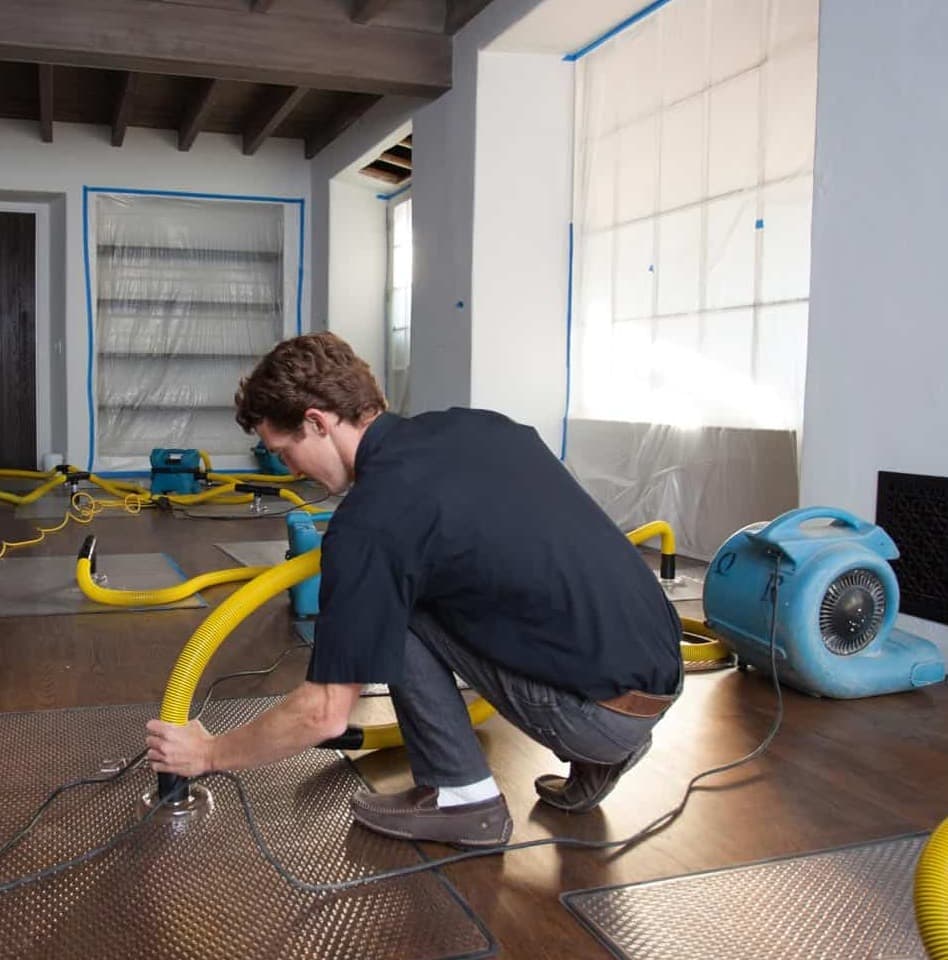
Our 5-step on-site process, built around safety: (1) Safety + source assessment — confirm power isolation, identify the water source, document conditions. (2) Moisture mapping — Tramex meters and FLIR thermal imaging of affected walls, subfloors, and structural cavities. (3) Extraction — truck-mounted vacuums pull standing water; we typically extract 80% of bulk water in the first 90 minutes. (4) Structural drying — air movers and LGR dehumidifiers run continuously, sized to the affected square footage; moisture readings logged on-site every 24 hours. (5) Antimicrobial + monitoring — EPA-registered biocide on affected surfaces, then daily visits until readings confirm structural dryness.
DRYING TIMELINE
How long until my basement is dry?
3 to 5 days for standard Category 1 losses; 5 to 10 days for Category 2; 10 to 21 days for Category 3. standard practice defines "dry standard" as moisture content matching unaffected reference materials in the same structure — not a calendar date. For a typical 800-1,200 sq ft Macomb County basement with carpet, pad, and 2 feet of drywall affected, expect 4 days of active drying with equipment running continuously. Concrete slabs read dry faster than framed walls; finished basements with insulation behind drywall take longest because trapped moisture cannot escape without controlled demolition (flood cuts at 24" or 48"). We log moisture readings every 24 hours throughout the dryout. We do not remove equipment until readings confirm structural dryness across all three substrates.
WHY MINUTES MATTER
Why every minute matters in the first hour
Mold growth begins within 24 to 48 hours as standard practice — that clock starts the moment standing water meets organic substrate (drywall, wood, carpet pad). Standing water past 72 hours can reclassify from Category 1 (clean) to Category 2 (gray) under the industry standard, and past 7 days to Category 3 (black). Every hour past hour 24 multiplies remediation cost by roughly 1.4× as the loss escalates. The fastest path to keeping a loss inside Category 1 is starting extraction immediately. Prime crews stage from Sterling Heights and reach 90% of Macomb County within 45 minutes and 90% of Oakland County within 60 minutes, 24/7. We prioritize crew and household safety on every dispatch. Many Michigan policies include a "duty to mitigate" clause asking you to take reasonable steps to prevent further damage. Always confirm coverage and next steps with your insurance carrier and policy.
WHY LOCAL MATTERS
Why local matters in Macomb and Oakland County
Response time is the entire game. Mold's 24-hour clock means a contractor 45 minutes away costs you a category bump. Prime crews stage from Sterling Heights and reach 90% of Macomb County within 45 minutes and 90% of Oakland County within 60 minutes. National franchises route through call centers and sub-dispatch to whichever local franchisee is available, which historically adds 90-180 minutes. We also know the local infrastructure: which Warren streets flood on the combined sewer overflow, which Sterling Heights subdivisions have failing 1990s drain tile, which Royal Oak homes have the original cast-iron stack ready to fail. We know the Macomb County Public Works escalation desk, the Detroit Water and Sewerage Department emergency line, and the local infrastructure of every Macomb and Oakland County zip code. Local is not marketing — it is response physics.
COST RANGES
What does basement flooding cleanup cost?
Typical range: roughly $2,800 to $18,000+ depending on contamination category, square footage, and scope. As a general guide: Category 1 (clean water, smaller footprint, no demo) often runs in the lower end of the range; Category 2 (gray water, partial demo) lands in the middle; Category 3 (sewage/contaminated, full demo + antimicrobial, larger footprint) trends to the upper end. These are mitigation cost ranges only — they do not include reconstruction (drywall, flooring, paint), which is a separate scope. With insurance, most homeowners' out-of-pocket cost is their deductible when the loss is covered. Final pricing depends on what we assess on-site: moisture mapping, affected square footage, materials, and Category determination. We'll walk you through scope and pricing during the on-site assessment.