MOST COMMON CAUSES
Why is sewage backing up into my basement?
Five causes drive nearly every Macomb and Oakland County sewage backup. (1) Combined-sewer overflow (CSO) during heavy rain — the dominant cause in older Detroit, Warren, and Sterling Heights neighborhoods where storm and sanitary lines share one pipe to the treatment plant. (2) Lateral-line clog or collapse between the house and the city main — usually root intrusion in older Royal Oak, Ferndale, and Birmingham districts with mature trees over cast-iron or clay laterals. (3) Main-line city block that surcharges the lateral and pushes sewage backwards into the lowest fixture (typically a basement floor drain). (4) Ejector or sump-with-ejector pump failure in homes with below-grade plumbing fixtures. (5) Toilet overflow past the trap, which the industry standard classifies as Cat-3 from the moment it enters the surrounding floor. Identifying the source determines who pays — homeowner, city, or carrier — and Prime documents the source on arrival so all three have accurate evidence.
INSURANCE COVERAGE
Will insurance cover sewage backup?
Only if you carry the water and sewer backup endorsement. Standard Michigan HO-3 policies exclude sewer backup by default — this is the single most common coverage surprise homeowners learn after the fact. The endorsement typically costs $40-$80 per year for $5,000-$25,000 in additional coverage. Michigan DIFS recommends the rider for every Macomb and Oakland County homeowner given the region's combined-sewer infrastructure. If a city main-line block caused the backup, you may also have a claim against the municipality under MCL 691.1417 (sewer disposal system events) — strict notice deadlines apply (45 days written notice in most cases). Always confirm coverage and limits with your carrier and attorney. See our Insurance Claims Guide for the full carrier-by-carrier breakdown.
HEALTH RISK
What's the actual health risk?
Sewage is the industry standard Category 3 black water — grossly contaminated water containing pathogens, toxins, and other hazardous agents. Common pathogens documented by the CDC and Michigan Department of Health and Human Services include E. coli, hepatitis A, rotavirus, norovirus, giardia, shigella, salmonella, and parasites. Skin contact, inhaled aerosols, and cross-contamination of surfaces, food, and HVAC ductwork are all documented exposure paths. CDC and MDHHS both require professional remediation — they do not recommend DIY for sewage events. Strict bloodborne-pathogen precautions govern the protective protocol for any worker entering a Cat-3 environment: full Tyvek suit, N95 respirator, nitrile gloves, rubber boots, and engineering controls. This is why sewage cleanup is not a job for a wet vac and a homeowner.
OUR ON-SITE PROCESS
What happens when Prime arrives
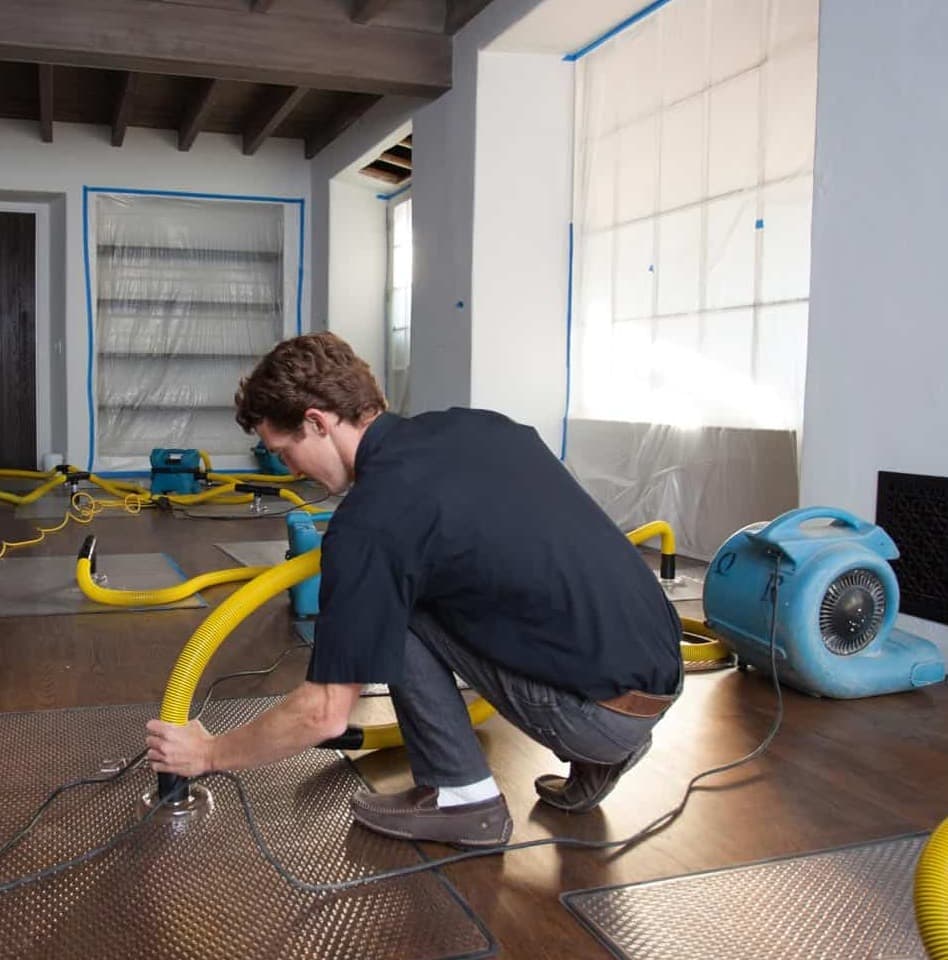
Our 6-step on-site response for Cat-3 sewage events, built around safety: (1) Containment — we seal the affected area with 6-mil poly and establish negative-air pressure with HEPA-filtered scrubbers so contaminated aerosols do not migrate to the rest of the home. (2) Source isolation — confirm shutoffs, identify the backup source, isolate HVAC if ductwork was contaminated. (3) Bulk extraction — truck-mounted vacuums pull standing sewage; we typically extract 80% of bulk water in the first 90 minutes. (4) Controlled demolition — removal of porous materials touched by Cat-3 water (drywall, carpet and pad, insulation, affected MDF and unsealed wood), bagged in red biohazard bags. (5) Antimicrobial application — EPA-registered biocide on every affected hard surface, dwell time per label, followed by HEPA scrubbing. (6) Structural drying — air movers and LGR dehumidifiers run continuously until readings confirm structural dryness.
TIMELINE
How long does sewage cleanup take?
Typically 7 to 14 days for a moderate basement. Cat-3 always takes longer than Cat-1 because the protocol is more demanding: full demolition of porous materials, antimicrobial dwell time, HEPA air-quality clearance, and a stricter standard practice dry standard before reconstruction. For a typical 800-1,200 sq ft finished basement with sewage on carpet, pad, and 2 feet of drywall, expect roughly 2 days of demolition and disposal, 5-7 days of active drying with equipment running continuously, and 1-2 days of post-dry antimicrobial verification. Larger losses, HVAC contamination, or crawl-space involvement can extend the schedule. We log moisture readings every 24 hours throughout the dryout. We do not remove equipment until readings confirm structural dryness.
WHY MINUTES MATTER
Why every minute matters with sewage
Sewage is Category 3 black water from minute zero as standard practice the industry standard. Mold colonization inside saturated wall cavities begins within 24 to 48 hours as standard practice. Pathogens in standing sewage continue to spread via aerosols and surface contact every hour the contamination remains in the home, and cross-contamination of HVAC ductwork can occur within minutes if the system is left running. The fastest path to limiting damage and exposure is starting Cat-3 containment, antimicrobial application, and controlled removal of porous materials immediately. Prime crews stage from Sterling Heights and reach 90% of Macomb County within 45 minutes and 90% of Oakland County within 60 minutes, 24/7, with full PPE. We prioritize household and crew safety on every dispatch. Always confirm coverage and next steps with your insurance carrier and policy.
WHY LOCAL MATTERS
Why local matters in Macomb and Oakland County
Sewage is a local-knowledge problem. Prime crews stage from Sterling Heights and reach 90% of Macomb County within 45 minutes and 90% of Oakland County within 60 minutes. We know which Warren streets surcharge first during a combined-sewer overflow, which Detroit zones are on the Basement Backup Protection Program priority list, which Royal Oak and Birmingham neighborhoods have original cast-iron laterals nearing failure, and which Macomb Township subdivisions still have the marginal 1990s ejector-pump designs. We know the DWSD emergency line, the Macomb County Public Works sewer-event escalation desk, the Great Lakes Water Authority ticket portal, and the local infrastructure of every Macomb and Oakland County zip code. National franchises route through call centers that don't know any of this. Local is not marketing — it is response physics.
COST RANGES
What does sewage backup cleanup cost?
Typical range: roughly $5,000 to $25,000+ depending on square footage, demolition scope, and material disposal. As a general guide: a small partial-basement sewage event with limited demolition often runs in the lower end of the range; a moderate finished basement with full Cat-3 demolition (drywall flood cuts, carpet and pad disposal, antimicrobial, full dryout) lands in the middle; a large or fully-finished basement with HVAC contamination, contents pack-out, and crawl-space involvement trends to the upper end. These are mitigation-only ranges — they do not include reconstruction (drywall replacement, flooring, paint), which is a separate scope. With insurance and a sewer-backup rider, most homeowners' out-of-pocket cost is their deductible when the loss is covered. Final pricing depends on what we assess on-site: moisture mapping, affected square footage, materials, and the scope of demolition typically required.