Michigan basements are the most mold-prone rooms in the house. We remove the growth, dry the space, and fix the moisture problem that caused it.
A musty basement is not "just how basements smell." It is mold telling you where the moisture is.
Prime Restoration is a top-rated, highly local mold remediation company: 5.0 on Google from 166 reviews, BBB A+ Accredited and Certified Best Pick 2027, with customer service homeowners rate highly.
Basements are where Southeast Michigan grows its mold. The region's clay-heavy soil holds water against foundation walls, the freeze-thaw cycle opens hairline cracks that seep every spring, and below-grade concrete stays cool enough to condense moisture out of humid summer air. Add a finished basement's drywall, carpet, and stored cardboard — all ideal mold food — and you have the reason basement mold is the most common remediation call we run in Macomb and Oakland County.
Basement mold rarely announces itself. It grows behind finished walls where paneling or drywall stands off the cool foundation, under carpet pad that wicked up a minor seep nobody noticed, inside stored boxes, and along the sill plate where humid air condenses all summer. The first sign is usually the smell — that persistent musty odor that comes back no matter how much you clean — or allergy symptoms that improve when you leave the house. By the time staining is visible on a finished wall, the growth on the back side of that drywall is typically much larger.
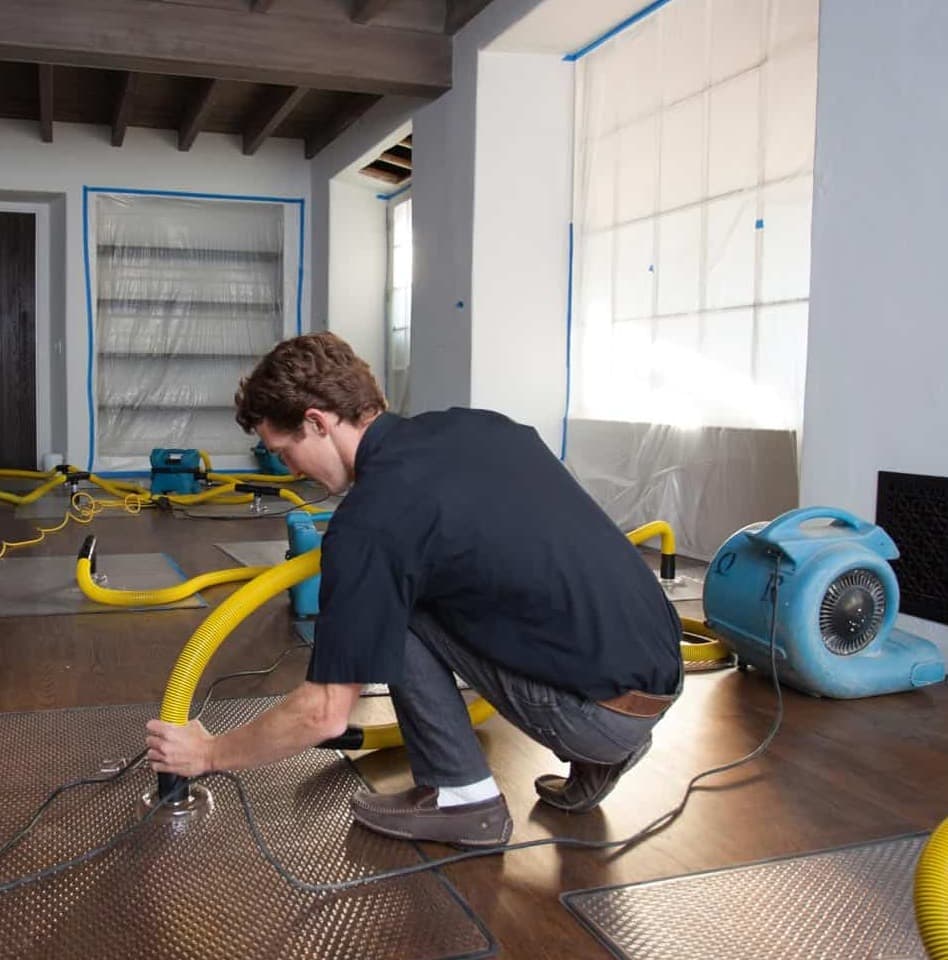
Prime Restoration remediates basement mold at the cause, not just the surface: containment and HEPA-filtered negative air, removal of contaminated drywall, carpet, and insulation, antimicrobial treatment of framing and masonry, monitored structural drying, and a clear diagnosis of the moisture path — seepage, condensation, plumbing, or a past flood that never fully dried. We provide a free on-site assessment with moisture mapping and a written estimate before any demolition, and we rebuild the space when remediation is done. We also work on luxury and high-value homes, including finished basements with custom hardwood and high-end finishes in areas like Bloomfield Hills and Birmingham.
Mold problems grow — literally — the longer the moisture source stays active. Here is what waiting costs.
The moisture source feeding the mold — seepage, condensation, or a slow leak — is still active. The colony grows as long as it stays wet.
Growth spreads across the back of finished walls, under carpet pad, and along framing — surfaces you cannot see. The musty smell strengthens as the colonized area expands.
Drywall, carpet, and stored contents progress from cleanable to disposable. Spores circulate to the rest of the house through the furnace and cold-air returns.
Chronic basement mold means recurring remediation cost and a disclosure issue when you sell. Long-wet framing and sill plates can develop rot on top of the mold problem.
A proven, step-by-step approach to restoring your property.
A technician inspects the basement, meters walls, floors, and framing, and traces the moisture to its source — foundation seepage, condensation, plumbing, or past flooding. Written scope and estimate before any work.
The basement (or the affected section) is sealed and placed under negative air pressure with HEPA scrubbers so removal work cannot push spores upstairs.
Moldy drywall, paneling, insulation, carpet, and pad are cut out, bagged inside containment, and disposed of. Salvageable contents are cleaned; unsalvageable stored items are documented for your records or claim.
Framing, masonry, and remaining surfaces are HEPA-vacuumed and treated with EPA-registered antimicrobial with proper dwell time. Air scrubbing continues throughout.
Dehumidifiers and air movers bring the structure to normal moisture levels, verified with daily meter readings — because rebuilding over a damp foundation restarts the clock.
The moisture path gets addressed — from downspout and grading corrections to coordinating foundation or plumbing repair — and then we rebuild the finished space with an itemized reconstruction estimate.
Comprehensive basement mold removal for every situation.
Common questions about basement mold removal in Macomb County.
Musty odor is produced by active mold metabolism, so a persistent musty basement almost always has growth somewhere you cannot see: behind finished walls, under carpet pad, inside stored boxes, on the back of ceiling tiles, or along the rim joist. A professional assessment with moisture meters and thermal imaging finds the wet area feeding the growth without tearing the basement apart on guesswork.
A whole-room basement mold remediation in Macomb and Oakland County typically runs $3,500 to $9,000 or more, depending on how much finished material must be removed and the reconstruction scope. Smaller contained problems — one wall section, a storage corner — often run $500 to $1,500. The free on-site assessment produces a written, itemized estimate so you know the real number before any demolition starts.
Yes — once the structure is verified dry and the moisture source is fixed. That second condition is the important one: refinishing a basement over unresolved seepage or condensation rebuilds the exact conditions that grew mold the first time. We advise on moisture-smart rebuild choices (inorganic insulation, standoff framing, hard flooring in flood-prone areas) as part of reconstruction.
Only when it results from a sudden, accidental covered event — a burst pipe or an appliance failure, for example — and often subject to a mold sub-limit (commonly around $5,000). Mold from gradual seepage, groundwater, humidity, or deferred maintenance is typically excluded, and groundwater itself generally requires separate flood coverage. Your carrier makes the coverage decision; we document the cause and scope in a format that supports the claim when one applies. As a top-rated contractor for water damage insurance claims in Michigan, Prime Restoration works with the adjuster from start to finish and documents moisture readings, photos and an itemized estimate, and you choose your own contractor.
A dehumidifier addresses one moisture source — humid air — and it is genuinely useful for condensation-driven problems, but it does not remove existing growth and cannot keep up with liquid water from seepage or leaks. Existing colonies need physical removal, and seepage needs drainage or foundation repair. Run a dehumidifier as prevention after remediation, not as a substitute for it.
Yes. If your basement flooded in the past — even years ago — and was dried with box fans instead of monitored professional equipment, hidden mold in wall cavities and under flooring is common. We assess exactly that situation frequently in Macomb County, where spring-thaw and sewer-backup flooding are routine. The assessment is free and includes moisture mapping of the suspect areas.
History and geology. The August 2014 flood (FEMA disaster DR-4195) damaged 118,000+ homes and businesses across the region, and the June 2021 flood (DR-4607) drove 94,356 households to apply for FEMA assistance — and a large share of those basements were dried with shop vacs and box fans, not monitored professional equipment. Layer on clay-heavy soil that holds groundwater against foundations, freeze-thaw cracking, and humid summers condensing on cool below-grade walls, and you have a county where the mold we find in finished basements very often dates to a flood that was never fully dried.
A typical contained basement remediation runs 2 to 5 working days for removal, treatment, and cleaning, plus 3 to 5 days of monitored structural drying — the phase that verifies the space is actually dry before anything gets rebuilt. Whole-basement jobs with extensive finished-material removal run longer. Reconstruction (framing, drywall, flooring) is a separate phase with its own itemized estimate, and its timeline depends on the rebuild scope you choose.
Yes, consistently. An unfinished basement — bare block walls, concrete floor — is mostly cleanable hard surfaces, so remediation often lands toward the lower end of the range. A finished basement adds drywall, insulation, carpet, and trim that must be removed, disposed of, and rebuilt, which is why whole-room finished-basement remediations typically run $3,500 to $9,000 or more in Macomb and Oakland County while smaller contained problems run $500 to $1,500. The free on-site assessment produces the real number for your basement before any work starts.
Yes — through the same stack effect that moves crawl-space air. Warm air rising through the house pulls basement air up through stairwells, duct chases, and floor penetrations, carrying the musty odor compounds and spores with it. Cold-air returns located in the basement accelerate it by putting basement air directly into the furnace circulation. If the first floor smells musty and the basement smells worse, the basement is the answer — deodorizing upstairs without remediating downstairs treats the symptom.
It is worth a free assessment. The June 2021 flood put water into tens of thousands of Southeast Michigan basements, and DIY cleanup with consumer fans typically dries the surfaces you can see while leaving wall cavities, insulation, and the space under flooring damp for weeks. If your basement has developed a persistent musty smell, staining along the lower walls, or allergy symptoms that ease when you leave the house, those are the classic markers. Moisture mapping and a visual inspection will settle the question either way without tearing anything open on speculation.
Learn more about basement mold removal and mold remediation.
Our restoration crews are available 24 hours a day, 7 days a week. Call now for a free mold assessment anywhere in Macomb or Oakland County.
Call (586) 277-1069 for Immediate Help