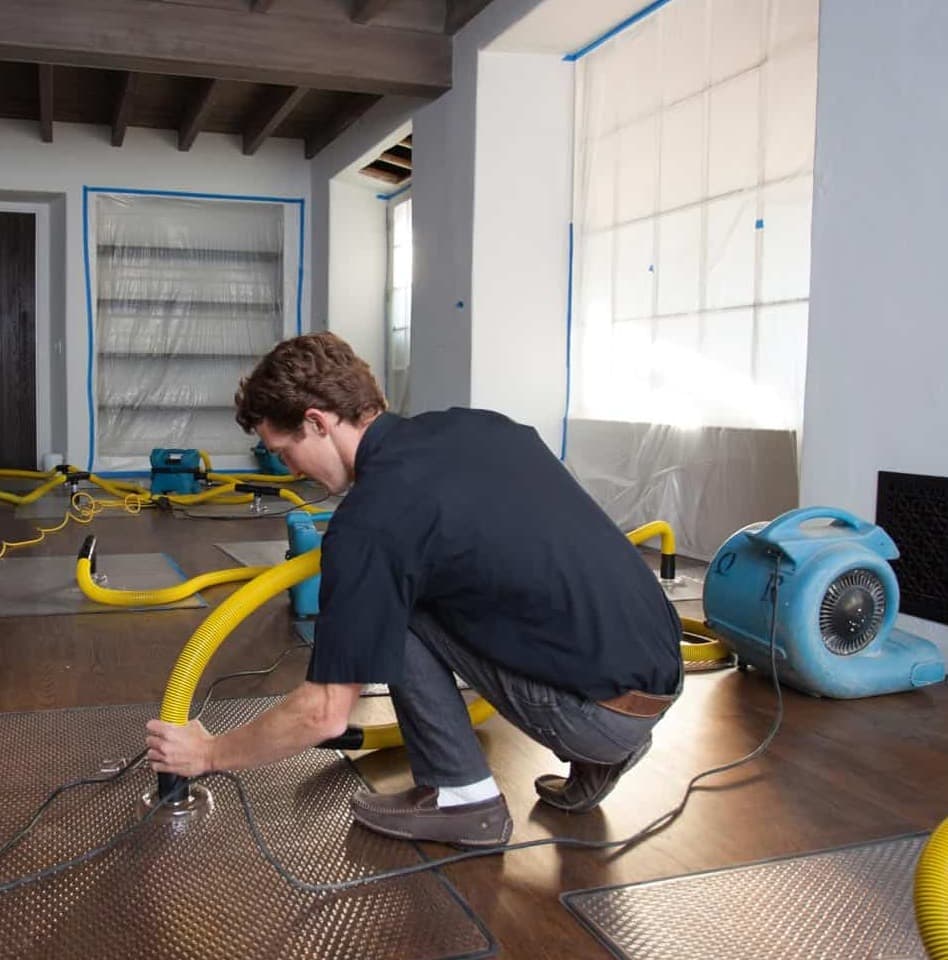
We clean it up properly, dry the subfloor, and repair what came out. Free inspection. On site in 25 minutes.
Answer this before you touch it
Did it overflow from the BOWL, or leak from the TANK?
This is the whole thing, and it takes two seconds to answer. Water that came over the rim of the bowl has been in the bowl, and it is treated as contaminated — Category 3 — from the first minute, regardless of how clear it looked. Water from a cracked tank or a failed supply line at the back is clean water that never entered the bowl, and that is an entirely different and much smaller job. Same puddle on the same floor, two completely different scopes.
So can I just mop it up?
If it came from the tank and you caught it immediately, often yes, and we will tell you so. If it came from the bowl, mopping spreads it — across the floor you are kneeling on, into the towels, and onto whatever those towels touch next. It also does nothing about the water that has already gone under the vinyl or tile, which is where the actual damage is. The visible puddle is the least important part.
It is a small amount. Is that still a problem?
The volume matters far less than where it went and what it was. A bathroom floor is not sealed — water finds the gap at the base of the toilet, the seam at the edge of the vinyl, and the joint where the floor meets the vanity, and from there it is in the subfloor within minutes. A cup of contaminated water in the subfloor is a bigger problem than a bucket of clean water on tile.
What does it cost to have someone look?
Nothing. The inspection, the moisture readings and the written scope are free, and you keep them whether you hire us or not. If it turns out to be a clean-water tank leak that you have already handled, we will say exactly that and go. That happens regularly and it is a fine outcome.
Published by Prime Restoration, a top-rated, highly local Michigan licensed residential builder dispatching from Sterling Heights, with a 5.0 Google rating, BBB A+ accreditation, and Certified Best Pick 2027 recognition. Last updated 2026-04-14.
Where it actually went
A bathroom floor is a surface, not a seal. By the time you are looking at the water, it has already gone to six places — and five of them you cannot see.
Under the flooring, immediately
Sheet vinyl and tile are surfaces, not seals. Water finds the seam at the edge of the room, the cut around the toilet flange, and any gap at the threshold, and it is under the covering within minutes. That is why a floor that looks dry an hour later frequently is not — the covering dried and the layer beneath it did not.
Into the subfloor around the flange
The opening cut for the toilet flange is the largest unsealed penetration in the room and it sits at the lowest point. Repeated wetting there is what rots a subfloor, and it is the reason a toilet that rocks slightly is worth taking seriously — the rocking is often the subfloor beneath it having already softened.
Behind the vanity toe kick
A void nobody has looked into since the vanity was installed, with a raw particle-board or plywood base sitting directly on the floor. It wicks, it holds, and it is invisible. This is one of the two places a bathroom keeps smelling after everything visible has been cleaned.
Through to the ceiling below
If the bathroom is on an upper floor, water reaching the subfloor goes into the joist bay and shows up downstairs — often a day or two later and not directly beneath the toilet, because it runs along the framing first. If there is a room under that bathroom, it gets checked rather than assumed fine.
Into the bottom of the drywall
Gypsum wicks upward from the floor. On a contaminated overflow the lower band of wall is porous material that absorbed Category 3 water, and porous material that absorbed it is removed rather than cleaned, because contamination cannot be verified out of it.
Into whatever was on the floor
Bath mats, towels, the contents of a low cupboard, a cardboard box of spare toiletries. On a contaminated event these are almost always the loss rather than the building, and they are the part people are most surprised by.
If it keeps happening
People replace the toilet. It does not help, because the restriction was never in the fixture. Here is how to tell where it actually is — and what to stop doing while you wait.
A toilet that overflows repeatedly is not a toilet problem
A single overflow is usually a blockage in the trap or the toilet itself. Repeated overflows in the same fixture, especially if other fixtures gurgle or drain slowly at the same time, point downstream — a partially blocked branch line or a failing lateral. Replacing the toilet solves nothing in that case, and people do it.
If other drains react, it is the line
Flush the toilet and watch the shower or the bath. If the water level moves, or you hear gurgling elsewhere, air is being displaced through a shared line, which means the restriction is past the fixture. That is a plumber with a camera, not a plunger.
If it backs up during heavy rain, it is the sewer
A toilet that overflows only when it rains hard is not blocked at all — the main is surcharging and the toilet is simply the lowest opening. That is the combined-sewer story, it is a different problem entirely, and it is covered on our city pages for the areas where it happens.
The wax ring is a symptom, not usually the cause
A failed wax ring leaks a small amount at every flush rather than overflowing. It causes the slow, hidden version of this — the subfloor rot and the ceiling stain below — without ever producing a puddle anyone notices.
What to do while you wait
Stop using every fixture in the house, not just the toilet. If the restriction is downstream, running a sink or a washing machine sends more water toward the same blockage and out through the same opening.
Already cleaned it up?
If it is still overflowing, call — do not use a form. This is for afterwards: the smell that will not go, a floor that feels soft near the base, or a stain appearing on a ceiling below. The moisture readings and the written scope are free either way.
24/7 Emergency
Free inspection and moisture readings. You keep them whether or not you hire us.
(586) 277-1069Source investigation to classify the loss as Category 2 (tank-side supply water) or Category 3 (bowl-side, sewage backup, or any water involving waste). Category decides demo scope, PPE, and disinfection protocol under industry-standard mitigation and biohazard practice.
Isolation of the affected area to prevent tracking contamination. Extraction of standing water with equipment dedicated to the category. Cat 3 work is run with containment barriers and PPE from the first step.
Toilet pulled to inspect the wax ring, flange, closet bolts, and subfloor below. Rotted or split flanges documented for replacement. Subfloor condition around the drain assessed and moisture readings taken.
Category 2: wet vinyl or laminate, wet baseboard, and wet drywall removed where readings require. Category 3: all affected porous materials removed and disposed of per industry-standard biohazard practice, including drywall flood cuts and insulation in adjacent wall cavities that contacted sewage.
4 to 8 air movers and 1 to 2 LGR dehumidifiers for 3 to 5 days. On Cat 3 losses, non-porous surfaces cleaned and disinfected with professional-grade antimicrobials appropriate for industry-standard biohazard remediation. Daily moisture logs against dry standard.
Itemized scope with category-specific line items, per-square-foot drying documentation, and ceiling-below scope if applicable. Rebuild coordinated after clearance readings confirm dry standard and, on Cat 3, after disinfection is complete.
Two bathrooms on the same street can have the same visible water footprint and end up with scopes that differ by $4,000 to $8,000. The reason is category. A cracked tank that dumped clean supply water onto the floor is a Category 2 loss — drying and partial demo. A bowl-side overflow during a flush, or a sewer backup that pushed water up through the toilet drain, is a Category 3 loss — full demo of affected porous materials, containment, PPE, and disinfection to industry-standard biohazard practice standards. The rule is simple: if the water touched the inside of the bowl or came up from the drain side, it is Category 3, regardless of how it looks.
This matters on the estimate because carriers increasingly scrutinize category calls. Documenting the source with photographs, plumber notes, and a clear cause-of-loss narrative is how the biohazard scope gets paid. We are not sewage cowboys and we do not inflate categories — we write what the source actually was and let the documentation stand up to review.
Stop the water first: lift the tank lid and push the flapper down by hand to seal it, then reach behind the toilet and close the small shutoff valve on the supply line — turn it clockwise. If that valve is seized, which is common on an older one that has never been moved, close the main instead. Then stop using every other fixture in the house, because if the restriction is downstream, running a sink or a washing machine pushes more water toward the same blockage and back out through the same opening. Get anything porous up off the floor — bath mats, towels, the contents of a low cupboard, anything cardboard — because on a contaminated overflow those are usually the actual loss. Photograph it before you move anything, timestamped, wide and close. Then leave the puddle alone rather than mopping it, and open the window. What you have not done at that point is spread it, and that is worth more than a clean-looking floor.
It depends entirely on one thing, and it takes two seconds to establish: did the water come over the rim of the BOWL, or did it leak from the TANK at the back? Water that came out of the bowl has been in the bowl and is treated as contaminated — Category 3 — from the first minute, no matter how clear it looked. Mopping that spreads it across the floor you are kneeling on, into the towels, and onto whatever those towels touch next, and it does nothing about the water that already went under the vinyl or tile. Water from a cracked tank or a failed supply line never entered the bowl and is clean water, which is a much smaller job you can often handle yourself if you caught it fast. Same puddle, same floor, two completely different scopes. If it was the tank and you have already dealt with it, we will tell you that and go.
The volume matters far less than what it was and where it went. A bathroom floor is a surface, not a seal — water finds the seam at the edge of the vinyl, the cut around the toilet flange, the threshold at the door and the joint where the floor meets the vanity, and it is under the covering within minutes. That is why a floor that looks dry an hour later frequently is not: the covering dried and the layer beneath it did not. A cup of contaminated water sitting in a subfloor is a genuinely bigger problem than a bucket of clean water on sealed tile. The useful test is not how much you saw, it is whether the floor feels at all soft near the base of the toilet and whether the room still smells a few days later.
Because the restriction is almost certainly not in the toilet, which is why replacing the fixture so often changes nothing. A single overflow is usually a blockage in the trap or the toilet itself. Repeated overflows in the same fixture point downstream to a partially blocked branch line or a failing lateral. There is a simple test: flush the toilet and watch the shower or the bath. If the water level moves, or you hear gurgling from another drain, air is being displaced through a shared line and the restriction is past the fixture — that is a plumber with a camera rather than a plunger. A third pattern is worth separating out entirely: if it only backs up during heavy rain, nothing is blocked at all. The main is surcharging and your toilet is simply the lowest opening in the house. While you are waiting on any of these, stop using every fixture, not just the toilet, because running a sink or a washing machine sends more water at the same blockage.
Because the two places that hold it are places you cannot clean from above. The first is the void behind the vanity toe kick — a raw particle-board or plywood base sitting directly on the floor, wicking and holding, invisible since the day it was installed. The second is the subfloor around the toilet flange, which is the largest unsealed penetration in the room and sits at the lowest point. Cleaning the visible floor addresses neither. If the smell persists after everything you can see has been washed, the material holding it is under or behind something, and it needs a moisture reading rather than more cleaning. A related tell: a toilet that rocks even slightly is often rocking because the subfloor beneath it has already softened from repeated wetting, which is worth taking seriously well before it becomes an overflow story.
It gets inspected rather than assumed fine, and the stain is unlikely to be directly under the toilet. Water reaching the subfloor enters the joist bay and runs along the framing before it drops, so it commonly appears a day or two later and some distance away — which is why people conclude the two events are unrelated. Downstairs, the wet zone above the ceiling is always wider than the mark, and the insulation in that bay holds water against the joists for weeks. On a contaminated overflow, the porous material in the affected area is removed rather than dried, because contamination cannot be verified out of it. If the ceiling below is bulging at all, clear the room underneath first — a pocket of water on paper-faced drywall comes down as a sheet rather than gradually.
Under industry-standard mitigation practice, Category 2 water is "significantly contaminated" — it contains chemical, biological, or physical contaminants that could cause discomfort or sickness on contact. Category 3 is "grossly contaminated" and may contain pathogens, sewage, or toxins. On a toilet overflow, the category depends entirely on the source. Clean supply-line water from the tank side (a cracked tank, a failed fill valve, a ruptured supply hose) that overflowed before contacting the bowl is generally Category 2 because it picks up contaminants from the floor as it spreads. An overflow from the bowl side during a flush, a sewer backup that came up through the toilet, or any overflow that involves visible waste is Category 3 and triggers industry-standard biohazard practice sewage remediation protocols. The scope, demo, and PPE are different for each.
No — wax ring failures are common but they leak slowly onto the subfloor around the base of the toilet, they rarely produce a sudden overflow. The usual sudden-overflow sources are: a failed fill valve that keeps running while the overflow tube is partially clogged, a bowl-side clog combined with a stuck flapper that fills the bowl faster than it can drain, a cracked tank that dumps 3 to 5 gallons on the floor at once, a failed braided or rubber supply line hose (very common — plan on replacing the line every 5 to 8 years), or a broken flange where the toilet is no longer sealed to the drain. Wax ring failures produce the slow hidden damage that rots subfloors and stains ceilings below over months.
Yes. Any water that has entered the bowl side of the toilet is considered Category 3 under industry-standard mitigation practice regardless of visual appearance because the bowl and the trap contain biological contamination at baseline. Even a "clean-looking" overflow from a minor bowl clog is remediated as Category 3: affected porous materials (drywall, insulation, carpet, pad, particle-board flooring) are removed and disposed of, non-porous surfaces are cleaned and disinfected to industry-standard biohazard standards, and PPE is worn through the demo and cleaning phases. This is the most common point of confusion with homeowners — the visual cleanliness of the water does not change its category.
Tank-side water that never touched the bowl is Category 2. On a typical 3 to 5 gallon tank failure that spreads across a bathroom floor and into the hall or adjacent room, the scope is: extract standing water, remove the toilet for access to the flange and subfloor, pull any vinyl or laminate flooring in the wet zone (particle-board underlayment swells permanently), cut wet baseboard and drywall to 12 inches if the water wicked into the wall cavity, dry the subfloor and wall framing with air movers and a dehumidifier for 3 to 4 days, and document with a detailed, itemized line-item scope. Tile bathroom floors over a mud bed usually survive. Sheet vinyl or laminate over particle board almost never does.
Bathroom floors on Macomb County two-stories are typically tile or vinyl over 1/4-inch particle-board underlayment on 3/4-inch plywood subfloor on 2x10 joists. When a toilet overflows, water finds the subfloor seam, the toilet flange penetration, or the heat register boot and drops through to the ceiling cavity below. Downstairs we cut a ceiling inspection hole, remove wet insulation and saturated drywall, and dry the joist bay. If the source was Category 3, the downstairs demo is more aggressive because the ceiling insulation and drywall below are treated as contaminated porous materials and removed rather than dried in place. This is the biggest reason category classification matters on the estimate — a Cat 3 scope on a two-story loss can be 50 percent larger than a Cat 2 scope on the same footprint.
Sudden and accidental toilet overflows from the tank side (cracked tank, failed supply line, fill valve failure) are typically covered under dwelling coverage on a standard Michigan HO-3 policy from State Farm, Auto-Owners, AAA, Allstate, Farm Bureau, or Citizens. A sewer backup coming up through the toilet is generally excluded unless you have a sewer backup endorsement on the policy — this is an optional rider that many homeowners do not realize they need. A clogged toilet that overflowed during a flush is usually covered as sudden and accidental discharge, even though the water is Category 3. A wax ring that was slowly leaking for months is typically excluded as gradual seepage and maintenance. Payment decisions, coverage determinations, and settlement amounts are made solely by the insurance carrier after their own inspection.
A small contained Category 2 overflow on a tile floor with minor drywall and baseboard damage runs $1,200 to $2,500 for mitigation. A typical Category 2 loss with laminate or vinyl removal, partial drywall, subfloor drying, and 3 to 4 days of equipment runs $2,800 to $5,500. A Category 3 (sewage) overflow on the same footprint runs $4,500 to $9,500 for mitigation because of the more aggressive demo, PPE, and disinfection scope. A two-story loss with ceiling damage below, multi-room affected area, or a sewer backup event runs $8,000 to $22,000 before rebuild. Sewer backup endorsement coverage is usually capped at $5,000 to $25,000 depending on the rider, so out-of-pocket exposure can be significant on larger Cat 3 losses. These are 2026 Macomb County averages and every project is priced from actual scope and affected square footage.
Shut off the water at the valve behind the toilet (turn the angle stop clockwise) — if the valve is stuck, shut off the main water supply to the house. Do not attempt to flush again. If the overflow is Category 3 or sewage, keep children and pets out of the affected area and do not touch the water without gloves. Clear contents off the wet floor. Photograph the source, the spread, and the damaged materials before anything moves. Call a plumber to resolve the clog, the failed component, or the backup. Call a restoration company for the extraction, demo, and drying. File the claim the same day with the cause of loss clearly documented. For Cat 3 events, do not try to clean it yourself — disinfection to industry-standard biohazard standard requires specific chemistry and PPE.
Prime Restoration is a top-rated, highly local restoration contractor known for very good customer service across Macomb County and Metro Detroit. Category 2 and Category 3 protocols, industry-standard sewage remediation, insurance-direct, itemized line-item documentation. Prime works with your adjuster from start to finish and documents moisture readings, photos, and an itemized estimate — you choose your own contractor. Claim filing and payment decisions stay between you and your carrier.
Call (586) 277-1069Prime Restoration is a licensed Michigan water damage restoration contractor. Payment decisions, coverage determinations, and settlement amounts are made solely by the insurance carrier after their own inspection. Cost ranges on this page are 2026 Macomb County averages and are not a quote; every project is priced from actual scope and affected square footage.