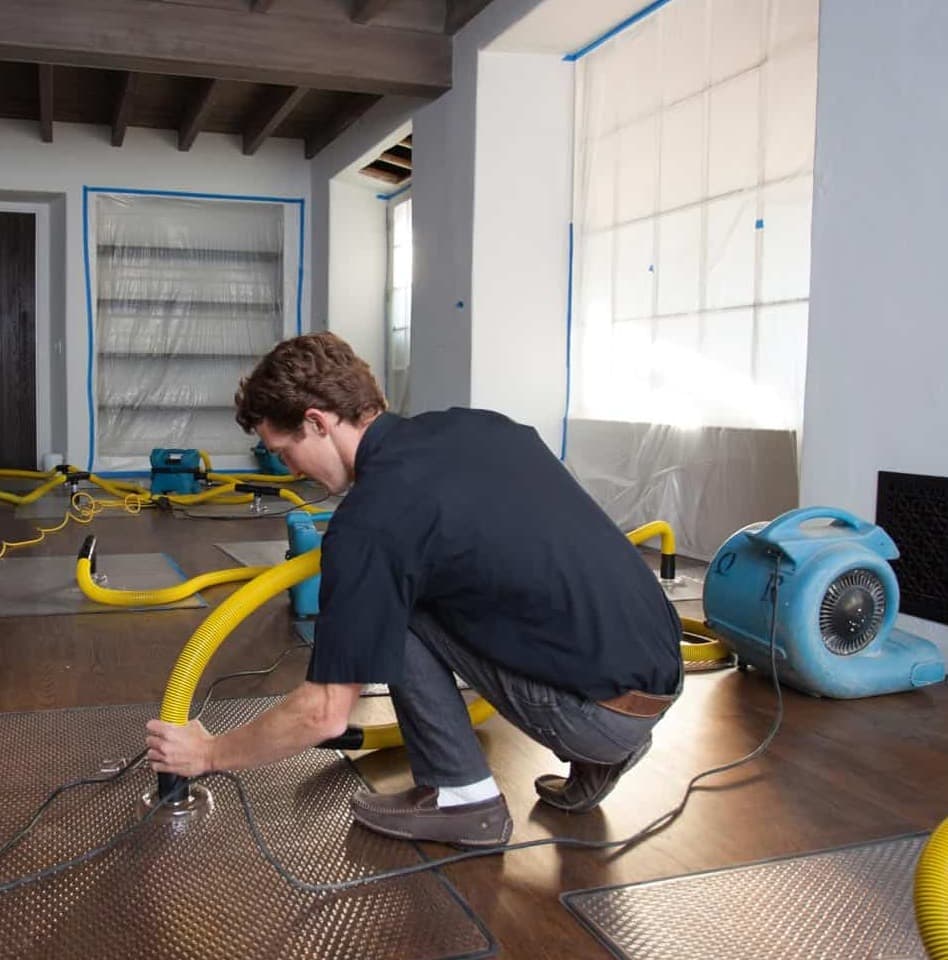
Precision moisture meters and thermal imaging chart the full extent of water intrusion, giving your home a documented drying plan instead of a guess.
Water where it should not be? Call (586) 277-1069 for a full moisture map today.
The most expensive mistake in water damage is drying what you can see and leaving what you cannot. Water does not stop at the edge of a visible wet spot — it migrates along studs, wicks up drywall, spreads under flooring, and pools in places you would never think to check. Moisture mapping is how Prime Restoration draws the true boundary of the water so we can dry all of it, not just the obvious part.
This is the heart of our Find-First Method. Using pin and pinless moisture meters alongside infrared thermal imaging, our IICRC-certified technicians take readings across the affected area and the materials around it, then record exactly which surfaces are wet, how wet, and how far the moisture has spread. That map becomes the drying plan: it tells us where to place equipment, how to set our targets, and — just as important — when the structure has genuinely reached a documented dry standard.
Homes across Macomb Township, Shelby Township, Mount Clemens, Rochester, and Warren face moisture that hides especially well thanks to Michigan's clay-heavy soil, freeze-thaw cycles, and aging municipal sewers. A basement that feels dry underfoot can still hold saturated bottom plates and insulation. As a licensed Michigan Residential Builder (#262500492) with a 5.0 rating across 167 Google reviews and accountable crews from diagnosis through restoration, we make sure the map — not a hunch — decides when the job is truly done.
Water damage gets exponentially worse over time. Here is what happens if you wait.
Water migrates outward and upward through porous materials for as long as it sits. Every hour before mapping means a larger wet footprint and more material at risk.
Per the IICRC S500 standard, clean water left undetected degrades to gray or black water within days. A moisture map catches the full spread while it is still the least hazardous — and cheapest — to handle.
A saturated wall base or wet insulation that never gets mapped stays wet for weeks and becomes a mold source. Mapping ensures those pockets are found and dried before growth starts.
Without readings, drying is guesswork — equipment gets placed by feel and pulled too early. A moisture map turns drying into a measurable process with a defined finish line.
Documented before-and-after moisture readings show your insurer both the extent of the loss and the proof that your home was dried to standard, reducing disputes over scope and completeness.
A proven, step-by-step approach to restoring your property.
A Prime technician is typically on-site within about an hour anywhere in Macomb or Oakland County, so mapping happens before the water spreads further.
We take moisture readings on unaffected, known-dry materials of the same type. This baseline tells us what "dry" actually means for your specific home and construction.
We use infrared imaging to spot suspect areas quickly, then systematically meter the affected rooms and everything adjacent — walls, floors, ceilings, cabinetry, and framing.
Every wet material and its moisture level is recorded on a map of your space, defining the exact drying footprint so nothing wet is missed and nothing dry is disturbed.
The map dictates equipment placement and drying targets. The same accountable team then dries to a documented standard, not to a stopwatch.
We re-map as drying progresses and confirm each material has returned to the dry baseline, then hand you and your insurer the full record.
Comprehensive moisture mapping & detection for every situation.
Common questions about moisture mapping & detection in Macomb County.
Moisture mapping is the process of measuring and recording how far water has spread through your home using moisture meters and thermal imaging. Instead of guessing where the water went, we chart every wet material and its moisture level. That map becomes the plan for drying — and the proof that everything got dry.
A pinless meter reads moisture through a surface without penetrating it, which is great for scanning large areas quickly. A pin meter uses two small probes to measure moisture at a specific depth for a precise reading. We use both together so we get a broad map and pinpoint confirmation.
Because water rarely stays where you can see it. It wicks up drywall, spreads along the bottom plates of walls, and travels under flooring well past the visible edge. If we only dry the obvious part, the hidden moisture keeps damaging materials and can grow mold — mapping is what prevents that.
We first establish a dry baseline by metering unaffected materials of the same type, so we know what dry means for your home. Then we re-map the wet areas as drying progresses and confirm each material has returned to that baseline. Drying ends when the readings say so, not when a set number of days pass.
Yes. Between clay-heavy soil and freeze-thaw cycles, a lot of Metro-Detroit basements carry background humidity, which is exactly why baseline readings matter. We compare the affected materials against known-dry ones so we can separate normal ambient dampness from an actual water intrusion.
Mapping shows the pattern and extent of the moisture, which usually points us back toward the source. If pinpointing the exact origin requires it, we combine the map with our leak-detection tools. The map ensures we treat both the source and the full spread, not just one or the other.
Often the small jobs benefit the most, because the wet area behind the surface is usually bigger than the visible spot. A quick map catches the true extent while the water is still Category 1 and confined, which keeps the job small instead of letting it become a demolition project.
We re-map throughout the drying process, not just at the start. Readings guide when to reposition equipment and tell us the moment each material is back to baseline. Continuous measurement is how we avoid both under-drying and running equipment longer than needed.
Yes. You receive the moisture map along with before-and-after readings that show the extent of the loss and confirm your home was dried to standard. This documentation is valuable for your records and gives your insurance adjuster clear, objective evidence.
We serve all of Macomb and Oakland County, including Sterling Heights, Clinton Township, Shelby Township, Macomb Township, Mount Clemens, Rochester Hills, Troy, and Bloomfield Hills. Wherever you are, our typical response time is about 25 minutes.
Our emergency restoration crews are available 24 hours a day, 7 days a week. Call now for a typical 25-minute response anywhere in Macomb County.
Call (586) 277-1069 for Immediate Help