
Storm Damage Repair in Macomb & Oakland County, Michigan
24/7 emergency storm damage services — roof tarping, water extraction, structural restoration, and complete reconstruction.
Storm damage your home? We respond immediately to secure and restore your property.
24/7 Emergency
Call Now
On-site within 60 minutes. Speak directly with our trained restoration team.
(586) 277-1069Licensed & Insured • Family-Owned
Michigan storms bring high winds, heavy rain, hail, ice, and fallen trees that can cause devastating damage to your home or business. From roof damage and broken windows to flooding and structural collapse, storm damage requires immediate professional response to prevent secondary water damage and further deterioration. Prime Restoration provides complete storm damage repair services across Macomb County and Oakland County with 24/7 emergency response.
Why You Must Act Fast
The longer you wait, the worse the damage — and the higher the cost
Immediate
Exposed structure allows water intrusion. Rain, snow, and debris continue entering through damaged roof, siding, or windows.
Hours 1-12
Water saturates insulation, drywall, and framing. Secondary water damage compounds the original storm damage.
Days 1-3
Mold risk increases on wet materials. Structural stability may be compromised. Contents and personal belongings at risk.
Days 3+
Extensive water damage requires full mitigation. Restoration costs escalate. Insurance claim timeline pressure increases.
Our Storm Damage Repair Process
Professional, methodical, and thorough — every time
Emergency Response & Securing
We typically arrive within 60 minutes to tarp damaged roofs, board up broken windows, and secure your property against further damage from weather and intrusion.
Storm Damage Assessment
Complete inspection of all storm damage including roof, siding, windows, structural elements, and interior water damage. Detailed documentation for insurance claims.
Water Extraction & Drying
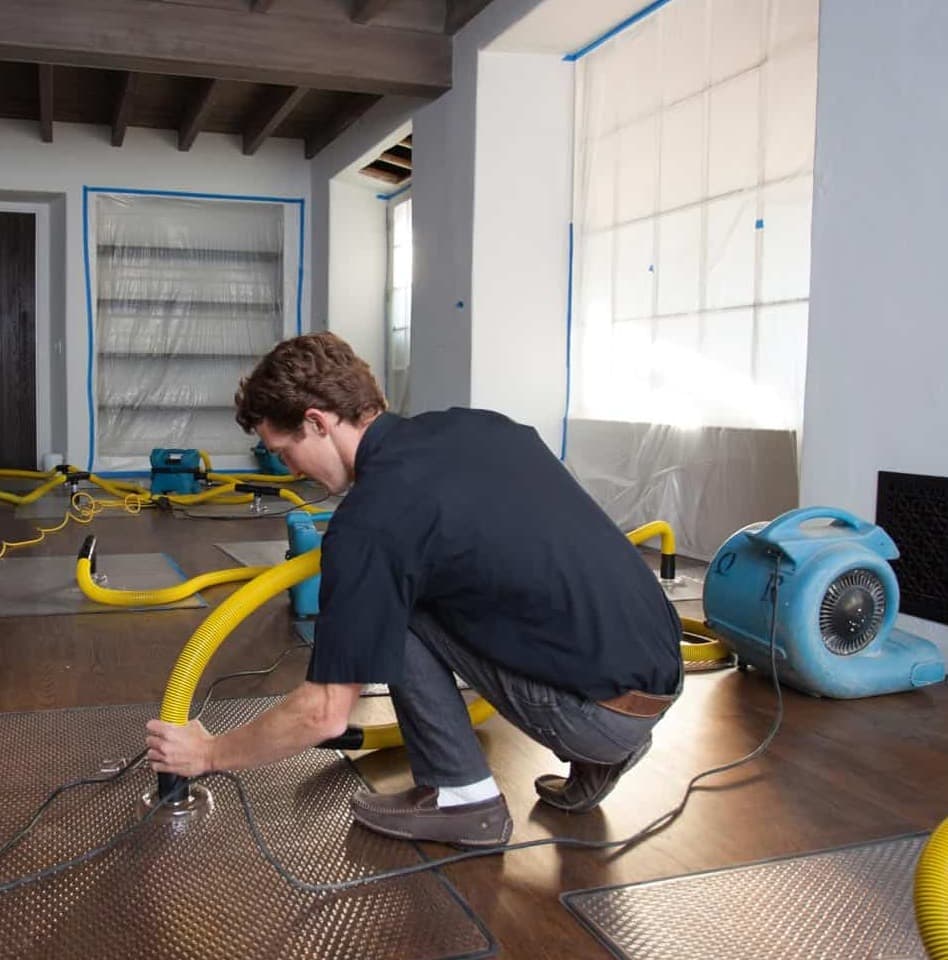
Remove all storm-driven water from the interior. Deploy commercial dehumidifiers and air movers for complete structural drying.
Debris Removal & Cleanup
Remove fallen trees, branches, and debris from the property. Clean and dispose of damaged materials safely.
Structural Repairs
Repair or replace damaged roofing, siding, windows, framing, and interior finishes. All work meets or exceeds building codes.
Complete Restoration
Full reconstruction to restore your property to pre-storm condition. Interior and exterior finishing, painting, and final inspection.
What We Handle
Two jobs, not one
Emergency stabilisation is a separate job from the repair
The most common confusion after a storm is expecting one visit to fix everything. Stabilisation happens in hours and its only purpose is to stop the loss growing. The repair happens in days or weeks and needs materials, sometimes a permit, and usually a decision that has not been made yet. Understanding the split is what keeps a homeowner from feeling abandoned between the two.
What stabilisation actually covers
Tarping an opening in the roof, boarding a broken window or door, and where necessary shoring something that is no longer safe. It is weather-tight and secure, not pretty and not permanent. A tarp is a temporary membrane with an expected life measured in weeks, and it needs looking at after every subsequent storm.
Why it happens before anything is decided
Every hour an opening stays open, water keeps arriving and the interior scope keeps growing. Stabilisation is the cheapest work on the whole job and it is the work that limits everything downstream. It does not commit you to a contractor for the repair, and any company implying otherwise is worth walking away from.
What it does not include
It is not a roof repair, it does not restore the interior, and it does not tell you what the permanent fix costs. Expect a separate assessment afterwards. A tarp going on is the start of the process rather than the answer.
Roofing is its own licensed trade
We do interior restoration and reconstruction. Permanent roof repair and replacement belongs to a licensed roofer, and on an active leak the honest first call is whoever stops the water soonest. We will say so on the phone rather than send a truck to sit in your driveway.
Tree removal is also its own trade
Getting a tree off a structure safely is arborist and crane work, and doing it in the wrong order can cause more damage than the fall did. The sequence is remove, then stabilise, then assess the structure, then restore. Nobody should be pulling limbs off a roof to see how bad it is.
What to ask for in writing at this stage
A description of exactly what was stabilised and where, dated photographs from before the tarp went on, and confirmation that the emergency work is a standalone scope. That is all reasonable to expect within a day, and it is what any later conversation will rest on.
Diagnosis
Four storm mechanisms, four different jobs
A storm is not one loss type. Wind, hail, impact and water intrusion damage a building in different ways, leave different evidence, and produce completely different scopes — and a single storm frequently delivers more than one. Knowing which you have before anyone quotes is most of the leverage available to you.
| Mechanism | What it looks like | What is easy to miss | What the scope turns on |
|---|---|---|---|
| Wind | Lifted, creased or missing shingles, torn siding, displaced flashing, gutters pulled loose, ridge or drip edge damage. | Creased shingles that did not blow off. The seal is broken and they will leak in the next driving rain even though the roof looks intact from the ground. | Whether the covering can be spot-repaired or the seal failure is widespread. This is a roofer’s determination, not ours. |
| Hail | Bruising and granule loss on shingles, dents in soft metals — gutters, vents, flashing, siding, air-conditioner fins. | That the softest metal on the property is the best evidence. AC condenser fins and gutter aprons record a hail event more reliably than a shingle does. | Whether the impacts broke the mat or only removed granules. That difference decides repair versus replacement and it is assessed close-up, not from the driveway. |
| Impact — trees and debris | An obvious hole, a crushed section, damaged framing, or a limb resting on the structure. | Everything that is not the hole. Rafters and trusses transmit an impact well beyond the visible opening, and the framing check matters more than the patch. | The structural assessment. Restoration of the interior cannot be sequenced until someone competent has confirmed what the frame did. |
| Water intrusion | Ceiling stains, wet insulation, water tracking down inside walls, a flooded lower level. | That it appears days later and far from the entry point. Water runs along framing before it drops, so the stain is not the location. | Moisture readings rather than the visible stain — the same measured approach as any other water loss. This is the half we own. |
The first hour
Photograph before the tarp goes on
This is free, takes ten minutes, and is the single most valuable thing a homeowner does after a storm. Once emergency work begins, the original condition is gone — and stabilisation is supposed to happen fast, so the window is short.
Safety first, and that is not a formality
Stay away from downed lines, standing water near electrical service, and anything structurally questionable. Do not go on a roof after a storm. Everything worth photographing can be photographed from the ground or from inside.
Wide shots that establish the whole property
Each elevation of the building from far enough back that the extent is unmistakable, plus the street. These are the frames that establish scale later, and they are the ones people forget because they seem too obvious.
Close shots of every specific damage point
The opening, the missing shingles, the dented gutter, the limb. Get something in frame for scale where you can. Photograph soft metals — gutters, vents, AC fins — even if they look minor, because they are the best hail evidence you have.
Inside, before anything is moved
Ceiling stains, wet flooring, affected contents in place. If water is actively coming in, get a frame that shows where. Timestamps matter more than composition.
Then the stabilisation itself
A shot of the tarp or board-up in place, so the record shows what was done and when. This closes the loop between the damage and the emergency work.
Keep them somewhere that is not the house
Cloud backup or emailed to yourself. On a serious loss the building is not a safe place to store the only copy of the record, and this is the sort of thing people discover the hard way.
After a big storm
How to vet whoever knocks on your door
A significant storm brings crews into the area that were not here the week before and will not be here next year. Most contractors are legitimate and some are not, and the difference is visible in about five questions. This list works on us as well as on anyone standing on your porch.
"What is your Michigan licence number?"
Residential building work in Michigan requires a licensed residential builder, and the licence is verifiable independently through the State of Michigan licence lookup. Ask for the number, write it down, and check it yourself. A business card, a magnet and a truck decal are not credentials.
"Where is your office, and how long have you been at that address?"
Not a hostile question and the answer is informative. A local address that predates the storm means someone you can find in six months when a repair needs revisiting. There is nothing wrong with an out-of-area firm, but you should know that is what you are hiring.
"What do you need up front, and what is it for?"
A reasonable deposit against scheduled work is normal. A large cash payment demanded on the doorstep before any scope exists is the single most common way people lose money after a storm. Pay in a traceable way and never in cash on the spot.
"Can I have the scope in writing before I sign anything?"
You are entitled to read what you are signing, in daylight, without someone waiting. Be particularly careful with anything that assigns your rights or authorises open-ended work — a work authorisation, an estimate and an assignment of benefits are three different documents and they should be identified as such.
"Who is doing the roof, and who is doing the interior?"
They are different trades and frequently different companies. Knowing who owns which half — and who owns the hand-off — prevents the gap where each assumes the other is handling something.
And one thing to refuse outright
If anyone offers to cover, absorb or "work around" your deductible, end the conversation. That is not a discount and it is not a favour — in Michigan it is generally insurance fraud, and it is you rather than them who is exposed. A contractor willing to start there has told you what the rest of the job will be like.
Coverage determinations, payment decisions and settlement amounts are made solely by your insurance carrier after their own inspection. Nothing here is a statement about your policy.
Michigan specifics
What the calendar actually does to buildings here
Storm exposure in Southeast Michigan is seasonal and fairly predictable, which means most of it can be looked at in advance rather than discovered. Each of these has a different failure mode and a different window.
Spring — saturated ground and high wind
The worst combination for tree fall, because the ground is soft and the canopy is newly leafed and catching wind. Mature trees over a structure are worth an arborist’s look in a dry month rather than after they have made the decision for you.
Summer — fast convective storms
The events that produce the most losses here are high volume in a short window rather than long steady rain: wind, hail and rainfall arriving faster than drainage can take it. This is the season for sewer surcharge and for hail on soft metals.
Autumn — blocked drainage
Leaf litter fills gutters, valleys, window wells and yard drains, which turns an ordinary rain into standing water against the building. Cheap to prevent, and it is the cause behind a surprising share of "the storm caused it" calls.
Winter — snow load and ice
Accumulated load on low-slope and flat roofs, ice in gutters and valleys, and frozen supply lines in unheated space. Flat commercial roofs and porch or garage additions are where load problems show up first.
Late winter — ice dams
The failure whose fix is at the other end of the house: heat escaping into the attic melts snow that refreezes at the cold eave, and the pool behind the dam works backward under the shingles. It is an air-sealing and insulation problem rather than a roofing one, and it is covered in full on our roof-leak page.
Any season — the thing to do in advance
Walk the property once a season and look at four things: where every downspout terminates, whether the window wells drain, whether anything overhangs the roof, and whether the sump and its backup actually run. That is most of the preventable damage in this region, and none of it requires a ladder.
Need Storm Damage Repair? We're Ready.
24/7 emergency response. On-site within 60 minutes. Free estimates.
What Our Storm Damage Repair Customers Say
Real reviews from Southeast Michigan homeowners
“Had a really good experience with Prime Restoration for mold remediation. They were professional, clear about the process, and actually made me feel confident about the process. Not pushy. I'd definitely recommend them around Bloomfield Hills”
Christian H.
Bloomfield Hills, MI
Storm Damage Repair FAQ
Answers to the most common questions from Michigan homeowners
Does homeowners insurance cover storm damage?
Yes, most homeowners insurance policies cover storm damage including wind, hail, lightning, and fallen trees. Flood damage from rising water typically requires separate flood insurance. Prime Restoration documents all damage thoroughly and provides a full restoration scope in Xactimate so you have accurate paperwork to submit to your insurance carrier.
How quickly can you tarp a damaged roof?
Prime Restoration typically provides emergency roof tarping within 60 minutes of your call. Our crews carry tarps and materials on our emergency response vehicles. Emergency board-up for windows and doors is also available immediately. Securing your property against further damage is always our first priority.
What should I do after storm damage to my home?
After storm damage: (1) Ensure everyone is safe, (2) Call Prime Restoration at (586) 277-1069 for emergency securing, (3) Document damage with photos before cleanup, (4) Contact your insurance company, (5) Do not enter structurally unsafe areas. We provide emergency tarping, water extraction, and complete restoration, plus itemized Xactimate documentation for your insurance paperwork.
How long does storm damage repair take?
Storm damage repair timelines vary by severity. Emergency tarping and board-up is same-day. Minor repairs (shingles, siding) take 1-3 days. Major structural repairs take 2-6 weeks. Complete reconstruction after severe storm damage can take 2-4 months. We provide detailed timelines during our initial assessment.
Why does the tarp go on before anyone tells me what the repair costs?
Because they are two different jobs and the first one limits the second. Stabilisation happens in hours and its only purpose is to stop the loss growing — tarping an opening, boarding a window or door, shoring anything unsafe. It is weather-tight and secure rather than pretty or permanent, and a tarp is a temporary membrane with a life measured in weeks that needs checking after every subsequent storm. Every hour an opening stays open, water keeps arriving and the interior scope keeps growing, which makes stabilisation the cheapest work on the whole job and the work that limits everything downstream. Crucially it does not commit you to a contractor for the repair, and any company implying otherwise is worth walking away from. What you should get within a day is a written description of exactly what was stabilised and where, plus dated photographs from before the tarp went on.
How do I tell wind damage from hail damage from something else?
They leave different evidence and produce different scopes, and one storm often delivers more than one. Wind shows as lifted, creased or missing shingles, torn siding, displaced flashing and gutters pulled loose — and the thing most often missed is a creased shingle that did not blow off, because the seal is broken and it will leak in the next driving rain while the roof still looks intact from the ground. Hail shows as bruising and granule loss on shingles and dents in soft metals, and the best evidence on the property is usually not the roof at all: air-conditioner condenser fins, gutter aprons and vents record a hail event more reliably than a shingle does. Impact from a tree or debris leaves an obvious hole, and the thing to check is everything that is not the hole, because rafters and trusses transmit an impact well beyond the visible opening. Water intrusion is the one that appears days later and far from the entry point, since water runs along framing before it drops — which is why it is diagnosed with moisture readings rather than from the stain.
What should I photograph, and when?
Before the tarp goes on, because once emergency work begins the original condition is gone — and stabilisation is supposed to happen fast, so the window is short. It is free and takes about ten minutes. Safety genuinely first: stay away from downed lines, standing water near electrical service and anything structurally questionable, and do not go on a roof after a storm; everything worth photographing can be captured from the ground or from inside. Take wide shots of each elevation from far enough back that the extent is unmistakable, plus the street — those establish scale later and they are the ones people forget because they seem too obvious. Then close shots of every specific damage point with something in frame for scale, including soft metals even if they look minor. Then inside, before anything is moved: ceiling stains, wet flooring, affected contents in place, and where water is actively entering. Then a shot of the tarp or board-up itself. Back it all up somewhere that is not the house.
Someone knocked on my door after the storm. How do I check them out?
Five questions, and they work on us too. Ask for the Michigan residential builder licence number and verify it yourself through the State of Michigan licence lookup — a business card, a magnet and a truck decal are not credentials. Ask where their office is and how long they have been at that address; there is nothing wrong with an out-of-area firm, but you should know that is what you are hiring, because a local address that predates the storm means someone you can find in six months. Ask what they need up front and what it is for: a reasonable deposit against scheduled work is normal, but a large cash payment demanded on the doorstep before any scope exists is the most common way people lose money after a storm. Ask for the scope in writing before signing anything, and be careful that a work authorisation, an estimate and an assignment of benefits are three different documents. And ask who is doing the roof versus the interior, since those are different trades and the hand-off needs an owner. One thing to refuse outright: if anyone offers to cover, absorb or work around your deductible, end the conversation — in Michigan that is generally insurance fraud and it is you who is exposed.
What can I actually do in advance to prevent storm damage?
Walk the property once a season and look at four things, none of which requires a ladder. Where every downspout actually terminates — moving roof discharge well away from the wall removes a large share of what would otherwise sit against the foundation. Whether the window wells drain, because a well without a working drain fills and pushes water through the frame. Whether anything overhangs the roof, since spring is the worst combination for tree fall with soft ground and a newly leafed canopy catching wind, and a mature tree over a structure is worth an arborist's look in a dry month. And whether the sump and its backup actually run, tested with the primary unplugged so the backup has to carry a full cycle alone. Beyond that, the seasonal pattern here is fairly predictable: summer brings fast convective storms with hail and rainfall arriving faster than drainage can take it, autumn brings blocked gutters and valleys that turn ordinary rain into standing water, and winter brings snow load, ice and frozen supply lines in unheated space.
Storm Damage Repair Service Areas
Serving all of Macomb County and Oakland County, Michigan
Macomb County
Prime Restoration is a Michigan restoration contractor headquartered at 13854 Lakeside Circle, Suite 558, Sterling Heights, MI 48313, with a Rochester office serving Oakland County. Our trained restoration team provides storm damage repair across Macomb County and Oakland County, with 60-minute emergency response and direct billing to State Farm, AAA, Auto-Owners, Citizens, Allstate, Farmers, USAA, Progressive, and Meemic.
Ready to Get Started?
Call now for 24/7 emergency storm damage repair service in Southeast Michigan.