

Top Rated Local Water Damage Restoration in Macomb Township, MI
A broken pipe, appliance leak, or storm surge can soak drywall and subfloor within hours. The longer water sits, the more secondary damage you pay for — warped hardwood, swollen MDF, wicking up studs, and Category 2 microbial growth within 48–72 hours. Fast extraction is the single biggest cost-control decision after a water loss.
Family-Owned · Insured & Licensed · 24/7 Emergency Dispatch
Local Macomb Township branch · 0.4 miles from the center of Macomb Township · on site in 25 minutes
Your local Macomb Township water damage restoration branch
Prime Restoration's Macomb Office is at Macomb Centre Plaza, 51058 Romeo Plank Rd, Macomb, MI 48042, 0.4 miles from the center of Macomb Township. From this branch a crew is typically on site in 25 minutes, 24/7, across Lakeside Estates and Westridge north of 23 Mile, Tuscany Estates and the Camelot area off Romeo Plank, and the older homes along 25 Mile and Card Road. The crew is set up for the homes here: late-1990s to 2010s colonials with engineered I-joist floors and finished basements that depend on sump pumps.
Homeowners highly recommend the branch for customer service: 5.0 on Google from 147 reviews, and one project manager answers your calls from the first visit to the last repair. Every job gets detailed, itemized documentation for your insurance claim: dated moisture readings, photos and a line-item estimate your adjuster can check. Call (586) 277-1069.
What Macomb Township Homeowners Need to Know
Newer construction in Macomb Township still sits on the same heavy clay soil as the rest of the county — modern sump systems help, but failures remain common after long-duration storms.
Housing here is predominantly One of Michigan’s fastest-growing townships in the 2000s — most homes are builder-grade new construction. The most common restoration-related issues in Macomb Township are sump pump failure, settling foundation, builder-grade drain tile. Our crews treat each property as its own project — scope, drying time, and rebuild needs are written based on what we measure on site, not a generic playbook.
Macomb Township's rapid 2000s growth means most homes are still relatively new, but they sit on the same heavy clay subsoil that affects older parts of the county. Builder-grade sump pumps and battery backups that were standard at construction are now 15–20 years old and reaching end of life. Restoration calls here follow predictable weather patterns: multi-day rain events in spring and fall consistently trigger sump failures across whole subdivisions at once.
For water damage work specifically in Macomb Township, the dominant driver we see on local jobs is sump pump failure — which affects how fast water spreads, where it hides, and how long drying realistically takes.
Seasonal pattern — Macomb Township
Multi-day spring rain events trigger clusters of sump-failure calls across entire subdivisions; winter calls are predominantly frozen supply line bursts.
Local conditions in Macomb Township
Soil & Water Table
Macomb Township's newer subdivisions sit on the same heavy clay subsoil as the rest of the county. Builder-grade perimeter drain tile is standard in 2000s-era homes, but it's typically a single-pipe system with no redundancy — when the tile clogs or the sump fails, there's no secondary drainage path, and water backs up fast.
Building Stock
Macomb Township is dominated by 2000s-2010s builder-grade new construction with poured-concrete basements, engineered wood I-joist floor systems, and vinyl or engineered wood flooring. Builder-grade materials are adequate under normal conditions but don't respond well to sustained moisture — prompt drying matters more here than in older, more forgiving construction.
Dispatch & Access
Newer subdivision streets and wide driveways make equipment staging straightforward in most neighborhoods. Dispatches from Sterling Heights reach the township in 20-35 minutes depending on route and traffic.
Plumbing leaks, flooded basements and mold in Macomb Township
These are the three things callers report to Prime most. Between April 16 and October 3, 2026, Prime logged 205 calls with a description: 83 mentioned basement water, 57 mold, and 52 a pipe, a supply line or another plumbing leak. Prime Restoration is top-rated and highly local, a family water damage restoration business since 1988, and is typically on site in 25 minutes.
Plumbing and supply line leaks in Macomb Township
Fifteen calls came to Prime from Macomb Township between April 16 and October 3, 2026. Six of them mentioned a pipe, a supply line or another plumbing leak.
The median Macomb Township home was built in 2000, and only 13 percent were built before 1980. Prime’s Macomb office is at Macomb Centre Plaza, 51058 Romeo Plank Rd.
“Prime Restoration is the best whether you have a broken pipe or flooded basement. If you are in Macomb check them out”
Flooded basements in Macomb Township
Eight of those fifteen Macomb Township calls mentioned basement water. The township is one of the 11 communities on the Macomb Interceptor.
On September 2 and 3, 2026, two rounds of storms left nearly 300,000 customers without power across southeast Michigan. A sump pump stops when the power does.
“If you have a roof leak or a basement sump pump flood, I recommend you give them a call. They have a great customer service.”
Macomb County flooded basement guide · Basement flooding cleanup
Mold after water damage in Macomb Township
Mold came up in 57 of 205 described calls in Prime’s log. The free mold check uses a moisture meter and a thermal camera.
“Prime Restoration spoke with me about mold and water damage I had. They were really nice and explained the process very simply. I would recommend if you are in Macomb.”
Water in the house now? Call (586) 277-1069. The estimate is free. See all Google reviews.
Sources: Macomb County Public Works, Macomb Interceptor Drain; National Weather Service Detroit, September 2-3, 2026 storms; U.S. Census Bureau, ACS 2019-2023, tables B25034 and B25035; Prime Restoration call log, April 16 to October 3, 2026.
Macomb Township Neighborhoods and Districts We Cover
Macomb Township is one of the fastest-growing residential townships in Macomb County, and its housing stock skews heavily toward subdivisions built between the late 1990s and the 2010s. The Lakeside Estates and Westridge subdivisions north of 23 Mile Road consist mostly of large two-story colonials on slab-and-basement foundations with engineered I-joist floor systems, which require careful cavity drying after Category 2 supply-line failures because trapped moisture in OSB webbing can lead to delayed microbial growth. The Tuscany Estates and Camelot area off Romeo Plank features newer brick colonials with finished basements and sump-pump-dependent drainage, raising the exposure during heavy-rain events. Older legacy farmsteads remain scattered along 25 Mile and Card Road, where well-and-septic systems and pole barns introduce different contamination categorization concerns under industry-standard practice.
Recent Storm History — Macomb Township, MI
Macomb Township's storm restoration history tracks the broader Macomb County pattern of high-impact regional events. The August 11, 2014 Metro Detroit flood contributed to widespread basement losses across the township's newer subdivisions, where finished basements and sump-dependent drainage amplified the severity of Category 2 and Category 3 water intrusion. The June and July 2021 Metro Detroit flooding produced another round of saturated-soil and groundwater-driven losses, and the December 2013 Michigan ice storm caused tree-fall and prolonged power outages that triggered frozen-pipe failures in unconditioned spaces. The April 15, 2026 Macomb County windstorm added a recent wave of roof, fascia, and envelope damage with secondary water intrusion, increasing demand for tarp stabilization, structural drying, and reconstruction work.
Working With Your Insurance Carrier in Macomb Township
Macomb Township's residential book is written across the same Michigan carrier landscape that prevails countywide, with AAA/Auto Club Group, Auto-Owners, State Farm, Allstate, Citizens, Farm Bureau, and Hanover all writing significant homeowner volume. Because the township's housing stock skews newer and replacement-cost values run high, carrier desk reviews on large-loss claims tend to be exacting, and Xactimate scopes are expected to reflect current Macomb County price-list rates with documented equipment counts and drying durations. Aligning the initial scope with industry-standard mitigation and mold remediation protocols, where applicable, supports cleaner approvals and reduces supplement cycles.
Prime Restoration is a licensed Michigan restoration contractor. We document project scope with detailed, itemized paperwork so homeowners have clear line-item records to submit to their carrier.
Permits & Code Compliance — Macomb Township
Building permits in Macomb Township are issued by the township Building Department, which inspects any construction a permit is taken out for; the township's own FAQ confirms that even a roof replacement needs a building permit. Houses fall under the 2015 Michigan Residential Code, still in force after a July 2025 court order paused the 2021 update. Macomb Township's plot plan review requires every new home's sump lead to connect to an enclosed storm sewer system, through a catch basin or manhole, so most sump water here leaves the lot through a pipe instead of onto the yard, and a failed or disconnected lead shows up as water at the foundation. The township's Department of Public Works maintains 8 sanitary pump stations, and the township drains to three subwatersheds: Anchor Bay, Clinton River East and the Clinton River North Branch.
Sources: Macomb Township Building Department · Macomb Township FAQ (roof permits) · Plot Plan Review Checklist (sump lead) · Macomb Township Department of Public Works · Which watershed do you live in? · Michigan LARA: current code books · LARA: 2021 residential code injunction notice
Water Damage Restoration — Macomb Township, MI
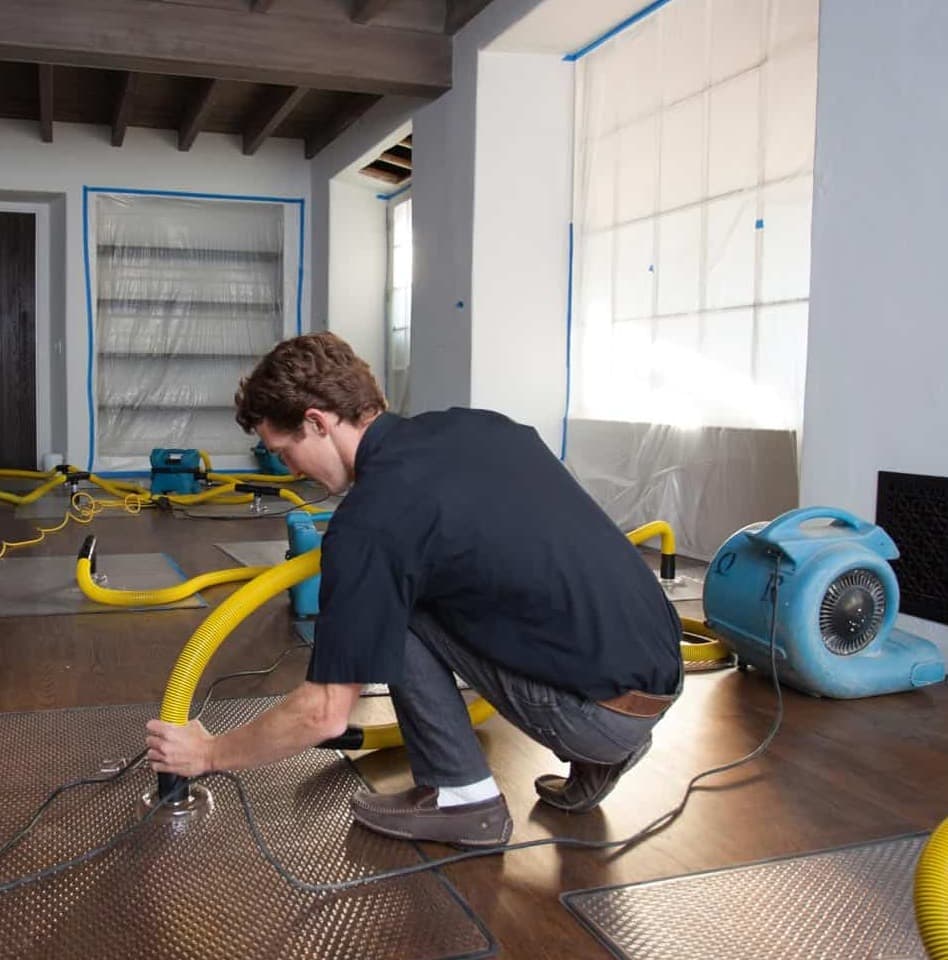
Prime Restoration provides 24/7 emergency water damage restoration built around the industry-standard mitigation protocol. Our crews extract standing water, set up containment, install industrial air movers and LGR dehumidifiers, and monitor moisture levels daily until the structure reaches documented dry standard. Every project is photographed and written up in Xactimate so homeowners have detailed line-item scope to submit to their insurance carrier.
Common causes we see in Macomb Township
- •Supply line failure (washer hose, toilet, dishwasher)
- •Burst or frozen pipe
- •Water heater rupture
- •Sump pump failure during heavy rain
- •Roof leak from ice dam or storm
- •Sewer line backup
Signs to watch for
- •Visible standing water or saturated carpet
- •Musty or damp smell
- •Swollen baseboards, warped hardwood, or bubbling paint
- •Water stains on ceilings or walls
- •Sudden spike in humidity
Our Water Damage Process in Macomb Township
The same documented process on every project.
1. Emergency Response & Inspection
A trained technician arrives, photographs the scene, identifies the water source, and maps affected materials with moisture meters and thermal imaging following industry-standard mitigation protocol.
2. Water Classification & Containment
Water is classified Category 1 (clean), 2 (gray), or 3 (black) and Class 1–4 by evaporation load. Non-affected areas are contained with 6-mil poly to prevent cross-contamination.
3. Water Extraction
Truck-mounted extractors and submersible pumps remove standing water. Saturated carpet pad is removed and disposed of. Drilling weep holes into wall cavities lets trapped water drain.
4. Structural Drying
Air movers, LGR dehumidifiers, and directed heat are set based on a written drying plan. Daily moisture readings are logged until materials reach dry standard.
5. Cleaning & Sanitization
Affected materials are cleaned with professional-grade antimicrobial. Contents are cleaned, dried, and inventoried for pack-out when needed.
6. Reconstruction & Xactimate Documentation
Drywall, flooring, trim, and paint are rebuilt to complete the project. Every line item is documented in Xactimate so you have detailed paperwork for your insurance carrier.
Equipment we bring to Macomb Township
Reviews
What Macomb Township Area Homeowners Say
5.0 Stars · 147 Verified Google Reviews
“Had a really good experience with Prime Restoration for mold remediation. They were professional, clear about the process, and actually made me feel confident about the process. Not pushy. I'd definitely recommend them around Bloomfield Hills”
Christian H.
Bloomfield Hills, MI
“Prime Restoration is a solid company in Michigan for basement floods and water damage. They're professional, knowledgeable and the kind of team you'd want handling a stressful situation.”
Nathan M.
Verified Google Review
“Prime Restoration in Bloomfield has an outstanding team for water damage restoration. Their crew is phenomenal. great people with top notch character who clearly know their stuff. Highly recommend for anyone facing water damage in Bloomfield.”
Ahmed W.
Bloomfield, MI
“Best in the game did my basement because it flooded and they left no messes clean and efficient”
Adam J.
Verified Google Review
“The Prime Restoration team was absolutely fantastic! Very professional and communicative. Completed the job in a timely manner. I would highly recommend!”
Jerome K.
Verified Google Review
“I called five different companies for restoration work, and Prime Restoration was hands down the fastest and most fair on price. They got me a quote the same day, while others were still "getting back to me." Their team works fast.”
Sean B.
Verified Google Review
Water Damage Questions — Macomb Township, MI
Common questions from Macomb Township homeowners before they call.
My Macomb Township home is only 15 years old — why is the sump pump failing?
Builder-grade sump pumps installed in mid-2000s construction typically have service lives of 7-15 years depending on use. Homes from that era are now reaching the end of their original pump life, and because entire subdivisions were built simultaneously, failures often happen across many neighboring homes in the same storm event. A failed pump during a heavy rain event is usually the trigger for a water damage call in Macomb Township.
How fast can a crew reach my home after water damage?
Our dispatcher assigns a trained restoration crew as soon as you call. Most residential losses are reached within about 25 minutes across our core service area, though severe weather or freeway closures can extend response time.
Do you work with my insurance company?
Prime Restoration is a licensed restoration contractor. We document the full project scope in Xactimate — the same software adjusters use — so you have clear paperwork to submit to your carrier.
How long does structural drying take?
A typical Class 2 water loss reaches dry standard in 3–5 days. Class 3 losses with saturated walls, carpet pad, and subfloor usually run 5–7 days. We log moisture readings daily so drying time is based on measurements, not guesswork.
Can I stay in the house during drying?
For Category 1 (clean water) losses, most homeowners stay in place. Industrial air movers are loud (roughly 65–75 dB) and the affected area should stay contained. Category 2 and 3 losses often require temporary relocation until sanitization is complete.
Prime Restoration is a licensed restoration contractor. We document the full project scope with detailed, itemized paperwork so you have clear line-item records to submit to your carrier.
Related Services in Macomb Township
Water Damage
Basement Flooding Cleanup in Macomb Township
Basement water extraction, contents pack-out, structural drying, and sanitization.
Water Damage
Burst Pipe Water Damage in Macomb Township
Emergency response to burst, frozen, or ruptured pipes — water extraction, wall cavity drying, and rebuild.
Water Damage
Ceiling Water Damage Repair in Macomb Township
Ceiling leak diagnosis, dry-out, drywall replacement, and painted finish restoration.
Water Damage Near Macomb Township
We also serve these nearby Macomb and Oakland County communities.
Need Water Damage in Macomb Township Now?
24/7 emergency dispatch. trained restoration crews. Typical response within 25 minutes across our core service area.
Prime Restoration
Macomb Office
Macomb Centre Plaza, 51058 Romeo Plank RdMacomb, MI 48042(586) 277-1069
A crew is typically on site in 25 minutes, 24/7, from our Macomb office.
Open in Google Maps →Water damage and mold help in Macomb
In Macomb, our crew handles flooded basements, burst pipes, sump pump failures, water heater leaks, sewage backups and ceiling leaks, including water damage from a roof leak. When water sits too long, we handle mold remediation, from basement mold to black mold removal.
Before you call, read what to do in the first 24 hours after water damage, check what water damage restoration costs in Michigan or what mold remediation costs, and see how to prevent mold after water damage.
Why Macomb homeowners pick Prime Restoration
Read about Prime Restoration, a family water damage restoration business since 1988, led by Cole Hartwell, Certified Water Damage Specialist. See our 147 five-star Google reviews. We are a Certified Best Pick and an IICRC Certified Firm. For customer support and insurance coordination, we work with all insurance companies, give your adjuster the moisture readings, photos and itemized estimate, and keep in contact until the last repair. Customers say we “kept in contact and explained the whole process.” Ask about 0% APR financing, read how homeowner's insurance treats water damage in Michigan, or find answers in our water damage FAQ.
Water damage at a business in Macomb
Our Macomb office also handles commercial water damage restoration for stores, restaurants, offices, medical and dental offices, manufacturing and multi-family buildings. Past commercial clients includePetco, Linamar, Quest Diagnostics and the Somerset Collection. A crew is on site in 25 minutes, 24/7, and we contain the wet area so the rest of the building can keep operating. Property managers and business owners can join Property Pro, our free priority program with priority scheduling, one point of contact and a property file on record, or book a free walkthrough for a commercial emergency ready plan.
Nearby areas we serve
From our Macomb office we also reach Shelby Township, Utica, Chesterfield Township, Washington Township, Ray Township, Clinton Township, Mount Clemens and Clinton Twp East.
Our other offices
water damage restoration in Sterling Heights, water damage restoration in Birmingham, water damage restoration in Troy, water damage restoration in Shelby Township, water damage restoration in Rochester Hills, water damage restoration in West Bloomfield and water damage restoration in Ann Arbor. See every city we serve.