
Troy runs separated storm sewers, so what comes up a Troy floor drain is usually not what comes up a Royal Oak one. The cove joint, the sump and the 1970s poured basement are the real story here. On site in 25 minutes. The estimate is free.
Rather talk now?Call (586) 277-1069
This page is published by Prime Restoration, a Michigan licensed residential builder with an office in Troy at 1621 W Big Beaver Rd. It covers what actually fails in Troy rather than what fails generally, and it says out loud where Troy differs from the cities south of it. Every infrastructure figure and dated event below is sourced at the bottom of the page. Last updated 2026-09-02.
What the work looks like
Extraction, readings, controlled drying, then the rebuild. The same crew and the same equipment on every job, and a written scope you keep.
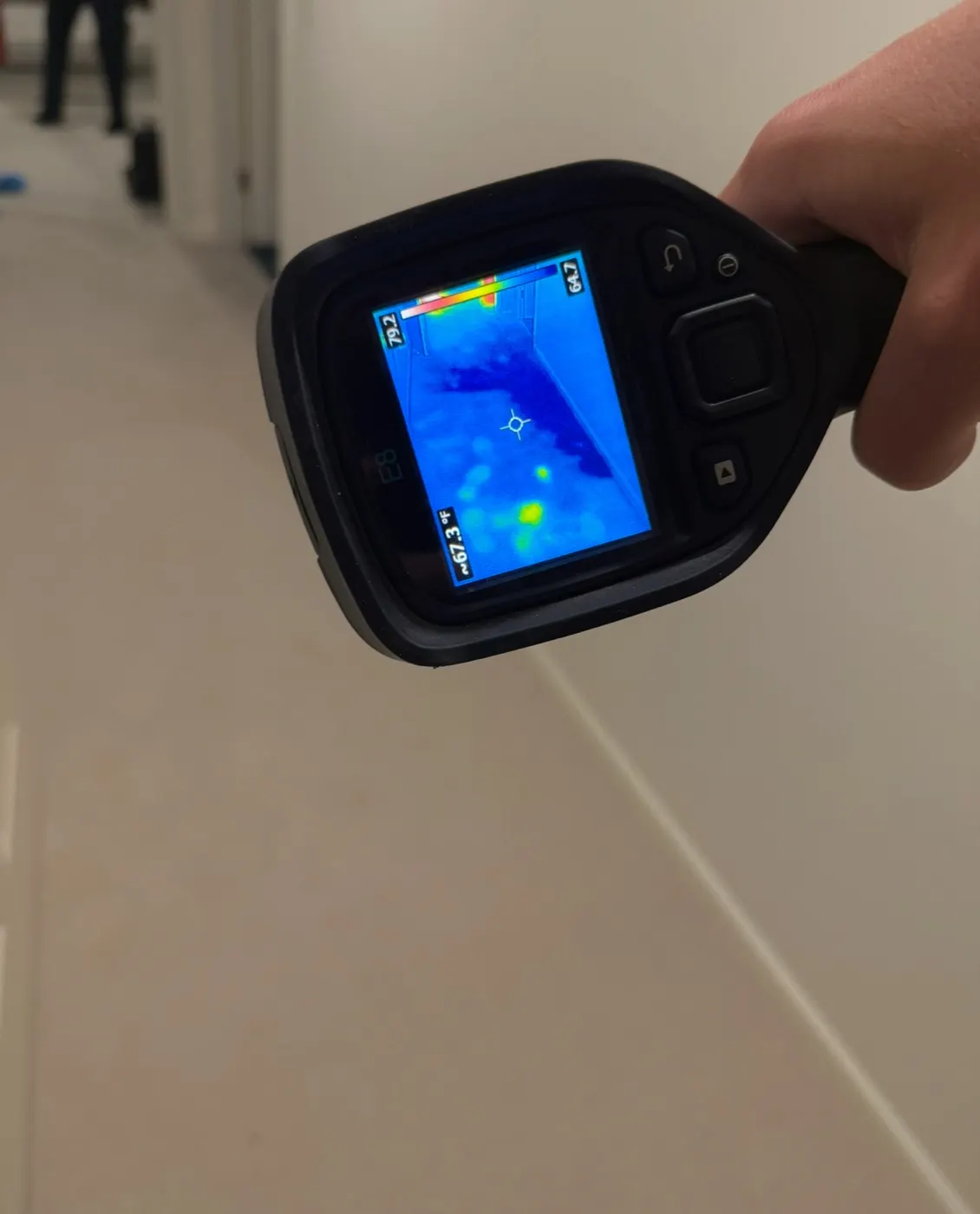
Thermal imaging finds water behind a wall before anything is opened up.
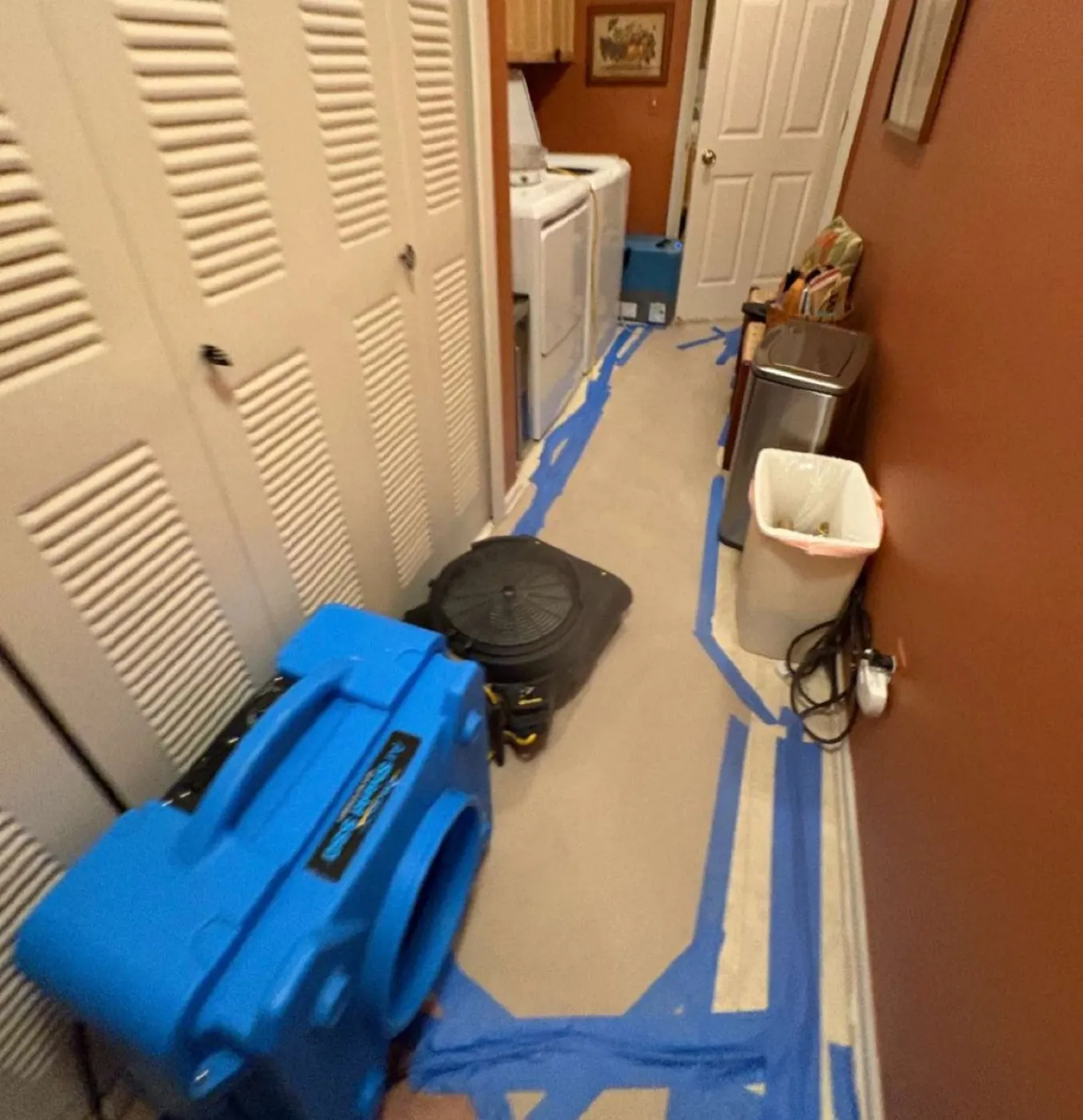
Air movers set along the wet wall, running until the readings say stop.

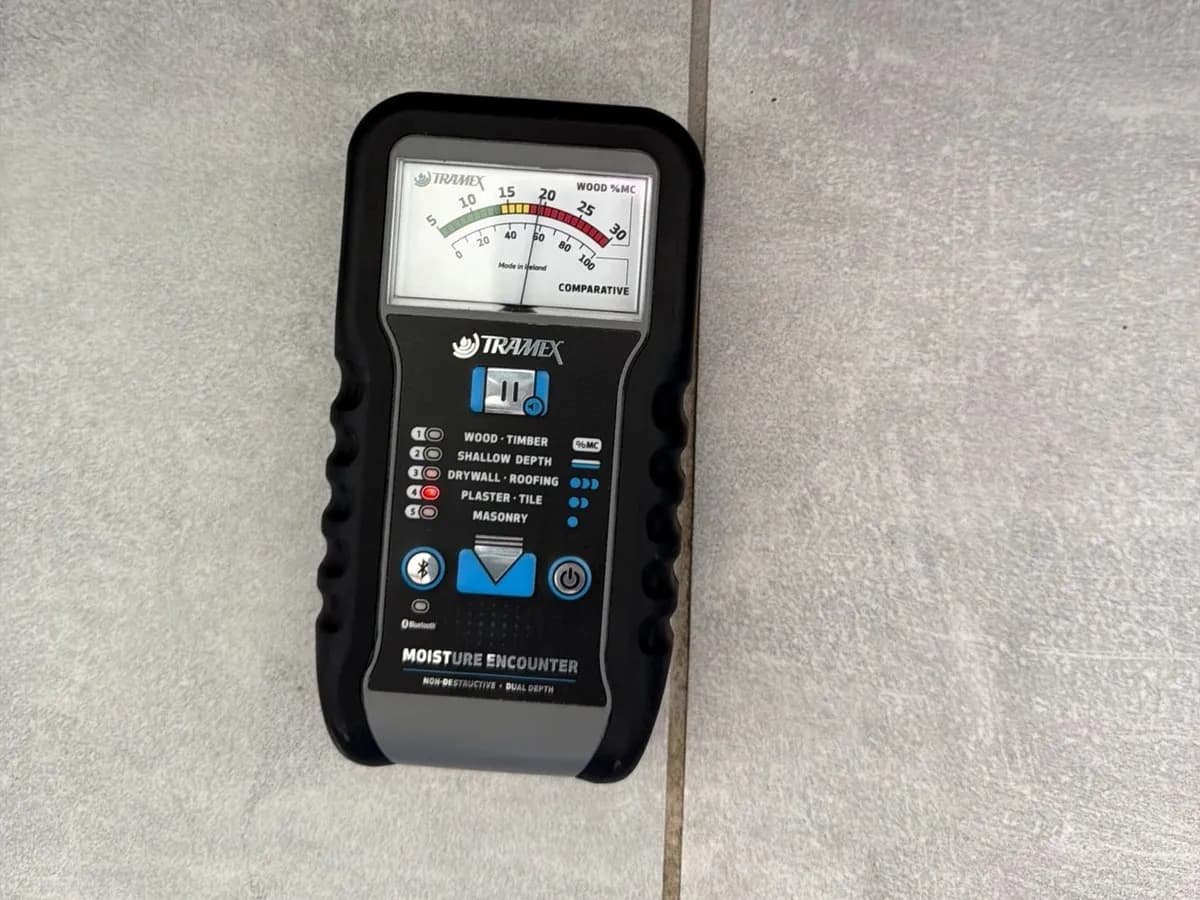
Every reading is taken against a dry standard from an unaffected room.
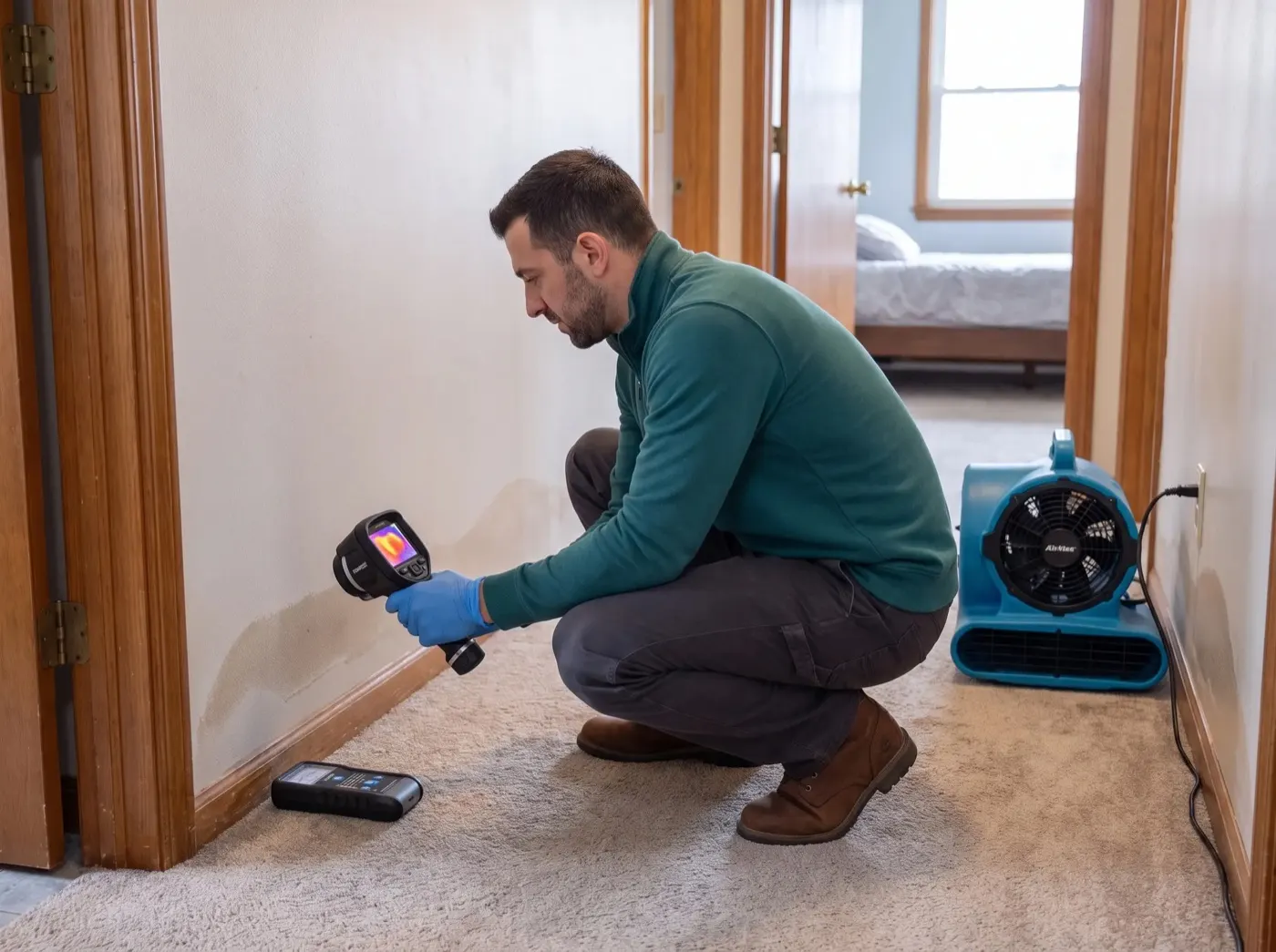
The camera shows where water travelled, which is rarely where it got in.
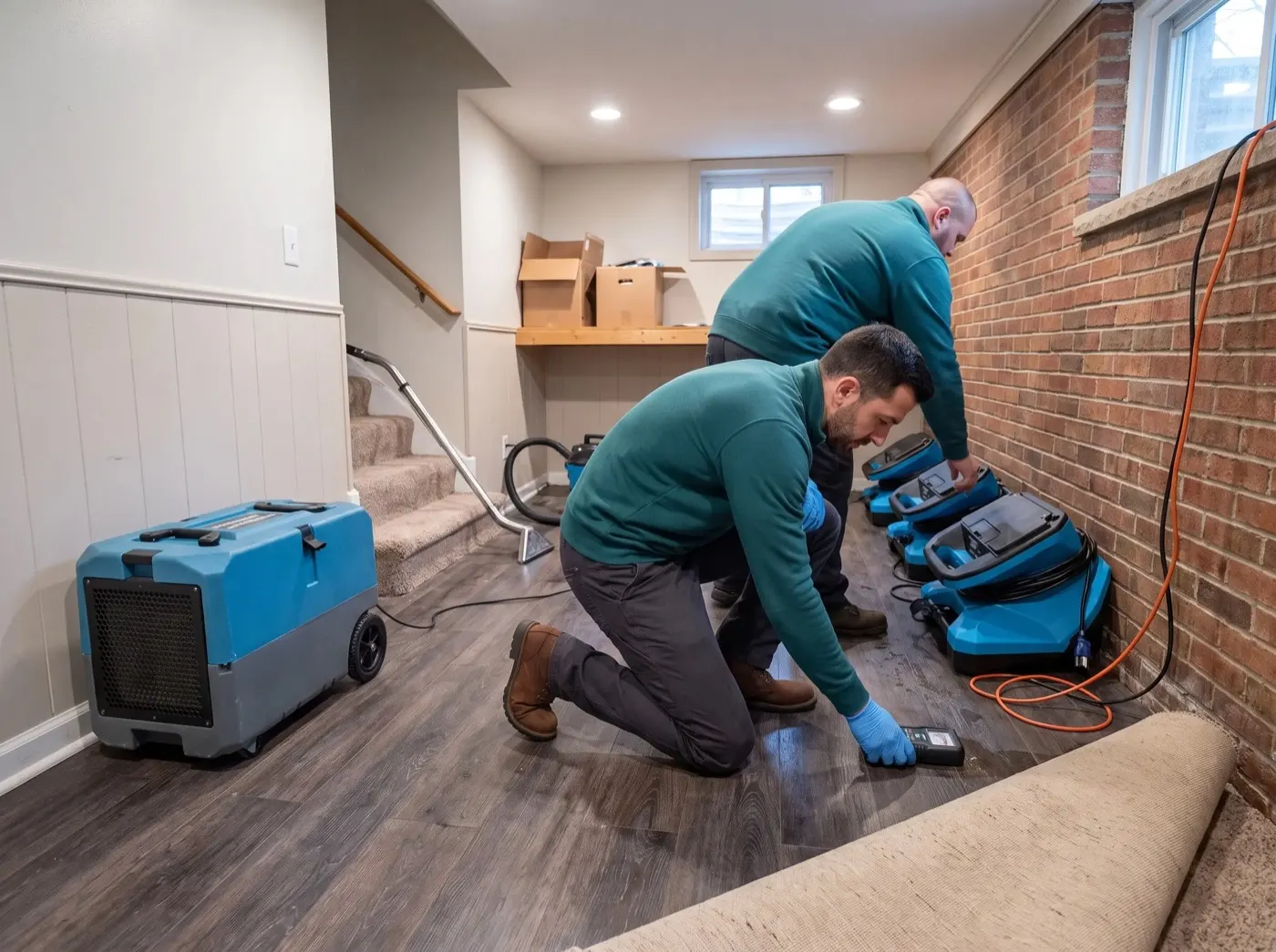
Carpet back, pad out, slab read before any drying equipment is placed.
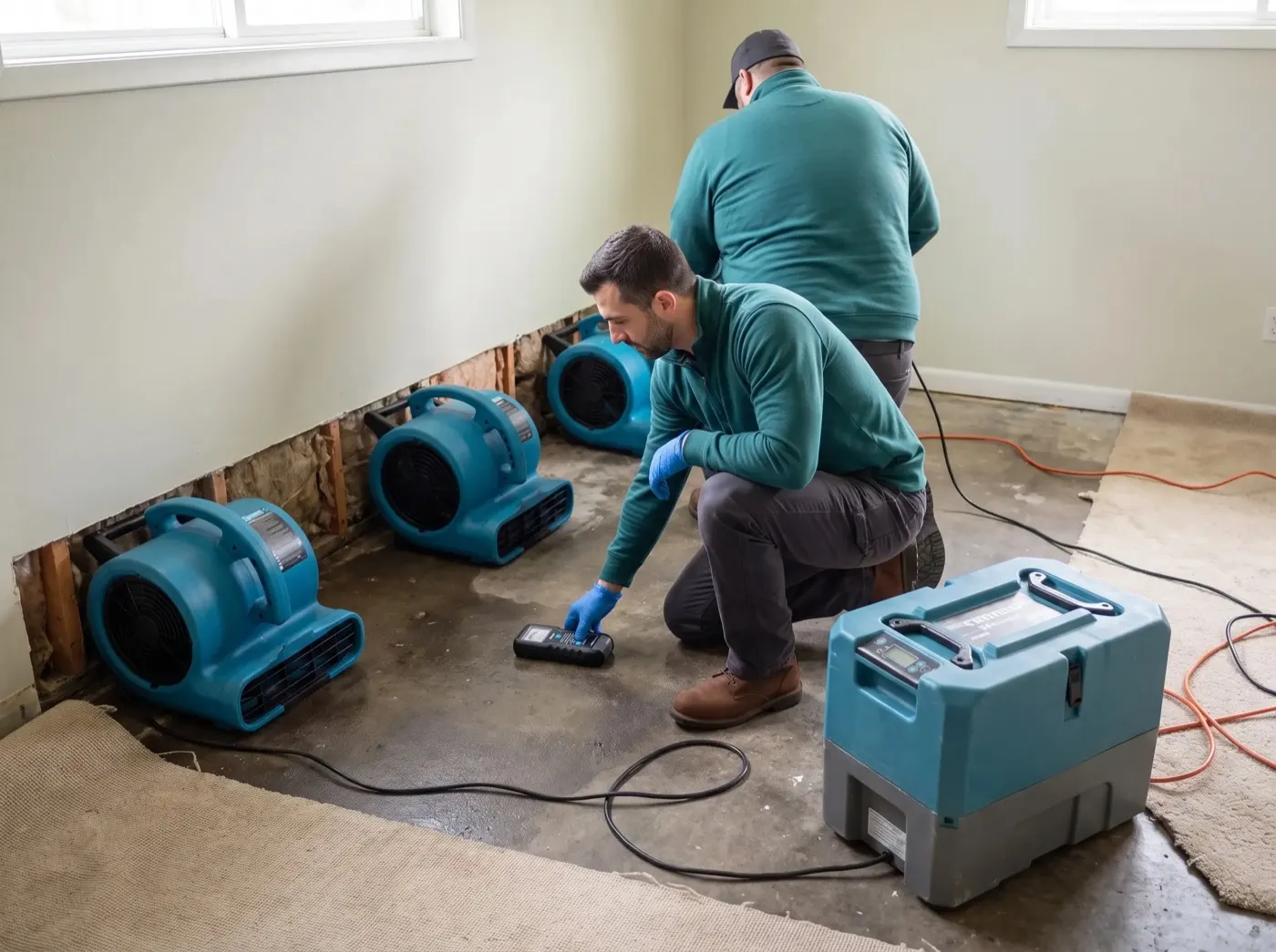
A straight flood cut above the water line, so the cavity dries and the patch is clean.

Cabinet toe-kicks opened, because a sink leak hides under the boxes.

Drywall removed only to the height the readings justify, never higher.

A bathroom floor that reads wet gets the subfloor opened and dried, not covered.
The thing nobody writes down
No, and that single answer changes what a Troy water loss is.
Troy’s engineering department operates under an NPDES permit for a municipal separate storm sewer system. Separate is the operative word. Rain has its own pipe and does not share a line with sanitary waste. The classic combined sewer overflow, where a heavy storm surcharges one shared pipe and pushes waste backward into the lowest opening in a house, is not the mechanism here.
That matters because of where Troy sits. Immediately south are communities running some of the oldest combined pipe in the state, and a crew that works those streets every week carries the contaminated water assumption with them. In Royal Oak or Ferndale that assumption is often correct. In Troy it frequently is not, and being wrong in that direction is expensive: containment, removal of porous material rather than drying it, and a scope built on a category nobody verified.
Now the complication, because the honest version has two halves. Troy is one of the fourteen communities in the George W. Kuhn Drainage District, the regional system whose basin discharges to the Red Run Drain at the Oakland and Macomb county border. Both things are true at once. Troy contributes to that regional system while running separated pipes inside its own boundary, and the district covers all or part of each community rather than every street in it.
So the practical rule for a Troy homeowner is this. Water arriving at your floor drain is not the weather. It is telling you something specific about your own sanitary lateral or the main it connects to, and it deserves a plumber with a camera as much as it deserves a restoration crew. Water arriving along the base of the wall is a different thing entirely, and the next section is about that.
The second thing nobody writes down
Troy was established as a home rule city in 1955. Before that it was farmland. By the 1880s Troy Township was known for its corn, wheat, melons and other fruits, along with wool and dairy, and it stayed small because the Detroit and Milwaukee Railroad ran through Detroit, Royal Oak and Pontiac and bypassed tiny Troy Corners at Square Lake Road and Livernois. Then the population did this.
| Census | Population | What was being built |
|---|---|---|
| 1960 | 19,402 | Five years after incorporation. Still mostly farmland and the old Troy Corners settlement. |
| 1970 | 39,419 | The population doubles in ten years. The office tower at 3100 W. Big Beaver Road goes up in 1969, built for more than 5,500 headquarters staff. |
| 1980 | 67,102 | Another 70 percent. Kresge, the precursor of Kmart, moved its headquarters from Detroit to Big Beaver Road in 1972. This decade builds the basement most Troy losses happen in. |
| 1990 | 72,884 | The wave breaks. Growth from here is infill and replacement rather than new subdivision. |
| 2000 | 80,959 | Steady. Later subdivisions push north toward Square Lake. |
| 2010 | 80,980 | Essentially flat for a decade. The housing stock is now ageing in place rather than being added to. |
| 2020 | 87,294 | The dominant basement in this city is now between forty-five and sixty-five years old, and so is the lateral under the front lawn. |
A city that more than tripled between 1960 and 1980 built almost all of its housing inside one construction window, and that window has a signature. Below grade it means poured concrete rather than stone or block, a cove joint where the wall meets the slab, and interior drain tile feeding a sump pit. Above grade it means drywall rather than plaster over wood lath, and mid-century hardwood rather than quarter-sawn original.
That combination makes a Troy loss more recoverable and cheaper to put back than an inner-ring loss of identical size. It is also why the tear-out instinct that makes sense on a 1925 bungalow is the wrong instinct here. In Troy the win is drying more and removing less.
The other half of the same fact is less comfortable. The lateral running from your house to the main went in during that same window, which makes it somewhere between forty-five and sixty-five years old. Age is not failure, but it is the reason a camera down the lateral is worth more here than most homeowners assume.
Where you are decides what the job is
Troy is 33.45 square miles of land laid on the mile-road grid, and the grid is a decent proxy for age. Maple is 15 Mile, Big Beaver is 16 Mile, Wattles is 17 Mile, Long Lake is 18 Mile and Square Lake is 19 Mile. Broadly, the further north you go the later the subdivision, and the later the subdivision the more likely the joists are engineered rather than solid. Rochester Road is the exception that proves it, because the road predates every subdivision on it.
| Area | Where | Housing or building stock | What tends to fail | What that means for scope |
|---|---|---|---|---|
| Big Beaver corridor | 16 Mile Road, from Crooks across I-75 to John R | Office towers, hotels and the Somerset retail spine rather than housing | Flat roofs, fire-suppression discharge and large-footprint slab losses. Water travels laterally across a floor plate instead of downward through joists. | Commercial sequencing. The controlling constraint is tenant access and business hours, not square footage. |
| Somerset | Big Beaver at Coolidge | Retail and the dense residential and hospitality built around it | Multi-level assemblies where one leak reaches three occupancies before anyone reports it. | Containment across a demising wall, and a drying plan that has to respect somebody else’s ceiling. |
| Troy Corners | Livernois at Square Lake, the original settlement | The oldest fabric in the city, with pockets predating the postwar build-out | Anything built before poured concrete was standard. Block walls, shallower footings, older laterals. | The one part of Troy where the pre-war playbook is sometimes the right one. Do not assume it elsewhere. |
| Maple Road corridor | 15 Mile, the southern edge, running toward Birmingham | Late 1950s and 1960s subdivisions, the earliest wave of the build-out | Block foundations at the early end, cove-joint seepage, laterals now sixty-odd years old. | The oldest sanitary lines in the city sit under the oldest subdivisions. Camera the lateral before assuming the house is the problem. |
| Wattles Road | 17 Mile, the middle band | Core 1960s and 1970s poured-basement subdivisions | Cove joint where wall meets floor, and sump failure. This is Troy’s single most common loss. | Wide save window. Drywall and mid-century hardwood, not plaster. The concrete is the long pole. |
| Long Lake Road | 18 Mile, shifting half a mile south at Woodward | 1970s subdivisions moving into larger 1980s lots | Sump dependence, and finished lower levels built into houses that were never designed to have them. | The finish is the money. A retrofitted lower level has framing and flooring detail nobody documented. |
| Square Lake Road | 19 Mile, the northern band | Later 1970s through 1990s construction, larger lots | Newer assemblies that hide water well. Engineered joists that read dry on the surface and are not. | Longer drying than the surface suggests. Engineered webbing holds moisture inside it. |
| Rochester Road | The old Paint Creek Trail alignment, running north to south | A mix of every era, because the road predates all of them | Two houses on the same street can be twenty years apart in construction and in failure mode. | Never scope this corridor from the street. The build year is the variable and it is not visible. |
| John R Road | The eastern flank, toward the Madison Heights and Sterling Heights lines | Denser, earlier postwar, smaller lots | The Troy stock most similar to its inner-ring neighbours, and the most likely to have an ageing lateral. | The one part of the city where treating the drain as suspect first is defensible. |
| Civic Center and the Lane Drain | The Red Run subwatershed, at the Civic Center and Aquatic Center | Municipal, but the drainage tells you where the city sheds water | A channelised county drain that was dammed in the early 1970s and has since been reopened. | Context rather than a service area. If you want to see Troy’s stormwater policy in physical form, it is here. |
| The I-75 spine | Running north to south through the middle of the city | Divides the commercial core from the residential east and west | Nothing hydrological. It divides access and staging. | A practical note only. Which side of I-75 you are on changes the approach, not the job. |
One naming note, because it turns up in searches. Big Beaver Road takes its name from the village of Big Beaver, settled in 1825 where the old Paint Creek Trail crossed an east to west two-track, and the village was named for a beaver dam across a brook. The Paint Creek Trail is now Rochester Road. Sixteen Mile Road, Big Beaver Road and Quarton Road are the same east to west line at different points in Oakland County.
Mechanism
Six mechanisms, and they are distinguishable in the first twenty minutes by where the water is and when it appeared. This is the table to hold a contractor to, because the category and the scope both fall out of getting this right rather than assuming it.
| Mechanism | What it actually is | How you tell | What it means for scope |
|---|---|---|---|
| The cove joint | The seam where the basement wall meets the basement floor. The wall was poured first and the slab second, so the two never bonded. It is a designed seam, not a defect. | A wet line running along the base of the wall, worst at a corner, appearing hours after rain rather than during it, and drying out between events. | Usually the lowest category on this list, and the widest save window. What it costs is drying time, because the concrete on both sides of the seam gives moisture up slowly. |
| Sump pump failure | The pit is the low point that the drain tile feeds. The pump is the only reason a Troy lower level stays dry during a saturated-ground event, and it is a consumable with a service life. | Water rising evenly from the floor with no single entry point, and a pit that is full and silent. Or a pump that runs continuously and never catches up. | The classic Troy finished-basement loss. Carpet and pad, the bottom band of drywall, and whatever was stored on the floor. |
| Power loss during the storm that causes the flood | The failure mode people underrate. The pump does not break. The grid does, at exactly the moment the pump was needed, and a pit with no power is a pit with no pump. | A dry basement, an outage, and four inches of water when the lights come back. | Identical to a pump failure once it has happened. Entirely preventable beforehand with a backup that does not depend on the grid. |
| Sanitary lateral surcharge or blockage | The pipe from the house to the main. In a separated-sewer city this is a sanitary line only, so a backup means the line itself failed, was blocked, or the main surcharged. It is not stormwater arriving. | Water at the floor drain or the lowest fixture, often with a smell, and often after normal household use rather than after rain. | Contaminated. Containment goes up, porous material in the affected area comes out rather than being dried, and drying starts after removal. Under sixty-year-old lines on the older corridors this is a real risk. |
| Supply-side failure | A water heater weeping at the bottom seam, a washing machine hose, a fridge line, a burst copper run in an unheated space. Clean water, arriving continuously, often into a finished room. | Water that is warm, or water that keeps coming after the rain stopped, or water where there is no rain at all. | The best case on this page and the one where speed buys back the most material. Carpet and pad can often stay. Hardwood is frequently recoverable if it is reached fast. |
| Engineered floor systems in the newer stock | North of Long Lake and through the 1990s construction, joists are engineered rather than solid dimensional lumber. They hold moisture inside the webbing. | A subfloor surface that meters dry over a cavity that is not. This is the trap, and it is why a reading taken only at the surface is not a reading. | Longer drying than the room looks like it needs, and a genuine reason to open an access point rather than trust a surface number. |
Dated, with sources
Four entries, each with a date and a published figure. Storm anecdotes without one do not appear on this site.
August 11, 2014
The National Weather Service Detroit office recorded 4 to 6 inches of rain over a 4 hour period, with Wayne, southern Oakland and Macomb counties worst hit. Troy sits at the northern edge of that footprint, which is part of why the city is a different conversation from the communities immediately south of it.
June 25 to 26, 2021
The same office logged storm totals of 4.39 inches at Bloomfield Township, 4.34 inches at Franklin and 4.11 inches at Bloomfield Hills, inside a widespread 3 to 5 inch event across Metro Detroit with localised 6 to 8 inch amounts. The nearest published station totals to Troy came from the Rouge watershed to the west.
Early 1970s, and reversed since
A dam was built near the Aquatic Center on the Lane Drain, a channelised county drain in the Red Run subwatershed at the Troy Civic Center. It has since been removed and the stream reconnected in a 1.6 million dollar project with the city, NOAA, the Oakland County Water Resources Commissioner and the Clinton River Watershed Council, restoring 3 acres of riparian vegetation and reconnecting 1.7 miles of stream channel. It is the clearest physical statement Troy has made about how it wants water to move.
The 1880s, for context
By the 1880s Troy Township was known for its corn, wheat, melons and other fruits, along with wool and dairy. It stayed small for a reason that decided the next hundred years: the Detroit and Milwaukee Railroad ran through Detroit, Royal Oak and Pontiac and bypassed tiny Troy Corners at Square Lake Road and Livernois. The city that now has 87,294 people arrived late. Everything below grade here was built in living memory, and that is the whole argument of this page.
What moves the number
The estimate is free, and the number for your job comes from readings rather than from a phone call. What is publishable is the list of things that actually move it, in rough order of how much they move it in this housing stock. If a contractor’s number changes after they arrive, one of these is the reason, and you are entitled to be told which.
What the water actually was
The single largest lever, and in Troy it is genuinely an open question rather than a foregone conclusion. Clean supply water, cove-joint groundwater and a sanitary backup are three different scopes out of the same wet floor. A contractor who decides before metering is guessing in a direction that happens to be expensive.
Whether the lower level was finished, and how well
Troy is a city of finished lower levels, many of them retrofitted into houses that were not designed for them. Framing held off the wall dries. Framing sitting against the wall does not. Nobody knows which one you have until it is opened, and that is the honest answer to why an estimate can move.
How much came out against how much was dried in place
Every square foot dried is a square foot nobody rebuilds. On drywall and mid-century hardwood the save window is wider than most crews use, which is why the removal list should exist on paper before the saw does.
Whether the sump was fixed before drying started
Drying a basement while the pit still cannot clear is money spent twice. If the cause was the pump or the power, that closes out first, and sometimes by a different trade.
Solid joists or engineered
A 1968 subdivision and a 1994 one meter completely differently. Engineered webbing holds moisture the surface does not show, so the newer house often takes longer than the older one, which surprises people.
Access and staging
Where a truck-mount can run hose, extraction is fast per gallon. Long driveways in the northern subdivisions and tight commercial staging on the Big Beaver corridor both cost time that square footage never shows.
Sequence
Drying ends on a reading rather than on a date, so nothing below is a promise about hours after the first row. It is the order the steps have to happen in.
Hour 0
Stop the source, then photograph
If it is still arriving, that is a shutoff valve, a plumber or the city. Then wide and close shots, timestamped, before anything moves. On a suspected sanitary backup, do not start pulling carpet.
Hour 1
On site in 25 minutes
Our dispatch target for Troy, 24 hours a day. What arrives first is a meter and a camera.
Day 0
Category call, moisture map, written scope
The category gets decided with a stated reason rather than assumed from the postcode. Readings are taken against a dry standard from an unaffected part of the same house in the same material. The estimate is free and the scope is yours to keep.
Days 1 to 2
Removal only where the readings require it
Containment first if the water was contaminated. On clean water in a finished lower level, the goal is to remove less, not more.
Days 2 to 5
Structural drying, logged daily
Poured concrete gives moisture up faster than block, and engineered joists slower than either. It ends on a reading rather than on a date.
After dry standard
Rebuild
Nothing closes over a wet cavity. In this housing stock the finishes are catalogue items, which makes the rebuild the fast part rather than the slow one.
Stopping the second one
Each measure below is listed with what it does not cover, because the failure mode here is a homeowner who installed one of these and assumed the problem was solved from every direction. In this city groundwater and the sanitary lateral are genuinely separate paths, and a measure that closes one does nothing to the other.
A sump backup that does not need the grid
What it does: Keeps the pit clearing when the primary pump fails or the power goes out, which in a Troy storm is frequently the same moment.
What it does not do: Nothing for a sanitary lateral problem, and nothing for a supply-line failure upstairs.
Who does it: A plumber for the install, you for the test. Pour a bucket into the pit twice a year and watch the whole cycle, including the backup, with the breaker off.
Camera the sanitary lateral, especially south of Big Beaver
What it does: Tells you whether the sixty-year-old pipe between your house and the main is intact, root-invaded or collapsed, before it tells you at two in the morning.
What it does not do: Anything about groundwater at the cove joint, which is a completely separate path.
Who does it: A licensed plumber. Worth doing once on any house built before about 1975, and worth doing before buying one.
Downspout extensions and lot grading
What it does: Moves roof discharge six to ten feet out and re-establishes fall away from the wall. On a cove-joint house this is the highest-return measure there is, and the cheapest.
What it does not do: Anything for a lateral backup. It is a groundwater measure.
Who does it: Homeowner or landscaper. Troy lots are generally wide enough for this to be geometrically possible, which is not true everywhere in the county.
Window well drains and covers
What it does: Stops a below-grade well filling and pushing water through the frame, which is a common secondary entry in this stock.
What it does not do: Address a well with no drain. A cover on an undrained well can hold water rather than shed it.
Who does it: Homeowner scale. Check for a working drain before buying covers.
A washing machine hose and water heater check
What it does: Removes two of the most common clean-water losses in the city for the price of an afternoon. Braided steel hoses instead of rubber, and a look at the base of the tank for a rust ring.
What it does not do: Anything below grade. This is an upstairs measure with a downstairs consequence.
Who does it: You. Both are visible in five minutes without tools.
Six inches of elevation under anything irreplaceable
What it does: Changes what a preventable event costs you on the items you actually care about. No permit, no trade, no scheduling.
What it does not do: Prevent anything. It reduces consequence, which is a different and equally useful thing.
Who does it: You, this weekend. In a city of finished lower levels used for storage, this is the most skipped measure on the list.
Before anyone starts
These work on our estimate as well as anyone else’s, which is the point of publishing them. The first two are Troy-specific and they are the ones that save money.
“What category are you treating this as, and what made you decide that?”
In Troy this is the question. A crew that drives up from a combined-sewer city often brings the contaminated-water default with them. Sometimes that is right. Frequently it is not, and it is an expensive way to be wrong. Ask for the reason, not the label.
“Did the water come from the cove joint, the pit, the lateral or a supply line?”
Four different mechanisms, four different scopes, and they are distinguishable in the first twenty minutes by where the water is and when it appeared. If nobody can tell you which one they think it was, nobody has looked properly.
“What is the dry standard, and where did you take it?”
A moisture reading with no baseline is a number with no meaning. The dry standard comes from an unaffected part of the same house in the same material.
“Are these joists solid or engineered, and how are you drying inside them?”
North of Long Lake and in the 1990s stock this matters a great deal. Engineered webbing holds moisture that a surface reading will not show, and a crew that has not thought about it will pull equipment early.
“What are you removing, and what are you attempting to dry in place?”
Ask for the list before the saw comes out, with a reason attached to each line. On drywall and mid-century flooring the save window is wider than most crews use.
“What ends this job, a date or a reading?”
The correct answer is a reading. Equipment pulled on a schedule rather than on a meter is the most common origin of growth found six weeks later.
“Are mitigation and the rebuild the same company, and if not, who owns the seam?”
One accountable party is worth more than a slightly lower line item, because the handoff between trades is where schedules die.
“Are you licensed in Michigan for the rebuild, not just the cleanup, and can I see it?”
Two different questions, and most homeowners ask only the first. Michigan licenses residential building work, and a rebuild after a loss is residential building work. Ask for the number and check it with the state.
The honest part
Our Troy office is at Coventry Place, 1621 W Big Beaver Rd, Troy, MI 48084 — 3.2 miles from the centre of the city. From that branch a crew is typically on site in 25 minutes, 24 hours a day, across the Big Beaver corridor, Somerset, Charnwood and Wattles Park, the Oakland Mall area along John R, and North Troy around Long Lake and Square Lake.
Other firms list Troy in their service areas and several are named in the comparison table further down this page, scored on the same public criteria. Compare them on what is published: licence, arrival window, Google standing, and whether one company carries the job from extraction through the rebuild.
That last one is where we would argue hardest for ourselves. One accountable crew holding mitigation and the rebuild together means nobody hands your job across a seam, and in Troy that seam is where the finished lower level either comes back properly or does not. We also work Macomb County every day, which means we see the combined-sewer version of this work constantly and know exactly why it does not apply to most of your city.
Troy operates under a municipal separate storm sewer system permit, which is what MS4 stands for on the city engineering department’s stormwater page. Separate means rain has its own pipe and does not share a line with sanitary waste. So the classic combined sewer overflow, where a storm pushes waste backward into the lowest opening in a house, is not the Troy mechanism. That is the single most useful thing a Troy homeowner can know, because it means water at your floor drain is telling you something specific went wrong rather than that it rained hard. The complication is that Troy is also one of the fourteen communities in the George W. Kuhn Drainage District, whose basin discharges to the Red Run Drain at the Macomb county line. Both things are true. Troy sends water into that regional system while running separated pipes inside its own boundary, and the district covers all or part of each community rather than every street. Confirm your own address with the city or the Water Resources Commissioner before treating any of this as a finding about your house.
That is almost certainly the cove joint, and it is the most common water event in this city. When a basement is poured, the walls go up first and the floor slab goes in second, so the two never bond. The seam where they meet is a designed feature rather than a defect. When the ground outside is saturated, water finds that seam and appears as a wet line along the base of the wall, usually worst at a corner, usually hours after the rain rather than during it, and usually drying out between events. It is generally the lowest category of loss on the list and has the widest save window. What it costs is drying time, because concrete on both sides of the seam gives moisture up slowly, and it will keep happening until the water outside stops arriving. Downspout extensions and grading do more about that than anything done inside.
A finished lower level taking water after the sump pit failed to clear. Troy built the overwhelming majority of its housing between roughly 1960 and 1990, so the dominant basement is a poured concrete wall with drain tile feeding a pit, and the pump in that pit is the only reason the room stays dry during a saturated-ground event. It is a consumable with a service life. The version people underrate is not the pump breaking but the power going out during the storm that made the pump necessary, which produces an identical basement and is entirely preventable with a backup that does not depend on the grid. The loss itself is carpet and pad, the bottom band of drywall, and whatever was stored on the floor, which in this city is usually more than the homeowner expected.
Troy was established as a home rule city in 1955 and had 19,402 people in 1960. By 1970 it had 39,419, and by 1980 it had 67,102. That is more than a tripling in twenty years, and it means the great bulk of what stands here today went up inside a single construction window. Practically, that tells you what is under the house without going down there: poured concrete rather than stone or block, a cove joint, interior drain tile in most of it, and a lateral running to the main that is now somewhere between forty-five and sixty-five years old. It also tells you what is upstairs. Drywall rather than plaster over wood lath, and mid-century hardwood rather than quarter-sawn original. That combination makes a Troy loss more recoverable and cheaper to rebuild than an inner-ring loss of identical size, and it is the single largest structural difference between this city and the ones immediately south of it.
Both, which is unusual and is worth knowing if you are trying to understand where your water goes. Troy participates in the Alliance of Rouge Communities and in the Clinton River Watershed Council, and its stormwater programme references both systems. The Lane Drain at the Troy Civic Center sits in the Red Run subwatershed, and the Red Run is a tributary of the Clinton River that leaves Oakland County and joins the Clinton in Macomb County. Meanwhile the western and southwestern parts of the city drain toward the Rouge. For a homeowner the consequence is modest but real: different parts of the city sit above different regional drainage, and the county infrastructure upstream of you is not the same infrastructure your friend across town has.
Our dispatch target is on site in 25 minutes, 24 hours a day, and we run to Troy on I-75, M-59, Big Beaver, Rochester Road and John R depending on where you are in the city. We do not publish a minutes-by-neighbourhood table, because any number we printed would be a guess about traffic at an unknown hour, and a number we cannot stand behind is worse than no number at all. Our Troy office at Coventry Place on W Big Beaver Rd is 3.2 miles from the centre of the city, so for most Troy addresses we are the closest crew with its own rebuild licence.
We handle remediation of growth that followed a water loss, which is nearly all of what turns up in this housing stock. In a Troy basement the usual locations are the paper facing on the back of the bottom band of drywall, the underside of a subfloor above a cove-joint leak, and the inside of an engineered joist that was never dried properly. We do not test, deliberately. The company removing the growth should not be the company certifying the removal worked, because that is one company grading its own homework. If you want the space assessed before the work or cleared after it, hire an independent indoor environmental professional or industrial hygienist directly, and we will work to their protocol and their clearance criteria. We do not identify species, interpret laboratory results, or make statements about health. Those belong to the hygienist and to your physician.
Very different, and in a separated-sewer city it means something quite specific. Water pushing up a floor drain is your sanitary lateral or the main it connects to, not stormwater arriving through a shared pipe. So it is contaminated, it is treated as such from the first minute, and the useful next call is a plumber who can camera the lateral rather than a restoration crew alone. Under the older corridors of the city, particularly along Maple and John R where the lines are oldest, root invasion and partial collapse are ordinary findings. The scope changes immediately: containment goes up first, porous material in the affected area comes out rather than being dried, and drying only starts once removal is finished. Tell whoever you call which one you saw, because it changes what they bring.
Some, and the part that differs is a genuine trap. The newer construction north of Long Lake and toward Square Lake typically uses engineered floor systems rather than solid dimensional joists, and engineered webbing holds moisture inside it long after the subfloor surface reads dry. A crew that meters only at the surface will pull equipment early and leave you with a cavity that is still wet, which is exactly where growth is found six weeks later. So a newer house often takes longer to dry than an older one, which is the opposite of what people expect. What you share with the 1968 house across the city is the pit: the sump is still the reason your lower level is dry, and the power going out still takes it offline.
The estimate is free. We come out, we meter the walls and the floor against a dry standard taken from an unaffected part of the same house, we tell you what is wet and what is not, and we leave you a written scope with the readings attached. If the honest answer is that you do not need us, that is the answer you get, and on cove-joint seepage and small single-room events it is a common one. The document is yours either way, and it is worth having before you talk to anybody else.
Mitigation is measured in days and the rebuild in weeks, and anybody giving you a total before seeing readings is describing a schedule rather than a process. What actually varies is the assembly. A poured concrete wall gives moisture up faster than block, so most of this city dries faster than the older communities south of it. Engineered joists dry slower than solid ones, so the newer subdivisions run longer than the 1970s ones. Drying ends on a reading. On the rebuild side Troy is the easy case: the finishes are catalogue items rather than replication trades, so once the cavity is at dry standard, putting it back is a scheduling question rather than a sourcing one.
Yes, and it is a different job rather than a bigger one. On the office, hotel and retail stock along 16 Mile between Crooks and John R, water travels laterally across a floor plate instead of downward through joists, so the affected area is usually wider and shallower than it looks. Fire-suppression discharge and flat-roof failures are the two events that dominate. The controlling constraint is almost never square footage; it is tenant access, occupancy and business hours, and the drying plan has to be built around when the space can actually be worked in. Multi-occupancy buildings add a containment problem across demising walls that a single-family scope never has.
Sources
The municipal separate storm sewer system permit, and Troy’s participation in both the Alliance of Rouge Communities and the Clinton River Watershed Council, come from the City of Troy engineering department’s stormwater page. The wastewater destination comes from the city’s water and sewer page.
The George W. Kuhn Drainage District community list, the 150 million gallon capacity, the 24,500 acre district and the discharge to the Red Run Drain at the county border come from the published record for that facility and from the Oakland County Water Resources Commissioner.
Incorporation year, census populations, land area and postcodes come from the public encyclopaedia entry for Troy. The mile road equivalences come from the entries for the Detroit mile road system and for Metropolitan Parkway. The Big Beaver naming, the 1825 settlement, the Paint Creek Trail alignment and the 1880s agricultural history come from the Troy Historic Village and from published local history. Somerset opening in 1969 and the Kresge headquarters move in 1972 come from the same material.
The Lane Drain figures come from the Clinton River Watershed Council project record. Rainfall figures come from the National Weather Service forecast office at Detroit and Pontiac.
Competitor names, street addresses, licence numbers and published arrival claims were read from those companies’ own pages and are attributed where they appear. No company paid to be referenced on this page.
Housing era and foundation descriptions are general development patterns for each corridor, not claims about any specific address. Water categories, growth timing and structural drying practice follow restoration industry standard. Permit and code requirements should be confirmed with the City of Troy building department for your specific work. No customer, address or job is described anywhere on this page.
24/7 dispatch across 48083, 48084, 48085, 48098. On site in 25 minutes. The estimate is free, and it comes with moisture readings, a written scope, and an honest answer about whether you need us at all.
Call (586) 277-1069Prime Restoration is a Michigan licensed residential builder (MI Residential Builder #262500492) and a full-service restoration contractor serving Troy and the surrounding area from Sterling Heights. Nothing on this page is legal, plumbing, electrical, engineering or medical advice. Scope and cost are set from actual moisture readings and affected square footage. Infrastructure and competitor figures are cited above and were current when read; confirm anything load-bearing with the issuing authority or the company named.
The housing stock changes faster than the drive time does. Each of these is a different problem rather than the same page with the city name swapped.
From Troy
“This company Prime Restoration in Troy, is absolutely incredible! I really hope you never have to deal with water damage, but if you do, just take a deep breath and reach out to Prime Restoration. Trust me, they're the real deal.”
“Prime Restoration was fantastic. I'd highly recommend using them for anything they can assist you with. Great service and best water damage cleanup in Troy”
“Prime Restoration in Troy did an excellent job. I HIGHLY RECOMMEND for water damage restoration”
“My house had a flood caused by a faulty refrigerator, but Prime Restoration resolved the situation. Highly recommend for fridge-related floods in Troy, Michigan.”
Local Troy branch · 3.2 miles from the center of Troy · on site in 25 minutes
Prime Restoration's Troy Office is at Coventry Place, 1621 W Big Beaver Rd, Troy, MI 48084, 3.2 miles from the center of Troy. From this branch a crew is typically on site in 25 minutes, 24/7, across the Big Beaver corridor near the Somerset Collection, Charnwood and Wattles Park, the Oakland Mall area along John R and 14 Mile, and North Troy around Long Lake and Square Lake roads. The crew is set up for the homes here: 1960s and 1970s ranches and quad-levels with finished lower levels, 1980s to 2000s colonials, and larger North Troy homes with walkout basements and engineered hardwood.
Homeowners highly recommend the branch for customer service: 5.0 on Google from 159 reviews, and one project manager answers your calls from the first visit to the last repair. Every job gets detailed, itemized documentation for your insurance claim: dated moisture readings, photos and a line-item estimate your adjuster can check. Call (586) 277-1069.
Prime Restoration
A crew is typically on site in 25 minutes, 24/7, from our Troy office.
Open in Google Maps →In Troy, our crew handles flooded basements, burst pipes, sump pump failures, water heater leaks, sewage backups and ceiling leaks, including water damage from a roof leak. When water sits too long, we handle mold remediation, from basement mold to black mold removal.
Before you call, read what to do in the first 24 hours after water damage, check what water damage restoration costs in Michigan or what mold remediation costs, and see how to prevent mold after water damage.
Read about Prime Restoration, a family water damage restoration business since 1988, led by Cole Hartwell, Certified Water Damage Specialist. See our 159 five-star Google reviews. We are a Certified Best Pick and an IICRC Certified Firm. For customer support and insurance coordination, we work with all insurance companies, give your adjuster the moisture readings, photos and itemized estimate, and keep in contact until the last repair. Customers say we “kept in contact and explained the whole process.” Ask about 0% APR financing, read how homeowner's insurance treats water damage in Michigan, or find answers in our water damage FAQ.
Our Troy office also handles commercial water damage restoration for stores, restaurants, offices, medical and dental offices, manufacturing and multi-family buildings. Past commercial clients includePetco, Linamar, Quest Diagnostics and the Somerset Collection. A crew is on site in 25 minutes, 24/7, and we contain the wet area so the rest of the building can keep operating. Property managers and business owners can join Property Pro, our free priority program with priority scheduling, one point of contact and a property file on record, or book a free walkthrough for a commercial emergency ready plan.
From our Troy office we also reach Rochester Hills, Clawson, Bloomfield Hills, Rochester, Birmingham, Utica, Sterling Heights and Shelby Township.
water damage restoration in Sterling Heights, water damage restoration in Birmingham, water damage restoration in Macomb, water damage restoration in Shelby Township, water damage restoration in Rochester Hills, water damage restoration in West Bloomfield and water damage restoration in Ann Arbor. See every city we serve.