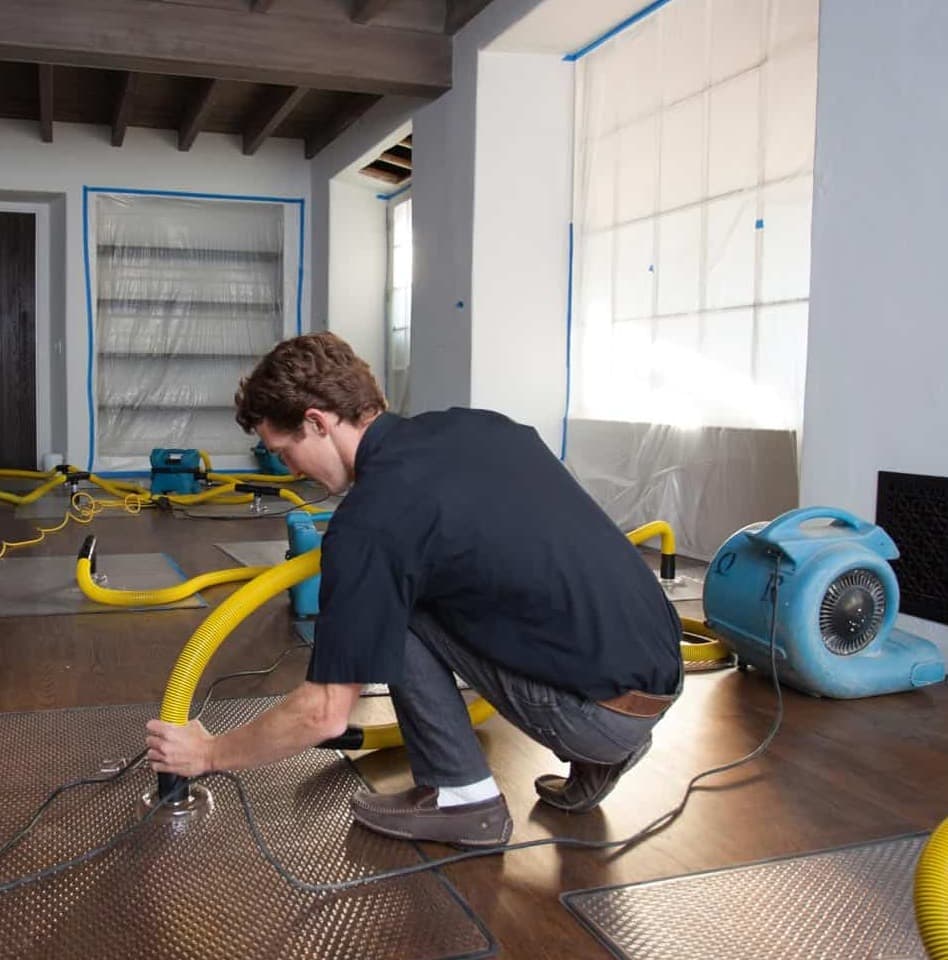
A ceiling stain, a musty attic, a wall that feels cold and damp. Half the calls we take on this turn out not to be the roof at all. Free inspection, moisture readings, and an honest answer about whether you need a roofer before you need us.
This guide is published by Prime Restoration, a Michigan licensed residential builder and water damage restoration contractor in Sterling Heights. Roofing is a separate licensed trade and we do not perform it, which is precisely why we can tell you plainly whether you need one. Written for Macomb and Oakland County. Last updated 2026-07-31.
The thing nobody tells you
The condition under which the stain appears identifies the failure. The location of the stain almost never identifies the leak. Those two sentences resolve most of the confusion on this subject, and they are the reason a roof can be repaired correctly while the interior stays wet.
Water entering a roof assembly does not fall straight down. It runs along a rafter, crosses the top plate of an exterior wall, soaks whatever insulation it passes through, and surfaces at the first place the drywall is absorbent enough to show it. That can be ten or fifteen feet from the entry point, or a floor lower. Meanwhile the actual wet zone is in a cavity nobody has opened.
So the useful question is never “where is the stain.” It is “under what condition did it appear.”
| When it shows up | What failed | Where you see it | Need a roofer? | The interior scope |
|---|---|---|---|---|
| Only during winter thaw, after snow has sat on the roof | Ice dam at the eaves | Ceiling along exterior walls, tops of window and door trim | Sometimes. The real fix is attic air-sealing and insulation, not shingles. | Matted attic insulation, wet top plate, drywall tape seams, often a wall cavity below. |
| Only in wind-driven rain from one direction | Flashing, sidewall, or chimney counter-flashing | Ceiling near a chimney chase, dormer, or the wall a roof plane dies into | Yes, and specifically someone who does flashing rather than tear-offs. | Concealed wall-cavity wetting. This is the pattern most likely to be found as mould rather than as a stain. |
| Every heavy rain, regardless of direction | Field-of-roof penetration, failed boot, or open seam | Ceiling more or less below the penetration, though often offset | Yes. Straightforward roof repair. | Localised insulation and drywall. Usually the smallest interior scope of the four. |
| Year-round, unrelated to weather | Not the roof. Plumbing, an HVAC condensate line, or a bath fan venting into the attic | Under a bathroom, near an air handler, or under a fan run | No. Sending a roofer here costs you a trip charge and finds nothing. | Same ceiling repair, completely different source. This is the one people misdiagnose most. |
The last row is the one that matters most. A meaningful share of “roof leaks” are plumbing, an HVAC condensate line, or a bath fan discharging into the attic instead of through the roof. If the stain has no relationship to weather, a roofer will find nothing and you will have paid for the visit.
Why the flashing case is the dangerous one
A failure at a chimney counter-flashing, a dormer, or the point where a roof plane dies into a wall does not usually announce itself on a ceiling. It wets a concealed wall cavity, only in wind-driven rain from one direction, a little at a time. On wet porous material, microbial growth can begin in roughly 24 to 48 hours, and a cavity that gets re-wet a few times a season never dries between events. That is the standard route by which a small flashing defect becomes a mould remediation rather than a ceiling patch, and it is why an inspection that stops at the visible stain is not an inspection.
The Michigan case
Because the roof is melting its own snow from underneath. Heat escaping the living space through attic air leaks, thin insulation and recessed lights warms the roof deck; the meltwater runs down the slope, crosses the eaves, which sit outside the heated envelope, and refreezes. Layer by layer a dam builds at the roof edge and the pool of standing water behind it deepens.
Shingles shed falling water. They are not designed to hold standing water. Once the pool is deep enough, it works uphill under the shingle laps and through the fastener penetrations in the deck.
Michigan code requires an ice-barrier membrane along the eaves on newer roofs and it is genuinely effective, but the membrane typically extends only a short distance up the slope, and a large dam can raise water above where it ends. Older homes often have none at all. The permanent fix is thermal rather than mechanical: air-seal the attic floor, insulate to current recommendations, and keep soffit-to-ridge ventilation clear so the deck stays at outdoor temperature. Those are the same attic defects that cause attic mould, which is why the two problems are almost always found together.
The December 2013 ice storm across Southeast Michigan is the reference event for what this looks like at scale: extended outages, frozen-pipe ruptures in pre-war homes with supply lines running through unconditioned attic space, and significant plaster-ceiling losses. The April 15, 2026 windstorm was the other failure mode, mature trees onto slate, tile and architectural-shingle roofs with hardwood and millwork below.
The Michigan one
This is the failure mode that costs Michigan homeowners the most and confuses them the longest, because everything about it points at the roof and almost none of it is the roof’s fault. Six steps, in order. It is worth reading in a dry month rather than in February.
Step one: heat escapes into the attic
Warm air leaks out of the living space through gaps that are almost never obvious — top plates, wire and pipe penetrations, recessed light housings, the attic hatch, and the chase around a chimney or a bath fan. That air warms the underside of the roof deck. On a well-sealed house it does not, which is the whole story in one sentence.
Step two: snow melts against the deck
The snow directly on the warmed part of the roof melts from underneath, even in genuinely cold weather, and the meltwater runs down the slope under the remaining snowpack. Nothing has gone wrong on the roof at this point. This is a building-envelope event happening on a roof.
Step three: it refreezes at the cold eave
The eave and the overhang are not over heated space, so they stay at outdoor temperature. Meltwater arriving there refreezes, and the ridge of ice grows with each cycle. That ridge is the dam.
Step four: water pools behind the dam and works uphill
Standing water builds behind the ice. Shingles shed water that is running downhill; they are not a waterproof membrane and they were never meant to hold a pool. Water works backward under the laps and through the fastener penetrations in the deck, and enters the attic — usually along the exterior wall line, which is why the stain shows at the top of window trim and along the ceiling edge rather than in the middle of the room.
What actually fixes it
Air-sealing the attic floor so heat stops arriving, then insulation to the appropriate depth, then ventilation balanced so the deck stays at outdoor temperature. In that order — insulation over an unsealed ceiling plane underperforms, and ventilation alone cannot outrun a heat leak. It is an insulation and air-sealing trade, and it is genuinely counter-intuitive that the fix for a roof leak is not on the roof.
What does not fix it
A new roof, on its own, does not — a re-shingled house with the same heat leak dams again the next winter. Heat cable is a symptom manager, useful for a specific problem eave while a real fix is scheduled, and expensive to run. Raking snow off the lower few feet helps in the moment and is worth doing carefully from the ground, but nobody should be on a ladder on ice for it.
A house that grows long icicles at the eaves every winter is telling you the attic is leaking heat. That is a useful diagnostic you can run from the driveway, and it is true regardless of how new the shingles are.
Above the ceiling
The ceiling stain is the last thing to happen, not the first. By the time it appears, the water has already been through several materials that behave very differently from one another — and two of them, the wall cavity below the top plate and attic ductwork, are the ones most often left out of a scope.
Blown fibreglass or cellulose
Water mats it down, and matted insulation has lost most of its R-value permanently because the loft is what was doing the insulating. It also holds moisture against the framing for weeks. Wet blown insulation in the affected area is generally removed rather than dried, and cellulose in particular does not recover.
Fibreglass batts
Same principle, sometimes salvageable at the edges of the wet zone if it is reached quickly and can be lifted and dried. The reason it usually comes out anyway is that leaving it in place stops you getting reliable readings on the framing underneath, which is the thing that actually has to dry.
Spray foam at the roofline
Changes the problem entirely. A foam-insulated roof deck is a sealed assembly, so a leak above it can travel between the foam and the deck with no visible sign inside at all, and it cannot be seen or read without opening it. On these houses a small stain is a bigger deal, not a smaller one.
The roof deck itself
Plank decking on older homes tolerates repeated wetting reasonably well. OSB does not — it swells at the edges and delaminates, and once it has, it does not come back. The distinction matters because it changes whether the roofer is repairing a covering or replacing structure.
The top plate and wall cavity below
This is where an ice-dam leak actually lands, and it is the part most often missed. Water arriving at the exterior wall line runs onto the top plate and then down inside the wall cavity, wetting insulation and the back of the drywall with nothing visible in the room until much later. If the entry was at the eaves, the wall gets read, not just the ceiling.
Ductwork and mechanicals in the attic
Where the air handler or ducts live in the attic, water reaching insulated flex duct soaks the insulation jacket and can enter the duct itself. That turns a localised roof leak into something the whole house breathes, and it gets inspected rather than assumed dry.
Method
In order, cheapest and least invasive first. Most roof-origin jobs that go wrong go wrong at step four, where the roof gets repaired, the stain gets painted, and the wet cavity nobody opened stays wet.
Start with the condition, not the location
The first question is what the weather was doing when it appeared: wind-driven rain from one direction, snow that sat and then thawed, any heavy rain regardless of direction, or no weather at all. That answer eliminates most of the possibilities before anyone goes up a ladder, and it is the reason the table above is the most useful thing on this page.
Go up into the attic in daylight
With lights off, daylight visible through the deck is a hole. Beyond that, look for staining and rust trails on the underside of the deck and on nail shanks, dark streaks running down rafters, and matted or discoloured insulation. Water tracks leave a record even when they are dry, and the highest stain on a rafter is closer to the truth than the stain on the ceiling.
Follow framing upslope, not straight up
Water runs along rafters and truss chords before it drops. A ceiling stain fifteen feet from the entry point, or a floor lower, is ordinary rather than strange. Tracing goes from the visible stain upslope along the framing until the trail stops.
Read the moisture rather than trusting the stain
A stain records where water once was. A meter records where it still is, and thermal imaging shows the shape of the wet zone including the parts behind finish. The scope comes from that footprint. This is the single most common failure on roof-origin jobs: the roof gets fixed, the stain gets painted, and the wet cavity nobody opened stays wet.
Water-test only after the passive checks
Controlled hose testing, one small area at a time working upslope, is how a roofer confirms an intermittent flashing leak. It has to be done deliberately and it can introduce water into a building, so it is a last diagnostic step rather than a first one, and it belongs to the roofer rather than to us.
Rule out the non-roof sources honestly
A bath fan venting into the attic instead of outside, an HVAC condensate line, a plumbing vent boot, or a supply line in an attic all produce ceiling stains that look exactly like roof leaks. If it appears year-round with no relationship to weather, a roofer is a trip charge that finds nothing.
The ceiling itself
What the ceiling is made of decides whether it can be dried, whether it is a hazard, and in one case whether anyone should touch it at all before it has been tested.
Modern drywall with a taped seam
The most common and the most forgiving. Sagging, tape release at the seams, or a soft spot that yields under light pressure means it is coming out; discolouration alone with sound board behind it often does not. It is decided by a reading and a touch, not by how bad the stain looks.
Plaster over wood lath
In pre-war housing this holds water far longer than drywall and fails in sheets rather than crumbling gradually. It can often be dried in place where the key between plaster and lath is intact, and the decision has to be made early. A ceiling holding a visible bulge is holding a pocket of water and should be treated as a falling hazard rather than a cosmetic problem.
Textured or sprayed ceilings in a pre-1980 home
Stop before disturbing it. Textured and sprayed ceiling finishes applied in that era may contain asbestos, and cutting, scraping or sanding one releases fibres. The correct sequence is to have the material tested by a qualified party before any demolition, and if it is positive, abatement is a licensed specialist trade with its own regulatory requirements — not a restoration task and not a homeowner task. This is the one place on this page where doing something yourself can cause harm that has nothing to do with water.
Suspended tile in a finished lower level or basement
Mineral-fibre tiles that got wet are effectively disposable and rarely worth arguing about; the grid usually survives. The value of a drop ceiling is that it comes down easily and lets everything above it be read and dried properly, which is the opposite of the problem with a foam-sealed roof deck.
Asbestos testing and abatement are licensed specialist trades with their own regulatory requirements. We do not perform either, and nothing on this page is a substitute for having a suspect material tested by a qualified party before it is disturbed.
The honest part
Stops the water. Shingles, decking, flashing, counter-flashing, boots, valleys, gutters, ice-barrier membrane. This is a separate licensed trade in Michigan and we are not it. If the roof is open and rain is forecast, this is your first call, not us.
Deals with everything the water already did. Moisture mapping and thermal imaging to find the real wet footprint, removal of insulation and drywall that cannot be dried, structural drying to a documented standard, mould remediation if growth has started, and the rebuild. That is us.
Plenty of jobs need both, in that order. Some need only one. The reason we publish the diagnostic above rather than keeping it is that a homeowner who calls the wrong trade first loses a week and a trip charge, and a week is the difference between drying a ceiling and remediating a wall cavity. If what you describe on the phone is a roof problem with a dry interior, we will tell you to call a roofer and we will not send a truck.
Possibly, and the delay is normal rather than reassuring. Water entering at a roof penetration or an eave soaks the attic insulation first, then travels along framing and the top plate of the exterior wall before it reaches drywall that is absorbent enough to show a stain. That journey can take days, and the insulation can hold moisture for far longer than that. The useful question is not whether it rained today but under what condition the stain first appeared: after wind-driven rain from one direction, after snow sat on the roof and then thawed, or with no weather at all. Each of those points at a different failure, and the last one usually is not the roof.
If water is actively coming in and it is safe to wait, a roofer stops the source and that is the right first call. If the water has already stopped, or you cannot tell where it is coming from, a moisture inspection is the more useful first step, because it tells the roofer where to look and tells you how much of the interior is actually wet. The two trades are separate for a reason. Roofing requires its own licensed contractor, and we are not one. We do the interior: moisture mapping, structural drying, insulation, drywall, and any mould that has started. Plenty of jobs need both, in that order, and we will tell you honestly which one you need on the phone.
Because water runs along framing before it drops. A leak at a chimney flashing can travel down a rafter, across the top plate of an exterior wall, and surface on a ceiling ten or fifteen feet from the entry point, or one floor lower. This is the single most common reason a repair is called complete while the interior is still wet: the roof was fixed, the visible stain was painted, and the actual wet zone was in a cavity nobody opened. Moisture readings and thermal imaging are how you find the real footprint rather than the visible one. Scope should come from the readings, never from the stain.
That is the tell that the trapped water is still there. Mould and mildew only produce that odour while they are actively growing, and growth needs moisture, so a musty smell after a completed roof repair means something in the assembly never dried. On wet porous material, colonisation can begin in roughly 24 to 48 hours, and attic insulation that has been matted down by water holds moisture for weeks. The fix is not an air freshener or a fan pointed at the ceiling, which only ventilates the room below. It is opening the cavity, removing what cannot be dried, and drying the framing to a documented standard.
By looking, which mostly means someone getting into the attic with a light and a moisture meter rather than guessing from below. The things worth checking are the underside of the roof deck for dark staining or a grey bloom, the insulation directly under any suspected entry point for matting and compaction, and the framing around chimney chases and dormers, which is where concealed flashing failures show up first. A slow flashing leak is the classic way attic mould develops without a single drop ever appearing on a ceiling, which is why a roof repair with no interior inspection is an incomplete job. Attic inspections are part of a free assessment.
It helps a great deal and it is not a guarantee. Michigan code requires an ice-barrier membrane along the eaves on new roofs, and it is genuinely effective against ordinary ice damming. The limitation is geometry: the membrane typically extends only a short distance up the slope, and a large enough dam raises the pool of standing water above where the membrane ends, at which point water works uphill under the shingle laps and through the fastener penetrations in the deck. Older roofs often have no membrane at all. So the presence of a shield changes the odds, not the physics, and a house that grows foot-long icicles at the eaves is telling you the attic is leaking heat regardless of what is under the shingles.
Sudden and accidental damage, such as wind or hail opening the roof and rain entering as a result, is generally a covered peril on a standard Michigan HO-3, and the resulting interior damage is usually handled with it. Long-term seepage through a roof that was worn out, and damage attributed to deferred maintenance, are typically excluded. The distinction an adjuster is looking at is whether this was one event or a slow condition, which is exactly why dated photographs and moisture readings taken before anything is torn out matter. Coverage determinations, payment decisions and settlement amounts are made solely by your insurance carrier after their own inspection, not by a contractor.
The inspection and the written scope are free, and a real number comes from moisture readings rather than a phone description. The range is wide because the interior scope is driven by how far the water travelled and how long it sat, not by the size of the hole in the roof. A single ceiling bay caught quickly, dried in place with the drywall saved, is at the low end. A run of matted attic insulation, a wet wall cavity below the top plate, and mould that has already started is a materially larger job, and in older Birmingham and Grosse Pointe housing the rebuild side runs higher again because plaster systems and original millwork are replicated rather than bought off a shelf. Anyone giving you a firm figure before seeing readings is guessing.
You get them because heat is escaping into your attic, and a new roof on its own will not stop them. The sequence is: warm air leaks out of the living space through top plates, wire and pipe penetrations, recessed light housings, the attic hatch and the chimney chase, and warms the underside of the roof deck. Snow sitting on that warmed area melts from underneath even in genuinely cold weather and runs down the slope beneath the remaining snowpack. The eaves and overhang are not over heated space, so they stay at outdoor temperature, and the meltwater refreezes there — that ridge is the dam. Water then pools behind it, and shingles are designed to shed water running downhill, not to hold a pool, so it works backward under the laps and through the fastener penetrations into the attic. That is why the stain shows along the exterior wall line and at the tops of window trim rather than in the middle of the room. The actual fix is air-sealing the attic floor, then insulating to depth, then balancing ventilation so the deck stays cold — in that order, because insulation over an unsealed ceiling plane underperforms and ventilation cannot outrun a heat leak. It is an insulation and air-sealing trade. A re-shingled house with the same heat leak dams again the next winter.
They are a symptom manager rather than a fix, and that is a legitimate role as long as everyone is clear about it. On a specific problem eave, while a real air-sealing job is being scheduled or budgeted, cable can keep a channel open through the dam and get you through a winter. What it does not do is address why the snow is melting in the first place, and it costs real money to run through a Michigan winter. The other common stopgap, raking snow off the lower few feet of roof, genuinely helps in the moment and is worth doing carefully with a roof rake from the ground — but nobody should be on a ladder against an iced eave to do it. Neither of these should be presented to you as the answer.
Blown insulation, whether fibreglass or cellulose, gets matted down by water, and matted insulation has lost most of its R-value permanently because the loft was what was doing the insulating. It also holds moisture against the framing for weeks. In the affected area it is generally removed rather than dried, and cellulose in particular does not recover. Batts are the same principle and are occasionally salvageable at the edges of the wet zone if reached quickly, though they usually come out anyway — leaving them in place prevents reliable readings on the framing underneath, which is the thing that actually has to dry. Spray foam at the roofline is a different situation entirely: it is a sealed assembly, so water can travel between the foam and the deck with no visible sign inside and cannot be read without opening it. On a foam-insulated roof, a small stain is a bigger deal rather than a smaller one.
No — stop before disturbing it, and this is the one item on this page where doing it yourself can cause harm that has nothing to do with water. Textured and sprayed ceiling finishes applied before roughly 1980 may contain asbestos, and cutting, scraping or sanding one releases fibres into the house. The correct sequence is to have the material tested by a qualified party before any demolition happens. If it comes back positive, abatement is a licensed specialist trade with its own regulatory requirements; it is not a restoration task and it is not a homeowner task. We do not perform testing or abatement, and we will not open a suspect ceiling until that question has been answered. It is a short delay that is entirely worth taking.
Usually by working the problem from inside out rather than from the shingles down, and in a specific order. First the condition it appears under — wind-driven rain from one direction, snow that sat and thawed, any heavy rain regardless of direction, or no weather at all — which eliminates most possibilities before anyone goes up a ladder. Then the attic in daylight, lights off: daylight through the deck is a hole, and beyond that, staining and rust trails on the underside of the deck and on nail shanks, dark streaks down rafters, and matted insulation all leave a record even when dry. The highest stain on a rafter is closer to the truth than the stain on your ceiling. Then tracing upslope along framing rather than straight up, because water runs along rafters before it drops and a fifteen-foot offset is ordinary. Then moisture readings and thermal imaging to establish the real wet footprint rather than the visible one. Controlled hose testing comes last, belongs to the roofer, and is done one small area at a time working upslope. And if it appears year-round with no relationship to weather, it is a bath fan venting into the attic, a condensate line, or plumbing — and another roofer visit will find nothing.
Sources
The failure signatures and interior scopes describe construction patterns and drying practice, drawn from the restoration industry standard for water categories and structural drying and from the assemblies common to Southeast Michigan housing stock. The ice-barrier point reflects Michigan residential code requirements for eave membrane on newer roofs, and the limitation described is geometric rather than a defect in the product. The weather events named are documented Southeast Michigan storms. No customer, address or job is described anywhere on this page. Roofing scope is described so that you can identify it, not so that we can sell it, because we are not licensed to perform it. Prime Restoration publishes this page and no company paid to be referenced on it.
Free inspection with moisture readings and a written scope, across Macomb and Oakland County. If the answer is that you need a roofer and your interior is dry, that is what we will say.
Call (586) 277-1069Prime Restoration is a Michigan licensed residential builder (#262500492) and a full-service water damage restoration contractor. We do not perform roofing work and nothing on this page is an offer to perform it; roofing in Michigan requires a separately licensed contractor. Nothing here is legal, insurance, roofing or engineering advice. Coverage determinations, payment decisions and settlement amounts are made solely by your insurance carrier after their own inspection. Interior scope and cost are set from actual moisture readings and affected square footage.