The dampest, least-visited space in the house — and the one feeding musty air and moisture into everything above it. We remediate the mold and shut down the moisture that grew it.
Roughly half the air on your first floor rises from the crawl space. If the crawl space is moldy, the house is breathing it.
Prime Restoration is a top-rated, highly local mold remediation company: 5.0 on Google from 166 reviews, BBB A+ Accredited and Certified Best Pick 2027, with customer service homeowners rate highly.
Crawl spaces are built to grow mold. They sit on bare or thinly-covered earth that evaporates moisture upward around the clock, they are cool enough to condense humid summer air on joists and ductwork, and nobody looks inside one from Thanksgiving to Memorial Day. In Macomb and Oakland County, where clay soil holds groundwater against foundations and spring thaw pushes moisture into every below-grade space, the crawl spaces we inspect are routinely the wettest square footage in the house — and the mold on the subfloor and joists above them is the payoff.
The problem does not stay in the crawl space. Stack effect — warm air rising through the house — pulls crawl-space air up through floor penetrations, duct chases, and gaps in the subfloor. A significant share of first-floor air originates below it, which is why a moldy crawl space shows up as a musty living room, allergy symptoms that will not quit, and cupping hardwood floors. Mold rotting the rim joist and floor framing is the slower, more expensive version of the same story.
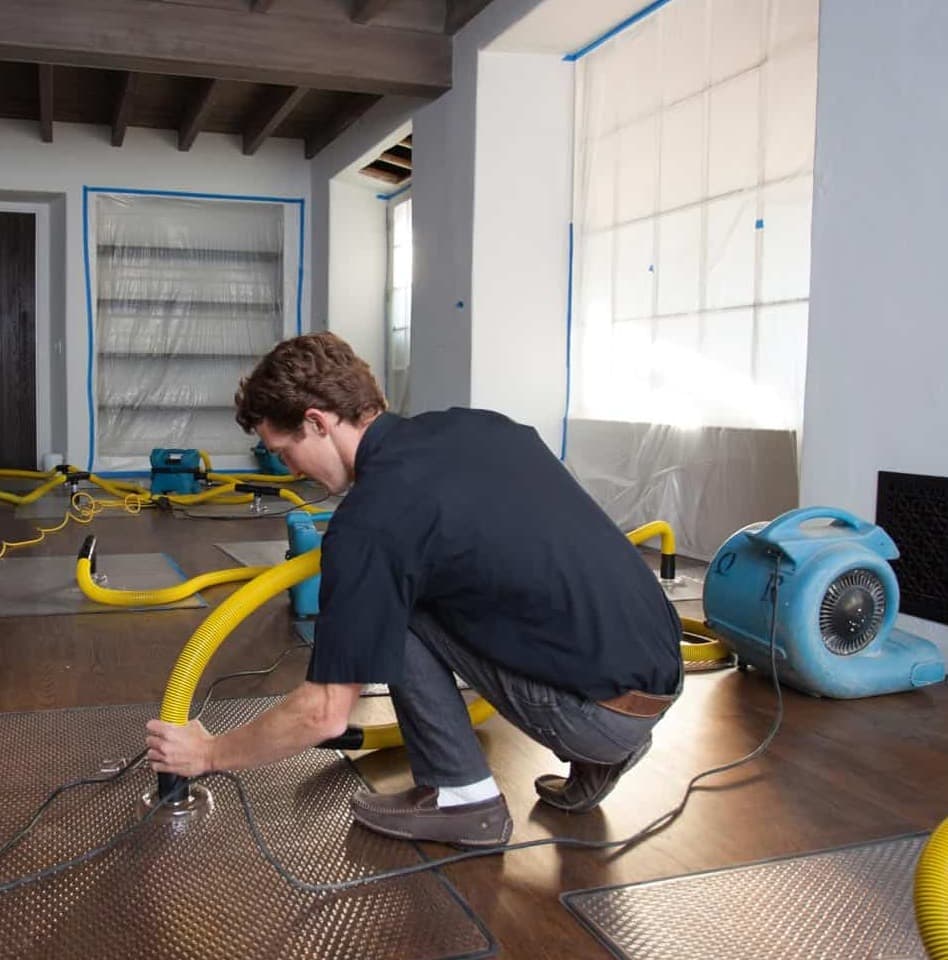
Prime Restoration remediates crawl-space mold at the source: containment and HEPA-filtered negative air at the access, removal of contaminated insulation and debris, cleaning and treatment of joists, subfloor, and framing, and a straight diagnosis of the moisture driver — ground vapor, foundation seepage, plumbing leaks, or unvented dryer and bath exhausts dumping below the house. We coordinate ground-vapor barriers and drainage fixes so the space stays dry after the mold is gone, and we document everything for your records or claim.
Mold problems grow — literally — the longer the moisture source stays active. Here is what waiting costs.
Ground moisture and condensation are feeding active growth on joists and subfloor, and stack effect is pulling spores into the living space above.
Fiberglass insulation between the joists absorbs moisture, sags, and becomes a spore reservoir. The musty smell upstairs strengthens.
Growth spreads across the subfloor and into the rim joist. Hardwood floors above chronically damp crawl spaces begin to cup. Ductwork in the space sweats and spreads the problem on the airflow.
Wet framing progresses from mold to rot. Sistering joists and rebuilding rim-joist sections costs many multiples of the remediation that would have prevented it.
A proven, step-by-step approach to restoring your property.
A technician inspects the full space — joists, subfloor, rim joist, insulation, ducts, and grade — and meters the wood. The moisture driver gets named: ground vapor, seepage, plumbing, condensation, or exhausts venting below the house. Written scope and estimate follow.
The access is sealed and the space put under negative air with HEPA filtration so the work does not push spores up into the house.
Contaminated fiberglass, fallen vapor barrier, construction debris, and stored items are bagged and removed. A clean space is a treatable space.
Joists, subfloor, sill, and rim joist are HEPA-vacuumed and treated with EPA-registered antimicrobial with proper dwell time; heavily affected areas are agitated and re-treated.
The space is dried to normal wood moisture levels, then the driver gets corrected — ground vapor barrier installation, exhaust re-routing, drainage and downspout corrections, or coordinated foundation repair.
New insulation appropriate for the moisture conditions is installed and the completed work documented — moisture readings included — for your records, your claim, or your sale.
Comprehensive crawl space mold removal for every situation.
Common questions about crawl space mold removal in Macomb County.
Three reliable proxies: a musty smell on the first floor that strengthens in humid weather, hardwood or laminate floors cupping or feeling damp-cold underfoot, and allergy symptoms that improve when you leave the house. Direct confirmation takes a flashlight at the access: white, green, or black fuzz on joists, sagging blackened insulation, or standing water and damp earth all say mold or the conditions for it. We inspect crawl spaces as part of a free assessment — you do not have to crawl in yourself.
Crawl space remediation falls within the same overall range as other mold work — roughly $1,500 to $9,000 in Macomb and Oakland County — driven by the size of the space, how much insulation must come out and be replaced, and the moisture-control work needed to keep it dry. A small, caught-early joist problem near one wet corner costs far less than a full-space remediation with new vapor barrier. The on-site assessment and written estimate are free.
Yes — through stack effect. Warm air rising through the house pulls replacement air up from the crawl space through floor penetrations, duct chases, and subfloor gaps; a commonly cited estimate is that a large share of first-floor air originates below it. That is why crawl-space mold presents as musty living-space air and why sealing and remediating the space improves the whole house, not just the part nobody visits.
Encapsulation — sealing the space with a heavy vapor barrier and conditioning it — is a legitimate moisture-control strategy, but it is step two, not step one. Encapsulating over active mold seals the problem in with the house breathing above it. The right order: remediate the existing growth, fix any liquid-water problems (seepage, plumbing, grading), then install the vapor barrier or full encapsulation. We handle the remediation and coordinate the moisture-control work in that order.
Sometimes — when it traces to a sudden, accidental covered event like a burst supply line under the floor, often subject to a mold sub-limit. Mold from ground moisture, humidity, or long-term seepage is generally considered a maintenance exclusion. Your carrier makes the call; we document the actual cause and full scope honestly, which protects you whichever way the coverage question lands. Prime Restoration is a top-rated contractor for water damage insurance claims in Michigan: the adjuster relationship runs start to finish, moisture readings and photos go in the file, and you choose your own contractor.
A crawl-space dehumidifier helps hold a dry space dry — it cannot remediate existing growth, and it fights a losing battle against an uncovered earth floor or active seepage. Existing mold needs physical removal and treatment, ground vapor needs a barrier, and liquid water needs drainage. After those, a properly sized and drained dehumidifier is a reasonable part of keeping the space dry.
The county sits on clay-heavy soil that drains poorly and holds groundwater against foundations year-round, and Michigan’s freeze-thaw cycle opens the hairline cracks that seep every spring. Add the regional flood history — the 2014 and 2021 federal disaster events pushed water into below-grade spaces across Macomb, Oakland, and Wayne counties — and humid summers condensing on cool framing, and a crawl space here faces moisture from below, beside, and above. That stack of local factors is why the vapor barrier and drainage conversation is part of every crawl-space remediation we scope, not an upsell.
Most crawl-space remediations run 2 to 4 working days: containment and insulation/debris removal first, then cleaning and treatment of joists and subfloor with proper dwell times, then drying to normal wood moisture levels. Moisture-control work — vapor barrier installation, exhaust re-routing — typically happens in the same visit window. Tight-access spaces and full re-insulation add time; a small, caught-early problem near one wet corner can finish in a day or two.
The old advice — open in summer, closed in winter — has largely lost the argument in cold, humid climates. Open summer vents pull humid outdoor air into a space cool enough to condense it, which feeds the exact moisture problem venting was supposed to solve. Current building-science practice increasingly favors sealing the crawl space (ground vapor barrier, sealed vents, and a controlled drying strategy) over seasonal venting. The honest caveat: the right answer depends on your combustion appliances, drainage, and how the space connects to the house — which is why vent strategy is part of the assessment, not a one-line rule.
Crawl-space remediation in Macomb and Oakland County falls in the same overall range as other mold work — roughly $1,500 to $9,000 — with the space’s square footage, how much insulation comes out and goes back, and the vapor-barrier scope driving the number. A localized joist problem runs far less than a full-space remediation with new ground cover. The assessment is free, the estimate is written and itemized, and nobody has to guess: we meter the wood and inspect the whole space before quoting.
Mold itself discolors and degrades surfaces, but the real structural threat is its companion: wood-decay fungi, which colonize the same chronically wet framing and consume the wood’s structure. A crawl space that has been damp long enough to blacken the joists has often been damp long enough to start decay somewhere — which is why our inspection probes suspect framing rather than just photographing it. Caught early, treatment and moisture control stop the process; caught late, sistering joists and rebuilding rim-joist sections becomes a carpentry project on top of a remediation.
Learn more about crawl space mold removal and mold remediation.
Our restoration crews are available 24 hours a day, 7 days a week. Call now for a free mold assessment anywhere in Macomb or Oakland County.
Call (586) 277-1069 for Immediate Help