WHY PIPES BURST
Why pipes burst in Michigan winters
Freeze-thaw cycles are the #1 cause of January-February burst pipes in Macomb and Oakland County. When water freezes inside a supply line, it expands roughly 9% — pressure inside a sealed pipe can climb past 40,000 PSI, far beyond what any residential plumbing is rated to hold. Failure points vary by material: copper splits along soldered joints first; PEX resists freeze better but ruptures at brass crimp fittings; galvanized steel (common in pre-1970 Royal Oak, Ferndale, and Warren homes) corrodes from the inside and fails without warning. Slab leaks appear in 1960s-1980s ranches when copper under the slab pinholes from soil pH. Water hammer — pressure spikes from fast-closing valves — fatigues joints over years. The IRC plumbing code requires supply lines on exterior walls to be insulated; many Michigan homes pre-date that requirement.
INSURANCE COVERAGE
Will insurance cover this?
Standard Michigan HO-3 policies generally cover sudden and accidental burst pipe damage under Coverage A (dwelling) and Coverage C (contents), but exclude gradual seepage and long-term leaks. The distinctions that matter: (1) Sudden supply line burst — a frozen pipe rupture or fitting failure is typically covered. (2) Gradual seepage — a slow drip behind drywall for weeks or months is excluded as "maintenance." (3) Freeze loss while unoccupied — many policies exclude freeze damage if heat was off and the home was vacant beyond a stated period. (4) Slab leaks — coverage varies; access (tear-out and replacement) may be covered even when pipe repair is not. Michigan DIFS requires carriers to acknowledge a claim within 30 days. Always confirm coverage and limits with your insurance carrier and policy. See our Insurance Claims Guide for the full breakdown.
MOLD TIMELINE
How fast can drying start to keep this Cat-1?
The the industry standard mold window is 24 to 48 hours. Under conditions present in any home with active or recently stopped water flow (organic substrate + moisture + 60-86°F), visible mold colonization begins within 24-48 hours. The CDC confirms this window for Stachybotrys, Aspergillus, and Penicillium. Burst pipe water starts as Category 1 (clean) — but only if extraction begins fast. After 72 hours unmitigated, the industry standard reclassifies the loss to Category 2 (gray); after 7 days it becomes Category 3 (black water), requiring antimicrobial treatment, contents disposal, and HEPA air scrubbing. The same $4,000 Cat-1 dryout becomes a $14,000+ Cat-3 demolition by day 5. That is why the first hour after a burst pipe is the single highest-leverage hour in the entire loss. Prime stages from Sterling Heights specifically to keep Macomb and Oakland County losses inside the Cat-1 envelope.
OUR ON-SITE PROCESS
What happens when Prime arrives
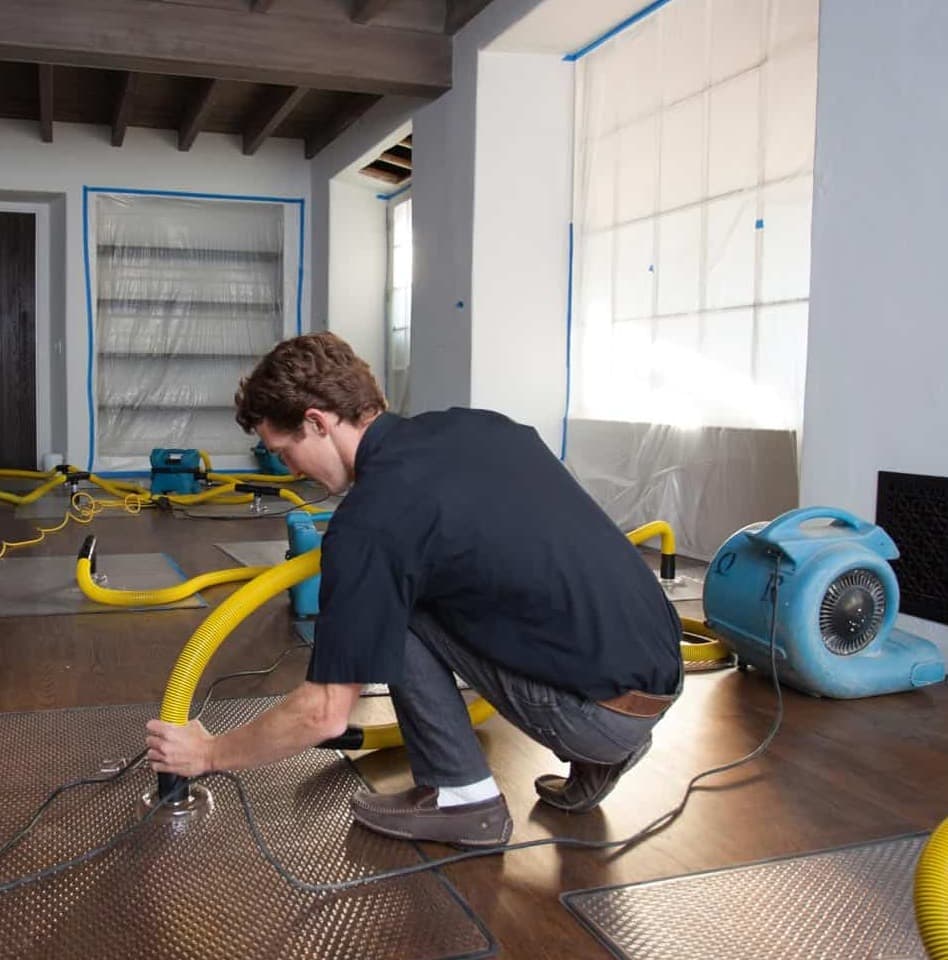
Our 5-step on-site process for burst pipe response, built around safety: (1) Safety + source isolation — confirm the main shutoff is closed, isolate electrical to affected areas, identify the failed pipe segment and material. (2) Moisture mapping — Tramex meters and FLIR thermal imaging trace water migration through wall cavities, ceiling assemblies, and subfloor. Burst pipe water travels horizontally along top plates and down stud bays far beyond the visible stain. (3) Extraction — truck-mounted vacuums pull standing water; weighted rovers extract from carpet and pad. (4) Structural drying — air movers and LGR dehumidifiers run continuously, sized to the affected square footage; readings logged on-site every 24 hours. (5) Antimicrobial + monitoring — EPA-registered biocide on affected surfaces, daily visits until readings confirm structural dryness. Prime documents conditions on arrival as a record for the homeowner.
DRYING TIMELINE
How long until everything is dry?
3 to 5 days is the typical Cat-1 burst pipe dryout when extraction begins inside the 24-hour window. industry standards define "dry standard" as moisture content matching unaffected reference materials in the same structure — not a calendar date. For a typical second-floor supply line burst that soaks ceiling drywall, insulation, and the floor below, expect 3-4 days of active drying with equipment running continuously. Slab leaks in finished basements run longer (5-7 days) because trapped moisture under flooring cannot escape without controlled demolition. Wall cavities with blown-in insulation are the slowest-drying assemblies in any structure; some require flood cuts at 24" or 48" to reach dry standard. We log moisture readings every 24 hours throughout the dryout and do not remove equipment until readings confirm structural dryness across drywall, framing, and subfloor.
WHY MINUTES MATTER
Why every minute matters with active water flow
A 1/8-inch crack in a half-inch supply line releases roughly 250 gallons per hour at residential pressure. A full-bore rupture pushes 8-10 gallons per minute. Until the main is closed, the volume on your floor is a function of clock time — not crack size. Standing water saturates drywall in 15 minutes, carpet pad in 30, and OSB subfloor in 60-90. Past hour 24, the industry standard's mold window opens; past hour 72, Category 1 reclassifies to Category 2 under the industry standard. Every hour past hour 24 multiplies remediation cost by roughly 1.4× as the loss escalates. The American Red Cross and IBHS both recommend knowing your main shutoff location before a burst event — the average homeowner loses 8-12 minutes searching for it during an active leak. Prime crews stage from Sterling Heights and reach 90% of Macomb County within 45 minutes and 90% of Oakland County within 60 minutes, 24/7.
WHY LOCAL MATTERS
Why local matters in Macomb and Oakland County
Winter response is the entire game. January and February drive the bulk of annual burst pipe calls in southeast Michigan, and the mold clock does not care that it is 3 a.m. on a holiday. Prime crews stage from Sterling Heights and reach 90% of Macomb County within 45 minutes and 90% of Oakland County within 60 minutes — 24/7/365, including the worst of the polar vortex weeks when call volume spikes. National franchises route through call centers and sub-dispatch to whichever local franchisee is available, historically adding 90-180 minutes during winter peak. We also know the local construction stock: which 1960s Warren ranches still have galvanized supply, which Sterling Heights subdivisions sit on slab with copper underneath, which Royal Oak two-stories run uninsulated supply through cantilevered overhangs that freeze first. Local is not marketing — it is response physics.
COST RANGES
What does burst pipe cleanup cost?
Typical range: roughly $1,500 to $16,000+ depending on scope, affected square footage, and how many floors the water traveled through. As a general guide: a contained Cat-1 burst caught fast (single room, no ceiling involvement, minimal drywall) often runs in the lower end of the range; a multi-room loss with ceiling drywall down and partial flooring replacement lands in the middle; a multi-floor loss with saturated insulation, full ceiling assemblies down, and hardwood replacement trends to the upper end. These are mitigation + controlled demolition ranges — reconstruction (new drywall, paint, flooring, trim) is a separate scope and often the larger line item. With insurance, most homeowners' out-of-pocket cost is their deductible when the loss is covered. Final pricing depends on what we assess on-site: moisture mapping, affected square footage, materials, and Category determination.
WHERE THEY FREEZE
Six places a pipe freezes in a Michigan house
Almost every frozen pipe in this region is in one of these six places, and five of them you can check with a torch on a Sunday afternoon before the cold arrives.
The rim joist
Where the floor framing meets the foundation, usually right above the basement wall. It is the single most common freeze point in this region because it is often poorly insulated, it is directly against the outside, and supply lines are routinely run through it. If your basement has a cold draught along one wall in January, that is where to look.
Inside an exterior wall
Any supply run in an outside wall is exposed to whatever the weather is doing, with only the insulation between. The kitchen sink on an outside wall is the classic. Opening the cabinet doors on a cold night genuinely helps, because it lets room air reach the pipe.
An unheated crawl space
Cold, closed, and full of plumbing. Crawl spaces in the older stock frequently have no insulation at the perimeter and a vent left open from summer. A crawl at outdoor temperature with a supply line running through it will freeze on the first hard night.
The garage
An attached garage is not heated space and people forget that the wall it shares with the house often carries plumbing — and that a laundry or a utility sink out there is on a completely exposed line. Leaving the garage door open on a cold day is how a lot of these start.
An attic run
Less common but far more damaging when it happens, because everything below it is in the path. Any plumbing above the insulation line in an attic is sitting in outdoor air. If a bathroom was added upstairs at some point, this is worth knowing about before January.
The hose bib and anything outside
The most preventable one on the list. An outdoor tap with a hose still attached cannot drain, so water sits in the bib and in the line behind it. That freeze then splits the pipe inside the wall, and you find out in spring when someone turns it on.
THE SHUTOFF
How to actually shut the water off
Everyone knows they should. Far fewer have ever found the valve, and almost nobody has turned it. Ten minutes today is worth more than anything else on this page.
Find it before you need it, not during
The single most useful ten minutes you will ever spend on your house. The main shutoff is usually where the service line enters — commonly a basement wall on the street side, near the meter. In a slab home it may be in a utility closet or the garage. Go and look now, today, while nothing is wrong.
Know which type you have
A ball valve has a lever and shuts with a quarter turn — fast and reliable. A gate valve has a round handle you turn several times, and it is the one that seizes. If yours is a gate valve that has not moved in fifteen years, there is a real chance it will not close when you need it. Turning it gently once or twice a year keeps it alive.
If it will not turn, do not force it
An old gate valve can snap or the packing can fail, and now you have an open main you cannot close and a second leak at the valve. If it resists, go to the curb stop instead.
The curb stop is the backup
There is a shutoff at the property line, usually under a small metal cover in the lawn or the verge near the street. It needs a long key rather than a hand, and in many municipalities the water department would rather operate it themselves — but on a real emergency it is the fallback when the interior valve has failed.
Then open the lowest tap in the house
Once the main is closed, opening a tap at the lowest point drains the standing water out of the system rather than leaving it sitting in the split. It reduces how much ends up in the building and it depressurises the line.
Kill the water heater too
If the supply is off, the water heater must not keep firing on a dropping level. Gas valve off, or the breaker on an electric unit. This is the step people skip and it is the one that turns a plumbing problem into an appliance replacement.
THAWING SAFELY
Thawing a frozen pipe without starting a fire
Every winter a fire department in this region attends a house fire that started as a frozen pipe. The method matters as much as the intent.
Open the tap first, always
Before applying any heat, open the faucet that pipe feeds. It gives melting water somewhere to go and relieves the pressure that actually causes the split. Thawing a pipe with every tap closed is how a frozen pipe becomes a burst one.
Warm the whole run, not one spot
Work from the tap end back toward the frozen section. Heating the middle of an ice plug expands water that has nowhere to escape in either direction, which is exactly the failure you are trying to avoid.
What is safe
A hair dryer on a low setting kept moving, a space heater placed at a sensible distance, warm towels wrapped around the pipe, or simply raising the house temperature and being patient. Slow is fine. Slow is better.
⛔ What sets houses on fire
A blowtorch, a propane torch, a kerosene or charcoal heater, or any open flame. Every winter a fire department in this region attends a house fire that started as a frozen pipe. The wall cavity you are heating is full of dry framing and old insulation, and you cannot see what is happening on the other side of the drywall.
If you cannot reach it, stop
A pipe frozen inside a wall or under a slab is not a homeowner job. Heating drywall to reach a pipe behind it is the fire scenario above. That is the point to call a plumber rather than to keep going.
Watch what happens when it thaws
The split does not leak while the ice is still in it. The water arrives at the moment it clears, which is why so many people report the burst happening hours after the cold snap ended. Stay with it, and know where the shutoff is before you start.
WHAT THE PIPE TELLS YOU
Material changes how it fails — and whether it failed at all
| Material | How it fails | What that means here |
|---|
| Copper | Splits, usually lengthwise along the tube or at a soldered joint. | The most common material in this region's pre-1990 stock and the least forgiving of a freeze. A copper split is normally a clean, obvious failure — and it releases a lot of water quickly. |
| PEX | Frequently survives a freeze that would split copper, because it expands. | It is not freeze-proof — it ruptures at the fittings and under repeated cycles — but a PEX system that froze once may genuinely be fine. Do not assume damage; do not assume safety either. Pressure-test it. |
| CPVC | Goes brittle in the cold and can crack rather than split. | The failure is often a hairline that leaks slowly rather than dramatically, which puts it in the hidden-leak category instead of the emergency one. |
| Galvanized steel | Rarely bursts from freezing. It corrodes from the inside instead. | Common in pre-1960 Michigan homes. The freeze risk is lower, but the pipe is often already narrowed by scale, and a galvanized system that fails tends to fail at a threaded joint. |
| The flexible connector under a fixture | Braided supply lines to toilets, sinks and washing machines. | Not a freeze failure at all, but worth knowing because it is one of the highest-volume burst sources in any house and it is a five-minute replacement. Washing machine hoses in particular have a service life and almost nobody replaces them. |
Pipe repair and replacement is a licensed plumbing trade. We do not perform it. What we do is everything the water did — finding how far it went, drying the structure, and repairing what came out.