A drain problem spills what is in the drum. A supply hose failure is an open pipe until somebody comes home. Free inspection with moisture readings across Macomb and Oakland County.
Rather talk now?Call (586) 277-1069
This guide is published by Prime Restoration, a Michigan licensed residential builder and water damage restoration contractor in Sterling Heights. We do not repair or replace washing machines and we do not install plumbing — both are other trades. We handle what the water did. Written for Macomb and Oakland County. Last updated 2026-08-13.
The thing nobody writes down
Almost everything written about this starts with the appliance. The appliance is rarely the story. Two entirely different failures share the same sentence — “the washer leaked” — and they are not the same event at all.
A drain-side problem spills what is in the drum. The hose works its way out of the standpipe during a spin cycle, or the standpipe backs up, and you get the contents of one wash on the floor. It is unpleasant. It is usually finite.
A supply hose failure is an open pipe. The hoses behind the machine are connected to household water at roughly 40 to 80 psi, and unlike the drain side there is nothing metering the flow. When one splits, water arrives continuously and it does not care how big the machine is. The volume is decided by one thing: how long until somebody closes the valve.
That is why the same appliance produces both a twenty-minute mop-up and a job that takes out flooring across two levels. The damaging cases are, with grim reliability, the ones that begin shortly after the household leaves for the day.
The sixty-second check worth doing today
Pull the machine forward far enough to see where the two hoses meet the valves. You are looking for a bulge near the crimped ends, surface cracking, rust at a braided collar, or any dampness at the coupling. Then work out how old they are.
| Hose type | Typical service life | What you are looking for |
|---|---|---|
| Black or grey reinforced rubber | Roughly 5 years | Bulge near the crimped ends, surface cracking, any weeping at the coupling. If you cannot remember buying them, they are older than you think. |
| Braided stainless steel | Roughly 10 years | Rust bloom at the collar, a broken braid wire that catches a cloth, kinks behind the machine. |
| Auto-shutoff hose | Roughly 10 years | The mechanism trips on a sudden flow rate. It does not protect against a slow weep, and the hose itself still ages. |
Replacement hoses cost very little and fitting them is a ten-minute job. Set against a single structural dry-out, this is the cheapest prevention in the house. If you are leaving town for more than a few days, close both valves.
Where it actually fails
Supply hose (hot or cold)
Rubber bulges and splits at the crimp, or the coupling lets go at the valve.
Full household line pressure, roughly 40 to 80 psi
The expensive one. It does not stop on its own.
Drain hose / standpipe
Hose walks out of the standpipe during spin, or the standpipe backs up.
Pump pressure only, and only while draining
Volume is limited to the drum, repeated per cycle.
Door boot or tub seal (front loaders)
Boot tears or the outer tub seal weeps behind the drum.
Gravity, during wash
Slow, chronic, often found by smell before sight.
Pump housing or hose clamp
Cracked housing or a clamp that lost tension.
Pump pressure, intermittent
Small per event, but it recurs until repaired.
Where it goes from there
The same failure produces a different job depending on which floor it happened on. This is the part worth knowing before you call anyone, because it tells you how urgent the situation actually is.
Basement laundry
Slab or finished floor, then along the bottom plate into drywall and stored contents.
The most common location on our book, and the one where the loss sits unnoticed longest.
Main-floor closet or mudroom
Under the door threshold, into hallway flooring, then down through the subfloor penetration.
Hardwood cups first. Cabinet toe kicks wick and hide the extent.
Second-floor laundry
Through the subfloor into the ceiling below, along joist bays, out at the light fixtures.
Common in newer Macomb Township and Shelby Township builds. One failure damages two levels.
Garage or unfinished utility
Toward the floor drain if there is one, into the wall base if there is not.
The best case. Usually a dry-out rather than a rebuild.
What we do
Stop the source, or tell you who does
If the hose is still delivering, the valves behind the machine close it. If the valves are seized, that is a plumber and we will say so on the phone rather than send a truck you do not need yet.
Find the actual edge of the water
Moisture meters and thermal imaging, not guesswork. Water travels under flooring and up drywall well past the visible line, and the edge decides the scope.
Extract, then dry the structure
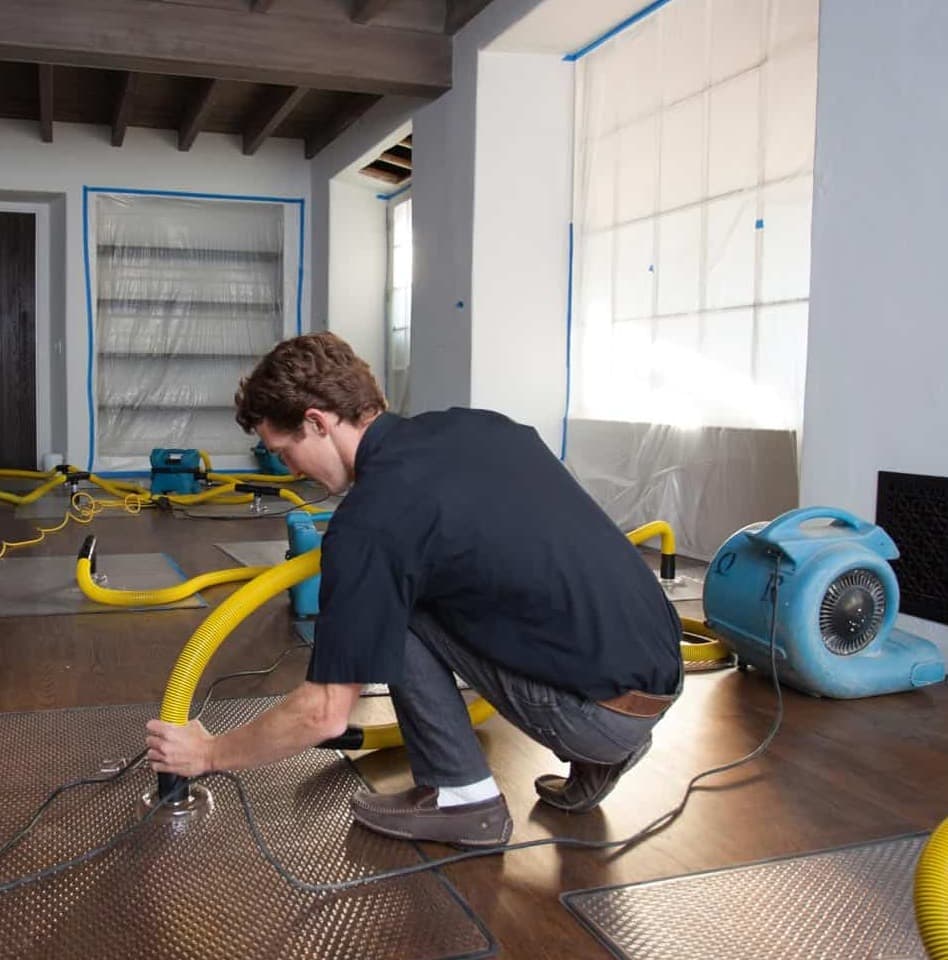
Standing water out first, then air movers and dehumidification sized to the wet material and the space, with readings logged as it dries.
Remove only what cannot be dried
Saturated pad and swollen particle board come out. Framing, subfloor and most drywall usually dry in place if the work starts early enough.
Confirm dry against a number
The job is finished when readings match a dry standard for the material, not when it looks dry or the equipment has been running a set number of days.
What we do not do
Appliance repair is one trade, plumbing is another, and restoration is a third. We do not replace washing machines, we do not fit supply hoses, and we do not install shutoff valves. If the water is still arriving, the person you need first is whoever can stop it.
Describe what happened on the phone and we will tell you which trade you actually need, in what order — including the times when the honest answer is that you need a plumber and not us.
Questions we get on the phone
My washing machine leaked. Do I need a restoration company or just a mop?
It depends entirely on which failure you had. If the drain hose came out of the standpipe and you caught it mid-cycle, that is the drum on the floor and a shop vac may genuinely be enough. If a supply hose let go, that is an open pipe at household pressure and the volume is not related to the size of the machine at all. The practical test is whether water kept arriving after the cycle stopped. If it did, it was supply-side, and the water has already travelled further than you can see.
How much water comes out of a burst washing machine hose?
Far more than people expect, because it is not limited by the appliance. A failed supply hose is an open line running at household pressure until somebody closes the valve. The damaging cases are almost always the ones that start after the household leaves for the day, because the duration, not the flow rate, is what decides the scope.
Do you repair or replace the washing machine?
No. Appliance repair and plumbing are separate trades and we do not perform either one. We do not replace machines, and we do not install shutoff valves or supply lines. What we handle is everything the water did: extraction, moisture mapping, structural drying, and removing material that cannot be dried. Plenty of these jobs need two trades and the order matters. Tell us what happened on the phone and we will tell you honestly which one you need first, including when the answer is that you only need a plumber.
The water dried on its own. Is there still a problem?
Sometimes, and the surface is the wrong place to judge it. Flooring can feel dry while the subfloor beneath it and the bottom of the wall are still holding water, because those materials release moisture slowly and there is no airflow behind them. On wet porous material, growth can begin in roughly 24 to 48 hours. A moisture reading answers this in a few minutes and costs nothing.
How long does drying take?
Most washing machine losses that get attention quickly dry in about three to five days. What extends it is duration before discovery, whether the water reached a second level, and how much of the wet material is dense or sealed. We take readings daily and the equipment comes out when the numbers say the structure is dry.
Can I prevent this?
Largely, yes, and it is one of the cheapest preventions in the house. Replace rubber supply hoses on a schedule rather than waiting for failure, use braided stainless, and close the valves behind the machine if you are leaving for more than a few days. The hoses cost very little compared with a single dry-out.
We will take readings and tell you how far it actually went. The estimate is free.
Call now : (586) 277-1069