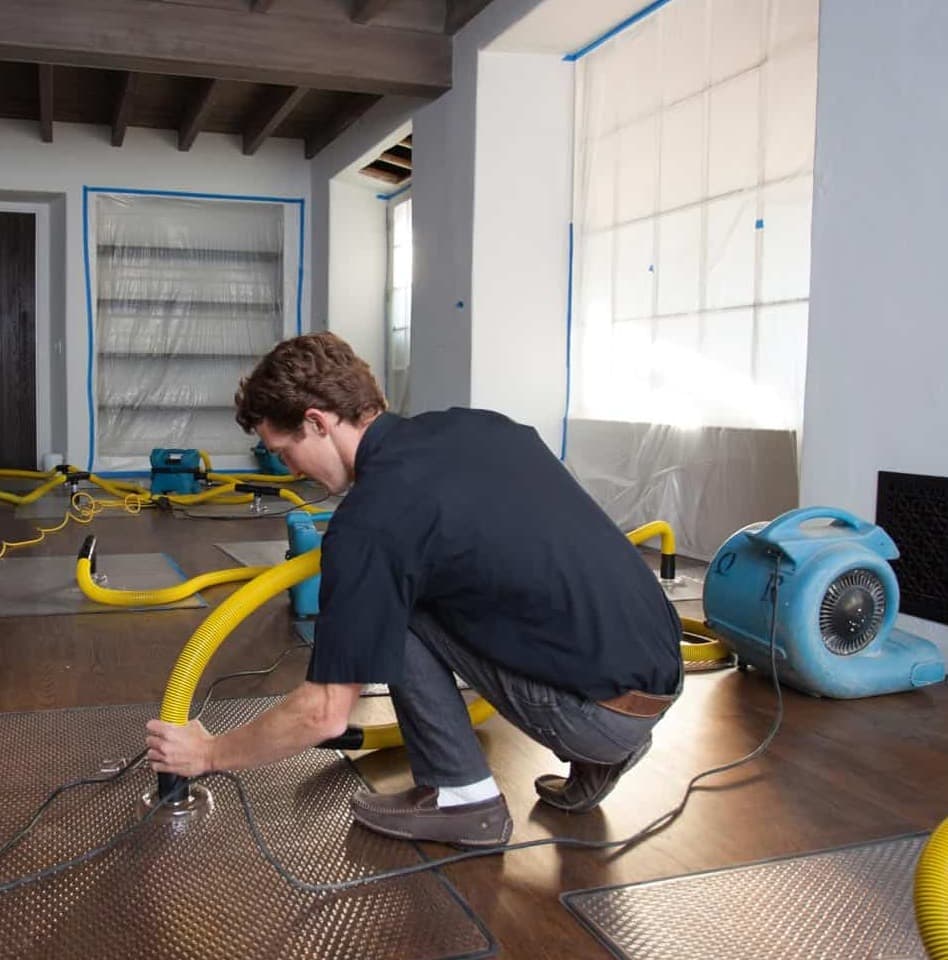
In Rochester Hills, elevation decides more than rainfall does. Thirty-two square miles sloping toward the Clinton River, where the corridor parcels flood on storms that leave the rest of the city dry. 24/7 dispatch across 48306, 48307 and 48309. Free inspection and a written scope.
This page is published by Prime Restoration, a Michigan licensed residential builder dispatching to Rochester Hills from Sterling Heights. It covers what actually fails in this city rather than what fails generally. Last updated 2026-07-31.
What is specific to this city
Rochester Hills covers roughly 32 square miles between M‑59 and Avon Road, and the ground slopes toward the Clinton River. That single fact explains most of the difference between two houses a few streets apart.
The Clinton River Trail corridor running east to west through the city traces the low-lying parcels, and river-adjacent homes near Yates and Bloomer Park face periodic high-water-table conditions that subdivisions on higher ground simply do not. In those corridors the sump system is not a safeguard, it is the mechanism keeping the basement dry.
Which is why the pattern documented across the June 2021 storms in this city was not dramatic flooding. It was sump pumps and battery backups failing, and that is a preventable loss. If you are in the corridor or in the lower-elevation subdivisions south of Avon Road, the pump and its backup power are the most consequential appliance in the house, and testing them before a storm costs nothing.
What this city has been through
Rochester Hills is not one market. What fails, and what it costs to put back, changes by era and elevation.
| Area | Where | Housing stock | What tends to fail | What that means for scope |
|---|---|---|---|---|
| Clinton River Trail corridor | Low-lying parcels near Yates and Bloomer Park, sloping toward the river | Mixed era, river-adjacent | Periodic high water table. Sump dependence is absolute here, and a battery backup is not optional. | Below-grade Category 2 and 3 intrusion into finished lower levels. Cove-joint and slab readings drive the scope. |
| North of Tienken, Oakland Township border | Half-acre to acre lots on the township line | 1990s–2010s custom builds | Tree fall onto complex roof geometry; generator and geothermal integrations complicate the rebuild. | Controlled drying of hardwood and cabinetry, millwork refinishing rather than replacement. |
| Christian Hills and Stoney Creek | East of Rochester Road | 1970s–1980s colonials and contemporaries | Cedar siding and original asphalt roofs at end of service life. Water enters high and surfaces low. | Wall-cavity wetting well away from the entry point. Attic insulation and sheathing get checked, not assumed. |
| Avondale and Brewster Heights | South of Hamlin Road near Adams | 1960s ranches with newer infill | Original galvanized supply lines and Federal Pacific panels are common findings on loss inspections. | Supply-line failures behind finished walls; electrical findings that belong in the report even when they are not the loss. |
The appliance that matters most
For a large share of this city the sump is not a backup, it is the thing keeping the basement dry, and the pattern documented repeatedly in the 2021 storms was not the rainfall — it was pumps and battery backups that could not keep up or had no power. So it is worth knowing what the system is actually made of. Six parts, six failure modes, and a check you can do yourself for each one. On most of the failures we are called to, the pump itself was fine.
| Part | What it does | How it fails | How to check it yourself |
|---|---|---|---|
| The pit | Collects what the drain tile brings to it and gives the pump somewhere to draw from. | Undersized or silted-in pits make the pump short-cycle, which is the single fastest way to kill one. A pit with no drain tile feeding it is decorative — it will sit dry while the wall leaks. | Look at it during a heavy rain, not on a dry day. Water should be arriving through the tile inlets, not just seeping up. |
| The primary pump | Moves water out. Everything else on this list exists to keep this one running. | Seized after a dry summer, float switch caught on the pit wall or on its own cord, or simply at end of service life. Pumps do not usually warn you. | Pour a bucket in twice a year and watch the whole cycle. If the float hangs up even once, that is the failure, found early and cheaply. |
| The check valve | Stops the column of water in the discharge pipe from draining back into the pit when the pump shuts off. | A failed check valve makes the pump re-lift the same water repeatedly. It looks like a pump that runs constantly and it burns one out fast. | Listen after the pump stops. A loud clunk is normal. Water audibly running back down is not. |
| The discharge line | Carries water far enough from the house that it does not come straight back. | The two classic ones here are a line that terminates three feet from the foundation, and a line that freezes shut in January. A frozen discharge turns a working pump into a pump running against a closed pipe. | Walk to where it ends. If you cannot find the end, that is the finding. In winter, confirm the outlet is clear before a thaw. |
| The backup pump | Runs when the primary cannot — usually because the power is out, which in the storms that cause these losses is the same hour. | Battery at end of life, battery never tested, or a backup sized to trickle rather than to actually keep up. A backup that cannot match inflow only changes how long you have. | Test it on the backup alone, with the primary unplugged, and let it run a full cycle. Batteries generally need replacing on a cycle of a few years, not when they fail. |
| The power supply | Feeds the pump. Frequently the actual root cause when the pump is found intact. | A tripped GFCI on the outlet nobody looks at, a shared circuit that trips for an unrelated reason, or an extension cord. The pump is fine; it just was not energised. | Know which breaker feeds it. If it is on an extension cord or shared with a freezer, fix that before buying anything else. |
What a loss inspection turns up
In this housing stock a water loss regularly surfaces something that was already there. None of it is water damage, none of it is work we do, and all of it belongs in the written scope anyway — because finding it and not writing it down would be the actual failure. Everything below goes to a licensed electrician or mechanical contractor, not to us.
Federal Pacific Stab-Lok panels
Common in the 1960s-70s stock south of Hamlin. These panels have been the subject of long-standing, widely reported concerns about breakers failing to trip on overload. It is not a water-damage issue and we do not repair it, but finding one during a loss inspection and not writing it down would be negligent.
What happens next: Have a licensed electrician evaluate it. If the panel is being replaced anyway as part of a wet-basement rebuild, that is the cheapest moment it will ever happen.
Zinsco and Sylvania-Zinsco panels
Same era, same category of long-reported concern, less commonly recognised by homeowners.
What happens next: Same referral. Note it in the written scope so it exists in the record.
Outlets and panels that were under water
Any device or equipment that was submerged is generally treated as compromised regardless of whether it still functions. Corrosion inside a breaker or receptacle is not visible and does not announce itself.
What happens next: A licensed electrician decides what is replaced. Nothing submerged gets re-energised on the basis that it seems to work.
Furnace, water heater and mechanicals that took water
Manufacturers generally direct that submerged gas controls and burner assemblies be replaced rather than dried and reused, because the failure mode is not immediate.
What happens next: A licensed mechanical contractor, and the manufacturer’s own guidance for that unit. This belongs in the scope on day one, not as a surprise in week three.
Extension-cord-fed sump pumps
Turns up constantly. It is a code and reliability problem at the same time, and it is frequently the real reason a pump was not running.
What happens next: A dedicated, properly protected circuit. This is a small electrical job and it is the highest-value one on the list.
What moves the number
Typical ranges for this kind of work are published on our service pages, but the number for YOUR job comes from readings rather than from a phone call. What is publishable here is the list of things that actually move it, roughly in order of how much they move it here. If a contractor’s number changes after they arrive, one of these is the reason, and you are entitled to be told which.
Whether the lower level is finished
The largest swing in this city by a wide margin. Rochester Hills has an unusually high share of finished and walkout lower levels, and a finished walkout loses flooring, base, drywall, cavity insulation and often built-ins where an unfinished space loses almost nothing.
Water category
Groundwater through a cove joint and a sanitary backup are not the same job. The category sets containment and removal before anyone looks at finishes.
How much cavity is involved
Water that entered high on the structure — the cedar-siding and end-of-life-roof pattern in Christian Hills — travels inside walls and surfaces far from where it started. Scope follows the readings, not the stain.
Custom and integrated systems
On the newer builds north of Tienken, geothermal loops, standby generators, low-voltage and custom millwork all have to be worked around rather than through. It is not more square footage, it is more coordination.
How long it sat
Category escalates with time and so does the removal list. On a finished cavity this is usually the difference between drying and rebuilding.
Sequence
Drying ends on a reading, not on a date, so none of this is a promise about hours. It is the order the steps have to happen in, and the one place it differs here is that the mechanical room gets assessed on day zero rather than discovered in week three.
Hour 0
Establish whether water is still entering
A sump that failed mid-storm often stops mattering once the ground drains. A failed check valve or a frozen discharge will keep going. Photograph everything before anything moves, wide and close, timestamped.
Day 0
Moisture map and a look at the mechanical room
Readings against a dry standard from an unaffected part of the house, plus the sump system itself and any electrical or mechanical equipment that took water. Free, and written down.
Days 1–2
Removal, scoped by the readings
On groundwater in a finished walkout, the goal is the smallest opening that lets the cavity dry. On a sanitary backup, containment first and porous material out.
Days 2–5
Structured drying, logged daily
Slab, bottom plate and cavity all dry on different curves. The equipment comes out on a reading, not on a date, and you should be shown the readings.
Then
Rebuild, with the mechanical findings resolved first
Electrical and mechanical items identified on day 0 get handled by their licensed trades before anything is closed up over them.
Stopping the second one
In a city where the basement stays dry because a machine is running, prevention is mostly maintenance rather than construction. Each measure is listed with what it does not cover, because a homeowner who bought a battery backup and still flooded usually bought the right thing for the wrong failure.
Test the sump the way it will actually be used
What it does: Finds the failure while it is cheap. A bucket poured into the pit twice a year, watching the full cycle, then again with the primary unplugged so the backup has to carry it alone.
What it does not do: Tell you whether the backup can keep up with real inflow during a storm. For that, watch it during a heavy rain at least once.
Who does it: You, in ten minutes. This is the highest-return item on any prevention list for this city.
Replace the backup battery on a schedule
What it does: Removes the most common reason a backup system fails at the exact moment it is needed.
What it does not do: Help if the backup was undersized to begin with. A backup that trickles buys time rather than staying ahead.
Who does it: You or a plumber. Put it on a calendar rather than waiting for a warning.
Get the sump on a dedicated, protected circuit
What it does: Ends the extension-cord and shared-circuit failure, which is the root cause far more often than the pump itself.
What it does not do: Help during a power outage. That is what the backup is for; these are two different problems that both present as a dead pump.
Who does it: A licensed electrician. Small job, disproportionate return.
Extend and winterise the discharge line
What it does: Stops the pump from re-lifting its own water, and stops a January freeze from turning a healthy pump into a pump running against a closed pipe.
What it does not do: Address inflow. It changes where the water goes, not how much arrives.
Who does it: Plumber or a capable homeowner. Walk to the end of the line first and see where it actually terminates.
Grade and swale on a sloped lot
What it does: On the parcels that fall toward the Clinton River corridor, keeping surface water moving past the house rather than into the low side is worth more than any appliance.
What it does not do: Do anything about a high water table, which arrives from below and is the sump’s job.
Who does it: Landscaper or civil-minded contractor. On a slope this is a design question, not a shovel question.
Deal with the panel while the wall is already open
What it does: If a loss inspection turned up a panel of long-reported concern, the rebuild is the cheapest moment that work will ever be scheduled.
What it does not do: Belong to us. We write the finding; a licensed electrician does the work.
Who does it: A licensed electrician.
Before anyone starts
These work on our estimate as well as anyone else’s, which is the point of publishing them. A homeowner standing in a wet lower level at eleven at night has very little leverage, and a short list of the right questions is most of the leverage available.
“Did you look at the sump system, or only at the water?”
In this city the sump is usually the story. An assessment that does not include the pit, the pump, the check valve, the discharge line, the backup and the circuit feeding it is not a complete assessment.
“Will you show me the readings and the dry standard you are comparing against?”
A reading with no baseline from an unaffected part of the same house is a number with no meaning. If nobody can produce one, drying is being judged by feel.
“What category are you treating this as, and why?”
Groundwater and a sanitary backup are different jobs. The category drives containment and removal before anyone assesses finishes.
“What is coming out and what are you drying in place?”
You want the list before the saw comes out, with a reason attached to each line. In a finished walkout this is most of the invoice.
“Did anything electrical or mechanical get wet, and what is your recommendation on it?”
Submerged panels, devices, furnaces and water heaters are generally treated as compromised. This should be in the written scope on day one, not raised in week three.
“Are mitigation and reconstruction the same company?”
If not, ask who owns the seam. The hand-off between trades is where schedules die and where cavities get closed before they are dry.
“What ends this job — a date or a reading?”
The correct answer is a reading. Equipment pulled on a schedule is the most common origin of mould found six weeks later.
“Are you licensed in Michigan, and can I see it?”
Residential building work in Michigan requires licensing. Ask, verify, and do not accept a business card as an answer.
The honest part
We dispatch from Sterling Heights, and Oakland County is well covered by firms based closer to you. On an active loss where water is still entering, the right call is whoever can stop it soonest, and we will say that on the phone rather than send a truck to sit in your driveway.
What we offer against drive time is one accountable crew from extraction through reconstruction instead of a different subcontractor for each phase. On a utility-room loss that difference is small. On the custom stock north of Tienken, where hardwood, cabinetry and millwork have to be dried and refinished rather than ripped and replaced, it is most of the job.
Because a large part of the city drains toward the Clinton River, and elevation decides more than rainfall does. The parcels along the Clinton River Trail corridor near Yates and Bloomer Park, and the lower-elevation subdivisions south of Avon Road, sit on a higher water table than the rest of the city. In those corridors the sump system is not a backup, it is the thing keeping the basement dry, and the failure documented repeatedly in the 2021 storms was not the storm itself but sump pumps and battery backups that could not keep up or had no power. If you are in one of those corridors, the pump and its backup are the most important appliance in the house.
We dispatch 24/7 from Sterling Heights and cover all of 48306, 48307 and 48309, typically running M-59 or Rochester Road depending on where in the city you are. We are not the closest company to Rochester Hills and on an active loss the honest advice is that whoever can stop the water soonest should. What we offer against drive time is one accountable crew from extraction through reconstruction rather than a different subcontractor for each phase, which matters more on the custom stock near the Oakland Township border than it does on a straightforward utility-room loss.
Almost everything about the scope. The 1970s and 1980s stock in Christian Hills and around Stoney Creek carries cedar siding and original asphalt roofs that are at or past service life, so water often enters high on the structure and surfaces somewhere else entirely. Further south, around Avondale and Brewster Heights, original galvanized supply lines and Federal Pacific panels turn up regularly on inspections, which changes both the likely failure and what belongs in the report. The newer custom builds north of Tienken bring the opposite problem: engineered floor systems, geothermal loops and standby generators that all have to be worked around rather than through.
It depends on what is being put back. Work is administered through the Rochester Hills Building Department under the 2015 Michigan Building Code and the companion residential, plumbing, electrical and mechanical codes. Like-for-like interior cosmetic repairs typically do not require a permit. Structural framing, plumbing rough-in beyond a fixture swap, electrical circuit changes, mechanical equipment replacement and roof-deck replacement do. Reconstruction after a Category 3 water loss or a fire usually involves several coordinated trade permits with their own inspection sequence, and geothermal, standby-generator and pool work each carry their own requirements. Licensed contractors of record are required for permitted work.
Stay out of standing water if the power is still on and you cannot reach the panel dry. Then work out whether water is still entering, because a sump that failed during a storm often stops being a problem once the ground drains, while a failed check valve or a discharge line frozen shut will keep going. Photograph everything before you move it, wide and close, timestamped. Get contents up off the floor if it is safe, but do not start pulling carpet or cutting drywall, because that decision should come from moisture readings rather than the waterline. Then call. The inspection and the written scope are free.
Surface dry is not dry, and in this city that matters more than most because of how many finished lower levels there are. The slab, the bottom plate, the framing behind the drywall and the pad under the carpet hold water long after the floor looks fine, and on wet porous material growth can begin in roughly 24 to 48 hours. Whether you have a problem is a five to ten minute moisture-meter check, not a judgment call from across the room. If the readings come back at dry standard we will tell you that and leave, and it costs you nothing either way.
Twice a year at minimum, and the test most people do is not the test that matters. Pouring a bucket into the pit and watching the primary run is the easy half. The half that finds real failures is unplugging the primary and making the backup carry a full cycle on its own, because a battery at end of life will look fine sitting there and do nothing when it is needed. Watch the float travel the whole way without catching on the pit wall or on its own cord, listen for a firm clunk from the check valve when the pump shuts off, and then walk outside and confirm the discharge is actually flowing where you think it is. Batteries generally want replacing on a schedule of a few years rather than when they fail. Ten minutes, twice a year, in a city where this appliance is the reason the basement is dry.
Four ways, and we see all of them. A failed check valve lets the column of water in the discharge pipe fall back into the pit every time the pump shuts off, so the pump spends the storm re-lifting the same water and eventually burns out. A discharge line that terminates a few feet from the foundation returns the water to the ground it just came from. A frozen or blocked discharge means the pump runs against a closed pipe, which sounds exactly like a pump doing its job. And a pit with no functioning drain tile feeding it will sit low and dry while water comes through the wall, because a pump can only move what reaches it. In every one of those the pump is not the problem, which is why an assessment that only looks at the pump is incomplete.
Because a loss inspection means someone is finally looking at the mechanical room with a light, and in the 1960s and 1970s stock south of Hamlin that regularly surfaces panel types — Federal Pacific Stab-Lok, Zinsco — that have been the subject of long-standing and widely reported concerns about breakers failing to trip. That is not water damage and it is not work we do. It goes in the written scope because finding it and not writing it down would be the real failure, and it goes to a licensed electrician for evaluation. The one practical note is that if a wet-basement rebuild already has walls open, that is the cheapest moment that work will ever be scheduled. Separately, anything that was actually submerged — receptacles, breakers, a furnace, a water heater — is generally treated as compromised regardless of whether it still runs, because corrosion inside a device is not visible and does not fail immediately.
Your policy cares a great deal, and the words mean specific things. Surface water arriving over the ground and into the house is generally treated as flood and is typically excluded without separate flood coverage. Groundwater pushing up through a cove joint or a slab is usually its own exclusion. A sewer or drain backup generally needs a specific endorsement. A sump pump failure often needs its own endorsement as well, and it is a common gap precisely in the cities where sumps matter most. Sudden and accidental discharge from a supply line is the one that is generally covered on a standard HO-3. Which of those you had is a factual question that moisture readings, photographs and the sump condition help answer, which is another reason to photograph before anything moves. Coverage determinations, payment decisions and settlement amounts are made solely by your insurance carrier after their own inspection.
More than you think, and it costs nothing. Wide shots of each affected room from the doorway so the extent is establishable, close shots of the water line on walls and on furniture legs, the pit with the pump visible, the discharge line where it terminates outside, the breaker feeding the pump, any mechanical equipment standing in water, and the contents before they are moved. If it is still arriving, get a shot that shows where it is entering. Timestamps matter more than composition, so use a phone and do not clean up first. This record is what any later conversation with a carrier, a plumber or a contractor will turn on, and it is the single thing homeowners most often wish they had done.
Around here
We took part in the Rochester Sidewalk Sale in downtown Rochester in 2025 and again in 2026. It is a small thing to put on a page about burst pipes, and it is here for a straightforward reason: a restoration company that only appears in your life on the worst day of your year is a stranger. Turning up on Main Street on a Saturday in July is how you stop being one.
Our office is in Sterling Heights, so we have never pretended to be a Rochester Hills company. What we can say is that we are in this part of Oakland County regularly, on ordinary days as well as emergencies, and that the people who answer the phone at two in the morning are the same people who were standing on the sidewalk in the summer.
Sources
Geography, neighbourhood boundaries and housing-era descriptions reflect publicly known Rochester Hills development patterns. Permit and code statements describe requirements administered by the Rochester Hills Building Department under the 2015 Michigan Building Code and its companion codes; confirm current requirements with the department for your specific work. The weather events named are documented Southeast Michigan storms. Water categories, growth timing and drying practice follow the restoration industry standard. No customer, address or job is described anywhere on this page. Prime Restoration publishes this page and no company paid to be referenced on it.
24/7 dispatch across 48306, 48307 and 48309. Free inspection with moisture readings and a written scope, and an honest answer about whether you need us at all.
Call (586) 277-1069Prime Restoration is a Michigan licensed residential builder (#262500492) and a full-service restoration contractor serving Rochester Hills and the surrounding Oakland County area from Sterling Heights. Nothing on this page is legal, insurance, plumbing, electrical or engineering advice. Permit requirements should be confirmed with the Rochester Hills Building Department for your specific project. Coverage determinations, payment decisions and settlement amounts are made solely by your insurance carrier after their own inspection. Scope and cost are set from actual moisture readings and affected square footage.
The housing stock changes faster than the drive time does. Each of these is a different problem rather than the same page with the city name swapped.