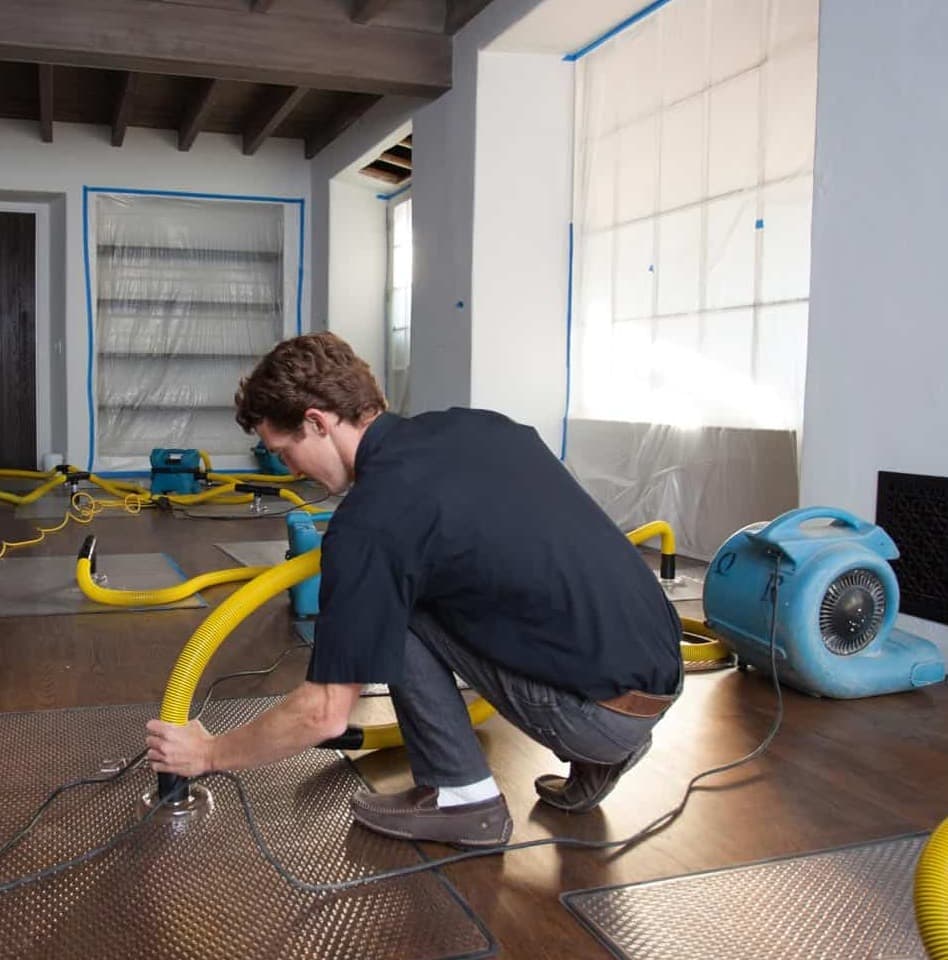
This is our home city, and the thing nobody tells you here is that access decides the job. Riverine exposure at Utica Junction, a 2014 flood that changed how this city buys insurance, and rear-yard fencing that determines whether a truck-mount or a portable unit ends up drying your basement. Free inspection and a written scope.
Rather talk now?Call (586) 277-1069
This page is published by Prime Restoration, a Michigan licensed residential builder dispatching from Sterling Heights. It covers what actually fails in Sterling Heights rather than what fails generally. Last updated 2026-07-31.
The short version
What is specific to this city
This is the operational fact that almost never makes it onto a restoration website, and in this city it is decisive. Rear-yard access across much of Sterling Heights is constrained by privacy fencing, and that single constraint determines what equipment can physically reach the loss.
A truck-mount extraction unit stays at the curb and runs hose. When the run is long or the side yard is tight, crews switch to portable extraction, which is slower per gallon and changes both the staging and the content pack-out plan. On a large loss that is not a detail, it is the difference between one day of extraction and two.
The geography adds a second layer. The Utica Junction area along the Clinton River near Dodge Park carries genuine riverine exposure, and homes in that corridor have documented basement infiltration during high-flow events. That is a different failure from the citywide backup pattern and it needs a different scope.
Then there is the housing split. Plumbrook, near Plumbrook Road and Van Dyke, is largely 1960s and 1970s ranch and tri-level with original galvanized supply lines and below-grade family rooms, which is why Category 2 and 3 losses complicate quickly there. The Lakeside corridor near Hall Road and Schoenherr is 1980s and 1990s colonial with finished basements over engineered I-joist floor systems, where the moisture hides in the webbing and careful mapping matters more than fast demolition.
What this city has been through
| Area | Where | Housing stock | What tends to fail | What that means for scope |
|---|---|---|---|---|
| Utica Junction | Along the Clinton River near Dodge Park | Mixed era, river-adjacent | Documented basement infiltration during high-flow events. Riverine, not sewer. | A different scope from the citywide backup pattern. Groundwater behaviour, not surcharge. |
| Plumbrook | Plumbrook Road and Van Dyke | 1960s-70s ranch and tri-level | Original galvanized supply lines; below-grade family rooms that are fully finished. | Category 2 and 3 complicate fast because the finished space sits below grade. |
| Lakeside corridor | Hall Road and Schoenherr | 1980s-90s colonial | Engineered I-joist floor systems holding moisture in the webbing. | Careful moisture mapping. The surface reading dry proves very little. |
| Citywide | Most residential streets | All eras | Rear-yard privacy fencing constraining equipment staging. | Truck-mount versus portable extraction, and the content pack-out plan, are set by access. |
The variable nobody writes about
Two identical losses on the same street can run very different timelines, and on a mitigation job timeline is most of the cost. The difference is usually physical access, which almost nothing written for homeowners covers and which is normally discovered on arrival rather than on the phone. Here is the whole list, so you can tell us the useful things in the first two minutes instead of us finding them out with a truck already loaded.
Whether a truck-mount can reach the water
A truck-mounted extraction unit sits at the curb and runs hose to the loss. It moves water far faster than anything portable, and on a large-volume basement that difference is most of day one. What stops it is hose distance and what the hose has to get through: a gated rear yard, a long side run, a corner it cannot turn. Where it cannot reach, crews go to portable units, which work fine and take longer.
Rear-yard privacy fencing
Common across most of this city, and it is the single most frequent access constraint we meet. A locked or narrow gate means equipment goes through the house instead of around it, which adds floor protection, adds trips, and changes where contents can be staged. None of this is a problem if it is known before the truck is loaded — it is only a problem when it is discovered on arrival.
Stair-only egress from a finished lower level
Everything that comes out of the room goes up a staircase by hand: wet carpet, saturated pad, drywall, insulation, contents. In a tri-level with a half-flight and a turn, that is slower per cubic foot than the same volume in a walkout. It is also where damage to the rest of the house happens if nobody has masked the path.
Where the contents actually go
A pack-out needs somewhere to put things. A dry garage or an unaffected room can hold a lot and keeps everything on site where you can see it. Where there is no dry space, contents leave the property, and then there is an inventory, a storage arrangement and a return trip. That is a real difference in both cost and how it feels, and you should be asked rather than told.
Where the dehumidifier condensate drains
Dehumidifiers pull real volumes of water out of the air and it has to go somewhere. A working floor drain or a laundry sink near the equipment means the units run unattended. Without one, they need pumping or emptying, which means someone has to be there, which changes the daily schedule.
Driveway and dumpster staging
On a demolition-heavy loss the debris needs a container, and the container needs a legal, non-destructive place to sit. Narrow drives, shared drives and short aprons all constrain that. Worth raising early rather than the morning the container is scheduled.
Power that can carry the equipment
Drying equipment draws real current, and in the 1960s and 1970s stock the available circuits in a finished lower level are frequently not sized for a full drying chamber. Sometimes the answer is spreading the load across circuits; sometimes it is a temporary supply. Either way it is a day-one question, not a discovery at 2am when a breaker drops the whole chamber.
Not a basement
A great deal of this city is tri-level and split-level, where the family room sits a half-flight down. That is not a basement and treating it like one is how these jobs go wrong. Six ways it differs, each of which changes the scope.
It is living space, not utility space
A tri-level family room a half-flight down is carpeted, drywalled, trimmed and often has a fireplace and built-ins. When water arrives there, nothing about the scope resembles a bare basement with a floor drain. Everything in the room is finish material.
There is frequently no floor drain
Utility basements have somewhere for water to go. Finished below-grade family rooms often do not, so water spreads laterally across the whole floor instead of finding a low point. That means more square footage affected from the same volume.
The wall assembly is the problem
Studs furred against a foundation wall with batt insulation and drywall over them is a cavity that cannot be inspected without opening it, sits directly against a cold masonry surface, and holds water at exactly the height that matters. This is where readings decide the job.
It is a half-flight from the rest of the house
Open stairs to the main level mean there is very little separating the affected air from the living space above. On a contaminated loss containment is not optional, and in this geometry it is harder to build than in a closed basement.
The mechanicals may be in the same room
Furnace, water heater and laundry are frequently in or adjacent to the finished area rather than in a separate utility space. Anything that took water gets evaluated by its own licensed trade before it is restarted, and that has to be sequenced on day one.
Recurrence hurts more
A repeat event in an unfinished basement is an inconvenience. A repeat event in a finished family room is the same rebuild twice. This is the housing type where the prevention conversation is worth having properly rather than being waved at.
Diagnosis
This city genuinely has three different mechanisms, and they are told apart by observation rather than by anything technical. It matters because they carry different categories, different drying plans and different coverage questions. Answer these five for yourself before anyone arrives — you will already know more about your own loss than most homeowners do at the end of the job.
| Question | Sanitary surcharge | Riverine | Groundwater |
|---|---|---|---|
| Where did it first appear? | Up out of the floor drain, or out of a basement toilet or laundry standpipe. The lowest opening connected to the sewer. | Through the foundation wall itself, or at the cove joint where wall meets floor. No drain involvement. | Cove joint, mortar seams, a cracked wall, or a window well. Often more than one point at once. |
| When did it start relative to the rain? | During the peak, often within minutes of the heaviest fall. It arrives fast and can stop as fast. | Lagging. Often hours after the rain stopped, and it can continue for a day or more as the river stays high. | Lagging and slow. It builds as the ground saturates and eases as it drains. |
| What did it look and smell like? | Discoloured, with solids or paper, and an unmistakable odour. Contaminated from the first minute. | Muddy and silty rather than sewage. Generally a lower category, though river water is not clean water. | Usually clear at first. It picks up whatever it crosses on the floor. |
| Did the neighbours get it too? | If the whole block went at once, it points at the street. If only your house did, it points at your own lateral. | Follows elevation and distance from the corridor rather than following the street. | Follows elevation and lot grading. The house at the low end of the block gets it and the one uphill does not. |
| What does it change? | Category 3 handling — containment, negative air, porous material out — before anyone assesses finishes. Coverage generally depends on a sewer-and-drain endorsement. | Generally a lower category, but a longer drying step because the surrounding ground stays saturated for days after the visible water is gone. Coverage generally depends on separate flood coverage. | Lower category, and the wall itself becomes the long pole — it keeps giving moisture back to the room after the floor reads dry. Coverage varies and is usually its own exclusion. |
Coverage determinations, payment decisions and settlement amounts are made solely by your insurance carrier after their own inspection. The coverage notes above are orientation, not a statement about your policy.
What moves the number
Typical ranges for this kind of work are published on our service pages, but the number for YOUR job comes from readings rather than from a phone call. What is publishable here is the list of things that actually move it, roughly in order of how much they move it here. If a contractor’s number changes after they arrive, one of these is the reason, and you are entitled to be told which.
Whether the affected space is finished
The largest swing in this city, because so much of the 1960s and 1970s stock has fully finished below-grade family rooms. The same water that costs almost nothing in a utility basement takes flooring, base, drywall, cavity insulation and built-ins out of a finished one.
Water category
A sanitary backup carries containment, negative air, antimicrobial treatment and removal of porous material before anyone assesses finishes. Riverine or groundwater intrusion is a different and generally lower-category job.
Access
Whether a truck-mount can reach the loss, whether everything has to go up a staircase by hand, and where contents can be staged. Access is a timeline variable, and on a mitigation job timeline is most of the cost.
Engineered floor systems
In the later Lakeside-corridor construction, I-joist webbing holds moisture well after the surface reads dry. It extends the drying step and raises the cost of getting the save-or-remove call wrong.
How long it sat
Category escalates with contact time and so does the removal list. It is the one variable a homeowner controls completely.
Sequence
Drying ends on a reading, not on a date, so none of this is a promise about hours. It is the order the steps have to happen in, and the one addition here is that the access walk happens on day zero rather than being discovered in the middle of the work.
Hour 0
Stop the source, then photograph
If water is still arriving, that is a plumber, the city or a sump problem rather than a restoration decision. Wide and close shots, timestamped, before anything moves.
Day 0
Moisture map, category, and an access walk
Readings against a dry standard from an unaffected part of the same house, the category decided from the source, and a walk of how equipment and debris will actually move through the property. The access walk is why we ask about your gate on the phone.
Days 1–2
Removal at the height the readings set
Containment first on a contaminated loss. Pad out, drywall cut above the highest wet reading, wet batt removed, path to the stairs masked before anything wet crosses it.
Days 2–5
Structural drying, logged daily
Air movement feeding dehumidification, with readings taken every day in the affected space, an unaffected space and outside. Equipment comes out on a reading, not a date.
Then
Rebuild, mechanicals resolved first
Anything that took water and belongs to a licensed trade gets handled before walls close over it.
Stopping the second one
This city has taken the same kind of event more than once, so prevention is not hypothetical. Each measure is listed with what it does not cover, because the households that spent money and still flooded usually bought the right thing for the wrong failure.
Backwater valve
What it does: Closes when flow reverses so a surcharging main cannot come back through the floor drain. In a city with this backup history it is the most directly relevant piece of hardware there is.
What it does not do: Address groundwater, riverine intrusion near the Clinton River corridor, or a supply line letting go upstairs.
Who does it: A licensed plumber, ideally after the lateral has been cameraed so you know whether the failure was the street or your own line.
Sump with a tested battery backup
What it does: Keeps the pit clearing when the power fails, which in these storms is the same hour it is needed.
What it does not do: Matter in a house with no drain tile feeding the pit, and it will not keep up if it was sized to trickle. Test it on the backup alone with the primary unplugged.
Who does it: Plumber to install, you to test twice a year.
Know whether your street is on the older lateral network
What it does: Tells you which problem you actually have. A house that backs up while the neighbours stay dry usually has a line condition rather than a street condition.
What it does not do: Change anything on its own. It changes what is worth spending money on next.
Who does it: A plumber with a camera, and the city for the street side.
Do not finish a below-grade room without solving the water first
What it does: The most valuable and least popular item on this list. Finishing a lower level that has taken water before converts a future inconvenience into a future rebuild.
What it does not do: Mean never finish it. It means valve, sump, grading and a dry season of observation come first, in that order.
Who does it: You, before you hire the finish carpenter.
Clear the gate and the path before you need them
What it does: Sounds trivial and is not. Knowing your own access, and telling whoever you call, is the difference between the right equipment arriving on the first trip and on the second.
What it does not do: Prevent water. It removes half a day from the response.
Who does it: You, when you call. Mention the fence, the gate width and whether the drive is shared.
Six inches of shelving in the lower level
What it does: Costs almost nothing and decides how much of a preventable event actually hurts. Cardboard wicks the full height of the box.
What it does not do: Prevent anything. It changes the consequences, which is worth doing anyway.
Who does it: You, this weekend.
Where we actually are
On an emergency we come to you, so most people never need this. It is here because being able to point at a real address in the city you are reading about is worth more than another paragraph saying we are local. If you want to drop off documents, collect something, or just confirm we exist before you call at two in the morning, this is where to find us.
Prime Restoration
13854 Lakeside Circle, Suite 558
Sterling Heights, MI 48313
Open directions in Google Maps →From I-696 or the Detroit side
Take Van Dyke — M-53 — north. Van Dyke runs the length of the city past Plumbrook and the older west-side grid. Stay on it to Hall Road (M-59), then head east past Mound and Schoenherr.
From M-59 / Hall Road
Hall Road is the main east-west route across the top of Sterling Heights and the road the Lakeside corridor is built around. The office sits on Lakeside Circle, the ring road at the Lakeside site at Hall and Schoenherr.
From Utica or Macomb Township
Hall Road (M-59) westbound. You will pass Hayes and then Schoenherr; Lakeside Circle is on the Lakeside property at that intersection.
From the Clinton River side of the city
From Utica Junction and Dodge Park along the river, take Utica Road south to Schoenherr, then Schoenherr north to Hall Road. This is the route through the part of the city with the documented riverine exposure.
Reference points rather than a service-area list. If you are near one of these, you already know roughly how far we are.
Not an emergency?
If water is actively running, call — do not use a form. This is for everything else: a stain you want read, a musty smell with no visible source, a second opinion on somebody else’s scope, or a quote for the rebuild half. The inspection, the moisture readings and the written scope are free either way.
24/7 Emergency
Free, no obligation, and you keep the readings whether or not you hire us.
(586) 277-1069The honest part
Sterling Heights is where we are based, so we will almost always be the fastest truck to your door. That is worth something on an active loss and we are not going to pretend otherwise.
But proximity is the easiest thing for any competitor to match on any given day, and it is not why a job goes well. If you are calling around, the questions worth asking any contractor here are whether they can actually get equipment to your basement given your side-yard access, whether they moisture-map engineered subfloor rather than reading the surface, and whether the same crew handles the rebuild. Those decide the outcome. Distance mostly decides the first hour.
On August 11, 2014, localised rainfall approached and exceeded four inches in a matter of hours and overwhelmed both the combined and separated systems serving the city. The result was thousands of Category 3 sewage backups in finished basements, and the scale of it visibly changed how households here buy coverage, with sewage-backup endorsements becoming far more common afterward. It can happen again, and it partially did in June and July 2021, concentrated in older subdivisions with under-sized laterals. What reduces your exposure is a working backwater valve, a sump with battery backup, and knowing whether your street is on the older lateral network.
It applies if you are in or near the Utica Junction corridor along the Clinton River near Dodge Park. Riverine exposure means the water arrives because the river is high, not because a sewer surcharged, and homes in that corridor have documented basement infiltration during high-flow events. It matters because the scope is different: the water is generally cleaner than a backup, the intrusion is through the foundation rather than a floor drain, and the drying plan has to account for surrounding ground that stays saturated for days after the visible water is gone.
It changes what equipment can reach the work, which changes the timeline, and timeline is most of the cost on a mitigation job. Rear-yard access across much of this city is constrained by privacy fencing. Where a truck-mount unit can run hose from the curb, extraction is faster per gallon. Where it cannot, crews use portable units, which take longer and change how contents are moved and staged. It is worth mentioning your access when you call, because it lets us bring the right equipment on the first trip instead of the second.
Age, and therefore failure mode. Plumbrook, around Plumbrook Road and Van Dyke, is largely 1960s and 1970s ranch and tri-level, and those homes commonly retain original galvanized supply lines with fully finished below-grade family rooms, so a supply failure lands directly in finished space. The Lakeside corridor near Hall Road and Schoenherr is later colonial construction over engineered I-joist floor systems, where the risk is not the water you see but the moisture held in the joist webbing after the surface reads dry. One needs speed, the other needs patience and measurement.
Usually, yes, and we will tell you honestly if a given call is one where someone else can be there sooner. But speed only decides the first hour. If water is still running, the priority is stopping it, and if that means a plumber or the city rather than us, we will say so on the phone rather than send a truck to sit in your driveway.
Not necessarily, and below-grade finished space is the case where that assumption is most expensive. Concrete, the bottom plate, framing behind drywall and pad under carpet all hold water long after the floor looks normal, and on wet porous material growth can begin in roughly 24 to 48 hours. Whether you have a problem is a short moisture-meter check rather than a guess. If the readings come back at dry standard we will tell you that and leave, and it costs nothing either way.
Your access, and it makes a genuine difference. Whether there is a fence and a gate to the rear yard and roughly how wide the gate is. Whether the drive is shared or narrow. Whether the affected room is reached only by a staircase with a turn in it. Whether there is a working floor drain or a laundry sink near where equipment would sit. Whether you have a dry garage or spare room where contents could be staged. That set of answers decides whether we bring a truck-mount or portable extraction, how much floor protection to load, and whether a pack-out stays on your property or leaves it. None of it is unusual and all of it is normally discovered on arrival, which costs half a day. Two minutes on the phone removes that.
Not for the purposes of this work, and treating it like one is how these jobs go wrong. A tri-level or split-level family room a half-flight below grade is finished living space: carpeted, drywalled, trimmed, often with built-ins and a fireplace. There is frequently no floor drain, so water spreads laterally across the whole floor rather than finding a low point, which means more square footage affected from the same volume. The wall assembly is usually studs furred against the foundation with batt insulation and drywall over them, which is a cavity nobody can inspect without opening it and which sits against a cold masonry surface. And the open stairs to the main level mean there is very little separating that air from the rest of the house, so on a contaminated loss containment matters more here and is harder to build than in a closed basement.
It can, and in the older stock it is worth planning for rather than discovering. A drying chamber draws real current, and the circuits available in a 1960s or 1970s finished lower level are frequently not sized for a full set of air movers plus dehumidification. The usual answer is spreading the load deliberately across circuits, sometimes running from an unaffected part of the house, and occasionally arranging a temporary supply. What you do not want is a breaker dropping the whole chamber at two in the morning and nobody noticing until the next visit, because those are lost hours the readings will show. Ask whoever sets up your equipment which circuits they are on.
Only after the water is genuinely solved, and that order matters more than anything else on this page. Finishing a below-grade room that has taken water before does not create risk, it converts a future inconvenience into a future rebuild — the same drywall, insulation, flooring and trim, twice. The sequence worth following is: find out whether the cause was the street or your own lateral, put in the hardware that addresses the actual cause, fix grading and downspout discharge, then watch it through a full wet season including a thaw. If it stays dry through that, finish it. If it does not, you have saved yourself the second rebuild. We would rather say this than sell you the finish work twice.
Sources
Neighbourhood boundaries, housing-era descriptions and infrastructure notes reflect publicly known Sterling Heights development patterns. The weather events named are documented Southeast Michigan storms. Water categories, growth timing and structural drying practice follow the restoration industry standard. Permit and code requirements should be confirmed with the local building department for your specific work. No customer, address or job is described anywhere on this page. Prime Restoration publishes this page and no company paid to be referenced on it.
24/7 dispatch across 48310, 48312, 48313 and 48314. Free inspection with moisture readings and a written scope, and an honest answer about whether you need us at all.
Call (586) 277-1069Prime Restoration is a Michigan licensed residential builder (#262500492) and a full-service restoration contractor serving Sterling Heights and the surrounding area from Sterling Heights. Nothing on this page is legal, insurance, plumbing, electrical or engineering advice. Coverage determinations, payment decisions and settlement amounts are made solely by your insurance carrier after their own inspection. Scope and cost are set from actual moisture readings and affected square footage.
The housing stock changes faster than the drive time does. Each of these is a different problem rather than the same page with the city name swapped.
Local Sterling Heights branch · 3.5 miles from the center of Sterling Heights · on site in 25 minutes
Prime Restoration's Sterling Heights Headquarters is at 13854 Lakeside Circle, Suite 558, Sterling Heights, MI 48313, 3.5 miles from the center of Sterling Heights. From this branch a crew is typically on site in 25 minutes, 24/7, across Plumbrook, the Lakeside corridor near Hall Road and Schoenherr, and Utica Junction along the Clinton River by Dodge Park. The crew is set up for the homes here: Plumbrook ranches and tri-levels with below-grade family rooms, 1980s and 1990s colonials with finished basements, and river-adjacent basements that take water in high-flow events.
Homeowners highly recommend the branch for customer service: 5.0 on Google from 147 reviews, and one project manager answers your calls from the first visit to the last repair. Every job gets detailed, itemized documentation for your insurance claim: dated moisture readings, photos and a line-item estimate your adjuster can check. Call (586) 277-1069.
Prime Restoration
A crew is typically on site in 25 minutes, 24/7, from our Sterling Heights headquarters.
Open in Google Maps →In Sterling Heights, our crew handles flooded basements, burst pipes, sump pump failures, water heater leaks, sewage backups and ceiling leaks, including water damage from a roof leak. When water sits too long, we handle mold remediation, from basement mold to black mold removal.
Before you call, read what to do in the first 24 hours after water damage, check what water damage restoration costs in Michigan or what mold remediation costs, and see how to prevent mold after water damage.
Read about Prime Restoration, a family water damage restoration business since 1988, led by Cole Hartwell, Certified Water Damage Specialist. See our 147 five-star Google reviews. We are a Certified Best Pick and an IICRC Certified Firm. For customer support and insurance coordination, we work with all insurance companies, give your adjuster the moisture readings, photos and itemized estimate, and keep in contact until the last repair. Customers say we “kept in contact and explained the whole process.” Ask about 0% APR financing, read how homeowner's insurance treats water damage in Michigan, or find answers in our water damage FAQ.
Our Sterling Heights office also handles commercial water damage restoration for stores, restaurants, offices, medical and dental offices, manufacturing and multi-family buildings. Past commercial clients includePetco, Linamar, Quest Diagnostics and the Somerset Collection. A crew is on site in 25 minutes, 24/7, and we contain the wet area so the rest of the building can keep operating. Property managers and business owners can join Property Pro, our free priority program with priority scheduling, one point of contact and a property file on record, or book a free walkthrough for a commercial emergency ready plan.
From our Sterling Heights office we also reach Utica, Fraser, Clinton Township, Shelby Township, Warren, Troy, Center Line and Clawson.
water damage restoration in Birmingham, water damage restoration in Troy, water damage restoration in Macomb, water damage restoration in Shelby Township, water damage restoration in Rochester Hills, water damage restoration in West Bloomfield and water damage restoration in Ann Arbor. See every city we serve.