
Four rivers drain this county and one of them runs the wrong way. Where you sit in that system, and which retention basin is above you, decides what your basement loss actually is. On site in 25 minutes. The estimate is free.
Rather talk now?Call (586) 277-1069
Comparing companies? Read Water Damage Restoration Contractors in Oakland County, MI: 12 Companies Compared.
This page is published by Prime Restoration, a Michigan licensed residential builder with four Oakland County offices, in Birmingham, Troy, Rochester Hills and West Bloomfield. It covers what actually fails here, county band by county band, rather than what fails generally. Every infrastructure figure and every dated event below is sourced at the bottom of the page. Last updated 2026-09-02.
What the work looks like
Extraction, readings, controlled drying, then the rebuild. The same crew and the same equipment on every job, and a written scope you keep.
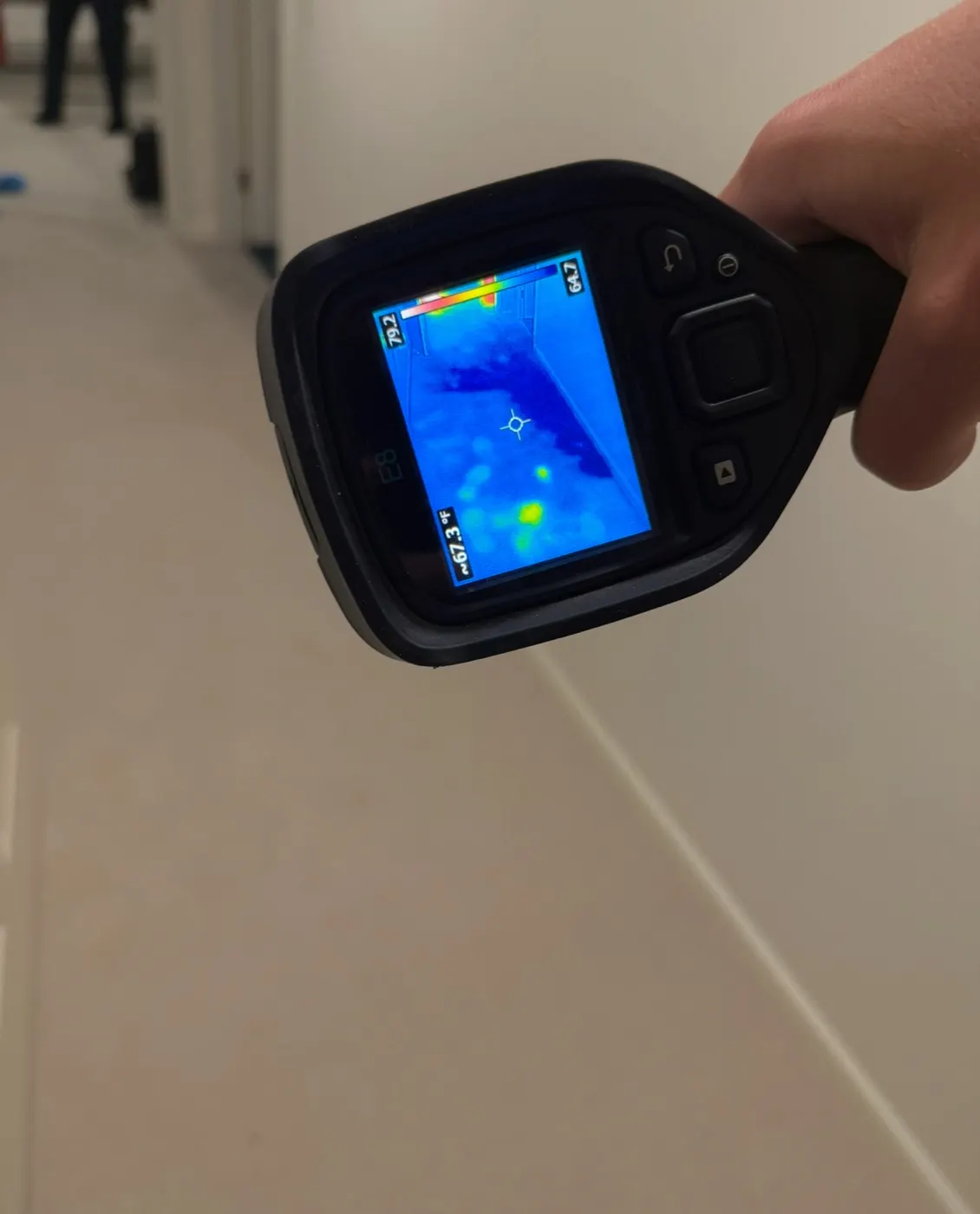
Thermal imaging finds water behind a wall before anything is opened up.
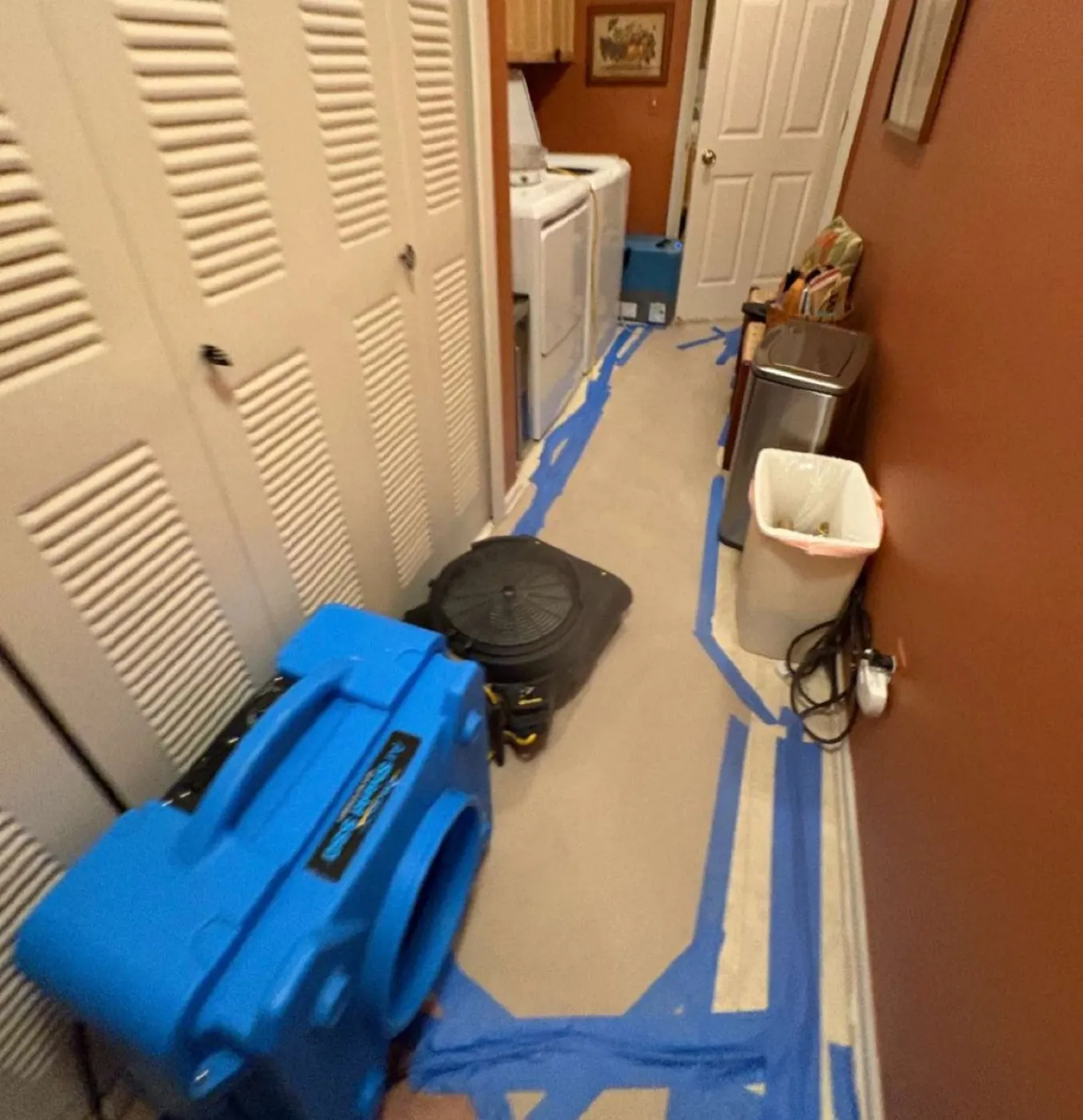
Air movers set along the wet wall, running until the readings say stop.

Every reading is taken against a dry standard from an unaffected room.

The camera shows where water travelled, which is rarely where it got in.
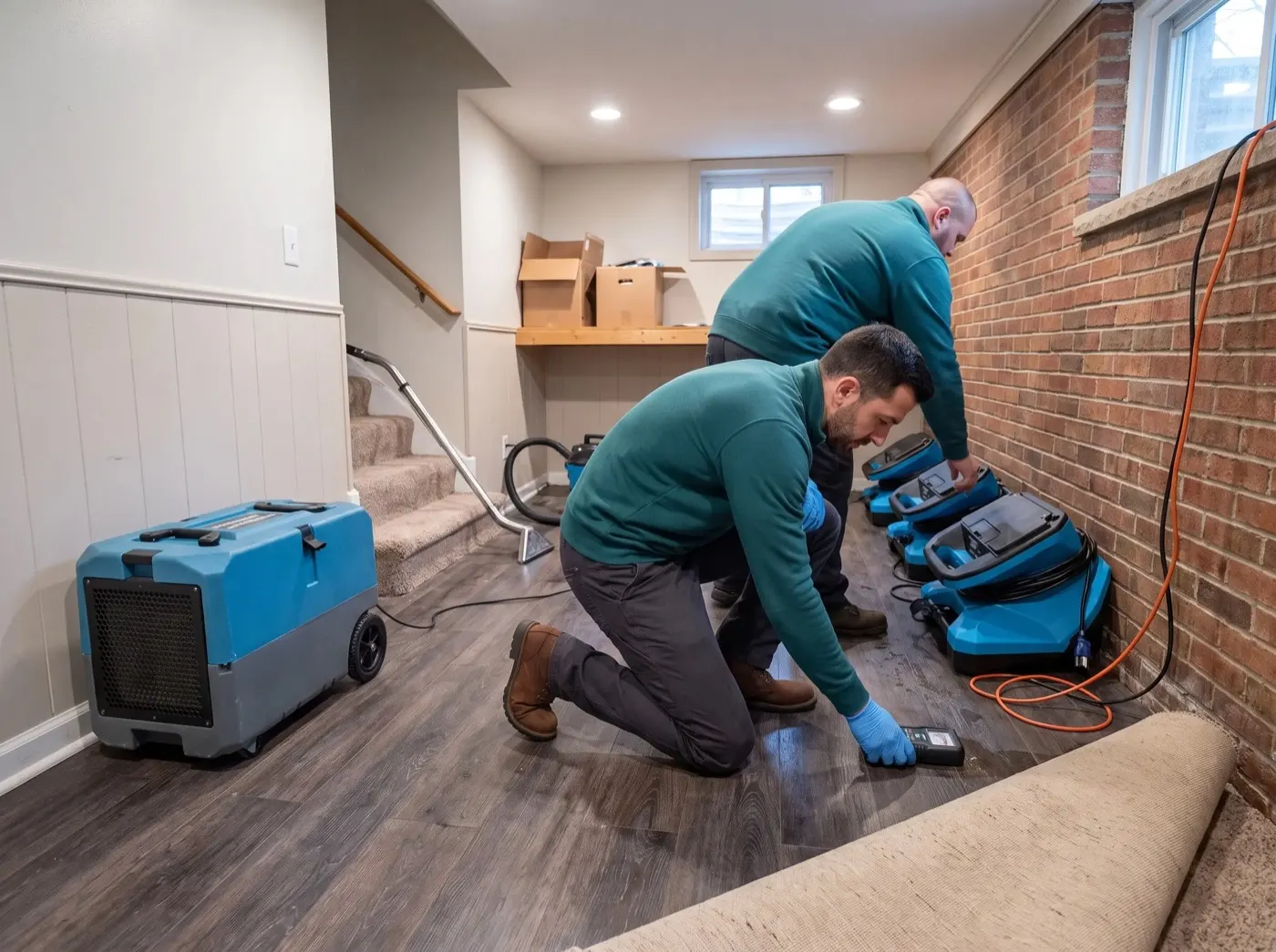
Carpet back, pad out, slab read before any drying equipment is placed.

A straight flood cut above the water line, so the cavity dries and the patch is clean.

Cabinet toe-kicks opened, because a sink leak hides under the boxes.

Drywall removed only to the height the readings justify, never higher.

A bathroom floor that reads wet gets the subfloor opened and dried, not covered.
The thing nobody writes down
Because they are usually in different systems. Most restoration copy written about this county treats it as one place with one answer. It is 907 square miles, 868 of them land, holding 1,274,395 people across 62 cities, villages and townships, and 387 lakes. That is not a market. It is four markets wearing one name.
Start with the water rather than the streets. Four separate rivers drain Oakland County: the Clinton, the Rouge, the Huron and the Shiawassee. Three of them run south and east toward Lake St. Clair or Lake Erie. The fourth does not.
The Shiawassee River rises at Shiawassee Lake in Springfield Township, inside this county, and runs about 110 miles north to the Tittabawassee, then the Saginaw River, then Saginaw Bay and Lake Huron. So a drainage divide runs through the northwest of Oakland County. Rain landing on one side of a Springfield Township road ends up in Lake Huron. Rain on the other side ends up in Lake St. Clair.
That is not trivia and it is not decoration on a service page. It is the reason a north-county water table, soil profile and surface-drainage pattern behave nothing like a southeast-county one, and the reason advice written for a Royal Oak basement is close to useless in Holly. When a company quotes you one method for the whole county, they are describing a franchise process rather than a place.
Layer two is the pipe. Some of this county runs rain and waste in the same line and some runs them separately, and that single fact decides whether water at your floor drain is a contaminated loss or a clean one. Layer three is the decade your foundation was poured, which decides whether it is stone, block, concrete, a crawl space or a walkout. Three layers, four bands, and no single answer.
Layer one
Find yourself in this table before you read anything else on this page. Which river you drain to sets your groundwater behaviour, and whether the nearest public drainage is a tunnel, a county drain or a roadside ditch.
| River | Where it rises | Where it ends | Scale | What it means for a basement |
|---|---|---|---|---|
| Clinton River | Wetlands and coldwater tributaries inside Independence, Brandon and Springfield townships | Lake St. Clair at Harrison Township, 83 miles downstream | 760 square miles of watershed, more than 1.4 million people across 60-plus municipalities | The drainage most Oakland County losses belong to. Its Red Run tributary is the pipe that carries the southeast county away, and it crosses into Macomb County to do it. A basement in Troy, Royal Oak or Madison Heights is upstream of a system that ends in somebody else’s county. |
| Rouge River | The main branch heads up in the southwest corner of Rochester Hills and the northeast corner of Bloomfield Township | The Detroit River at Zug Island, 127 miles downstream, and from there Lake Erie | 467 square miles across four branches, all or part of 48 municipalities and more than 1.35 million people | Four branches means four separate flood behaviours under one river name. Three of the county’s four retention treatment basins sit in this watershed, which tells you where the old combined pipe is concentrated. |
| Huron River | The northwest and west of the county, through the chain of lakes country | Lake Erie, well south of the county line | The western drainage, and the one that carries almost none of the county population density | Low-density lake and wetland country. Losses here are groundwater and lake-level driven far more than they are pipe driven, and the nearest municipal storm system is often a ditch. |
| Shiawassee River | Shiawassee Lake in Springfield Township, inside Oakland County | The Tittabawassee, then the Saginaw River, then Saginaw Bay and Lake Huron, 110 miles later | The one that runs the other way | This is the fact that reframes the whole county. Water that lands on one side of a Springfield Township road ends up in Lake Huron. Water on the other side ends up in Lake St. Clair. The northwest of Oakland County is not upstream of Detroit at all, and it does not share the water table, the soil profile or the drainage assumptions of the southeast. |
One detail in that table is worth pulling out. The Clinton and the Shiawassee both take headwater from Springfield Township. The same township feeds two different Great Lakes. If you want to see the divide on a map rather than take our word for it, that is where to look.
Layer two
A combined sewer carries rain and waste in one pipe. When enough rain arrives at once the system surcharges, and the path of least resistance is backward into the lowest opening in the nearest building. That makes it a contaminated loss from the first minute rather than a wet-carpet problem that turns dirty later. A separated system keeps storm water in its own line, so a backup means something else went wrong and the category is genuinely an open question.
Nobody hands homeowners a map of which is which. The closest public proxy is which retention treatment basin sits above you. The Oakland County Water Resources Commissioner operates four. Three are in the Rouge watershed and one is in the Clinton.
George W. Kuhn Retention Treatment Basin
Madison Heights, at the head of the Red Run Drain · Clinton River watershed
Holds 150 million gallons. Its drainage district covers 24,500 acres upstream of the Red Run and serves all or part of fourteen named communities.
Why it matters to you: The largest single reason a southeast Oakland County floor drain is a contaminated-water risk. When the basin fills, disinfected combined flow leaves through the Red Run Drain at the Oakland and Macomb county border. In an ordinary year that happens eight to ten times.
Acacia Park Retention Treatment Basin
Beverly Hills · Rouge River watershed
Serves a Rouge River tributary area in Beverly Hills. The Water Resources Commissioner publishes its tributary acreage, storage volume and the storm it was designed against.
Why it matters to you: Read the design standard rather than the capacity. A basin is sized against a stated storm, and that figure is a specification, not a promise about a hundred-year storm. It is the honest answer to why Beverly Hills and the streets around it still take water in a large event.
Birmingham Retention Treatment Basin and Tunnel
Birmingham · Rouge River watershed
Serves a Rouge River tributary area under Birmingham. Acreage and capacity are published by the Water Resources Commissioner.
Why it matters to you: A city with its own basin is a city with its own combined-sewer history. Older sections near the Birmingham core still run rain and waste in one pipe, which is why an identical rainfall produces a different category of loss there than in a 1990s subdivision four miles north.
Bloomfield Village Retention Treatment Basin
Birmingham · Rouge River watershed
The fourth of the four county basins, and the second inside Birmingham city limits.
Why it matters to you: Two basins inside one small city is the clearest signal in the county about where the old pipe is. If you are in or near Bloomfield Village, treat a floor drain event as contaminated until somebody proves otherwise.
Check your own city against this list
Formerly the Twelve Towns Drainage District. It covers all or part of these fourteen, across 24,500 acres upstream of the Red Run Drain. The original Twelve Towns Drain was built in 1962 and 1963; the Kuhn basin itself was started in October 2001 and finished in 2005.
Two cautions on using this list. First, the district covers all or part of each community, so being on it does not mean every street in your city is affected, and Troy is the clearest example of a large city with only part of its area in the district. Second, sitting in the district is not the same as sitting on a combined pipe. Confirm your own address with the Water Resources Commissioner or your city before you treat this as a finding about your house. What the list does tell you reliably is where to be suspicious, and suspicion is the correct default when water arrives at a floor drain.
Layer three
This county went from farmland to more than 1.27 million people in waves, and each wave built a different basement. The bands below are general development patterns, not claims about any address. What they are good for is knowing which first question applies to you, because the four bands do not share one.
| Band | Where | Dominant era | Below grade | What tends to fail | What that means for scope |
|---|---|---|---|---|---|
| The inner ring | Ferndale, Hazel Park, Pleasant Ridge, Huntington Woods, Berkley, Oak Park, Royal Oak | Pre-war through the early 1940s | Stone and block foundations, partial basements, original shallow window wells | Combined connections below and lateral seepage through mortar seams at the same time. Two directions in one storm. | Assume contaminated water at the floor drain. Assume plaster and original hardwood upstairs, which turns tear-out into a replication decision rather than a materials line. |
| The postwar build-out | Troy, Madison Heights, Clawson, Southfield, Farmington, Oak Park south | Roughly 1955 to 1980 | Poured concrete full basements, block in the earlier stretch, cove joints and interior drain tile in the later stretch | Sanitary line surcharge and sump failure rather than combined overflow. Cove-joint seepage where the wall meets the floor. | Wider save window on materials, because the finishes are drywall and mid-century hardwood rather than plaster. The long pole is usually the concrete itself, which gives moisture back slowly. |
| The lakes district | West Bloomfield, Commerce Township, Waterford, White Lake, Walled Lake, Keego Harbor, Sylvan Lake, Orchard Lake Village, Union Lake | Mixed. Original lake cottages, 1960s infill, and 1990s replacement builds on the same street | Crawl spaces and shallow basements in the original cottages, full basements in the newer stock, high seasonal water table throughout | Hydrostatic pressure and groundwater, not pipes. A pump that cannot keep up, or a crawl space that never dries between events. | The crawl space is the job. Vapour barrier condition, standing water, and joist and subfloor moisture read from below. A crawl space dried by opening a hatch and leaving a fan in it has not been dried. |
| The north and the divide | Springfield, Independence, Brandon, Rose, Holly, Groveland, Oxford, Addison, Clarkston, Lake Orion | Rural into the 1980s, then walkout and daylight subdivisions | Walkout and daylight basements cut into grade, private wells and septic in the rural stretch | Water entering at the walkout door and window level, driven by surface grade rather than by any municipal system. Septic backup where there is no municipal sanitary line to surcharge. | Different first question. Not what came up the drain, but where the grade fell toward the door. A walkout takes water from above, and the fix is often landscaping rather than plumbing. |
Dated, with sources
Three entries, each with a date and a published figure. We do not print storm anecdotes without one.
August 11, 2014
The National Weather Service Detroit office records 4 to 6 inches of rain falling over a 4 hour period, with Wayne, southern Oakland and Macomb counties taking the worst of it. This is the event the inner ring still measures itself against, and it is the reason the combined-sewer question in the fourteen Kuhn communities is not academic.
June 25 to 26, 2021
The same office recorded storm totals of 4.39 inches at Bloomfield Township, 4.34 inches at Franklin, 4.11 inches at Bloomfield Hills and 4.01 inches near Davisburg, inside a widespread 3 to 5 inch event with localised 6 to 8 inch amounts across Metro Detroit. Note where the highest county numbers landed: the Rouge watershed, above the three retention basins.
Ordinary years, eight to ten times
Oakland County releases partially treated combined stormwater and sewage after heavy rain between eight and ten times a year, according to reporting by Tracy Samilton for Michigan Public in September 2024. The state environmental agency has stated those releases are in compliance with federal and state discharge regulations. Compliance is a legal status, not a description of what reaches a basement.
What moves the number
The estimate is free, and the number for your job comes from readings rather than from a phone call. What is publishable is the list of things that actually move it, in rough order of how much they move it across this county. If a contractor’s number changes after they arrive, one of these is the reason, and you are entitled to be told which.
Water category, which the pipe above you largely decides
Contaminated water changes the job before anyone looks at a finish. Containment goes up first, porous material in the affected area comes out rather than being dried, and the drying step does not start until removal is finished. In the fourteen Kuhn communities a floor drain event starts from that assumption. In a 1975 Troy subdivision it genuinely does not.
How much came out against how much was dried in place
Every square foot dried is a square foot nobody rebuilds. This is why the drying decision belongs to a meter on day zero and not to a saw on day one, and it is the largest single lever a homeowner has any influence over.
Whether the material is bought or replicated
Drywall is a consumable. Plaster over wood lath, original quarter-sawn oak, leaded glazing and 1920s trim profiles are a millwork trade at a millwork price. This is why an inner-ring loss and a postwar loss of identical square footage are not the same number.
What the below-grade structure is
A stone wall, a block wall, a poured wall, a crawl space and a walkout all release moisture on different curves. A stone or block wall keeps handing moisture back to room air for days after the floor reads dry, which lengthens drying. A crawl space has to be dried from inside the crawl space.
Whether the cause was fixed before drying started
Drying against an active source is money spent twice. If the source is a supply line, a lateral, a sump or a grade problem, that gets closed out first, and sometimes by a different trade than ours.
Access and staging
Where a truck-mount can run hose, extraction is fast per gallon. Where it cannot, portable extraction is slower and staging changes. Narrow inner-ring lots and long lake-district driveways both cost time in ways square footage never shows.
Sequence
Drying ends on a reading rather than on a date, so nothing below is a promise about hours after the first row. It is the order the steps have to happen in.
Hour 0
Stop the source, then photograph
If water is still arriving, that is a plumber, the city, or a shutoff valve, and it comes before anyone else. Then wide shots and close shots, timestamped, before a single item moves.
Hour 1
On site in 25 minutes
That is our dispatch target across Macomb and Oakland County, 24 hours a day. What arrives is a meter and a camera, not a contract.
Day 0
Moisture map, category call, written scope
Readings taken against a dry standard from an unaffected part of the same house in the same material. A category decision with a stated reason. A written scope you keep. The estimate is free.
Days 1 to 2
Removal only where the readings require it
Containment first on contaminated water. Original glazing, millwork and salvageable plaster protected rather than cleared. The list of what comes out exists before the saw does.
Days 2 to 6
Structural drying, logged daily
Longer on block and stone than on poured concrete, and longer in a crawl space than in a basement. It ends on a reading rather than on a date.
After dry standard
Rebuild, sequenced
Nothing closes up over a wet cavity. Replication trades are booked rather than assumed, which is a scheduling conversation on inner-ring housing and a warehouse pickup on postwar housing.
Mold that followed water
More people search this county for mold than for water, which is backwards from how the work arrives. Almost everything found here grew because something was wet first. That is the frame worth holding, and it also sets the boundary of what a restoration contractor is entitled to tell you.
It is a moisture problem with a biological symptom
Growth follows water. Fix the water and the growth has nothing to work with. Any plan that treats the growth and leaves the moisture source in place is a plan to do the work twice, and that is true whether the source is a lateral, a grade fall, a crawl space with no vapour barrier or a sump that stopped.
Where it starts in each of the four bands
Inner ring: behind plaster on an exterior wall, and in the joint between original millwork and the wall it is fixed to. Postwar: the bottom band of drywall and the paper facing behind it, plus the underside of a subfloor over a cove-joint leak. Lakes district: the crawl space, on joists and subfloor, from below. North county: at the walkout door threshold and the window frames beside it.
Containment is not decoration
Disturbing growth without containment moves material through the rest of the building. In a house with open stairs and original ductwork there is very little separating a lower level from the living space. This is why the sequence is containment, then removal, then drying, and never the reverse.
Testing and clearance come from somebody who is not us
The company that performs the removal should not be the company that certifies the removal worked. If you want the space tested before or after the work, use an independent indoor environmental professional or industrial hygienist you hire directly. We will work to their protocol and their clearance criteria. We will not write our own report card, and you should be wary of anyone who offers to.
What we will not tell you
We do not identify species, we do not interpret a lab result, and we do not make statements about health. Those are outside a restoration contractor’s lane. Questions about health belong to a physician, and questions about what is in the air belong to the hygienist.
Stopping the second one
Most houses in this county that take water once take it again, because the cause is usually infrastructure or grade rather than an accident. Each measure below is listed with what it does not cover and which county band it pays off in, because a measure that solves one direction feels like a failure when water arrives from the other.
Backwater valve on the sanitary lateral
What it does: Closes a one-way gate when flow reverses, so a surcharging main cannot push back through the lowest opening in the building.
What it does not do: Nothing about groundwater through a wall, nothing about a failed sump, and nothing about surface water at a walkout door. In a large storm more than one of those is usually happening.
Who does it: A licensed plumber. Camera the lateral first. A valve on a collapsed line solves the wrong problem at full price.
Where it pays: Highest value in the fourteen Kuhn communities and the older Rouge-watershed cities.
Sump pump with a backup that does not need the grid
What it does: Keeps the pit clearing when the primary pump fails or the power goes out, which in the storms that cause these losses is the same moment.
What it does not do: Help a house with no interior drain tile feeding the pit. A pump can only move water that reaches it, and a good deal of pre-1960 stock has no tile at all.
Who does it: A plumber for the install, you for the test. Pour a bucket in the pit twice a year and watch the full cycle with the breaker off.
Where it pays: Load-bearing everywhere, and close to mandatory in the lakes district.
Downspout extension and lot grading
What it does: Moves roof discharge six to ten feet out and re-establishes fall away from the wall. The cheapest measure available and the most skipped.
What it does not do: Anything at all for a sewer surcharge. This is a seepage and surface-water measure.
Who does it: Homeowner or landscaper. On a narrow inner-ring lot, falling away on all four sides is sometimes not geometrically possible, and that is worth knowing before paying for it.
Where it pays: The single best measure at a north-county walkout.
Window well drains and covers
What it does: Stops a below-grade well filling and pushing water through the frame. A common entry point where the wells are original and shallow.
What it does not do: Address a well with no drain at all, which is common in pre-war stock. A cover on an undrained well can hold water rather than shed it if it is not sealed to the wall.
Who does it: Homeowner scale. Check whether the well has a working drain before buying covers.
Where it pays: Inner ring, and any walkout with wells cut below grade.
Crawl space vapour barrier and a way to dry it
What it does: Separates the living structure from ground moisture, and gives you a space that can actually be dried after an event rather than one that stays damp until August.
What it does not do: Stop water entering. A barrier manages vapour. Bulk water needs a grade fix, a pump, or both, and a barrier laid over standing water hides the problem instead of solving it.
Who does it: A contractor for the barrier. You for the twice-a-year look with a torch.
Where it pays: The lakes district measure, and the one most often missing.
Six inches of elevation under anything irreplaceable
What it does: Changes what a preventable event costs you on the items you actually care about. No permit, no trade, no scheduling.
What it does not do: Prevent anything. It reduces consequence, which is a different and equally useful thing.
Who does it: You, this weekend.
Where it pays: Every band. Nobody does it.
Before anyone starts
These work on our estimate as well as anyone else’s, which is the point of publishing them. A homeowner standing on a wet floor at eleven at night has very little leverage, and a short list of the right questions is most of the leverage available.
“What category are you treating this as, and what made you decide that?”
Category drives containment, removal and protective equipment, so it is the first answer that matters. On a suspected sanitary or combined backup the answer should be the contaminated category and it should be immediate rather than pending a result.
“What is the dry standard you are measuring against, and where did you take it?”
A moisture reading with no baseline is a number with no meaning. The dry standard comes from an unaffected part of the same building, in the same material. If nobody can produce one, drying is being judged by feel.
“What are you removing, and what are you attempting to dry in place?”
Ask for the list before the saw comes out, with a reason attached to each line. This is where money is made or lost, especially on anything built before 1950.
“What ends this job, a date or a reading?”
The correct answer is a reading. Equipment pulled on a schedule rather than on a meter is the most common origin of growth found six weeks later.
“Who is testing, and do they work for you or for me?”
On any mold scope, the remediator should not be the party certifying the remediation. If the same company offers to test, remediate and clear, that is one company grading its own work.
“Are mitigation and the rebuild the same company, and if not, who owns the seam?”
The handoff between trades is where original material gets lost and where schedules die. One accountable party is worth more on pre-war housing than a slightly lower line item.
“Are you licensed in Michigan for the rebuild, not just the cleanup, and can I see it?”
These are two different questions and most homeowners ask only the first. Read the next section before you accept a business card as an answer.
“Will you put the scope in writing before anything is removed?”
A written scope with readings attached is the document that protects you. Verbal scope on a wet floor at eleven at night is not a scope.
Licensing
For the cleanup, Michigan does not issue a restoration licence. For putting the house back together, it does, and most homeowners never separate the two questions.
Residential building work is regulated under Article 24 of the Michigan Occupational Code, at MCL 339.2401 through 339.2412. It reaches the repair, alteration, addition, subtraction or improvement of a residential structure for compensation. There is an exemption where the aggregate contract price for labour, material and every other item on one project comes to less than 600 dollars, and the statute expressly closes the obvious loophole: the exemption does not apply where the work forms part of a larger operation, or where a job has been divided into contracts under 600 dollars to get beneath the line.
Apply that to a real loss. A rebuild after a flooded lower level passes 600 dollars on the first invoice, so the rebuild side is licensed work in Michigan. Ask for the number, then check it with the state rather than accepting a business card or a logo on a truck.
Prime Restoration is MI Residential Builder #262500492. Nothing in this section is legal advice, and licensing rules change. Confirm current requirements with the state before you rely on any of it.
The honest part
Birmingham at 801 S Adams Rd. Troy at Coventry Place, 1621 W Big Beaver Rd. Rochester Hills at Hampton Professional Park, 705 Barclay Cir. West Bloomfield at 5600 W Maple Rd. From the nearest of those, a crew is typically on site in 25 minutes, 24 hours a day, anywhere in the county.
This is the most competitive restoration market in the state, so the thing worth comparing is not who owns the closest building. It is who carries the whole job. We are a licensed Michigan residential builder as well as a restoration contractor, which means one accountable crew holds mitigation and the rebuild together and nobody hands your job across a seam.
On inner-ring Oakland County housing, with plaster over wood lath and original hardwood, that seam is most of the risk in the job. Material that gets torn out by one trade cannot be replicated by the next, and the handoff is where schedules die.
The clearest public signal is which retention treatment basin sits above you. The Oakland County Water Resources Commissioner operates four. Three are in the Rouge River watershed: the Acacia Park basin at Beverly Hills, the Birmingham basin and tunnel, and the Bloomfield Village basin, also in Birmingham. The fourth is the George W. Kuhn basin in the Clinton River watershed, whose drainage district covers all or part of fourteen communities: Berkley, Beverly Hills, Birmingham, Clawson, Ferndale, Hazel Park, Huntington Woods, Madison Heights, Oak Park, Pleasant Ridge, Royal Oak, Royal Oak Township, Southfield and Troy. If your city is on that list, or you are near one of the Rouge basins, treat water arriving at a floor drain as contaminated until somebody proves otherwise. That is a scope decision, not a scare. Confirm your own address with the Water Resources Commissioner or your city, because the districts cover parts of communities rather than whole ones.
Because they are usually in different systems, and often in different watersheds. This county is drained by four rivers. The Clinton takes the north and east toward Lake St. Clair, the Rouge takes the southeast toward the Detroit River, the Huron takes the west toward Lake Erie, and the Shiawassee takes the northwest away from all of them toward Saginaw Bay. Underneath that, one street may be above a combined pipe carrying rain and waste together, and the next may be above a separated system where the storm water has its own route. Then the decade the house was built decides whether the foundation is stone, block, poured concrete, a crawl space or a walkout. Those three variables produce very different losses out of identical rainfall, and none of them are about the quality of the contractor either homeowner called.
The Shiawassee River rises at Shiawassee Lake in Springfield Township, inside Oakland County, and runs roughly 110 miles to join the Tittabawassee, form the Saginaw River and empty into Saginaw Bay on Lake Huron. Everything else in the county eventually reaches Lake St. Clair or Lake Erie. So a drainage divide runs through the northwest of the county, and Springfield Township sits on it. This is not trivia. It is why a north-county water table, soil profile and surface-drainage pattern do not behave like a southeast-county one, and why advice written for Royal Oak basements is close to useless in Holly or Rose Township. When somebody quotes you a single method for the whole county, they are describing a franchise process rather than a place.
Our dispatch target is on site in 25 minutes, 24 hours a day, and we run to the county on I-696, M-59, I-75, Woodward and Telegraph depending on where you are. We deliberately do not publish a minutes-by-city table, because any number we printed would be a guess about traffic on I-696 at an unknown hour, and a number we cannot stand behind is worse than no number. Four of our eight offices are inside the county — Birmingham, Troy, Rochester Hills and West Bloomfield — so for most Oakland County addresses the nearest crew is already here rather than coming over from Macomb.
We handle remediation of growth that followed a water loss, which is the overwhelming majority of what is found in this county. We do not test, and that is deliberate. The company removing the growth should not be the company certifying that the removal worked, because that is one company grading its own homework. If you want the space assessed before the work or cleared afterwards, hire an independent indoor environmental professional or industrial hygienist directly, and we will work to their protocol and their clearance criteria. We do not identify species, interpret laboratory results or make any statement about health. Those questions belong to the hygienist and to your physician.
Substantially, and the difference is structural rather than stylistic. The inner ring built stone and block foundations before the war, sits on the oldest pipe in the county, and holds plaster and original hardwood that has to be replicated rather than replaced. The postwar band from roughly 1955 to 1980 built poured concrete full basements with cove joints, and its losses are sanitary surcharge and sump failure rather than combined overflow. The lakes district has a high seasonal water table, crawl spaces in the original cottage stock, and losses driven by groundwater instead of pipes. The north county built walkout and daylight basements cut into grade, some on septic with no municipal sanitary line to surcharge at all, and takes water at the door and window level from surface grade. Four different first questions.
The Red Run is a tributary of the Clinton River, and it is the route by which the southeast of Oakland County leaves Oakland County. The George W. Kuhn basin sits at its head, holds 150 million gallons, and serves a drainage district of 24,500 acres upstream of the drain. When the basin is overwhelmed, disinfected combined flow is released into the Red Run at the Oakland and Macomb county border. Reporting by Michigan Public in September 2024 put that at between eight and ten times in an ordinary year, with the state environmental agency stating the releases comply with federal and state discharge regulations. For a homeowner the practical consequence is simple: if you are in the Kuhn district, the system above your floor drain is designed to overflow, on purpose, several times a year, and your scope assumptions should start there.
This is two questions and the answer differs. Michigan regulates residential building work through Article 24 of the Occupational Code, at MCL 339.2401 through 339.2412, which covers the repair, alteration, addition, subtraction or improvement of a residential structure for compensation. There is an exemption where the aggregate contract price for labour, material and every other item on one project is less than 600 dollars, and that exemption expressly does not apply where the work is part of a larger operation or where a job has been split into small contracts to get under the line. Read what that means in practice. A restoration job that puts the house back together crosses 600 dollars immediately, so the rebuild side is licensed work. Ask to see the licence and check it with the state rather than accepting a card. Prime Restoration is Michigan Residential Builder #262500492.
Different mechanism, different category, different scope, and in the older parts of this county both happen in the same storm. Water pushing up a floor drain is a surcharging sanitary or combined line and is treated as contaminated from the first minute. Water weeping through mortar seams, through the cove joint where wall meets floor, or through a tie-rod penetration is groundwater, generally a lower category with far more of the room recoverable. The reason it matters is that the drying plan changes. A stone or block wall keeps releasing moisture into room air for days after the floor reads dry, so it has to be dried directly rather than waited out. Tell whoever you call which one you saw first, because it changes what they bring.
Mitigation is measured in days and the rebuild in weeks, and anyone giving you a total before seeing readings is describing a schedule rather than a process. What actually varies is the material. Poured concrete gives moisture up faster than block, block faster than stone, and a crawl space slower than any of them because there is no room air movement to work with unless you create it. Drying ends on a reading, which is why the honest answer to how long is a range with a reason rather than a date. On the rebuild side the postwar band is fast because the finishes are catalogue items, and the inner ring is slow because matching a plaster system or a 1920s trim profile is a trade booking.
Some of it, and the parts that differ matter more than the parts that overlap. You have no municipal sanitary main above you to surcharge, so the classic backup mechanism is off the table. What replaces it is a septic system that can back up when the field is saturated, which is exactly when a storm is happening, and that is contaminated water by any measure. Your other exposure is surface water at a walkout door or at window wells cut below grade, driven by where the lot falls rather than by any pipe. And your water supply is a well, so a power failure takes the pump out at the same time it takes the sump out. The measures that pay here are grading, a backup that does not need the grid, and knowing where your septic field is.
The estimate is free. We come out, we meter the walls and the floor against a dry standard taken from an unaffected part of the same house, we tell you what is wet and what is not, and we leave you a written scope with the readings attached. If the honest answer is that you do not need us, that is the answer you get, and it happens more often than you would expect on small ceiling stains and single-room events. The document is yours either way, and it is worth having before you talk to anybody else.
Sources
County area, population, lake count and the four draining rivers come from the public encyclopaedia entry for Oakland County. River lengths, headwaters, mouths and watershed areas come from the corresponding entries for the Clinton River, the River Rouge and the Shiawassee River.
Retention treatment basin names, locations, watersheds, tributary acreages and design capacities come from the Oakland County Water Resources Commissioner. The George W. Kuhn drainage district community list, the 150 million gallon figure, the 24,500 acre district area, the former Twelve Towns name and the 1962 to 1963 and 2001 to 2005 construction dates come from the published record for that facility.
The August 11, 2014 rainfall figure and the June 25 to 26, 2021 station totals come from the National Weather Service forecast office at Detroit and Pontiac. The eight to ten releases a year figure and the state compliance statement come from reporting by Tracy Samilton for Michigan Public, published September 18, 2024.
Michigan licensing requirements are stated from Article 24 of the Michigan Occupational Code at MCL 339.2401 through 339.2412 and the 600 dollar aggregate exemption as adopted in local building code. Competitor names, street addresses and company claims were read from those companies’ own published pages and are attributed where they appear.
Housing era and foundation descriptions are general development patterns for each county band, not claims about any specific address. Water categories, growth timing and structural drying practice follow restoration industry standard. Permit and code requirements should be confirmed with your local building department for your specific work. No customer, address or job is described anywhere on this page. No company paid to be referenced on it.
24/7 dispatch across Oakland County. On site in 25 minutes. The estimate is free, and it comes with moisture readings, a written scope, and an honest answer about whether you need us at all.
Call (586) 277-1069Prime Restoration is a Michigan licensed residential builder (MI Residential Builder #262500492) and a full-service restoration contractor with Oakland County offices in Birmingham, Troy, Rochester Hills and West Bloomfield. Nothing on this page is legal, plumbing, electrical, engineering or medical advice. Scope and cost are set from actual moisture readings and affected square footage. Infrastructure figures are cited above and were current when read; confirm anything load-bearing with the issuing authority.
The housing stock changes faster than the drive time does. Each of these is a different problem rather than the same page with the city name swapped.