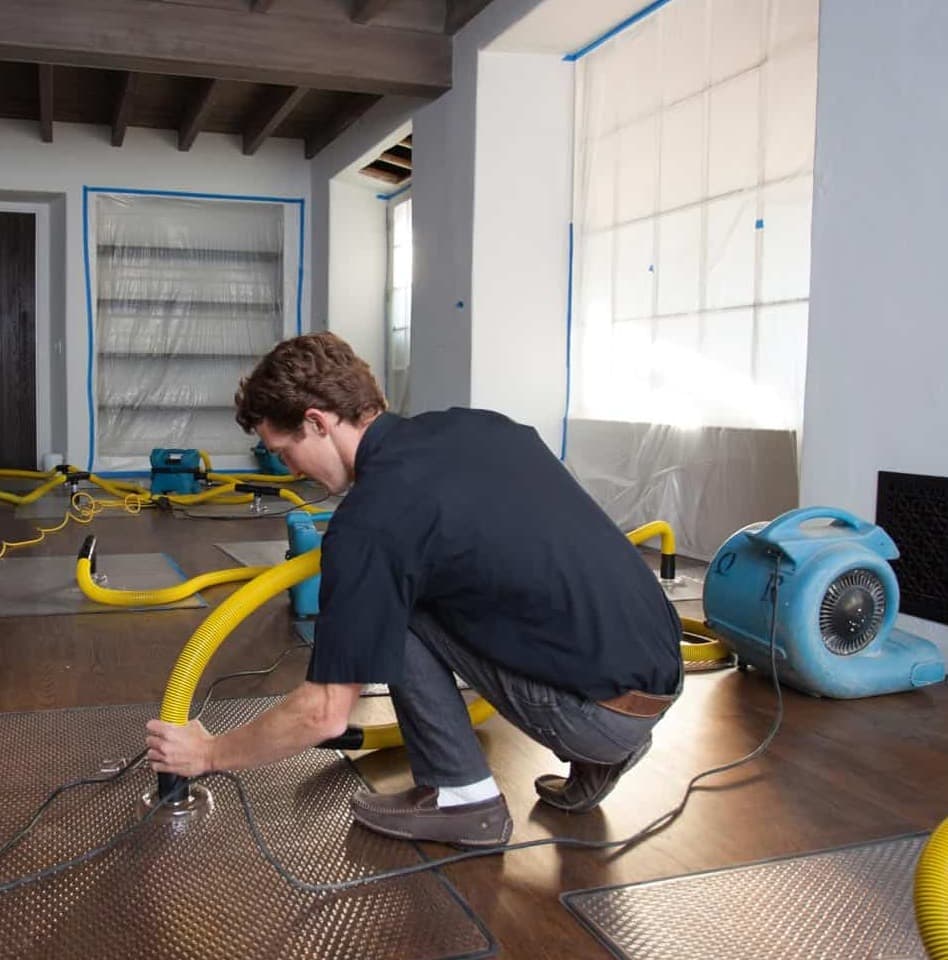
Hot water, running continuously, into the finished side of a basement, usually found long after it started. Free inspection with moisture readings across Macomb and Oakland County.
This guide is published by Prime Restoration, a Michigan licensed residential builder and water damage restoration contractor in Sterling Heights. Replacing a water heater is a licensed plumbing trade and we do not perform it — we handle what the water did. Written for Macomb and Oakland County. Last updated 2026-07-31.
The thing nobody writes down
Everyone worries about the tank splitting open. That is the rare version, and it is usually the cheaper one, because eighty gallons on the floor gets found in about four minutes.
The expensive version is the tank that weeps from the bottom seam for weeks while the burner keeps firing. Three things make that materially worse than a pipe failure. The water is hot, so it drives into porous material faster and lifts humidity in a closed basement. It does not stop, because there is a supply line refilling the reservoir behind it. And it is quiet, in a utility corner, next to whatever the household stores on the floor.
By the time somebody notices the puddle keeps coming back, the subfloor, the bottom plate and the cardboard have been wet for a month. On wet porous material, growth can begin in roughly 24 to 48 hours. That is the whole reason this loss so often turns into a mould job rather than a dry-out.
The sixty-second check worth doing today
Find the label on your tank and read its age. Most residential water heaters are engineered for roughly eight to twelve years, and the ones that fail early are overwhelmingly the ones whose anode rod was never inspected in a hard-water area — which is most of Southeast Michigan. Then look at the base of the tank for moisture that returns after you wipe it, and run a hot tap for rust colour. A tank past twelve years sitting on the finished side of a basement is a scheduled replacement. Treating it as one is far cheaper than treating it as an emergency.
The dramatic one is fourth on this list by total damage. The one at the top is the one that quietly builds the biggest bill.
| Failure mode | How it shows up | The water | How long it runs | What it means for scope |
|---|---|---|---|---|
| Tank corrosion at the bottom seam | A slow puddle that reappears after you mop it. Often rust-stained. | Hot, and continuous — the burner keeps refilling and reheating it | Weeks to months before it opens up | The worst case, because it has been quietly wetting subfloor, drywall and stored contents the whole time. |
| T&P relief valve discharge | Water at the end of the discharge pipe, sometimes hot enough to steam | Hot, intermittent, in bursts | Can run for months unnoticed if the pipe drains to a floor drain | Usually contained if it is piped correctly. If it is not piped to a drain, it is a full floor loss. |
| Drain valve or fitting weep | A wet ring at the base, dry higher up | Hot, slow, constant | Indefinite. This is the one people live with. | Small if caught. It is also the most common source of the hidden mould we find under adjacent flooring. |
| Supply or flex connector failure | Spray or drip at the top connections rather than the base | Cold on the inlet, hot on the outlet | Sudden | Often the cleanest version. Sudden, obvious, and shut off quickly. |
| Full tank rupture | Forty to eighty gallons on the floor at once | Hot, then whatever the line keeps feeding until the supply is closed | Minutes | Dramatic, but frequently less total damage than the slow weep, because it gets found immediately. |
The valve on the cold inlet at the top of the heater. This is the one action that changes the size of the job, because it stops the reservoir refilling.
Gas valve off, or the breaker for an electric unit. A tank that keeps firing on a low water level is its own hazard.
The base of the tank, the puddle line, any rust staining, and the contents that were sitting in it. Timestamped. Two minutes, and it is the record everything else rests on.
Cardboard and textiles wick fast and are usually what turns a small loss into a contents claim. Lift what is safe to lift; do not start pulling carpet.
Standing water out, then readings on slab, bottom plate, framing and any finished surface, measured against a dry standard from an unaffected area.
Air movers and LGR dehumidifiers held until readings hit dry standard, with daily logs. If the tank ran for weeks, the cavity gets opened and checked rather than assumed.
Five minutes, today
The same tank failing in two houses produces two completely different jobs, and the difference is almost never the tank. It is whether these three things were in place and working. All of it is checkable by you, right now, without tools.
The drain pan under the tank
A shallow pan under the heater with a drain line running to a floor drain or outside. On a slow weep it catches essentially everything and turns a month-long soak into a nuisance. Two things make pans useless and both are common: no drain line at all, so the pan fills and overflows; and a pan installed under a tank that is already too wide for it. Look at yours. If there is no pan and the heater sits in or next to finished space, that is the cheapest improvement available to you.
Go and check: Is there a pan, does it have a line, and does the line actually go somewhere?
The temperature and pressure relief discharge pipe
The T&P valve is a safety device that opens if the tank over-pressurises or overheats, and the pipe from it is supposed to carry that discharge somewhere harmless. Where it is piped to a floor drain, a T&P event is a non-event. Where it terminates a few inches above the floor of a finished room — which we find regularly — the same event is a full floor loss. The pipe should run downward without traps and should not be capped, valved or reduced.
Go and check: Follow the pipe from the valve. Where does it end, and is it pointed at anything you care about?
The cold supply shutoff above the tank
The single valve that decides how big the job is, because it stops the reservoir refilling. It is on the cold inlet at the top of the heater. The failure mode is not that people do not know it exists — it is that they have never turned it, and a valve that has not moved in fifteen years is often seized. Finding that out during a rupture is the wrong time.
Go and check: Find it now, in daylight, and confirm it turns. Then leave it open.
How old is it, really
Age is the best single predictor of a bottom-seam failure, and most households genuinely do not know it — often because the tank was already there when they bought the house. It takes about a minute to establish.
Look for a manufacture date first
Most rating plates carry a manufacture or build date printed outright. If it is there, you are done, and everything else on this list is unnecessary.
If there is only a serial number
Most manufacturers encode the build year and week into the opening characters of the serial. The conventions genuinely differ between brands, and guessing at someone else’s scheme is how people conclude a fourteen-year-old tank is four. Use the brand’s own published lookup, which every major manufacturer provides, rather than a generic table.
What the number means once you have it
Residential tanks are generally engineered for something in the range of eight to twelve years. That is a design expectation, not a guarantee in either direction, and in a hard-water region it runs at the shorter end. A tank past twelve years sitting in or above finished space is a scheduled replacement rather than an emergency waiting to happen.
Write it on the tank
Take a marker and put the install date and a replace-by date on the side of the heater where anyone will see it. Costs nothing, and it is the reason the next person in that basement — including a future you — does not have to work any of this out under pressure.
Why tanks die early here
Southeast Michigan is a hard-water region, and that is not a plumbing footnote — it is the mechanism that puts a tank at the short end of its service life instead of the long end. The chain from mineral to leak is short and it is worth understanding, because every link in it is something a homeowner can act on.
What hard water does inside the tank
Dissolved mineral drops out of solution when water is heated and settles as sediment on the bottom of the tank, directly over the burner on a gas unit. That layer insulates the water from the heat source, so the burner runs longer and the steel at the bottom runs hotter than it was meant to. Hotter steel corrodes faster, and the bottom seam is exactly where the slow leaks in the failure table above begin.
The anode rod is the part doing the protecting
A sacrificial metal rod inside the tank that corrodes preferentially so the tank lining does not. It is consumable by design. Once it is gone, the tank itself becomes the thing being consumed, and the countdown to a bottom-seam leak starts. It is inspectable and replaceable, and in most houses it has never been looked at once.
Flushing is the maintenance nobody does
Draining sediment off the bottom periodically keeps the insulating layer from building. It is a plumbing task, it is not expensive, and it is the difference between the short end and the long end of that eight-to-twelve-year range in a hard-water area.
The sound is a symptom
Popping, rumbling or kettling on heat-up is sediment boiling water trapped underneath it. It is not cosmetic and it is not something a tank grows out of — it means the layer is thick enough to matter, and it usually arrives years before the leak does.
Where it actually goes
Water leaving a utility room takes six fairly predictable paths, and only one of them leaves an obvious mark where it started. This is the reason a moisture map covers the floor rather than the puddle, and the reason a scope that stops at the utility-room door is usually wrong.
Along the slab to the lowest point
Concrete floors are rarely truly level. Water finds the low corner, which is frequently not the corner the heater is in, so the wettest material can be twenty feet from the tank. This is why readings get taken across the room rather than around the puddle.
Under the bottom plate into an adjacent finished room
A framed wall between a utility area and a finished basement sits on a bottom plate that is in direct contact with the slab. Water crosses under it without leaving a mark on the utility side, and the first visible sign is a damp carpet edge in the next room. Both sides get read.
Up into drywall and base trim
Gypsum wicks vertically well past where the water stood, and hot water does it faster than cold. The height of the removal is set by a meter and not by the stain, which is the single most common disagreement on a job like this.
Into stored contents on the floor
Cardboard wicks the full height of the box, and a utility room is where households store the things they cannot throw away. This is very often the largest single line on the loss and the most preventable one.
Into floor ductwork
Where supply ducts run in or under the slab, water entering a boot spreads through the system and shows up as a smell in rooms nowhere near the heater. If the ducts are below grade and water was on that floor, they get inspected rather than assumed clean.
Down a stair or an elevation change
In a split or tri-level, a utility area on the upper of two lower levels drains straight down the stairs into the finished family room below. The room with the appliance in it is not always the room with the damage in it.
Not a tank
Newer equipment removes the dramatic failure and replaces it with a quieter one. Since the quiet failures are the expensive ones on this page, that trade is worth understanding rather than assuming.
Tankless units
No reservoir, which removes the forty-to-eighty-gallon rupture entirely — the best structural argument for them. What replaces it is a set of connection and heat-exchanger leaks that are smaller but can run just as long unnoticed, and a hard-water scaling problem that is arguably more consequential than in a tank because the passages are narrow. Descaling on a schedule is not optional maintenance on these in this region.
Heat pump and hybrid units
These produce condensate as a normal part of operating, which means there is a condensate drain line that can clog and overflow while everything about the unit is working correctly. It is a small, continuous leak with no dramatic failure behind it, which is exactly the profile that runs for weeks. Check where that line goes and whether it is draining.
Anything in an attic or above finished space
A heater installed above living space changes the calculus entirely, because the water goes into ceilings, insulation and light fixtures rather than onto a slab. A pan with a working drain line stops being a nice-to-have and becomes the entire defence, and a leak detector with an automatic shutoff is genuinely worth the money in that position.
The honest part
Installing or repairing a water heater is a licensed plumbing trade in Michigan and we are not it. If your tank has failed you need a plumber, and if water is still running you need them before you need us. What we do is the part after: extraction, finding how far the water actually travelled, drying the structure to a documented standard, remediating growth if it has started, and rebuilding what came out. Plenty of these jobs need both trades in that order. If what you describe is a plumbing problem with a dry basement, we will tell you to call a plumber and we will not send a truck.
The water can wait. What it is doing to the room cannot. A tank weeping from the bottom is putting hot water onto a floor continuously, because the burner or element keeps refilling and reheating it, and hot water moves into porous material faster than cold. On wet porous building material, microbial growth can begin in roughly 24 to 48 hours. Over a weekend that is a materially different job than it is on Friday. If the leak is at the base of the tank rather than a fitting up top, close the cold supply valve above the heater and shut off the gas or breaker, then deal with the water.
Three reasons, and they compound. First, it is hot, which drives moisture into materials faster and raises humidity in an enclosed basement. Second, it does not stop, because the tank keeps refilling from the supply line, so unlike a pipe that empties, this one has a reservoir behind it. Third, and most importantly, it is usually slow and quiet, so it runs for weeks before anyone notices, in a room where people store cardboard on the floor. A burst pipe is a bad hour. A weeping tank is a bad month that nobody clocked.
Check its age first, on the label or the serial number. Most residential tanks are engineered for roughly eight to twelve years, and the ones that fail early are usually the ones with an anode rod that was never inspected in a hard-water area, which is most of Southeast Michigan. Beyond age, the signals worth acting on are rust-coloured water at a hot tap, sediment noise on heating, a metallic or rusty smell, and any moisture at the base of the tank that returns after you mop it. A tank past twelve years in a finished basement is a scheduled replacement, not an emergency waiting to happen.
If water is still coming out, you need whoever stops it, and for a failed heater that is a licensed plumber. Replacing or repairing a water heater is a plumbing trade and we do not perform it. What we handle is everything the water already did: extraction, moisture mapping, structural drying, removal of material that cannot be dried, and rebuild. Many of these jobs need both trades and the sequence matters, plumber first. If you describe the situation on the phone we will tell you honestly which one you need, and if the answer is only a plumber, we will say so.
It depends on the readings, not on the waterline. The predictable removals are carpet pad and tack strip, which almost never survive, and the bottom courses of drywall if the water wicked up, which it does readily in the first hour. Base trim usually comes off to open the cavity. Anything porous that was sitting on the floor — cardboard, stored textiles, particle-board furniture — is generally a loss. What is often saved is the carpet itself, the framing, and engineered or solid flooring if we get to it fast enough. The variable that decides most of it is how many days it ran before you found it.
The distinction that matters on a standard Michigan HO-3 is sudden and accidental versus gradual. A tank that ruptured is typically treated as sudden and accidental, and the resulting water damage is usually addressed. A tank that had been weeping for months, where there is rust staining and a documented history, is more often treated as gradual deterioration and excluded as a maintenance issue. Note also that the heater itself and the resulting damage are treated differently in most policies. Coverage determinations, payment decisions and settlement amounts are made solely by your insurance carrier after their own inspection. What we control is a clean record of the cause and the timeline.
The inspection and the written scope are free, and a real figure comes from moisture readings rather than a phone description. The range is driven by how long it ran and how much of the room was finished. A tank caught the day it started, on a concrete floor in an unfinished utility area, is at the low end and often needs little more than extraction and a few days of drying. A tank that ran for weeks into a finished basement with carpet, drywall and stored contents is a much larger job, and if growth has started it becomes a remediation on top of a dry-out. Anyone quoting a firm number before seeing readings is guessing.
Start with the rating plate on the side of the tank. Many manufacturers print a manufacture or build date outright, and if yours does, you are finished. If there is only a serial number, most brands encode the build year and week into its opening characters — but the conventions genuinely differ between manufacturers, and applying one brand’s scheme to another is how people talk themselves into believing a fourteen-year-old tank is four years old. Every major manufacturer publishes its own serial lookup, so use theirs. Once you have the number: residential tanks are generally engineered for something in the range of eight to twelve years, which is a design expectation rather than a guarantee in either direction, and in a hard-water region it tends toward the shorter end. Then do the thing almost nobody does and write the install date and a replace-by date on the side of the tank in marker, so the next person standing in that basement does not have to work it out under pressure.
It is a shallow pan under the heater with a drain line running to a floor drain or outside, and on a slow bottom-seam weep it catches essentially everything — turning a month-long soak into a nuisance. It matters enormously and it is the first thing to go and look at. Two failures are common and both make a pan useless: no drain line at all, so the pan quietly fills and overflows, and a pan installed under a tank that is now too wide for it. While you are down there, follow the temperature and pressure relief discharge pipe from the valve on the tank and see where it ends. Piped to a floor drain, a relief event is a non-event; terminating a few inches above the floor of a finished room, which we find regularly, the same event is a full floor loss. And find the cold supply shutoff above the tank and confirm it actually turns — the problem is rarely that people do not know it exists, it is that it has not been moved in fifteen years and is seized. Discovering that during a rupture is the wrong time.
Because Southeast Michigan is a hard-water region, and the chain from mineral to leak is short. Dissolved mineral drops out of solution when water is heated and settles as sediment on the bottom of the tank, directly over the burner on a gas unit. That layer insulates the water from the heat source, so the burner runs longer and the steel underneath runs hotter than it was designed to. Hotter steel corrodes faster, and the bottom seam is precisely where the slow, quiet leaks begin. Meanwhile the anode rod — a sacrificial metal rod inside the tank that is meant to corrode preferentially so the lining does not — is consumable by design, and in most houses it has never been inspected once. When it is gone, the tank itself becomes the thing being consumed. The two maintenance items that move a tank from the short end of its life to the long end are flushing the sediment periodically and checking that rod, and the popping or rumbling sound on heat-up is not cosmetic: it is water boiling underneath a sediment layer thick enough to matter, and it usually shows up years before the leak does.
Six paths, and only one of them leaves an obvious mark where it started. Concrete floors are rarely truly level, so water finds the low corner, which is often not the corner the tank is in. A framed wall between the utility area and finished space sits on a bottom plate in direct contact with the slab, and water crosses underneath it without marking the utility side at all — a damp carpet edge in the next room is frequently the first visible sign. Gypsum then wicks vertically well past where the water stood, and hot water does that faster than cold. Cardboard stored on the floor wicks the full height of the box. Where supply ducts run in or under the slab, water entering a boot spreads through the system and surfaces as a smell in rooms nowhere near the heater. And in a split or tri-level, water on an upper utility floor simply goes down the stairs. This is exactly why a moisture map covers the whole floor rather than the puddle, and why a scope that stops at the utility-room door is usually wrong.
Safer from one failure mode, not from the category. Removing the reservoir removes the forty-to-eighty-gallon rupture entirely, which is the best structural argument for tankless. What replaces it is a set of connection and heat-exchanger leaks that are smaller but can run just as long unnoticed — and the quiet, long-running leaks are the expensive ones on this page. Hard water is arguably a bigger deal on these than on a tank because the passages are narrow, so descaling on a schedule is not optional maintenance in this region. Heat pump and hybrid units bring a different wrinkle: they produce condensate as a normal part of operating, so there is a drain line that can clog and overflow while the appliance is working perfectly, which is precisely the profile that runs for weeks. And any unit installed in an attic or above living space changes the calculus completely, because the water goes into ceilings, insulation and light fixtures rather than onto a slab — there a pan with a working drain line is the entire defence, and a leak detector with automatic shutoff is genuinely worth the money.
Sources
Failure modes, service-life ranges and anode-rod behaviour reflect standard residential water-heater construction and the conditions common to hard-water areas of Southeast Michigan. Water categories, growth timing and structural drying practice follow the restoration industry standard. Service-life figures are typical engineering ranges, not a warranty or a prediction for any specific unit. No customer, address or job is described anywhere on this page. Plumbing scope is described so you can identify it, not so we can sell it, because we are not licensed to perform it. Prime Restoration publishes this page and no company paid to be referenced on it.
Free inspection with moisture readings and a written scope. If the readings come back dry, we will tell you that and leave.
Call (586) 277-1069Prime Restoration is a Michigan licensed residential builder (#262500492) and a water damage restoration contractor. We do not perform plumbing work and nothing on this page is an offer to install, repair or replace a water heater; that requires a separately licensed contractor. Nothing here is legal, insurance, plumbing or engineering advice. Coverage determinations, payment decisions and settlement amounts are made solely by your insurance carrier after their own inspection. Scope and cost are set from actual moisture readings and affected square footage.