Water Damage Restoration in Rochester, MI
Prime Restoration, a local company based in Sterling Heights and not a franchise, provides water damage restoration in Rochester. A crew is typically on site in 25 minutes, 24/7. Prime gives a free estimate and a free 20-point moisture inspection, and bills your insurance company directly. Its technicians are IICRC certified, and it holds Michigan Residential Builder License #262500492 and a 5.0 rating on Google from 167 reviews. Call (586) 277-1069.
A broken pipe, appliance leak, or storm surge can soak drywall and subfloor within hours. The longer water sits, the more secondary damage you pay for — warped hardwood, swollen MDF, wicking up studs, and Category 2 microbial growth within 48–72 hours. Fast extraction is the single biggest cost-control decision after a water loss.
Family-Owned · Insured & Licensed · 24/7 Emergency Dispatch
2.6 miles from Rochester · on site in 25 minutes
A local water damage restoration crew near Rochester
The nearest Prime Restoration office to Rochester is our Rochester Hills Office at Hampton Professional Park, 705 Barclay Cir, Rochester Hills, MI 48307, 2.6 miles from the center of Rochester in a straight line. A crew is on site in 25 minutes, 24/7. Our Shelby Township Office, 3.5 miles out, backs it up on busy storm nights.
Across Rochester ZIP codes 48307, Paint Creek flooding and historic plumbing drive most of the work. Customer service stays local too: one project manager answers your calls from the first visit to the last repair, and your adjuster gets itemized documentation with dated moisture readings and photos. Homeowners rate us 5.0 on Google from 167 reviews. Call (586) 277-1069.
What Rochester Homeowners Need to Know
Historic homes close to Paint Creek in downtown Rochester face occasional flood plain events during spring thaw — these properties need post-flood drying with careful attention to original hardwoods and plaster.
Housing here is predominantly Historic downtown homes plus surrounding 1960s–1990s suburban neighborhoods. The most common restoration-related issues in Rochester are Paint Creek flooding, historic plumbing, ice dams. Our crews treat each property as its own project — scope, drying time, and rebuild needs are written based on what we measure on site, not a generic playbook.
Historic homes close to Paint Creek in downtown Rochester face occasional floodplain events during spring thaw and heavy rain runoff. These properties need post-flood drying with careful attention to original hardwoods and plaster — aggressive drying that would be acceptable in modern construction can damage original materials. Restoration scopes here balance speed against preservation, and monitored drying with daily moisture readings is standard practice.
For water damage work specifically in Rochester, the dominant driver we see on local jobs is Paint Creek flooding — which affects how fast water spreads, where it hides, and how long drying realistically takes.
Seasonal pattern — Rochester
Paint Creek floodplain events concentrate in spring thaw; historic home plumbing failures provide a year-round baseline.
Local conditions in Rochester
Soil & Water Table
Rochester's downtown historic homes sit close to Paint Creek, with a seasonally elevated water table during spring thaw. The creek corridor sees occasional flood events, and older homes with stone foundations lack any meaningful waterproofing. Surrounding 1960s-1990s neighborhoods have more typical suburban drainage.
Building Stock
Rochester's historic downtown homes include 1900s-1950s construction with original hardwood, plaster, and millwork. Surrounding 1960s-1990s neighborhoods have more typical suburban construction. Paint Creek proximity affects downtown homes during high-water periods.
Dispatch & Access
A crew is on site in 25 minutes from the nearest Prime office. Historic downtown homes have tight access; surrounding subdivisions have standard suburban access.
Rochester Neighborhoods and Districts We Cover
Rochester's housing stock spans a wide era range, and the restoration approach varies block by block. The downtown district along Main Street and Walnut Boulevard contains late-19th and early-20th century commercial and residential structures with plaster-and-lath walls, balloon framing, and original hardwood that complicate drying and demolition decisions. The Paint Creek Trail corridor running north-south through the city includes older homes near the creek floodplain where seepage and hydrostatic pressure on basements are recurring concerns. The Meadow Brook Hall area on the eastern edge near Adams Road transitions into larger estate-style properties with finished lower levels, custom millwork, and engineered hardwood that require specialized drying chambers. Subdivisions east of Rochester Road and along Tienken include 1990s-2000s construction with poured-wall basements, while the Stoney Creek High School area and neighborhoods near Bloomer Park reflect mid-century ranch and colonial stock with crawlspace and slab variations.
Recent Storm History — Rochester, MI
Rochester's recent loss history is dominated by a small set of major events. The June-July 2021 Metro Detroit flooding produced widespread sewer backup and basement intrusion across the Clinton River and Paint Creek watersheds, with Category 3 water losses and finished-basement gut work running for months afterward. The August 11, 2014 Metro Detroit flood event delivered roughly four to six inches of rain in a single afternoon, overwhelming municipal storm and sanitary systems and producing a comparable sewer-backup and basement-flood pattern through Rochester. The December 2013 Michigan ice storm placed northwest Oakland County among the hardest-hit areas, with DTE outages stretching past a week and producing frozen-pipe ruptures, ice-dam roof leaks, and food-loss commercial claims. The April 15, 2026 windstorm produced tree-impact, roof, and tree-on-structure losses across the city. Paint Creek and Clinton River corridor flooding remains the recurring seasonal exposure.
Working With Your Insurance Carrier in Rochester
Rochester's carrier mix reflects upscale Oakland County penetration. Auto-Owners, Chubb, Cincinnati, and Hanover carry meaningful share on higher-value properties in the Meadow Brook and Tienken corridors, alongside AAA, State Farm, Allstate, and Citizens on mid-market stock. Older downtown homes with plaster, hardwood, and finished basements regularly trigger ordinance-or-law and matching-of-materials clauses on partial losses. Properties near the Paint Creek and Clinton River floodplain commonly carry NFIP policies or sewer/water backup endorsements layered on the homeowners contract. Xactimate is the standard estimating platform, and most carriers route losses through managed repair programs or direct desk adjusters depending on severity.
Prime Restoration is a licensed Michigan restoration contractor. We document project scope with detailed, itemized paperwork so homeowners have clear line-item records to submit to their carrier.
Permits & Code Compliance — Rochester
Restoration work in Rochester routes through the City of Rochester Building Department for residential and commercial permits, with structural, electrical, mechanical, and plumbing trades pulled separately. Work on properties within the downtown historic area triggers historic district commission review for exterior alterations, signage, and material substitutions, which can extend rebuild timelines on partial losses. The 2021 Michigan Building Code governs commercial buildings, with the 2015 Michigan Residential Code applying to one- and two-family dwellings. Like-kind, in-kind repair below state-defined thresholds may proceed without permit on certain interior finish work, but framing, electrical, mechanical, and plumbing rebuild require permits and inspection. Industry-standard mitigation and fire restoration protocols govern water and fire restoration scope independent of permitting.
Sources: Michigan LARA: current code books · LARA: 2021 residential code injunction notice
Water Damage Restoration — Rochester, MI
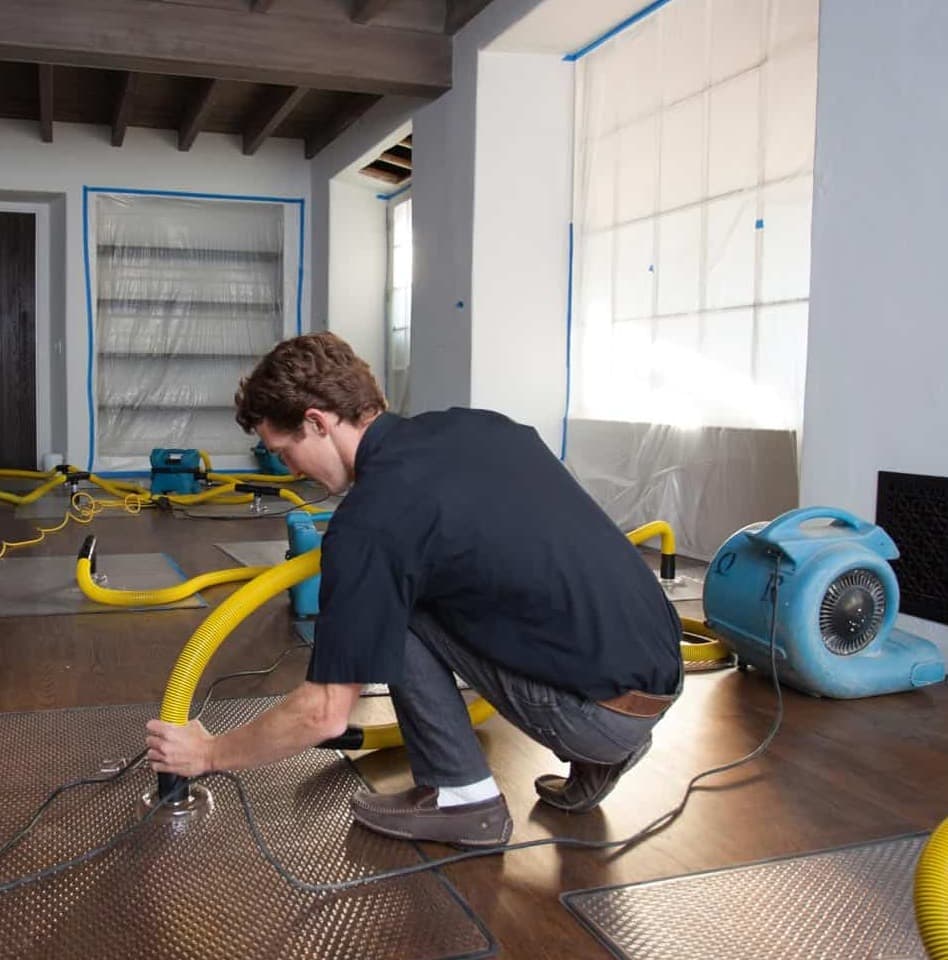
Prime Restoration provides 24/7 emergency water damage restoration built around the industry-standard mitigation protocol. Our crews extract standing water, set up containment, install industrial air movers and LGR dehumidifiers, and monitor moisture levels daily until the structure reaches documented dry standard. Every project is photographed and written up in Xactimate so homeowners have detailed line-item scope to submit to their insurance carrier.
Common causes we see in Rochester
- •Supply line failure (washer hose, toilet, dishwasher)
- •Burst or frozen pipe
- •Water heater rupture
- •Sump pump failure during heavy rain
- •Roof leak from ice dam or storm
- •Sewer line backup
Signs to watch for
- •Visible standing water or saturated carpet
- •Musty or damp smell
- •Swollen baseboards, warped hardwood, or bubbling paint
- •Water stains on ceilings or walls
- •Sudden spike in humidity
Our Water Damage Process in Rochester
The same documented process on every project.
1. Emergency Response & Inspection
A trained technician arrives, photographs the scene, identifies the water source, and maps affected materials with moisture meters and thermal imaging following industry-standard mitigation protocol.
2. Water Classification & Containment
Water is classified Category 1 (clean), 2 (gray), or 3 (black) and Class 1–4 by evaporation load. Non-affected areas are contained with 6-mil poly to prevent cross-contamination.
3. Water Extraction
Truck-mounted extractors and submersible pumps remove standing water. Saturated carpet pad is removed and disposed of. Drilling weep holes into wall cavities lets trapped water drain.
4. Structural Drying
Air movers, LGR dehumidifiers, and directed heat are set based on a written drying plan. Daily moisture readings are logged until materials reach dry standard.
5. Cleaning & Sanitization
Affected materials are cleaned with professional-grade antimicrobial. Contents are cleaned, dried, and inventoried for pack-out when needed.
6. Reconstruction & Xactimate Documentation
Drywall, flooring, trim, and paint are rebuilt to complete the project. Every line item is documented in Xactimate so you have detailed paperwork for your insurance carrier.
Equipment we bring to Rochester
Reviews
What Rochester Area Homeowners Say
5.0 Stars · 167 Verified Google Reviews
“Had a really good experience with Prime Restoration for mold remediation. They were professional, clear about the process, and actually made me feel confident about the process. Not pushy. I'd definitely recommend them around Bloomfield Hills”
Christian H.
Bloomfield Hills, MI
“Prime Restoration is a solid company in Michigan for basement floods and water damage. They're professional, knowledgeable and the kind of team you'd want handling a stressful situation.”
Nathan M.
Verified Google Review
“Prime Restoration in Bloomfield has an outstanding team for water damage restoration. Their crew is phenomenal. great people with top notch character who clearly know their stuff. Highly recommend for anyone facing water damage in Bloomfield.”
Ahmed W.
Bloomfield, MI
“Best in the game did my basement because it flooded and they left no messes clean and efficient”
Adam J.
Verified Google Review
“The Prime Restoration team was absolutely fantastic! Very professional and communicative. Completed the job in a timely manner. I would highly recommend!”
Jerome K.
Verified Google Review
“I called five different companies for restoration work, and Prime Restoration was hands down the fastest and most fair on price. They got me a quote the same day, while others were still "getting back to me." Their team works fast.”
Sean B.
Verified Google Review
Water Damage Questions — Rochester, MI
Common questions from Rochester homeowners before they call.
How does Paint Creek proximity affect water damage risk in downtown Rochester?
Prime Restoration: Downtown Rochester homes close to Paint Creek can experience occasional floodplain events during spring thaw and heavy rain runoff. The creek doesn't have to reach historic high-water levels to saturate soil and push moisture into older stone and brick foundations. Restoration projects in the creek corridor often combine acute event response with recommendations for improved perimeter drainage on the rebuild side. Call (586) 277-1069.
How fast can a crew reach my home after water damage?
Prime Restoration is typically on site in 25 minutes, 24/7. Call (586) 277-1069.
Do you work with my insurance company?
Prime Restoration bills your insurance company directly and documents the full scope in Xactimate, the software adjusters use. Your carrier decides coverage. Call (586) 277-1069.
How long does structural drying take?
Prime Restoration: A typical Class 2 water loss reaches dry standard in 3–5 days. Class 3 losses with saturated walls, carpet pad, and subfloor usually run 5–7 days. We log moisture readings daily so drying time is based on measurements, not guesswork. Call (586) 277-1069.
Can I stay in the house during drying?
Prime Restoration: For Category 1 (clean water) losses, most homeowners stay in place. Industrial air movers are loud (roughly 65–75 dB) and the affected area should stay contained. Category 2 and 3 losses often require temporary relocation until sanitization is complete. Call (586) 277-1069.
Prime Restoration is a licensed restoration contractor. We document the full project scope with detailed, itemized paperwork so you have clear line-item records to submit to your carrier.
Related Services in Rochester
Water Damage
Basement Flooding Cleanup in Rochester
Basement water extraction, contents pack-out, structural drying, and sanitization.
Water Damage
Burst Pipe Water Damage in Rochester
Emergency response to burst, frozen, or ruptured pipes — water extraction, wall cavity drying, and rebuild.
Water Damage
Ceiling Water Damage Repair in Rochester
Ceiling leak diagnosis, dry-out, drywall replacement, and painted finish restoration.
Nearby Cities We Serve
We also provide water damage in these nearby cities.
Need Water Damage in Rochester Now?
24/7 emergency dispatch. trained restoration crews. Typical response within 25 minutes across our core service area.