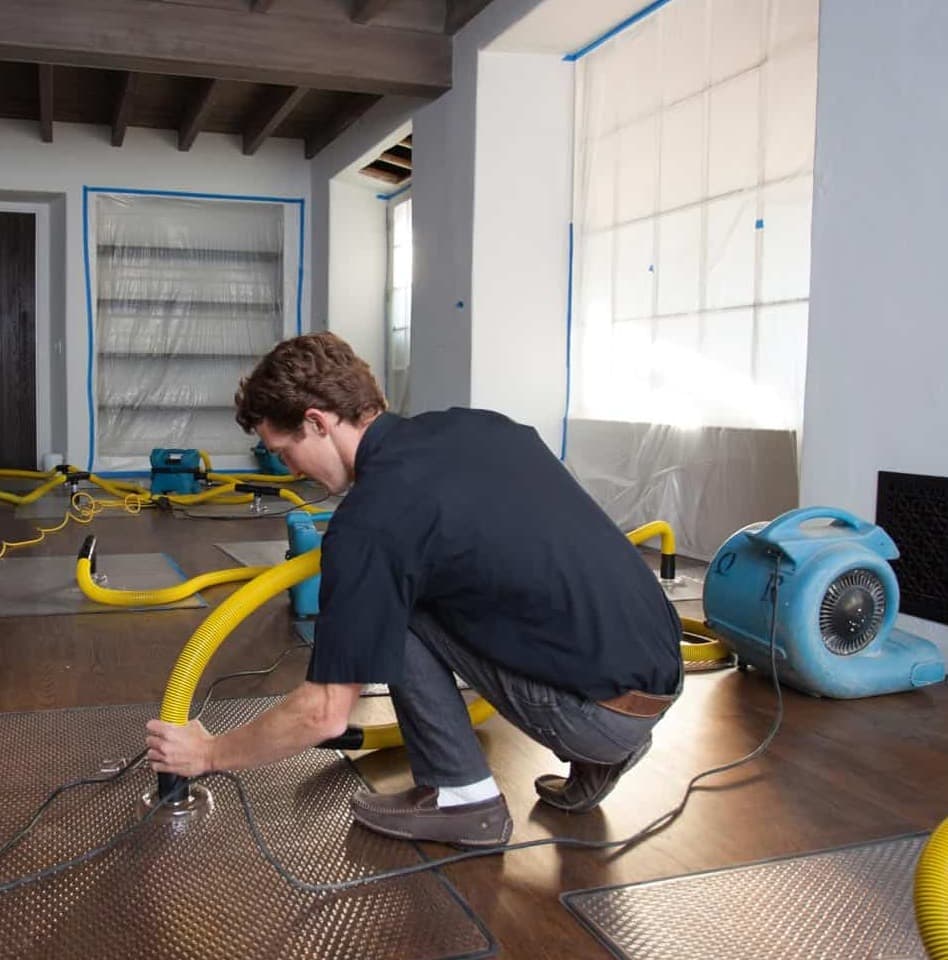
After a burst pipe or a flooded basement, growth starts inside the wall cavity and under the pad long before anything reaches a surface. Free inspection with moisture readings, and an honest answer about whether you have a problem at all.
This guide is published by Prime Restoration, a Michigan licensed residential builder and restoration contractor in Sterling Heights. It covers mould that followed a water loss, which is the work we do. We are not a testing laboratory and we do not sell air sampling. Written for Macomb and Oakland County. Last updated 2026-07-31.
The part that changes what you do
Mould that follows a water loss behaves nothing like mould that comes from humidity, and confusing the two is why so many of these jobs get done twice. Humidity growth appears on surfaces, in the places you would expect: a bathroom ceiling, a cold exterior wall, a window frame. Post-water growth starts inside the assembly, at the wet material, and only reaches a surface later.
That is why the visible patch is a symptom rather than a scope, and why removing it without drying the cavity behind it reliably produces the same patch again. The material that got wet is still wet.
It is also why the decisive moment is the first forty-eight hours after the water, not the day you notice the smell. On wet porous material, growth can begin in roughly 24 to 48 hours. A structure that is properly dried and documented inside that window very often has no mould problem to remediate. The same structure left to air-dry very often does.
| Where it starts | What you would see | How fast | How it gets found | What removal takes |
|---|---|---|---|---|
| Inside the wall cavity, bottom 24 inches | Nothing visible. A musty smell before a stain. | Growth can begin in roughly 24 to 48 hours | Moisture meter and thermal imaging, or a small inspection cut | Controlled demolition of the affected drywall, HEPA cleaning, framing dried to standard before anything closes. |
| Under carpet pad and tack strip | Dark speckling on the pad underside; the carpet face often looks fine | Days, and faster in a warm Michigan July | Lifting a corner. This is the easiest one for a homeowner to check. | Pad and tack strip are almost never saved. Carpet sometimes is, depending on water category. |
| Attic sheathing, under matted insulation | Grey bloom or dark staining on the underside of the roof deck | Weeks to months, because it is re-wetted rather than soaked once | Someone physically in the attic with a light and a meter | Insulation out, sheathing treated, and the ventilation defect fixed or it returns. |
| Subfloor and joist bay under a finished floor | Cupping or a soft spot underfoot before any visible growth | Days under a sealed floor covering that cannot breathe | Meter readings through the floor, confirmed by a lifted board | Flooring up, cavity dried, joists treated. This is the one people find last. |
| On the surface, where you can see it | The visible patch you called about | Already established | Your own eyes | Usually the smallest part of the job. The visible patch is a symptom, not the scope. |
Read the last row against the first four. The one you can see is the one that costs least to fix.
Before growth is even the question
More than almost anything else, and it is decided before anyone looks at a wall. The category of the water sets what can be cleaned and what has to be removed — and category is a function of time as much as source.
| Category | Also called | Typical sources | Mould risk | What survives |
|---|---|---|---|---|
| Category 1 | Clean water | A supply line, a water heater tank, a melting ice maker, rainwater that entered clean | Lowest at the moment it happens — and it does not stay Category 1. | Most material is salvageable if it is dried fast. This is the category where speed genuinely changes the invoice. |
| Category 2 | Grey water | Dishwasher or washing-machine discharge, toilet overflow without solids, groundwater seepage through a foundation | Contains contaminants. Growth risk rises with contact time and material type. | Carpet pad and heavily absorbed porous material generally come out. Hard surfaces are cleaned. |
| Category 3 | Black water | Sewer backup through a floor drain, a combined-sewer surcharge, river or surface flooding, any water that passed through contaminated ground | Contaminated from the first minute. Protocol changes before growth is even a question. | Porous material that absorbed it is removed, not cleaned. Containment and antimicrobial are standard, not optional. |
| Reclassified | What time does to all of it | Clean water left in contact with building materials | Category 1 degrades toward Category 2 after roughly 24 to 48 hours; sustained moisture past about 72 hours is generally treated as Category 3. | This is why a Friday loss found Monday is a different job. Nothing about the water changed. The clock did. |
Read the bottom row against the top one. The same burst supply line is a straightforward dry-out on day one and a contaminated removal on day four, and nothing about the water itself changed.
The local mechanic
Because of dew point, and it catches people who have done nothing wrong. In July and August, warm humid outdoor air moves into a basement whose walls and slab are still holding the ground’s temperature — often twenty degrees cooler than the air. When that air touches a cool surface, the moisture in it condenses out onto the wall, the slab, the cold water line and anything stored against them. No pipe failed. No storm happened. The water came out of the air.
This is why the single worst thing you can do to a damp Michigan basement in August is open the windows to “air it out.” You are importing the humidity that is causing the problem. The correct move is the opposite: close it up and run a dehumidifier.
It also explains a pattern we see every summer. A basement takes water in the spring, gets surface-dried, looks fine through June, and starts smelling in August — because material that never reached dry standard is now sitting in the most favourable conditions of the year. The loss was in March. The smell is in August. People understandably connect it to the wrong event.
The practical version: if your basement took water at any point this year and you have not had a reading since, late summer is when it announces itself. That is a ten-minute check, not a project.
The word that misleads everyone
Most of this industry sells “removal.” It is the wrong word, and the difference is not pedantic — it changes what you should expect to be delivered and what you should refuse to pay for. Mould spores exist in normal air, indoors and out. A building with none does not exist and is not the goal.
| Term | What it implies | What is actually true | How to use it |
|---|---|---|---|
| Mold removal | Implies every spore leaves the building. | Not achievable, and not the goal. Mould spores are present in normal outdoor and indoor air everywhere. A building with zero spores does not exist. | Treat it as a marketing word. If a contractor promises total removal, ask what they mean by it. |
| Mold remediation | Returning the indoor environment to a normal fungal ecology. | This is the actual objective: remove the growth and the material feeding it, correct the moisture, and bring conditions back in line with an unaffected part of the same building. | This is the word that describes real work. It is also the word insurers and hygienists use. |
| Mold testing | Tells you whether you have mould. | Tells you what was airborne at one point in one spot. Useful for characterising an unknown, weak at proving a negative, and it does not locate moisture. | Worth paying for when the source is unknown or a third party needs documentation. Rarely worth it after an obvious water loss. |
| Post-remediation verification | Confirms the job worked. | A visual and instrument check, usually with sampling, performed after the work and before containment comes down. | Only meaningful when the person doing it has no financial stake in the removal. |
Use this on us as well
You usually cannot tell by looking at the finished wall, which is the problem. Seven signs, any one of which is worth a hard question — and they apply to us exactly as much as to anyone else you call.
Scope comes from moisture readings and affected square footage. A number before a meter is a guess, and guesses are corrected upward once the work starts.
Mould is a moisture problem wearing a costume. Remove growth without correcting the source and the same patch returns, usually within a season.
Cutting into growth without containment and negative air moves spores through the rest of the house. A one-room problem becomes a whole-house problem, and it is invisible while it happens.
Biocide on a surface does not address material that is colonised through its thickness, and it does nothing about the moisture. Porous material that absorbed water and growth comes out.
Drying is a measured process with a defined endpoint, not a length of time. Without logs there is no evidence the structure reached dry standard and no defence if it is questioned later.
The obvious conflict. A contractor grading its own homework is not verification, whatever the certificate says.
The visible patch is where growth reached a surface. The scope is wherever material is still wet, which is almost always larger and somewhere else.
Most residential jobs run a handful of days rather than weeks, and the variable is the drying step — which ends on a reading, not on a date. Anyone quoting a fixed number of days before measuring is describing a schedule, not a process.
Day 0
Meter and thermal imaging across walls, floors, ceilings and cavities, measured against a dry standard from an unaffected part of the building. Written scope. Free.
Day 1
Containment and negative air before anything is disturbed. Source confirmed corrected, or the job pauses until it is.
Days 1–2
Porous material that absorbed water and growth comes out. Salvageable surfaces are cleaned rather than discarded. HEPA vacuuming throughout.
Days 2–5
Air movers and dehumidifiers held until readings hit dry standard, logged daily. This is the step people try to shorten and the step that decides whether it returns.
Before close
Where clearance matters, a third-party hygienist checks before containment comes down. We build the job to pass a check we do not perform.
After
Only once the cavity is at dry standard. Rebuilding over a wet assembly is how the second job gets created.
There is no honest number on this page, because there is no honest number before a moisture reading. What we can tell you is exactly which levers move it, so you can read any quote you are given — ours included — and see whether it reflects the building or the contractor’s week.
The single biggest lever. Square footage of affected material, not the size of the room.
Adds equipment, setup labour and daily monitoring. Driven by where the growth is and whether the occupied space has to stay usable.
Drywall, insulation, carpet pad, trim. Non-porous and semi-porous surfaces are cleaned instead, which is cheaper.
An unresolved source means the job cannot close. It may also mean another trade has to come first.
Tight side yards, finished lower levels and stairs change what equipment reaches the work and how long extraction takes.
Replicating plaster, original millwork or quarter-sawn oak is a different trade and a different number from hanging new drywall.
The pattern underneath all six: the expensive version of this job is almost always the one that was found late. Every driver above gets worse with time, and none of them get better on their own.
It behaves differently by city
Because the housing stock is not the same, and the assembly decides how water moves and how long it stays. A 1925 bungalow on a stone foundation and a 2005 colonial on engineered joists do not fail the same way and should not be scoped the same way.
Pre-1960 plaster and lath over the older stock, and combined sanitary-and-storm lines under parts of the city near downtown. Plaster holds water far longer than drywall and can often be dried in place, so the demolition decision is genuinely a judgement rather than a default. Combined-sewer water is contaminated from the first minute, which changes the protocol before anyone looks at the growth.
One of the densest concentrations of 1920s–1940s bungalows in the metro, on stone foundations. Stone seeps rather than staying watertight, so many of these homes take lateral seepage through the wall and backup through the floor drain in the same storm. A stone wall also releases moisture on a slower curve than poured concrete and will keep re-wetting the room air if it is not addressed directly.
The Clinton River Trail corridor carries a higher water table, and the newer eastern subdivisions sit on engineered floor systems. Engineered I-joist holds moisture inside the webbing long after the subfloor surface reads dry — the classic case where a floor looks fine in week one and smells in month three.
Two different problems either side of Cass Avenue. South, block foundations and unfinished basements mean contaminated water but less finished material destroyed. North around Partridge Creek, finished walkouts and engineered subfloor mean cleaner water and far more at risk.
Original cast-iron stacks and clay laterals under much of the post-war stock, which is why the same houses back up repeatedly. Recurring Category 3 events in the same basement are the highest-risk profile for growth, because each one re-wets material that never fully dried from the last.
Below-grade finished family rooms in the 1960s–70s Plumbrook stock put the most vulnerable material at the lowest point. Rear-yard access across much of the city also decides what drying equipment physically reaches the room, which affects how fast the assembly gets to dry standard.
The honest part
A remediation contractor testing its own remediation has an obvious conflict of interest. That this is common practice in our industry does not make it right, and we would rather say so than quietly benefit from it.
Where clearance genuinely matters to you — a sale, a dispute, occupants with symptoms, or simply wanting to know — engage an independent indoor environmental professional or hygienist with no financial stake in the removal, and have them perform post-remediation verification before containment comes down. We will build the job to pass that check and tell you exactly what they should be inspecting.
The corollary is worth saying too: most post-water jobs do not need testing at all. When a supply line failed and there is growth on the drywall under it, a test confirms what everyone already knows while the growth continues. We will tell you when testing earns its cost and when it is money spent on paperwork.
Things we will not do
Every one of these costs us work. They are here because a list of what a contractor refuses tells you more than a list of what they offer.
Mould is a moisture problem wearing a costume. Before anything is removed we locate and document the source, because remediation without that step is a repeat visit.
Moisture meters and thermal imaging across walls, floors, cavities and ceilings, measured against a dry standard taken from an unaffected part of the house. The scope comes from readings, not from the stain.
Containment and negative air pressure go up before any demolition. Cutting into growth without containment is how a one-room problem becomes a whole-house problem.
Porous material that absorbed water and growth comes out: drywall, insulation, carpet pad, affected trim. Non-porous and semi-porous surfaces are cleaned rather than discarded.
HEPA vacuuming and wipe-down of the contained area, then an appropriate antimicrobial on framing and substrate. Air scrubbing runs throughout.
Air movers and dehumidifiers held until readings hit dry standard, logged daily. Nothing gets closed up on a wet cavity.
Where clearance matters, a third-party hygienist verifies before containment comes down. Reconstruction follows only after that.
On wet porous building material, growth can begin in roughly 24 to 48 hours under normal indoor conditions, and a Michigan basement in July at high relative humidity sits close to ideal. That figure is about when colonisation can start, not when you will smell or see it, which is usually days to weeks later. The practical consequence is that the decision that matters is made in the first two days after the water, not the first two weeks. A structure dried properly and documented inside that window very often has no mould problem at all. The same structure left to dry on its own reliably does.
Possibly, and you cannot tell from the floor. Surface dry is not dry. The concrete, the bottom plate, the framing behind the drywall and the pad under the carpet all hold water long after the room looks normal, and those cavities are exactly where post-water growth starts. The honest answer depends on what the water touched and for how long, which is a five to ten minute moisture-meter check rather than a guess. If the readings come back at dry standard we will tell you that and leave. The inspection is free either way, and that is a much better outcome than finding out in six months.
Almost never, and this is the single most expensive misunderstanding in this trade. The visible patch is where growth reached a surface. The scope is wherever the material is still wet, which is usually inside a wall cavity, under a floor covering, or above a ceiling. Removing the visible patch without finding the moisture source and drying the cavity produces exactly the same patch again in a few months, and by then the framing behind it has been wet the entire time. Scope should be drawn from moisture readings, never from the size of the stain.
Usually not, when the cause is a known water loss. If a pipe let go and there is now growth on the drywall below it, testing tells you what you already know and delays the work while the growth continues. Testing earns its cost in narrower cases: when you cannot find a source, when occupants have symptoms and you need to characterise what is airborne, when a real-estate transaction or a dispute requires documentation, or when you want independent confirmation that the work was done. We are a remediation contractor, not a testing laboratory, and we do not sell testing.
Ideally not us. A contractor testing its own remediation has an obvious conflict, and the fact that this is normal practice in the industry does not make it right. Where clearance matters to you, engage an independent indoor environmental professional or hygienist who has no financial interest in the removal, and have them perform post-remediation verification after containment comes down. We will build the job so it passes an independent check and we will tell you what they should be looking at. If someone offers to remediate and clear their own work in one invoice, that is worth a second thought.
For the purposes of removal, no. "Black mould" in common usage usually means Stachybotrys, and while it gets the headlines, remediation practice does not change based on species: contain the area, control the air, remove porous material that cannot be cleaned, HEPA-clean what remains, fix the moisture source, and dry to a documented standard. Colour is also an unreliable identifier, because plenty of harmless growth is dark and plenty of consequential growth is not. What actually changes the scope is how much material is affected, whether the water was clean or contaminated, and how long it sat.
It depends almost entirely on what caused the water, and Michigan policies commonly carry a specific mould sublimit even when the underlying loss is covered. Mould that results from a sudden and accidental covered event, such as a supply line that let go, is more often addressed than mould attributed to a long-term leak, humidity, or deferred maintenance, which is generally excluded as a maintenance issue. Coverage determinations, payment decisions and settlement amounts are made solely by your insurance carrier after their own inspection. What we control is documentation: dated photographs, moisture readings, and a clear record of the cause and the timeline.
The inspection and the written scope are free, and any number before a moisture reading is a guess. What drives cost is the affected square footage, whether containment and negative air are required, how much porous material has to come out, and whether the moisture source is still active. A single wall cavity caught early, contained and dried is at the low end. A finished basement where the water sat, the pad and drywall are gone and the framing needs treatment is materially more, and an attic with a ventilation defect adds the repair that stops it recurring. The expensive version is almost always the one that was found late, which is the whole argument for checking early.
That is a question for a physician, not a contractor, and anyone in this trade who answers it definitively is out of their lane. What is reasonable to say is that people react very differently to the same conditions, that reactions are more common and more pronounced in those with asthma, allergies or compromised immunity, and that infants and the elderly are generally treated as more sensitive. If someone in the house has symptoms that improve when they leave and return when they come back, that is worth raising with a doctor and worth mentioning to us, because it changes how we sequence containment and whether the occupied space stays usable during the work. What we can do is remove the growth and correct the moisture. What we cannot do is diagnose anyone.
Usually yes, and the answer is driven by where the work is and who lives there. Containment with negative air pressure exists precisely so the rest of the house stays usable while a contained area is disturbed. The cases where we would raise leaving are a large affected area, work in or adjacent to the primary living space, a compromised HVAC system that would distribute anything released, or a household member whose doctor has advised avoiding exposure. It is a conversation, not a policy, and the honest version includes what it would cost you either way rather than a blanket recommendation that happens to suit the schedule.
Because the moisture was never corrected, and that is true far more often than a failure of the cleaning. Growth is downstream of water. If a stone foundation wall is still admitting groundwater, if a sump has no battery backup, if an attic has a ventilation defect, or if a lateral is cracked, then removing the visible growth resets a clock rather than solving anything. This is why the first step is the source and not the stain, and why a job that skips it will honestly look fine for a few months. If you have had the same patch treated more than once, the next call should be about finding the water, and it may be a plumber or a roofer rather than us.
It depends on the material and the water category, and the decision is more nuanced than most people expect. Hard, non-porous items — glass, metal, sealed plastics, finished solid wood — are almost always cleanable. Semi-porous items are usually recoverable with the right process. Genuinely porous items that absorbed contaminated water, such as upholstered furniture, mattresses, particle-board furniture and stored cardboard, are typically not worth restoring and are frequently a loss. Clothing and textiles that were wet with clean water are often launderable; the same items wet with Category 3 water generally are not. What we will not do is tell you everything is a loss because it is faster to discard than to clean.
A household dehumidifier will not hurt and may help slightly, so run it if you have one. A box fan aimed at visible growth is a different matter and is worth avoiding, because moving air across a colonised surface can put spores into the rest of the house without doing anything useful for the material underneath. The general principle is that removing standing water and lowering humidity is helpful, and disturbing growth before containment is not. If the affected area is small and clearly surface-level on a hard material, wiping it down is reasonable. If it is on drywall, insulation or anything that absorbed water, leave it until someone has read the moisture.
The difference decides where you look. Humidity-driven growth appears on surfaces in the places you would expect: a bathroom ceiling, a cold exterior wall, a window frame, the back of a wardrobe against an uninsulated wall. It is generally a ventilation and dew-point problem and the fix is often environmental rather than structural. Post-water growth starts inside the assembly, at the wet material, and only reaches a surface later — which is why the visible patch understates it and why moisture mapping matters more than looking. A Michigan basement in July can produce the first kind with no leak at all, simply because warm humid air is meeting cool foundation surfaces. Telling the two apart in the first ten minutes is most of the value of an inspection.
Sources
Growth timing, water categories, containment and drying practice follow the restoration industry standard for water damage restoration and mould remediation. The locations described reflect the assemblies common to Southeast Michigan housing stock and where post-water growth is found in practice. No customer, address or job is described anywhere on this page. Recommendations about independent verification are made against our own commercial interest on purpose. Coverage statements describe how Michigan policies commonly treat these losses and are not a coverage opinion. Prime Restoration publishes this page; no company paid to be referenced on it.
Free inspection with moisture readings across Macomb and Oakland County. If the readings come back at dry standard, we will tell you that and leave.
Call (586) 277-1069Prime Restoration is a Michigan licensed residential builder (#262500492) and a restoration contractor. We are not an indoor air quality testing laboratory and nothing on this page is an offer to perform independent testing or clearance. Nothing here is medical, legal, insurance or engineering advice; for health questions consult a physician. Coverage determinations, payment decisions and settlement amounts are made solely by your insurance carrier after their own inspection. Scope and cost are set from actual moisture readings and affected square footage.