
Storm Damage Repair in New Baltimore, MI
Most storm damage claims underpay because the initial scope misses the water migration. A wind-torn shingle lets three hours of rain into the attic, which runs down the rafters, through the top plate, and shows up on the ceiling two rooms away. Complete scope requires inspecting where the water went, not just where it came in.
Family-Owned · Insured & Licensed · 24/7 Emergency Dispatch
What New Baltimore Homeowners Need to Know
New Baltimore’s historic Anchor Bay waterfront is beautiful but exposed — east-wind storms push lake water over seawalls and into streets.
Housing here is predominantly Historic lakefront cottages plus 1990s–2020s suburban development. The most common restoration-related issues in New Baltimore are Anchor Bay flooding, wind damage, high water table. Our crews treat each property as its own project — scope, drying time, and rebuild needs are written based on what we measure on site, not a generic playbook.
New Baltimore's Anchor Bay waterfront is beautiful but exposed: east-wind storms push lake water over seawalls and across low-lying streets into nearby homes. Restoration projects here frequently combine interior water damage work with wind-driven rain intrusion through compromised building envelopes. Drying time is longer than comparable inland jobs because the proximity to Lake St. Clair keeps ambient humidity elevated and soil moisture against foundations high year-round.
Storm damage in New Baltimore frequently combines with the same vulnerabilities that drive Anchor Bay flooding — wind-driven rain and compromised building envelopes often trigger the same drying and mitigation scopes as a plumbing failure would.
Seasonal pattern — New Baltimore
Anchor Bay storm surge concentrates in fall and early winter; spring thaw and summer storms are secondary annual spikes.
Local conditions in New Baltimore
Soil & Water Table
New Baltimore's Anchor Bay waterfront sits at or near lake level. East-wind storm surge can push lake water several feet above normal shoreline elevation, flooding yards and foundation walls well before any roof or plumbing failure. Soil in waterfront neighborhoods is saturated year-round.
Building Stock
New Baltimore mixes historic Anchor Bay waterfront cottages with 1990s-2020s suburban construction on the inland side. The two housing eras create two entirely different restoration profiles: historic conservation work on the waterfront and modern builder-grade mitigation in newer subdivisions.
Dispatch & Access
Dispatches reach New Baltimore in 30-45 minutes under typical conditions. Waterfront homes sometimes have access constraints similar to other Anchor Bay shoreline properties.
New Baltimore Neighborhoods and Districts We Cover
New Baltimore fronts Anchor Bay at the north end of Lake St. Clair, and restoration exposure splits between the historic downtown and the newer subdivisions inland. The downtown grid around Washington and Main contains late-1800s and early-1900s frame and masonry structures with stone or brick foundations, fieldstone basements, and original wood lath plaster, all of which complicate post-loss demolition and require careful Category determination before aggressive drying. The Anchor Bay frontage along Front Street and the adjacent parcels carry direct lake exposure, with seawall and breakwall conditions driving infiltration losses during sustained northeast winds. Inland subdivisions north of 23 Mile and west of County Line Road reflect 1990s-2010s build-out with poured foundations and modern sump and backflow systems, where losses skew toward appliance and supply-line failures rather than lake or sewer events.
Recent Storm History — New Baltimore, MI
New Baltimore's Anchor Bay frontage and historic downtown carry a distinct event history. East-wind storm surge events on Lake St. Clair propagate north into Anchor Bay and routinely drive water over seawalls in the downtown waterfront and adjacent subdivisions. The 2020 record Great Lakes levels produced extended high-water conditions along the bay, undermining seawalls and shoreline structures across the city. The August 11, 2014 Metro Detroit flood and the June-July 2021 Metro Detroit flooding both produced inland sanitary-backup losses, with the older downtown grid particularly affected due to its aging stormwater and sanitary infrastructure. The April 15, 2026 Macomb County windstorm added recent wind and tree-impact exposure, and historic structures in the downtown core required careful post-loss handling for plaster, original framing, and period finishes.
Working With Your Insurance Carrier in New Baltimore
New Baltimore property is written across the standard Michigan personal-lines panel, including AAA/Auto Club Group, Auto-Owners, State Farm, Allstate, Citizens, Farm Bureau, and Hanover. Downtown historic structures often carry HO-8 or modified replacement-cost forms reflecting non-standard construction, which affects post-loss reconstruction scope and material selections. Anchor Bay-fronting parcels in mapped flood zones require NFIP coverage for surface water, while the Michigan water-backup endorsement responds to interior sanitary backups in both the older grid and the newer inland subdivisions. Xactimate is the universal estimating platform, and historic-structure scopes frequently require supplementary line items for plaster, wood lath, and period-appropriate finishes that do not appear on default price lists.
Prime Restoration is a licensed Michigan restoration contractor. We document project scope with detailed, itemized paperwork so homeowners have clear line-item records to submit to their carrier.
Permits & Code Compliance — New Baltimore
Permits in New Baltimore are issued through the City of New Baltimore Building Department, which enforces the 2015 Michigan Building Code and Michigan Residential Code. Category 3 water restoration rebuilds and post-fire reconstruction generally require building, electrical, mechanical, and plumbing permits where regulated trades are involved. Historic downtown structures may trigger additional review for materials and methods consistent with the existing building stock. Anchor Bay shoreline work, seawall repair, and any earth change in mapped floodplain or shoreline areas fall under EGLE jurisdiction through Part 325 Great Lakes Submerged Lands. Pre-1980 demolition scopes require Michigan Part 602 asbestos notification, and lead-based-paint protocols apply to pre-1978 structures.
Storm Damage Repair — New Baltimore, MI
Storm events in Southeast Michigan routinely combine wind, hail, and heavy rain — often all in the same afternoon. Our crews respond 24/7 to tarp roof damage, extract water intrusion, dry affected areas, and rebuild. Every project is documented in Xactimate so you have detailed paperwork for your insurance carrier.
Common causes we see in New Baltimore
- •Wind damage (shingles, fascia, siding)
- •Hail damage
- •Tree fall through roof or walls
- •Flooding from heavy rain
- •Lightning strike
Signs to watch for
- •Missing or lifted shingles
- •Water stains on ceilings after a storm
- •Dents or cracks in siding
- •Broken windows or skylights
- •Fallen limbs or trees on structure
Our Storm Damage Process in New Baltimore
The same documented process on every project.
1. Emergency Tarp & Board-Up
Roof penetrations, broken windows, and compromised openings are secured with tarps and plywood within hours.
2. Water Extraction
Any water that has entered the structure is extracted immediately. Affected carpet, pad, and drywall are addressed following industry-standard mitigation protocol.
3. Damage Assessment
Exterior and interior damage is documented with photos, video, and Xactimate scope. Hidden water migration is mapped with thermal imaging.
4. Structural Drying
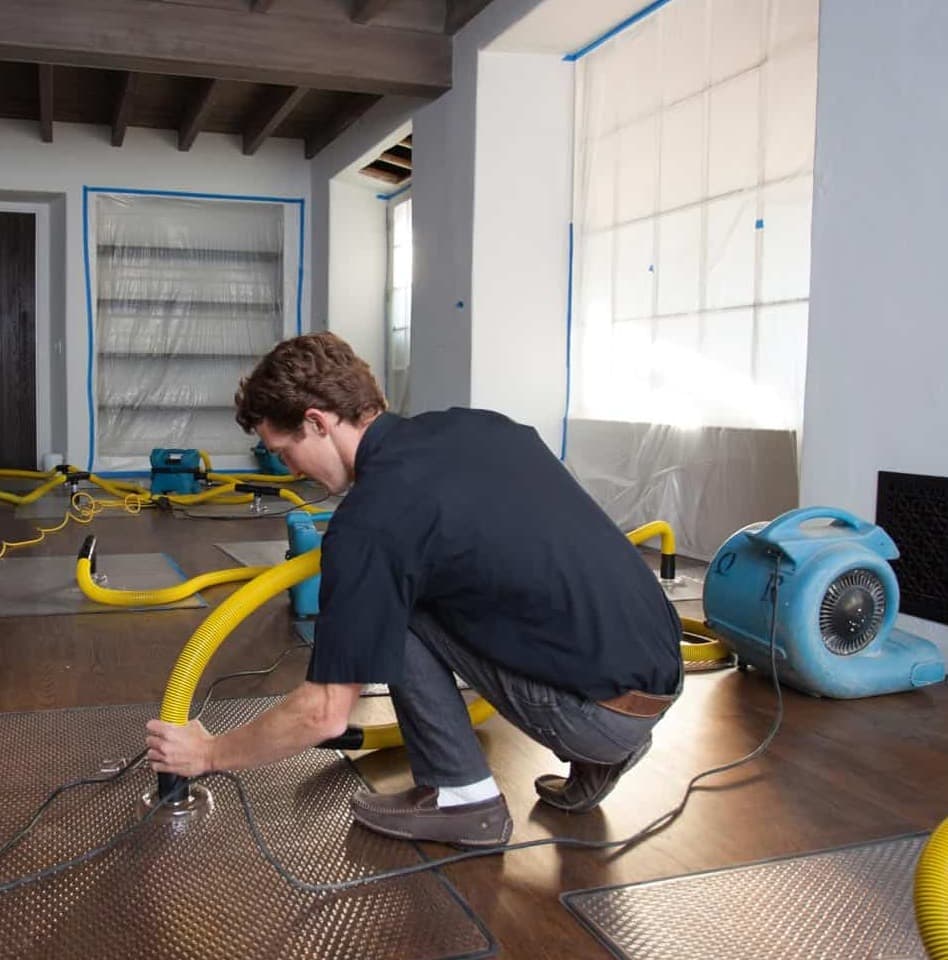
Air movers and dehumidifiers dry affected framing, subfloor, and cavities until moisture meters confirm dry standard.
5. Reconstruction
Roof, siding, windows, drywall, paint, and flooring are rebuilt. We coordinate with licensed roofers for the roof repair itself.
Equipment we bring to New Baltimore
Reviews
What New Baltimore Area Homeowners Say
5.0 Stars · 133 Verified Google Reviews
“Had a really good experience with Prime Restoration for mold remediation. They were professional, clear about the process, and actually made me feel confident about the process. Not pushy. I'd definitely recommend them around Bloomfield Hills”
Christian H.
Bloomfield Hills, MI
“Prime Restoration is a solid company in Michigan for basement floods and water damage. They're professional, knowledgeable and the kind of team you'd want handling a stressful situation.”
Nathan M.
Verified Google Review
“Prime Restoration in Bloomfield has an outstanding team for water damage restoration. Their crew is phenomenal. great people with top notch character who clearly know their stuff. Highly recommend for anyone facing water damage in Bloomfield.”
Ahmed W.
Bloomfield, MI
“Best in the game did my basement because it flooded and they left no messes clean and efficient”
Adam J.
Verified Google Review
“The Prime Restoration team was absolutely fantastic! Very professional and communicative. Completed the job in a timely manner. I would highly recommend!”
Jerome K.
Verified Google Review
“I called five different companies for restoration work, and Prime Restoration was hands down the fastest and most fair on price. They got me a quote the same day, while others were still "getting back to me." Their team works fast.”
Sean B.
Verified Google Review
Storm Damage Questions — New Baltimore, MI
Common questions from New Baltimore homeowners before they call.
Can storm surge from Anchor Bay affect homes that aren't directly on the water?
Yes. During strong east-wind events with elevated lake levels, Anchor Bay water can push several feet above normal shoreline elevation and flow across low-lying streets into nearby inland homes. Properties several blocks back from the waterfront have experienced flooding in major storm events because the topography doesn't drain quickly once surge water reaches it. FEMA floodplain maps don't always capture these secondary-intrusion scenarios.
Do you handle the roof repair?
We coordinate roofing work with licensed roofing contractors and include the full scope in the Xactimate paperwork. Prime Restoration's direct scope is water damage mitigation, drying, interior rebuild, and project coordination.
How soon can you tarp my roof?
Emergency tarping is typically completed same-day after dispatch. Tarping is weather-dependent — for safety reasons, tarping is not performed during active storms or on ice-covered roofs.
Prime Restoration is a licensed restoration contractor. We document the full project scope with detailed, itemized paperwork so you have clear line-item records to submit to your carrier.
Related Services in New Baltimore
Storm Damage
Wind Damage Repair in New Baltimore
Wind damage assessment, emergency tarping, and water intrusion cleanup.
Water Damage
Water Damage Restoration in New Baltimore
Industry-standard water extraction, structural drying, and full restoration with Xactimate documentation.
Water Damage
Ceiling Water Damage Repair in New Baltimore
Ceiling leak diagnosis, dry-out, drywall replacement, and painted finish restoration.
Storm Damage Near New Baltimore
We also serve these nearby Macomb and Oakland County communities.
Need Storm Damage in New Baltimore Now?
24/7 emergency dispatch. trained restoration crews. Typical response within 60 minutes across our core service area.