
Commercial Restoration in Macomb & Oakland County, Michigan
Minimize business downtime with large-scale water, fire, and storm damage restoration for commercial properties.
Every hour of downtime costs your business money. Let us get you back to normal — fast.
24/7 Emergency
Call Now
On-site within 60 minutes. Speak directly with our trained restoration team.
(586) 277-1069Licensed & Insured • Family-Owned
When disaster strikes your business, every hour of downtime means lost revenue, disrupted operations, and potential loss of customers and employees. Prime Restoration specializes in large-scale commercial restoration for offices, retail spaces, restaurants, warehouses, medical facilities, and industrial properties throughout Macomb County and Oakland County. We work around your business schedule with flexible hours and rapid turnaround to minimize disruption.
Why You Must Act Fast
The longer you wait, the worse the damage — and the higher the cost
Every Hour
Business downtime means lost revenue, canceled appointments, and disrupted operations. Employee displacement compounds costs.
Day 1
Inventory and equipment at risk. Customer trust erodes. Competitor advantage grows with every closed day.
Days 2-7
Secondary damage (mold, corrosion) increases scope and cost. Employee uncertainty leads to potential workforce issues.
Weeks 1+
Extended closure risks permanent customer and revenue loss. Insurance claim urgency increases. Lease obligations continue.
Our Commercial Restoration Process
Professional, methodical, and thorough — every time
Emergency Response & Assessment
Immediate on-site response with full damage assessment. We evaluate structural integrity, damage extent, and develop a restoration timeline and plan tailored to minimize your business downtime.
Damage Mitigation
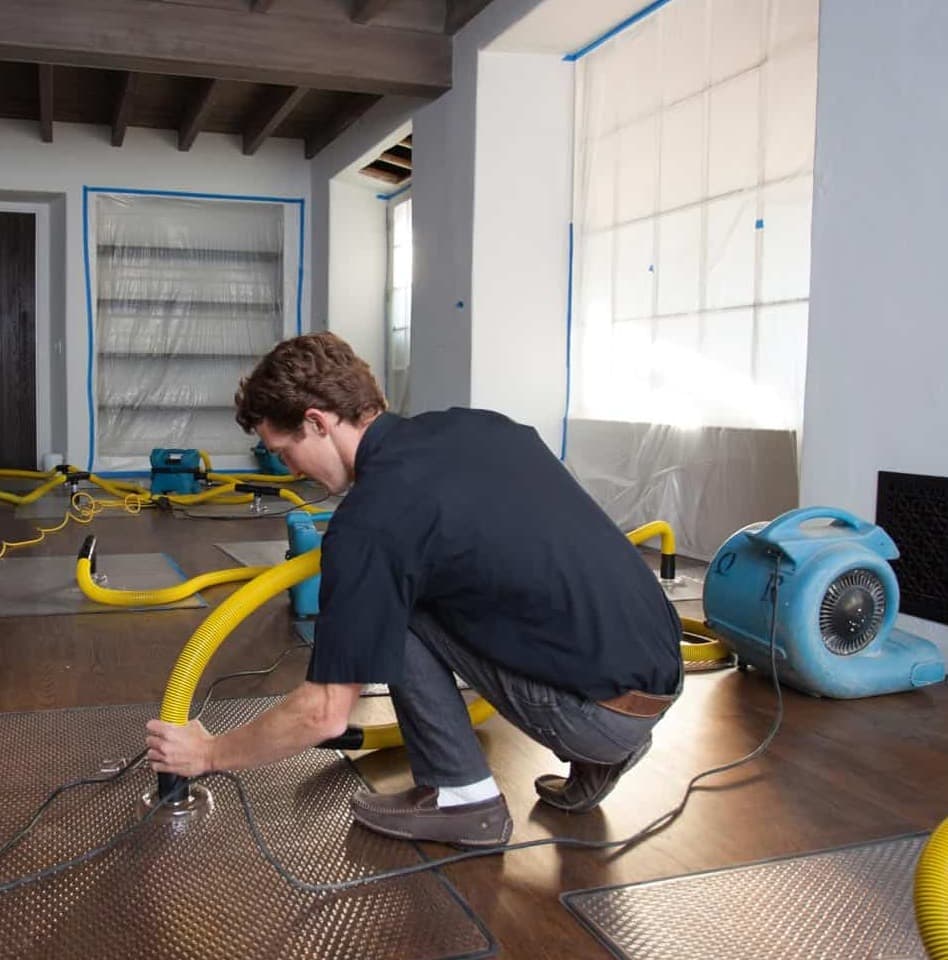
Rapid water extraction, emergency board-up, content protection, and asset preservation. We prioritize protecting your inventory, equipment, documents, and critical business assets.
Restoration Plan & Documentation
Detailed scope of work, timeline, and cost estimate. We document the full restoration scope in Xactimate so you have accurate paperwork compatible with your commercial insurance carrier to submit with your claim.
Restoration Execution
Full restoration with flexible scheduling — evenings, weekends, phased approach — to work around your business operations. Multiple crews for faster completion when needed.
Reconstruction & Build-Out
Complete commercial build-out including flooring, walls, ceilings, fixtures, and systems. All work meets commercial building codes and ADA requirements.
Final Walkthrough & Handoff
Detailed final inspection, punch list completion, and documentation. We ensure everything meets your standards before project completion.
What We Handle
The first question on a commercial loss
Who authorises the work, and who pays for it
On a house this is one conversation with one person. On a commercial property it is frequently three or four parties with different interests, and the delay that costs a business the most is almost never technical — it is waiting for someone to establish who is allowed to say yes. Sorting this in the first hour is worth more than any piece of equipment.
Tenant, landlord, or both
Most commercial leases split responsibility somewhere between the structure and the improvements — the shell versus what the tenant built inside it. Which side of that line a loss falls on decides who authorises and who ultimately carries it. Nobody should be reading the lease for the first time while water is still running, so it is worth knowing your own answer in advance.
The property manager is usually the practical authority
Even when the owner carries the cost, the manager typically controls access, vendor approval and after-hours entry. Getting them on the first call — rather than looping them in later — removes most of the friction. They are also the party who knows the building.
The building engineer knows things nobody else does
Where the shutoffs are, which panel feeds what, whether the roof drains have a history, how the rooftop units are configured. On a multi-storey or older commercial building this person saves more time than any other single input, and they are frequently not on the contact list anyone hands you.
Emergency stabilisation rarely needs the full chain
Stopping the loss growing is generally within someone’s authority immediately, and it should not wait for a decision about the full scope. The mistake is treating the whole job as blocked because the reconstruction question is unresolved.
Get authority in writing, even when everyone is agreeable
A short written authorisation naming who approved what scope, for which space, protects every party — including the one who authorised it. Verbal approval at 2am is remembered differently at the reconciliation.
Adjacent tenancies are stakeholders too
Water and smoke do not respect a demising wall. If a neighbouring unit is affected, they have their own insurer, their own lease and their own opinion about access — and the sooner that is acknowledged, the less of it becomes a dispute.
The constraint that shapes everything
You cannot close, so the work has to fit around you
The technical restoration is the same as any other building. What is genuinely different is that the work happens inside a business that still has customers, staff, inventory and obligations. Almost every decision on a commercial job is a scheduling decision wearing a technical disguise.
Phasing beats speed
Restoring the whole space at once is usually faster on paper and worse in practice. Sectioning the building so part stays open and revenue keeps moving is normally the better outcome, even when the total number of days goes up. That is a business call, and it should be yours rather than assumed.
After-hours and overnight work
Noisy and disruptive phases — demolition, drilling, equipment placement — frequently move outside operating hours. This has to be arranged with the property manager for access and alarm reasons, and it needs deciding early because it changes crew scheduling rather than being a same-day switch.
Hard barriers, not plastic and tape
Where the public or staff share a building with active work, temporary partitions have to look deliberate and hold up to being leaned on. This is as much about the impression the space gives as about containment — a restaurant dining room next to visible sheeting reads as closed even when it is open.
Equipment noise is a real constraint
A drying chamber is loud, and in an office, a medical suite or a hotel that is not a detail. Equipment selection and placement change accordingly, and sometimes drying takes longer specifically so the space stays usable. Worth saying out loud rather than discovering.
Inventory and records come before finishes
Stock, paper files, servers and equipment are frequently worth more than the building materials around them and are on a much shorter clock. The first hour is better spent protecting and relocating those than deciding about flooring.
Downtime is part of the scope, not a side effect
A plan that restores the building beautifully while the business is dark for six weeks may be the wrong plan. Ask any contractor to describe the sequence in terms of what reopens when — if they can only describe it in terms of trades, they are solving a different problem.
Systems residential work never touches
The commercial building elements that change the job
A commercial structure fails in ways a house does not, and several of these are both a cause of losses and a complication in restoring them. If your building has these, they belong in the conversation on day one.
| Element | Why it matters | What it changes |
|---|---|---|
| Fire sprinkler system | A single accidental head discharge or a frozen line in an unheated area releases a very large volume very fast, and it does not stop until the system is shut down. | The system must be restored to service, which is a licensed fire-protection trade. The building may not legally operate without it, so that step often controls the reopening date rather than the drying does. |
| Suspended ceiling grid and tile | Tiles are mineral fibre and effectively disposable once wet; the grid usually survives. | A genuine advantage — the ceiling comes down easily and gives full access to everything above it, which makes the plenum inspectable rather than a mystery. |
| Return-air plenum above the ceiling | In many commercial buildings the ceiling void IS the return duct, so anything airborne up there is being circulated. | Containment has to account for the plenum, not just the room. This is the most commonly missed element in a commercial containment and it is why a room-level barrier can be worthless. |
| Rooftop units and commercial HVAC | Large multi-zone systems serving areas well beyond the affected space, often with shared returns. | The system usually comes down early and stays down until someone qualified has assessed it, because running it distributes the problem across every zone it serves. |
| VCT, sheet vinyl and adhesives | Common in older commercial floors, and pre-1980 flooring and mastic may contain asbestos. | Stop before disturbing it and have suspect material tested by a qualified party. Abatement is a licensed specialty and it is not restoration work. |
| IT rooms, servers and raised floors | The highest-value contents in most commercial buildings, and a raised floor hides a large void that water finds first. | Power-down and protection decisions are made with the client’s IT people, not by a restoration crew. The void under a raised floor gets inspected rather than assumed dry. |
| Elevator pits and shafts | The lowest point in the building, so water arrives there and stays. | A flooded pit takes the elevator out of service and is a licensed elevator contractor’s work. In a multi-storey building that is an accessibility and occupancy issue, not an inconvenience. |
| Walk-in coolers and freezers | Insulated panel construction that holds water inside the panel, plus a refrigeration system and a product loss on its own clock. | Panels frequently cannot be dried in place and the food-safety decision belongs to the operator and the health authority, not to us. |
Staying open, staying legal
Compliance while the work is happening
A building open to the public during restoration still has to meet the obligations it had the day before. These are the ones that get overlooked when everyone is focused on the loss, and they are the ones that stop a job rather than slow it.
Exits and egress paths stay clear
Equipment, hose runs and containment cannot obstruct a required exit or reduce an egress path below what the occupancy requires. This is the single most common way a well-run restoration creates a code problem, and it is entirely avoidable with a walk-through before equipment lands.
Accessible routes stay accessible
A temporary barrier that makes an accessible entrance or restroom unusable is not a neutral choice. Where a route has to close, an alternative gets planned rather than improvised.
Fire protection out of service is a notification
If sprinklers or alarms are impaired during the work, that generally requires notifying the authority having jurisdiction and often the insurer, and it may require a fire watch. This is a real obligation rather than a formality, and it belongs to the building rather than to the restoration contractor alone.
Food service has its own authority
A restaurant or commercial kitchen answers to the local health department on reopening, and their requirements are independent of whether the building is dry. Involve them early rather than presenting a finished job.
Healthcare and dental spaces have infection-control requirements
Construction and restoration in a clinical setting carries containment and air-management requirements beyond ordinary practice. If your space is licensed for patient care, say so on the first call — it changes the plan rather than the price alone.
Documentation is heavier and it matters more
Multiple parties, a lease, and often more than one insurer mean the record has to satisfy people who were never on site. Dated photographs, a written scope per space, daily moisture logs, and a clear statement of who authorised what. That is not bureaucracy on a commercial job — it is the deliverable.
Need Commercial Restoration? We're Ready.
24/7 emergency response. On-site within 60 minutes. Free estimates.
What Our Commercial Restoration Customers Say
Real reviews from Southeast Michigan homeowners
“Had a really good experience with Prime Restoration for mold remediation. They were professional, clear about the process, and actually made me feel confident about the process. Not pushy. I'd definitely recommend them around Bloomfield Hills”
Christian H.
Bloomfield Hills, MI
Commercial Restoration FAQ
Answers to the most common questions from Michigan homeowners
How fast can you respond to commercial water damage?
Prime Restoration typically responds to commercial water damage emergencies within 60 minutes, 24 hours a day, 7 days a week. We understand that business downtime is extremely costly, so we deploy multiple crews and equipment when needed to expedite the restoration process.
Do you work around business hours?
Yes, we offer flexible scheduling including evenings, weekends, and overnight work to minimize disruption to your business operations. For multi-phase projects, we can work on sections of your facility while you continue operating in unaffected areas.
Does commercial insurance cover restoration?
Most commercial property insurance policies cover water damage, fire damage, and storm damage restoration. Business interruption insurance may also cover lost income during restoration. Prime Restoration documents the full restoration scope in Xactimate so you have accurate paperwork — photos, estimates, and scope of work — compatible with major Michigan commercial carriers to submit with your claim.
How do you minimize business downtime?
We minimize downtime through: typical 60-minute emergency response, deployment of multiple crews simultaneously, flexible scheduling around your operations, phased restoration approaches that allow partial occupancy, and priority procurement of materials. Our goal is to get your business back to full operation as quickly as safely possible.
Who has to approve the work on a commercial property?
Frequently three or four parties, and the delay that costs a business most is almost never technical — it is waiting to establish who is allowed to say yes. Most commercial leases split responsibility somewhere between the structure and the tenant improvements, and which side of that line a loss falls on decides who authorises and who ultimately carries it; nobody should be reading the lease for the first time while water is still running. The property manager is usually the practical authority even when the owner carries the cost, because they control access, vendor approval and after-hours entry, so getting them on the first call removes most of the friction. The building engineer knows things nobody else does — where the shutoffs are, which panel feeds what, whether the roof drains have a history, how the rooftop units are configured — and is frequently not on the contact list anyone hands you. Emergency stabilisation rarely needs the full chain and should not wait for the reconstruction decision. And get authority in writing even when everyone is agreeable, because verbal approval at 2am is remembered differently at the reconciliation.
Can you work without shutting my business down?
Usually, and that constraint should shape the plan rather than be bolted onto it. Restoring the whole space at once is often faster on paper and worse in practice; sectioning the building so part stays open and revenue keeps moving is normally the better outcome even when the total number of days goes up — but that is a business call and it should be yours rather than assumed. Noisy phases like demolition and equipment placement frequently move outside operating hours, which has to be arranged with the property manager for access and alarm reasons and needs deciding early because it changes crew scheduling. Where the public or staff share the building with active work, temporary partitions have to be hard barriers that look deliberate rather than plastic and tape, because a dining room next to visible sheeting reads as closed even when it is open. Equipment noise is a real constraint in an office, medical suite or hotel, and sometimes drying deliberately takes longer so the space stays usable. Ask any contractor to describe the sequence in terms of what reopens when — if they can only describe it in terms of trades, they are solving a different problem.
What is different about a commercial building technically?
Several systems that residential work never touches, and most are both a cause of losses and a complication in restoring them. A fire sprinkler discharge releases an enormous volume very fast and does not stop until the system is shut down, and restoring it to service is a licensed fire-protection trade — the building may not legally operate without it, so that step often controls the reopening date rather than the drying does. Suspended ceiling tiles are effectively disposable once wet while the grid survives, which is genuinely an advantage because it gives full access above. But in many commercial buildings the ceiling void IS the return-air plenum, so containment has to account for the plenum and not just the room; that is the most commonly missed element in a commercial containment. Rooftop units serving multiple zones usually come down early and stay down until assessed. Pre-1980 VCT, sheet vinyl and mastic may contain asbestos and must be tested before disturbance. IT rooms and raised floors hide a void water finds first, and power-down decisions belong with your IT people. Elevator pits are the lowest point in the building and are licensed elevator work. Walk-in cooler panels hold water inside the panel and the food-safety call belongs to you and the health authority.
Does the building still have to meet code while you are working in it?
Yes, and these are the obligations that stop a job rather than slow it. Equipment, hose runs and containment cannot obstruct a required exit or reduce an egress path below what the occupancy requires — that is the single most common way a well-run restoration creates a code problem and it is entirely avoidable with a walk-through before equipment lands. Accessible routes stay accessible, and where one has to close an alternative gets planned rather than improvised. If sprinklers or alarms are impaired during the work, that generally requires notifying the authority having jurisdiction and often the insurer, and it may require a fire watch. Food service answers to the local health department on reopening independently of whether the building is dry, so involve them early rather than presenting a finished job. Licensed healthcare and dental spaces carry infection-control and air-management requirements beyond ordinary construction practice — say so on the first call, because it changes the plan rather than the price alone.
What documentation should I expect on a commercial job?
More than on a house, and it matters more, because multiple parties and often more than one insurer mean the record has to satisfy people who were never on site. Expect dated photographs, a written scope per space rather than one scope for the building, daily moisture logs showing readings against a dry standard, and a clear written statement of who authorised what work in which space. On a commercial job that is not bureaucracy — it is the deliverable, and it is what lets anyone reconcile the job months later. Two additions worth insisting on: if adjacent tenancies were affected, their spaces should be documented separately because they have their own insurer and their own lease; and if any building system was taken out of service — sprinklers, HVAC, an elevator — the record should show when it went down, who was notified, and when it was restored. Those are the facts that get asked about long after the crews have gone.
Commercial Restoration Service Areas
Serving all of Macomb County and Oakland County, Michigan
Macomb County
Prime Restoration is a Michigan restoration contractor headquartered at 13854 Lakeside Circle, Suite 558, Sterling Heights, MI 48313, with a Rochester office serving Oakland County. Our trained restoration team provides commercial restoration across Macomb County and Oakland County, with 60-minute emergency response and direct billing to State Farm, AAA, Auto-Owners, Citizens, Allstate, Farmers, USAA, Progressive, and Meemic.
Ready to Get Started?
Call now for 24/7 emergency commercial restoration service in Southeast Michigan.