
Commercial Water Damage Restoration in Mount Clemens, MI
Commercial properties often have concealed utilities — data cables, network runs, HVAC trunks — running through the same ceiling spaces where water damage occurs. Drying has to account for equipment the landlord usually does not even know is there.
Family-Owned · Insured & Licensed · 24/7 Emergency Dispatch
What Mount Clemens Homeowners Need to Know
Historic homes in downtown Mount Clemens often have lath-and-plaster walls — after water damage, plaster must be carefully dried to avoid permanent cracking or delamination.
Housing here is predominantly Historic Victorian and early-1900s homes downtown, mixed with postwar ranches further out. The most common restoration-related issues in Mount Clemens are historic plumbing, Clinton River flooding, plaster water damage. Our crews treat each property as its own project — scope, drying time, and rebuild needs are written based on what we measure on site, not a generic playbook.
Mount Clemens' historic downtown homes were built with lath-and-plaster wall systems that absorb and release moisture very differently from modern drywall. After water damage, plaster must be dried slowly and carefully to avoid permanent cracking, delamination from the lath, or efflorescence staining on the finish coat. Restoration crews in this area frequently coordinate with period-materials specialists for the rebuild phase when original finishes are being preserved.
Commercial restoration work in Mount Clemens has to fit around tenant operations and business continuity — and the local building conditions that drive historic plumbing in residential work affect commercial scopes too, just across larger square footage and more complex mechanical systems.
Seasonal pattern — Mount Clemens
Clinton River floodplain events concentrate in spring thaw; historic home plumbing failures are a year-round baseline.
Local conditions in Mount Clemens
Soil & Water Table
Mount Clemens historic downtown sits in the Clinton River corridor with a correspondingly high seasonal water table. Many historic homes have stone or brick foundations that were waterproofed with original-era materials never designed for modern moisture standards. Spring thaw events can raise the river several feet into low-lying properties.
Building Stock
Mount Clemens historic downtown features Victorian and early-1900s homes with lath-and-plaster walls, hardwood floors, and original millwork. Surrounding postwar neighborhoods have more typical 1950s-1960s ranch housing. The two eras require completely different restoration approaches — conservation vs. modern mitigation.
Dispatch & Access
Historic downtown homes often sit on smaller lots with constrained driveway access. Crews frequently stage from the street and work with longer hose runs than in modern subdivisions.
Mount Clemens Neighborhoods and Districts We Cover
Mount Clemens sits inland along the Clinton River and presents a distinct restoration profile from the lakefront cities. The downtown core around Macomb Place and the Cherry Street historic district contains pre-1930 housing with stone foundations, knob-and-tube remnants, and plaster walls, and post-loss reconstruction routinely triggers asbestos and lead-based-paint protocols. The neighborhoods between Gratiot and the river, including the area around McKinley Elementary and the older grid south of Cass, sit in or near the Clinton River floodplain and have a documented history of riverine flooding. The newer subdivisions north of Elizabeth Road reflect post-1970s construction with finished basements, where sewer backup and sump failure losses dominate. Across the city, age-of-construction governs scope: structural drying plans must account for plaster-on-lath cavity wetting and historic floor systems.
Recent Storm History — Mount Clemens, MI
Mount Clemens sits along the Clinton River and has a documented history of riverine flooding distinct from the lakefront cities. The August 11, 2014 Metro Detroit flood produced extensive sanitary-sewer backups across the older neighborhoods between Gratiot and the river, with hundreds of finished basements taking Category 3 water through floor drains. The June-July 2021 Metro Detroit flooding generated a second comparable event. The Clinton River itself has produced repeated overtopping and floodplain inundation events, and the December 2013 Michigan ice storm caused widespread tree damage and roof and gutter system failures across the city. The April 15, 2026 Macomb County windstorm contributed recent wind and tree-impact losses. Historic-district structures complicate post-loss work, with plaster-on-lath cavity wetting and asbestos-suspect materials routinely encountered.
Working With Your Insurance Carrier in Mount Clemens
Mount Clemens draws the same carrier mix as the surrounding county, with AAA/Auto Club Group, Auto-Owners, State Farm, Allstate, Citizens, Farm Bureau, and Hanover all writing residential property. The Clinton River floodplain exposure makes NFIP a recurring consideration for parcels in mapped Special Flood Hazard Areas; standard HO-3 forms exclude surface flooding regardless of source. The Michigan sewer-backup endorsement is the working coverage for the Category 3 losses driven by combined sanitary and storm system surcharge in the older neighborhoods. Xactimate scopes are standard, and historic-district properties typically generate supplementary scope for plaster, original trim, and asbestos-and-lead protocols that exceed default price-list assumptions.
Prime Restoration is a licensed Michigan restoration contractor. We document project scope with detailed, itemized paperwork so homeowners have clear line-item records to submit to their carrier.
Permits & Code Compliance — Mount Clemens
Permits in Mount Clemens are issued through the City of Mount Clemens Building Department, which administers the 2015 Michigan Building Code and Michigan Residential Code. Category 3 water restoration rebuilds and post-fire reconstruction require the standard suite of building, electrical, mechanical, and plumbing permits where regulated trades are disturbed. Clinton River floodplain parcels are subject to city floodplain ordinance review, with substantial improvement and substantial damage thresholds governing scope on repetitive-loss properties. Any work within the river corridor falls under EGLE jurisdiction through Part 301 Inland Lakes and Streams. Historic-district properties and pre-1980 housing stock routinely trigger Michigan Part 602 asbestos notification and pre-1978 lead-based-paint protocols before demolition can proceed.
Commercial Water Damage Restoration — Mount Clemens, MI
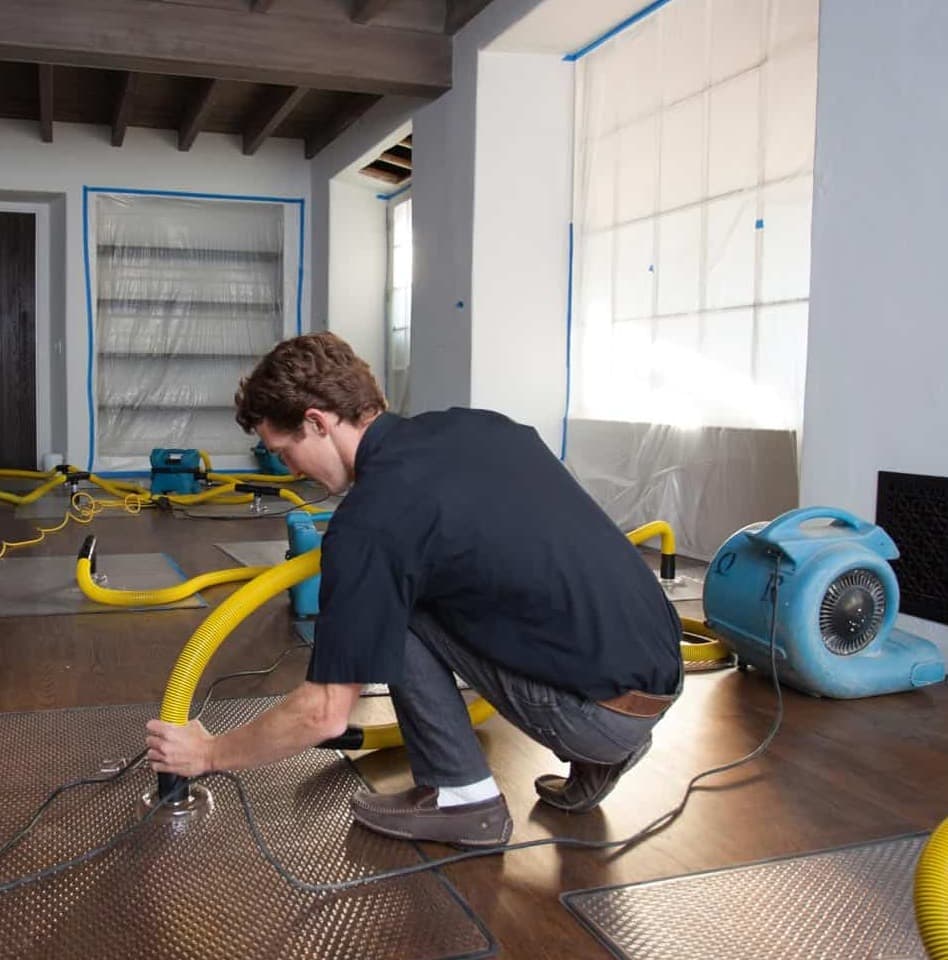
Commercial water losses are scoped around business continuity — the goal is to get the property dry and open as fast as safely possible. Our crews coordinate after-hours work, containment around operating areas, and documentation that works for commercial insurance carriers. Industry-standard mitigation protocol applies the same way it does residentially, but scale and coordination are the main differences.
Common causes we see in Mount Clemens
- •Sprinkler system discharge
- •Roof leak
- •HVAC condensate overflow
- •Plumbing failure in restroom or kitchen
- •Storm-driven water intrusion
- •Fire suppression water
Signs to watch for
- •Water accumulation on commercial flooring
- •Saturated ceiling tiles
- •Musty smell in office or retail space
- •Electrical issues after water event
Our Commercial Water Process in Mount Clemens
The same documented process on every project.
1. Business Continuity Planning
Before any demolition, we coordinate with facility management on which areas can stay operational during mitigation.
2. Containment & Isolation
6-mil poly and negative air isolate affected areas so operations in other zones can continue.
3. Water Extraction & Drying
Truck-mounted extractors, large-capacity LGR dehumidifiers, and industrial air movers are deployed at commercial scale.
4. Contents Protection
Office furniture, electronics, inventory, and documents are protected or packed out. Contents inventory is documented for the carrier.
5. Reconstruction
Ceiling tiles, carpet, drywall, and finishes are rebuilt around the business operation schedule.
Equipment we bring to Mount Clemens
Reviews
What Mount Clemens Area Homeowners Say
5.0 Stars · 133 Verified Google Reviews
“Had a really good experience with Prime Restoration for mold remediation. They were professional, clear about the process, and actually made me feel confident about the process. Not pushy. I'd definitely recommend them around Bloomfield Hills”
Christian H.
Bloomfield Hills, MI
“Prime Restoration is a solid company in Michigan for basement floods and water damage. They're professional, knowledgeable and the kind of team you'd want handling a stressful situation.”
Nathan M.
Verified Google Review
“Prime Restoration in Bloomfield has an outstanding team for water damage restoration. Their crew is phenomenal. great people with top notch character who clearly know their stuff. Highly recommend for anyone facing water damage in Bloomfield.”
Ahmed W.
Bloomfield, MI
“Best in the game did my basement because it flooded and they left no messes clean and efficient”
Adam J.
Verified Google Review
“The Prime Restoration team was absolutely fantastic! Very professional and communicative. Completed the job in a timely manner. I would highly recommend!”
Jerome K.
Verified Google Review
“I called five different companies for restoration work, and Prime Restoration was hands down the fastest and most fair on price. They got me a quote the same day, while others were still "getting back to me." Their team works fast.”
Sean B.
Verified Google Review
Commercial Water Questions — Mount Clemens, MI
Common questions from Mount Clemens homeowners before they call.
Can historic plaster walls in my Mount Clemens home be saved after water damage?
In most cases yes, if the plaster is dried slowly and carefully. Aggressive dehumidification can dry the plaster face faster than the lath behind it, causing cracking or delamination. We use conservative drying protocols with daily moisture readings on historic plaster, and we coordinate with period-materials specialists when patching or rebuilding is needed. The goal is always preservation of original materials over replacement, which is also what preserves the value of historic homes.
Can the business stay open during mitigation?
In most cases, yes. Containment isolates the affected area and work can proceed after hours. This is coordinated with facility management on a project-by-project basis.
Do you work with commercial insurance carriers?
We provide detailed Xactimate documentation that commercial insurance carriers and third-party adjusters use as a starting point. Claim submission and any follow-up discussions remain between the property owner and their carrier.
Prime Restoration is a licensed restoration contractor. We document the full project scope with detailed, itemized paperwork so you have clear line-item records to submit to your carrier.
Related Services in Mount Clemens
Water Damage
Water Damage Restoration in Mount Clemens
Industry-standard water extraction, structural drying, and full restoration with Xactimate documentation.
Commercial & Rebuild
Reconstruction & Rebuild in Mount Clemens
Full reconstruction of drywall, flooring, trim, cabinetry, and finishes after restoration.
Commercial Water Near Mount Clemens
We also serve these nearby Macomb and Oakland County communities.
Need Commercial Water in Mount Clemens Now?
24/7 emergency dispatch. trained restoration crews. Typical response within 60 minutes across our core service area.