
Water Damage Restoration in Sterling Heights, MI
A broken pipe, appliance leak, or storm surge can soak drywall and subfloor within hours. The longer water sits, the more secondary damage you pay for — warped hardwood, swollen MDF, wicking up studs, and Category 2 microbial growth within 48–72 hours. Fast extraction is the single biggest cost-control decision after a water loss.
Family-Owned · Insured & Licensed · 24/7 Emergency Dispatch
What Sterling Heights Homeowners Need to Know
Sterling Heights sits on heavy clay soil typical of the Clinton River watershed — foundations here take on hydrostatic pressure during every major rain event.
Housing here is predominantly 1960s–1990s suburban subdivisions, with a large share of split-level and ranch homes. The most common restoration-related issues in Sterling Heights are clay-soil basement seepage, sump pump failure, ice dams. Our crews treat each property as its own project — scope, drying time, and rebuild needs are written based on what we measure on site, not a generic playbook.
Sterling Heights subdivisions built between the 1960s and 1990s were designed before modern drain-tile standards became common. Combined with the heavy clay subsoil that defines the Clinton River watershed, that means after a multi-inch rain event we commonly see foundation seepage, sump pit overflow, and slow wicking up drywall from the bottom plate. Restoration scope here usually involves moisture mapping the full basement perimeter — not just the visible wet area — before drying equipment goes down.
For water damage work specifically in Sterling Heights, the dominant driver we see on local jobs is clay-soil basement seepage — which affects how fast water spreads, where it hides, and how long drying realistically takes.
Seasonal pattern — Sterling Heights
Spring thaw and multi-day fall rain events drive most calls here; frozen pipes account for a smaller but concentrated burst of January–February work.
Local conditions in Sterling Heights
Soil & Water Table
Sterling Heights sits on the heavy clay subsoil characteristic of the Clinton River watershed. Clay doesn't absorb water quickly, so after major rain events hydrostatic pressure builds against foundation walls and finds any weak point — hairline cracks, floor-to-wall joints, window wells. Homes built before modern drain-tile standards often rely on aging interior French drains.
Building Stock
Sterling Heights housing is dominated by split-level and ranch homes built between 1960 and 1995, with a smaller wave of 2000s construction on the city's northern edge. Most have poured-concrete foundations, copper supply lines, and PVC drains in the newer homes — but older subdivisions still commonly have galvanized or cast-iron plumbing due for replacement.
Dispatch & Access
Dispatches from our Sterling Heights office reach most of the city in under 30 minutes outside of rush hour. Wide suburban streets mean equipment staging is straightforward on all but the tightest cul-de-sacs.
Which one did you have?
Sterling Heights has three separate ways water reaches a basement, and they are told apart by what you saw rather than by a lab result. The answer changes what the work is.
| What to check | Sanitary surcharge | River intrusion | Groundwater |
|---|---|---|---|
| Where did it first appear? | Up out of the floor drain, or out of a basement toilet or laundry standpipe. The lowest opening connected to the sewer. | Through the foundation wall itself, or at the cove joint where wall meets floor. No drain involvement. | Cove joint, mortar seams, a cracked wall, or a window well. Often more than one point at once. |
| When did it start, relative to the rain? | During the peak, often within minutes of the heaviest fall. It arrives fast and can stop as fast. | Lagging. Often hours after the rain stopped, and it can continue for a day or more while the river stays high. | Lagging and slow. It builds as the ground saturates and eases as it drains. |
| What did it look and smell like? | Discolored, with solids or paper, and an unmistakable odor. Contaminated from the first minute. | Muddy and silty rather than sewage. Generally a lower category, though river water is not clean water. | Usually clear at first. It picks up whatever it crosses on the floor. |
| Did the neighbors get it too? | If the whole block went at once, it points at the street. If only your house did, it points at your own lateral. | Follows elevation and distance from the corridor rather than following the street. | Follows elevation and lot grading. The house at the low end of the block gets it and the one uphill does not. |
| What does it change about the work? | Category 3 handling. Containment, negative air, and porous material out before anyone assesses finishes. | Generally a lower category, but a longer drying step, because the surrounding ground stays saturated for days after the visible water is gone. | Lower category, and the wall itself becomes the long pole. It keeps giving moisture back to the room after the floor reads dry. |
If you are not sure which column you are in, that is normal, and it is what the on-site moisture readings settle. The visit is free.
Where you live in Sterling Heights decides what the job is
The same rainfall produces different work on different sides of Sterling Heights. Find the row that matches your street before you assume your neighbour’s repair is your repair.
| Area | Where | Building stock | How water gets in | What that changes |
|---|---|---|---|---|
| Utica Junction | Along the Clinton River near Dodge Park | Mixed era, river-adjacent | Documented basement infiltration during high-flow events. Riverine, not sewer. | A different scope from the citywide backup pattern — groundwater behaviour rather than surcharge. |
| Plumbrook | Plumbrook Road and Van Dyke | 1960s–70s ranch and tri-level | Original galvanized supply lines, and below-grade family rooms that are fully finished. | Category 2 and 3 complicate fast, because the finished space sits below grade. |
| Lakeside corridor | Hall Road and Schoenherr | 1980s–90s colonial | Engineered I-joist floor systems holding moisture in the webbing. | Careful moisture mapping. A dry surface reading proves very little here. |
| Citywide | Most residential streets | All eras | Rear-yard privacy fencing constraining equipment staging. | Access decides truck-mount versus portable extraction, and it sets the content pack-out plan. |
Sterling Heights Neighborhoods and Districts We Cover
Sterling Heights spans a wide range of housing eras across distinct sub-areas. The Plumbrook neighborhood near Plumbrook Road and Van Dyke contains predominantly 1960s and 1970s ranch and tri-level homes, many with original galvanized supply lines and below-grade family rooms that complicate Category 2 and Category 3 water losses. The Lakeside corridor near Hall Road and Schoenherr trends toward 1980s and 1990s colonial construction with finished basements and engineered I-joist floor systems that require careful moisture mapping during structural drying. The Utica Junction area along the Clinton River near Dodge Park presents heightened riverine exposure, and homes in this corridor have documented basement infiltration during high-flow events. Access to rear yards is constrained by privacy fencing in much of the city, which affects equipment staging for large-loss water extraction and content pack-outs.
Recent Storm History — Sterling Heights, MI
Sterling Heights sustained widespread basement flooding during the August 11, 2014 Metro Detroit flood, when localized rainfall totals approached and exceeded four inches in a few hours and overwhelmed combined and separated sewer systems across Macomb and Wayne Counties. Sewage backups in finished basements throughout the city produced thousands of Category 3 water losses governed by industry-standard mitigation protocols, and the event reshaped sewage-backup endorsement adoption across the residential market. The June and July 2021 Metro Detroit flooding events produced renewed basement-backup losses, particularly in older subdivisions with under-sized laterals. The April 15, 2026 Macomb County windstorm caused widespread tree-fall and roof damage across Sterling Heights, generating a follow-on wave of wind-driven rain intrusion claims and tarping work that overlapped with ongoing utility-restoration timelines.
Working With Your Insurance Carrier in Sterling Heights
Sterling Heights homeowners are insured through the standard Michigan carrier mix, with AAA/Auto Club Group, Auto-Owners, State Farm, Allstate, Citizens, Farm Bureau, and Hanover all maintaining substantial residential books in Macomb County. This carrier diversity means restoration documentation must be prepared to satisfy multiple desk-adjuster and field-adjuster review standards. Xactimate remains the industry-standard estimating platform across these carriers, and line-item scope built to current Xactimate price-list and methodology specifications is generally required for sketch, mitigation, and rebuild estimates. Photo documentation, moisture mapping, and psychrometric logs aligned with industry-standard reporting expectations support efficient claim resolution across the carrier landscape.
Prime Restoration is a licensed Michigan restoration contractor. We document project scope with detailed, itemized paperwork so homeowners have clear line-item records to submit to their carrier.
Permits & Code Compliance — Sterling Heights
Building permits in Sterling Heights are issued through the City of Sterling Heights Building Department, which administers code review and inspections under Michigan's adopted 2015 Michigan Building Code and the corresponding mechanical, electrical, and plumbing codes. Category 3 water-restoration rebuilds and post-fire reconstruction commonly require coordinated permits across structural, electrical, mechanical, and plumbing trades, with separate trade applications submitted by licensed Michigan contractors. Reconstruction work that disturbs load-bearing assemblies, replaces electrical service, or relocates plumbing rough-ins triggers structural and trade plan review. Inspection sequencing typically follows rough-in, insulation, and final stages consistent with Michigan code enforcement practice.
Water Damage Restoration — Sterling Heights, MI
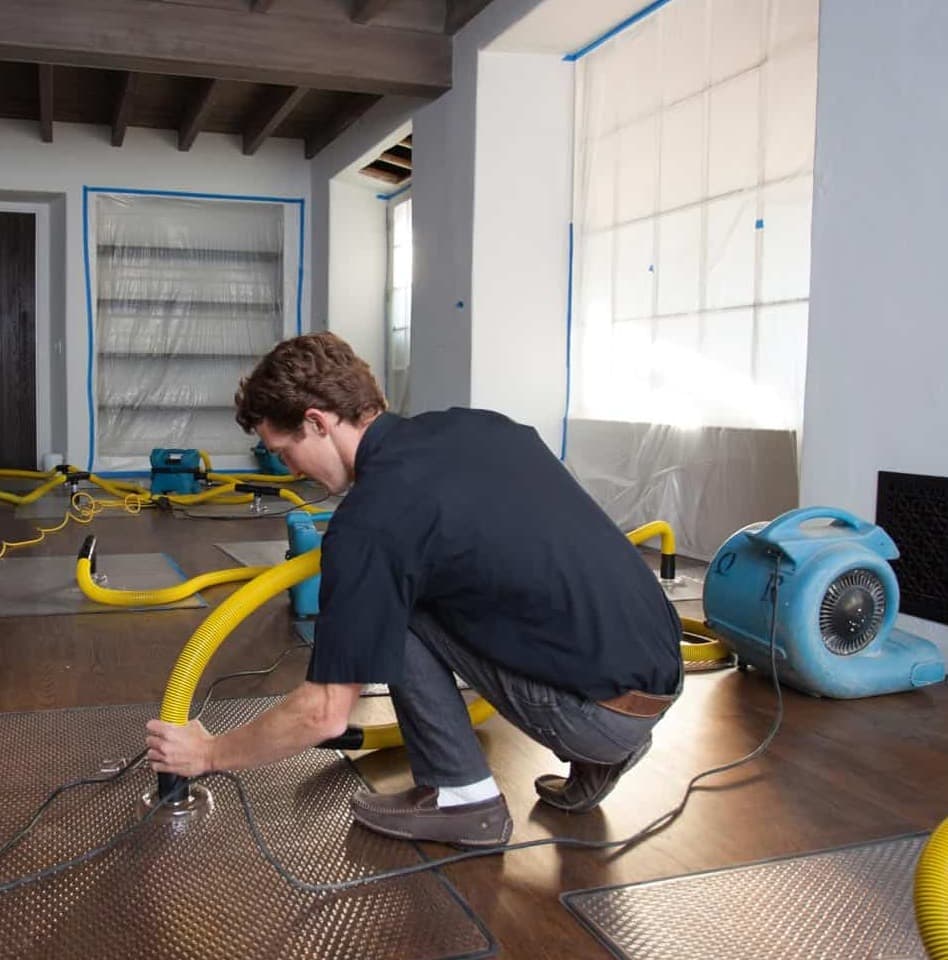
Prime Restoration provides 24/7 emergency water damage restoration built around the industry-standard mitigation protocol. Our crews extract standing water, set up containment, install industrial air movers and LGR dehumidifiers, and monitor moisture levels daily until the structure reaches documented dry standard. Every project is photographed and written up in Xactimate so homeowners have detailed line-item scope to submit to their insurance carrier.
Common causes we see in Sterling Heights
- •Supply line failure (washer hose, toilet, dishwasher)
- •Burst or frozen pipe
- •Water heater rupture
- •Sump pump failure during heavy rain
- •Roof leak from ice dam or storm
- •Sewer line backup
Signs to watch for
- •Visible standing water or saturated carpet
- •Musty or damp smell
- •Swollen baseboards, warped hardwood, or bubbling paint
- •Water stains on ceilings or walls
- •Sudden spike in humidity
Our Water Damage Process in Sterling Heights
The same documented process on every project.
1. Emergency Response & Inspection
A trained technician arrives, photographs the scene, identifies the water source, and maps affected materials with moisture meters and thermal imaging following industry-standard mitigation protocol.
2. Water Classification & Containment
Water is classified Category 1 (clean), 2 (gray), or 3 (black) and Class 1–4 by evaporation load. Non-affected areas are contained with 6-mil poly to prevent cross-contamination.
3. Water Extraction
Truck-mounted extractors and submersible pumps remove standing water. Saturated carpet pad is removed and disposed of. Drilling weep holes into wall cavities lets trapped water drain.
4. Structural Drying
Air movers, LGR dehumidifiers, and directed heat are set based on a written drying plan. Daily moisture readings are logged until materials reach dry standard.
5. Cleaning & Sanitization
Affected materials are cleaned with professional-grade antimicrobial. Contents are cleaned, dried, and inventoried for pack-out when needed.
6. Reconstruction & Xactimate Documentation
Drywall, flooring, trim, and paint are rebuilt to complete the project. Every line item is documented in Xactimate so you have detailed paperwork for your insurance carrier.
Equipment we bring to Sterling Heights
Reviews
What Sterling Heights Area Homeowners Say
5.0 Stars · 133 Verified Google Reviews
“Had a really good experience with Prime Restoration for mold remediation. They were professional, clear about the process, and actually made me feel confident about the process. Not pushy. I'd definitely recommend them around Bloomfield Hills”
Christian H.
Bloomfield Hills, MI
“Prime Restoration is a solid company in Michigan for basement floods and water damage. They're professional, knowledgeable and the kind of team you'd want handling a stressful situation.”
Nathan M.
Verified Google Review
“Prime Restoration in Bloomfield has an outstanding team for water damage restoration. Their crew is phenomenal. great people with top notch character who clearly know their stuff. Highly recommend for anyone facing water damage in Bloomfield.”
Ahmed W.
Bloomfield, MI
“Best in the game did my basement because it flooded and they left no messes clean and efficient”
Adam J.
Verified Google Review
“The Prime Restoration team was absolutely fantastic! Very professional and communicative. Completed the job in a timely manner. I would highly recommend!”
Jerome K.
Verified Google Review
“I called five different companies for restoration work, and Prime Restoration was hands down the fastest and most fair on price. They got me a quote the same day, while others were still "getting back to me." Their team works fast.”
Sean B.
Verified Google Review
Water Damage Questions — Sterling Heights, MI
Common questions from Sterling Heights homeowners before they call.
Why do Sterling Heights basements flood even when the sump pump works?
Sterling Heights' heavy clay subsoil doesn't drain quickly, which means after a multi-inch rain event hydrostatic pressure builds against foundation walls from all sides at once — not just at the drain tile the sump can reach. Water finds the weakest point: a hairline crack, an unsealed floor-to-wall joint, or a window well. A working sump handles normal events but can't relieve perimeter pressure that exceeds what the drain-tile system was designed to capture.
How fast can a crew reach my home after water damage?
Our dispatcher assigns a trained restoration crew as soon as you call. Most residential losses are reached within about 60 minutes across our core service area, though severe weather or freeway closures can extend response time.
Do you work with my insurance company?
Prime Restoration is a licensed restoration contractor. We document the full project scope in Xactimate — the same software adjusters use — so you have clear paperwork to submit to your carrier.
How long does structural drying take?
A typical Class 2 water loss reaches dry standard in 3–5 days. Class 3 losses with saturated walls, carpet pad, and subfloor usually run 5–7 days. We log moisture readings daily so drying time is based on measurements, not guesswork.
Can I stay in the house during drying?
For Category 1 (clean water) losses, most homeowners stay in place. Industrial air movers are loud (roughly 65–75 dB) and the affected area should stay contained. Category 2 and 3 losses often require temporary relocation until sanitization is complete.
Prime Restoration is a licensed restoration contractor. We document the full project scope with detailed, itemized paperwork so you have clear line-item records to submit to your carrier.
Related Services in Sterling Heights
Water Damage
Basement Flooding Cleanup in Sterling Heights
Basement water extraction, contents pack-out, structural drying, and sanitization.
Water Damage
Burst Pipe Water Damage in Sterling Heights
Emergency response to burst, frozen, or ruptured pipes — water extraction, wall cavity drying, and rebuild.
Water Damage
Ceiling Water Damage Repair in Sterling Heights
Ceiling leak diagnosis, dry-out, drywall replacement, and painted finish restoration.
Water Damage Near Sterling Heights
We also serve these nearby Macomb and Oakland County communities.
Need Water Damage in Sterling Heights Now?
24/7 emergency dispatch. trained restoration crews. Typical response within 60 minutes across our core service area.