Sewage & Biohazard Cleanup in Macomb & Oakland County, Michigan
Emergency sewage cleanup, professional sanitization, and complete decontamination. Safety is our #1 priority.
Sewage is a serious health hazard. Do not attempt cleanup yourself — call professionals now.
24/7 Emergency
Call Now
On-site within 25 minutes. Speak directly with our trained restoration team.
(586) 277-1069Licensed & Insured • Family-Owned
Sewage backups are classified as Category 3 (black water) under industry-standard mitigation practice. Raw sewage may contain bacteria, viruses, and parasites. Prime Restoration provides emergency sewage and biohazard cleanup across Macomb County and Oakland County, Michigan, using strict safety protocols, full PPE, containment barriers, commercial-grade antimicrobial treatment, and regulated-waste disposal methods. For health-related questions about sewage exposure, consult a licensed medical professional or industrial hygienist.
Why You Must Act Fast
The longer you wait, the worse the damage — and the higher the cost
Immediate
Raw sewage contains dangerous pathogens including E. coli, Salmonella, and Hepatitis. Direct contact or airborne exposure creates immediate health risks.
Hours 1-6
Sewage spreads and seeps into porous materials. Contamination zone expands. Airborne bacteria levels increase in enclosed spaces.
Hours 6-24
Contamination penetrates deeper into flooring, subfloor, and wall cavities. Salvageability of materials decreases rapidly.
Days 1+
Extensive contamination requires demolition of affected materials. Mold growth compounds the biohazard. Restoration costs multiply.
Our Sewage & Biohazard Cleanup Process
Professional, methodical, and thorough — every time
Emergency Response & Safety
Immediate response with proper PPE (Personal Protective Equipment). We establish safety zones and prevent occupant exposure to contaminated areas.
Sewage Extraction & Removal
Commercial extraction of all sewage and contaminated water using specialized equipment designed for Category 3 (black water) situations.
Contaminated Material Removal
All porous materials contacted by sewage (carpet, pad, drywall below flood line, insulation) are removed and properly disposed of as regulated waste.
Sanitization & Disinfection
Multiple rounds of professional-grade antimicrobial treatment and disinfection using commercial-grade products. All surfaces are sanitized to safe levels.
Structural Drying
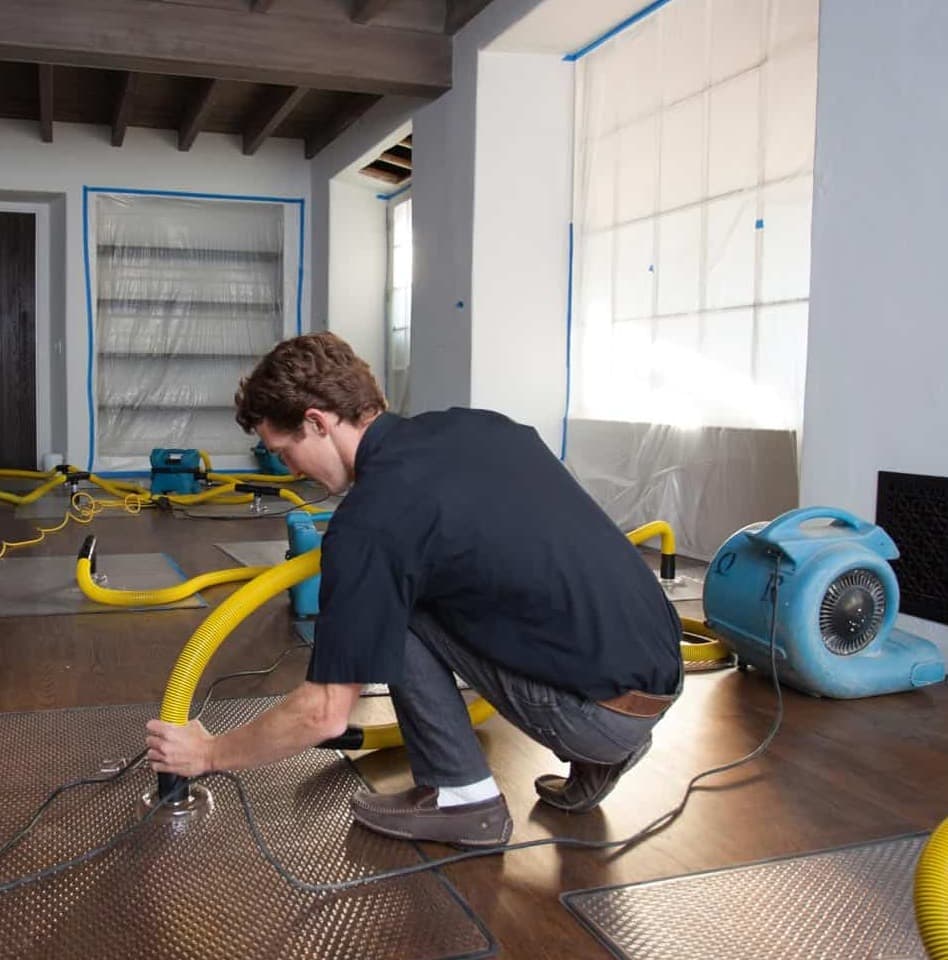
Industrial dehumidifiers and air movers dry the structure completely. Moisture monitoring ensures all materials reach safe moisture levels.
Restoration & Rebuild
Replace removed materials including drywall, flooring, and trim. Complete reconstruction that rebuilds and finishes the project.
What We Handle
Scope
What "biohazard" covers here — and what we refer out
Biohazard is a broad word covering work that ranges from a backed-up floor drain to situations that need a different specialty entirely. Being specific about where our work ends is more useful to you than a longer capability list, because the wrong contractor on the wrong job is worse than a delay.
Sewage backups and Category 3 water
The core of this work and the majority of what we are called for: water that came back up through a floor drain, a toilet or a laundry standpipe, or arrived from a failed septic system. Contaminated from the first minute by definition rather than after a lab result.
Contaminated crawl spaces and sub-floor voids
Where sewage reached an earth-floor crawl space, the affected soil layer and any saturated insulation are part of the removal rather than something you dry around. These are also the ones found late, because nothing in the living space changes.
Animal intrusion and droppings
Rodent or bird contamination in an attic, crawl or wall cavity, which is handled with the same containment and protective-equipment discipline. The exclusion work itself — sealing entry points — is a pest-control trade and is coordinated rather than performed by us.
Commercial and multi-unit sewage events
Where a backup affects shared plumbing or more than one tenancy, the containment problem is bigger than the cleaning problem, and access and sequencing are usually the constraint.
What we do NOT do: trauma and unattended death scenes
That is a distinct specialty with its own training, its own regulatory footing and — genuinely — its own way of dealing with the people involved. We do not hold ourselves out as providing it, and if you call us about one we will say so immediately and point you somewhere appropriate rather than take the job.
What we do NOT do: hazardous materials abatement
Asbestos and lead are licensed abatement trades with their own regulatory requirements. Pre-1980 buildings frequently surface both once demolition starts, and when they do the correct action is to stop and have the material tested by a qualified party before anything is disturbed.
Why it is not just cleaning
The things that make this regulated work
The visible part of a sewage job looks like aggressive cleaning. The parts that make it a different category of work are mostly things a homeowner never sees, and they are the reason the price is not comparable to a carpet cleaner’s.
Protective equipment that is not optional
Category 3 work is performed in appropriate respiratory and skin protection because of what is in the water rather than because of how it looks. This is also the honest reason a homeowner should not do it themselves — not squeamishness, but that a wet-vac and a household fan aerosolise and redistribute the contamination through the rest of the house.
Containment as a health control, not a dust control
On a mould job containment protects finishes. Here it protects the rest of the building from the affected air while material is being removed and carried out. In a house with open basement stairs and original ductwork there is very little else between that room and the bedrooms.
Products that are registered for the use
Disinfectants used in this work are EPA-registered for the purpose and applied at the label’s contact time — the amount of time a surface must stay wet to do anything. Wiping a product on and immediately drying it off is the single most common way disinfection is performed and does nothing.
The waste is a stream, not a pile
Material removed from a contaminated loss is bagged inside containment, sealed, and disposed of through a route appropriate to what it is, rather than going into a general construction skip because it is convenient. "We hauled it away" is not an answer to where it went.
The plumbing cause is somebody’s job and it may not be ours
If the backup came from a failing lateral or a surcharging main, cleanup does not change that and it will happen again. A camera inspection by a licensed plumber belongs in the plan on day zero, and on a second backup it belongs before the rebuild rather than after it.
Documentation that outlives the crew
Photographs before anything moves, what was removed and why, moisture readings against a dry standard, and the disinfection record. On this loss type more than any other, the paperwork is the only thing that can answer questions asked months later.
Location changes the job
The same backup is a different scope in different rooms
Volume matters far less than where the water went. These five situations come up constantly in this region and each one changes what has to come out.
| Where it happened | What makes it different | What that means |
|---|---|---|
| Unfinished basement with a floor drain | The best case. Hard surfaces, a drain to work toward, and little porous material at risk. | Frequently a contained job: extraction, removal of anything porous that was stored on the floor, cleaning and disinfection of hard surfaces, then drying. The contents are usually the loss rather than the building. |
| Finished basement or lower-level living space | Carpet, pad, drywall, base trim and cavity insulation are all porous and all in contact with the water. | The removal list is long and it is not negotiable at the edges — porous material that absorbed Category 3 water is removed rather than dried, because contamination cannot be verified out of it. |
| Crawl space with an earth floor | There is no floor to clean. The ground itself is the affected surface and the framing above it stays in contact with that air. | The affected soil layer and any saturated insulation come out, then the volume is dried as a sealed space. This is the one found months later as an odour, because nothing in the living space changes. |
| Slab-on-grade with floor ductwork | Supply ducts run in or under the slab, so a backup can enter the duct system directly. | The ductwork is inspected rather than assumed clean. This is where a sewage job quietly becomes a whole-house job, and it should be settled in writing early instead of discovered later. |
| Multi-unit or commercial shared plumbing | One failure affects tenancies that did not cause it, and access is controlled by more than one party. | Sequencing and authority become the constraint rather than the cleaning. Establishing who authorises work in which space, before crews arrive, is most of what determines how long it takes. |
The question to insist on
How do you know it is actually clean?
This is the part that is easiest to assert and hardest to demonstrate, which is exactly why it is worth asking about directly. Nobody can prove a house is sterile and nobody should claim to. What can be shown is that a defined process was completed and that the building reached a documented dry standard.
What we can legitimately document
That contaminated porous material was removed, that remaining surfaces were cleaned and treated with a product registered for the purpose at its contact time, and that the affected materials reached the dry standard measured against an unaffected part of the same house. That is a process record, and it is real.
What we do not certify
Habitability, air quality, or that a space is safe for a particular person. Those are not a contractor’s determinations to make. We do not issue our own clearance, and a company that inspects, remediates and then declares its own work passed has an incentive attached to every one of those steps.
Independent verification, where it is wanted
Post-remediation verification is coordinated through an independent third-party industrial hygienist or accredited laboratory whose report goes to you rather than to us. On a Category 3 loss in occupied living space, that is a reasonable thing to want and we will arrange it rather than argue about it.
The odour test is not nothing
A properly completed sewage job does not smell afterwards, including on the first warm humid day and when the furnace first runs. Persistent odour means material was left, a cavity was missed, or the ductwork was not addressed — and it is worth calling about rather than living with.
Health questions belong to a physician
We are not a medical provider, we do not diagnose, and we do not advise on exposure. If anyone in the household has a concern about symptoms, that conversation belongs with a licensed medical professional, and it should not wait on a contractor’s schedule.
Prime Restoration does not certify habitability or air quality, and does not identify organisms or diagnose health conditions. Those determinations belong to a licensed industrial hygienist or medical professional.
While the work happens
People, pets and the practical questions
The questions people actually ask on the phone, answered plainly. None of these are health advice — they are how the work runs.
Can we stay in the house?
On a contained lower-level job with the affected area sealed and under negative pressure, occupants frequently remain in the rest of the home. On a larger event, or where the affected area cannot be properly isolated from the living space, that changes. Any health-driven decision about staying belongs with a physician rather than with us, and we will tell you honestly which situation you are in.
What about pets?
Keep them out of the affected area and out of the path between it and the exit, for the whole job rather than just while crews are present. Pets go where people do not and they do not read containment. This is worth planning before the first day rather than improvising on it.
Should we move things out ourselves?
Move anything valuable that is well away from the affected area, and otherwise leave it. Carrying contaminated items through the house is precisely what containment exists to prevent, and once things are in a pile in the yard nobody can establish what the water actually reached.
Can we run the furnace or air conditioning?
Not until someone has looked at it, and this catches people out because the instinct is to air the place out. If the system runs while there is contamination in the affected space, it distributes that air through every room the ducts serve. Drying is done with equipment inside the containment instead.
How long will it take?
Removal and cleaning are usually the shorter half. Drying ends on a reading rather than a date, and it runs longer where block cores, a stone foundation or a crawl space are involved, because those release moisture slowly. Then reconstruction is scheduled after the readings clear — not alongside them.
What should we have in hand at the end?
Photographs from before anything moved, the list of what was removed and why, the disinfection record, and the final moisture readings showing dry standard. If independent verification was performed, that report too. Those five things are what let anyone answer a question about this job a year from now.
Need Sewage & Biohazard Cleanup? We're Ready.
24/7 emergency response. On-site within 25 minutes. Free estimates.
What Our Sewage & Biohazard Cleanup Customers Say
Real reviews from Southeast Michigan homeowners
“Had a really good experience with Prime Restoration for mold remediation. They were professional, clear about the process, and actually made me feel confident about the process. Not pushy. I'd definitely recommend them around Bloomfield Hills”
Christian H.
Bloomfield Hills, MI
Sewage & Biohazard Cleanup FAQ
Answers to the most common questions from Michigan homeowners
Is sewage backup dangerous?
Yes, sewage backup is classified as Category 3 (black water) and is extremely dangerous. It contains bacteria (E. coli, Salmonella), viruses (Hepatitis A, Norovirus), parasites, and other pathogens that can cause serious illness. Never attempt to clean sewage yourself — professional cleanup with proper PPE and disinfection protocols is essential for safety.
Does insurance cover sewage backup?
Standard homeowners insurance typically does not cover sewage backup unless you have added a sewage/sewer backup endorsement to your policy. This endorsement usually costs $40-$70 per year and provides $5,000-$25,000 in coverage. If your sewage backup resulted from a covered event (like a storm), it may be covered under your standard policy. Check with your insurance provider.
How long does sewage cleanup take?
Sewage cleanup typically takes 3-7 days total. Emergency extraction and removal of contaminated materials takes 1-2 days. Sanitization and disinfection takes 1-2 days. Structural drying takes 2-4 days. Reconstruction and restoration adds additional time depending on the scope of materials removed.
Can sewage in a basement be cleaned?
Professional sewage cleanup follows industry-standard mitigation and mold remediation protocols to address a Category 3 loss. The process includes extraction, removal of contaminated porous materials per industry standard, multiple rounds of disinfection with commercial-grade products, structural drying, and reconstruction. Residual contamination and health outcomes depend on factors outside a contractor’s control — for habitability, air quality, or health-related determinations, consult a licensed industrial hygienist or medical professional. Prime Restoration does not certify habitability or air quality.
What counts as biohazard work, and is there anything you will not take?
Yes, and being specific about where our work ends is more useful than a longer capability list. We handle sewage backups and Category 3 water, contaminated crawl spaces where the affected soil layer and saturated insulation have to come out, animal intrusion and droppings in attics and wall cavities, and commercial or multi-unit sewage events where containment and access are the real constraint. What we do not do is trauma and unattended death scenes — that is a distinct specialty with its own training and its own way of dealing with the people involved, and if you call us about one we will say so immediately and point you somewhere appropriate rather than take the job. We also do not perform asbestos or lead abatement; those are licensed abatement trades, and in pre-1980 buildings they surface once demolition starts, at which point the correct action is to stop and have the material tested by a qualified party before anything is disturbed.
What makes this different from just cleaning it very thoroughly?
Mostly things you never see. Protective equipment is not optional, because of what is in the water rather than how it looks — and that is the honest reason a homeowner should not do this themselves, since a wet-vac and a household fan aerosolise and redistribute the contamination through the rest of the house. Containment here is a health control rather than a dust control: it protects the rest of the building from the affected air while material is removed and carried out, which matters enormously in a house with open basement stairs and original ductwork. Disinfectants are EPA-registered for the purpose and applied at the label's contact time, meaning the surface has to stay wet for a specified period — wiping a product on and immediately drying it off is the most common way disinfection gets performed and it does nothing. Removed material is bagged inside containment, sealed and disposed of through a route appropriate to what it is, rather than going into a general skip because it is convenient. And if the cause was a failing lateral or a surcharging main, cleanup does not change that, so a plumber's camera inspection belongs in the plan on day zero.
Does it matter where in the building the sewage went?
Far more than how much there was. An unfinished basement with a floor drain is the best case — hard surfaces, a drain to work toward, little porous material at risk, and the contents are usually the loss rather than the building. A finished lower level is the opposite: carpet, pad, drywall, base trim and cavity insulation are all porous and all in contact with the water, so the removal list is long and is not negotiable at the edges, because contamination cannot be verified out of a porous material. A crawl space with an earth floor has no floor to clean — the ground itself is the affected surface, the affected soil layer and saturated insulation come out, and the volume is then dried as a sealed space; this is the one found months later as an odour because nothing in the living space changes. Slab-on-grade with floor ductwork is where a sewage job quietly becomes a whole-house job, since a backup can enter the duct system directly. And in multi-unit or commercial buildings, sequencing and authority become the constraint rather than the cleaning.
How do I know it is actually clean when you are finished?
By asking exactly that, and by understanding what can honestly be demonstrated. Nobody can prove a house is sterile and nobody should claim to. What can be documented is that contaminated porous material was removed, that remaining surfaces were cleaned and treated with a product registered for the purpose at its contact time, and that affected materials reached the dry standard measured against an unaffected part of the same house. What we do not certify is habitability, air quality, or that a space is safe for a particular person — those are not a contractor's determinations to make, and we do not issue our own clearance, because a company that inspects, remediates and then declares its own work passed has an incentive attached to every step. Where independent post-remediation verification is wanted we coordinate it through a third-party industrial hygienist or accredited laboratory whose report goes to you. One practical test: a properly completed sewage job does not smell afterwards, including on the first warm humid day and when the furnace first runs.
Can we stay in the house, and what about pets?
On a contained lower-level job with the affected area sealed and held under negative pressure, occupants frequently remain in the rest of the home. On a larger event, or where the affected area cannot be properly isolated from the living space, that changes — and any health-driven decision about staying belongs with a physician rather than with us. We will tell you honestly which situation you are in. Pets need keeping out of the affected area and out of the path between it and the exit for the whole job rather than only while crews are present, because pets go where people do not and they do not read containment; plan that before the first day rather than improvising on it. Do not run the furnace or air conditioning until someone has looked at it, which catches people out because the instinct is to air the place out — if the system runs while there is contamination in the affected space it distributes that air through every room the ducts serve. And leave things where they are unless they are well away from the affected area, because once contents are in a pile in the yard nobody can establish what the water actually reached.
Sewage & Biohazard Cleanup Service Areas
Serving all of Macomb County and Oakland County, Michigan
Macomb County
Prime Restoration is a Michigan restoration contractor headquartered at 13854 Lakeside Circle, Suite 558, Sterling Heights, MI 48313, with a Rochester office serving Oakland County. Our trained restoration team provides sewage & biohazard cleanup across Macomb County and Oakland County, with 25-minute emergency response and direct billing to State Farm, AAA, Auto-Owners, Citizens, Allstate, Farmers, USAA, Progressive, and Meemic.
Ready to Get Started?
Call now for 24/7 emergency sewage & biohazard cleanup service in Southeast Michigan.