
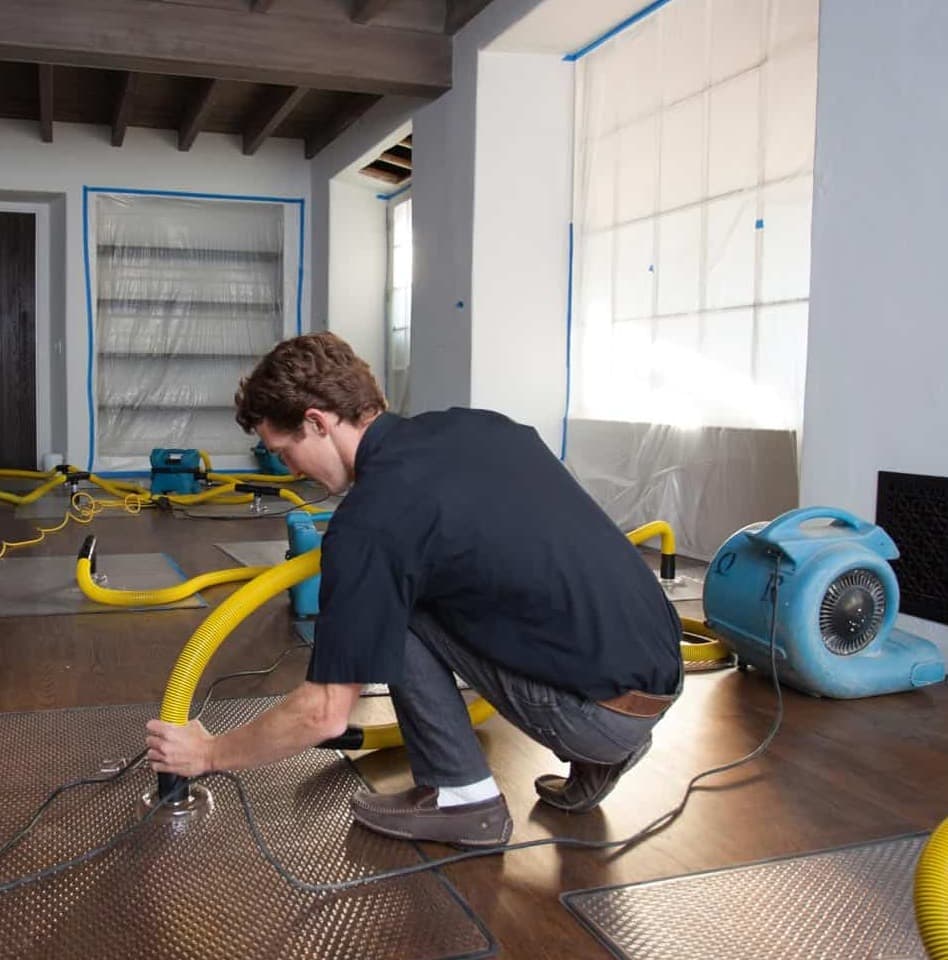
Sewage Backup Cleanup in Clinton Township, MI
Most municipal sewer backups in Southeast Michigan happen during heavy rain when the combined sewer system exceeds capacity. The backup comes up through basement floor drains. The material that has touched sewage — carpet pad, drywall bottom, MDF baseboards — is disposed of, not cleaned.
Family-Owned · Insured & Licensed · 24/7 Emergency Dispatch
What Clinton Township Homeowners Need to Know
Multi-unit condos and townhomes in Clinton Township share plumbing stacks, which means a single upstairs leak often damages two or three units at once.
Housing here is predominantly Mixed 1970s–2000s subdivisions with a notable share of townhomes and condos. The most common restoration-related issues in Clinton Township are hardwood floor swell, condo stack water intrusion, ice dams. Our crews treat each property as its own project — scope, drying time, and rebuild needs are written based on what we measure on site, not a generic playbook.
Clinton Township's large share of multi-unit condo and townhome stock creates a restoration challenge homeowners in single-family housing rarely face: a single upstairs water event can damage two or three units simultaneously. Shared plumbing stacks, party walls, and ceiling cavities mean water tracks horizontally through joist bays before it shows up downstairs, and coordination with association management and neighboring owners is part of almost every scope.
Sewage cleanup projects in Clinton Township are handled with strict Category 3 sewage precautions regardless of location — but the conditions that make hardwood floor swell common here also shape how contamination migrates through substrates and what physical removal looks like in practice.
Seasonal pattern — Clinton Township
Condo-related upstairs-leak calls are roughly constant year-round; basement sump failures concentrate around spring thaw and late-fall rain.
Local conditions in Clinton Township
Soil & Water Table
Clinton Township has a moderate-to-high water table depending on proximity to the Clinton River. Multi-unit condo developments commonly share drainage infrastructure that was built to 1970s-1990s code — adequate for normal events but regularly overwhelmed during multi-inch rain. Shared parking lot drainage is a frequent source of basement intrusion.
Building Stock
Clinton Township includes single-family 1970s-2000s subdivisions alongside a significant share of condo and townhome developments. Multi-unit construction creates shared-wall, shared-stack, shared-roof scenarios that single-family restoration rarely encounters, and coordination with condo associations is part of many projects.
Dispatch & Access
Condo and townhome access often requires coordination with property management for gate codes, service entrance access, and neighboring unit notifications. Single-family neighborhoods have typical suburban access.
Clinton Township Neighborhoods and Districts We Cover
Clinton Township covers a wide spectrum of housing stock that drives different restoration approaches across its sub-areas. The Moravian Drive corridor and the older neighborhoods south of Cass Avenue contain a substantial inventory of mid-century ranches and small Cape Cods built in the 1950s and 1960s, where original galvanized supply lines, cast-iron drains, and unfinished basements with block foundations are common, making Category 2 and Category 3 water losses frequent. The Partridge Creek and Hall Road area trends newer, with two-story colonials and finished walkout basements containing engineered subfloors and luxury vinyl plank that respond differently to extraction and dehumidification timelines. Pockets near Harrington Elementary and along Romeo Plank also include 1980s split-levels with wood-frame crawl spaces, where cavity drying and moisture mapping under floor systems become central to restoring pre-loss condition.
Recent Storm History — Clinton Township, MI
Clinton Township has experienced several regionally significant weather events that shaped its restoration caseload. The August 11, 2014 Metro Detroit flood produced rainfall totals that overwhelmed sanitary and combined systems across Macomb County, generating large volumes of Category 3 sewer-backup losses in basements throughout the township and forcing extended drying timelines under industry-standard mitigation protocols. The June and July 2021 Metro Detroit flooding events again saturated the area, with sustained rainfall producing groundwater intrusion in lower-lying neighborhoods. The April 15, 2026 Macomb County windstorm added widespread tree-fall, roof, and siding damage to the recent restoration record, with secondary water intrusion through compromised roof envelopes driving structural drying and selective demolition work in homes already vulnerable from earlier events.
Working With Your Insurance Carrier in Clinton Township
Clinton Township homeowners are insured through the typical Michigan carrier mix that dominates Macomb County, including AAA/Auto Club Group, Auto-Owners, State Farm, Allstate, Citizens, Farm Bureau, and Hanover. Because these carriers each maintain established large-loss desks and field-adjuster networks in southeast Michigan, restoration documentation must be prepared in Xactimate, the industry-standard estimating platform, with line-item scoping, photo evidence keyed to industry-standard loss categorization, and daily psychrometric logs. Carrier-specific supplements, mortgagee endorsements, and depreciation recovery thresholds vary, so detailed initial scopes reduce friction during reinspection and supplement review.
Prime Restoration is a licensed Michigan restoration contractor. We document project scope with detailed, itemized paperwork so homeowners have clear line-item records to submit to their carrier.
Permits & Code Compliance — Clinton Township
Building permits for restoration reconstruction in Clinton Township are administered by the Charter Township of Clinton's municipal building department. Category 3 water-loss rebuilds and post-fire reconstruction typically require separate building, electrical, mechanical, and plumbing permits when the work touches structural framing, branch circuits, ductwork, or supply and waste lines. Michigan has adopted the 2015 Michigan Building Code and the related 2015 Michigan Residential Code, which govern framing, fire-resistance ratings, and means-of-egress restoration after structural fire damage. Inspections at rough and final stages are coordinated through the township department, and prescriptive code provisions apply to drywall replacement, insulation, and vapor-retarder installation following extended Category 3 mitigation.
Sewage Backup Cleanup — Clinton Township, MI
Sewage backup is classified as Category 3 "black water" and requires strict containment, PPE, and disposal protocols. Porous materials that have contacted sewage are removed and disposed of — they cannot be cleaned. Non-porous surfaces are cleaned and treated with commercial-grade disinfectant. The scope is documented in Xactimate for your insurance carrier.
Common causes we see in Clinton Township
- •Municipal sewer backup during heavy rain
- •Clogged main line
- •Tree root intrusion in lateral
- •Collapsed sewer line
- •Failed ejector pump
Signs to watch for
- •Water coming up through floor drains
- •Strong sewage smell in basement
- •Toilet or tub backing up when draining
- •Multiple fixtures draining slowly
Our Sewage Backup Process in Clinton Township
The same documented process on every project.
1. Full PPE Setup
Crews enter in Tyvek suits, gloves, boots, eye protection, and P-100 respirators. Entry and exit are controlled through a decontamination zone.
2. Sewage Extraction
Sewage is pumped out with dedicated equipment. Pump discharge is to sanitary sewer per code, not storm sewer.
3. Affected Material Removal
All porous materials in contact with sewage — carpet, pad, drywall bottom 24", MDF trim, insulation — are removed and disposed of. Non-porous materials stay.
4. Cleaning & Disinfection
Non-porous surfaces are cleaned and treated with commercial-grade disinfectant rated for Category 3 water. Two-step clean-then-disinfect process.
5. Structural Drying
After disinfection, air movers and dehumidifiers dry affected framing and concrete following industry-standard mitigation protocol.
6. Verification & Rebuild
Moisture verification confirms dry standard. Drywall, trim, flooring, and paint are rebuilt. Documented in Xactimate.
Equipment we bring to Clinton Township
Reviews
What Clinton Township Area Homeowners Say
5.0 Stars · 133 Verified Google Reviews
“Had a really good experience with Prime Restoration for mold remediation. They were professional, clear about the process, and actually made me feel confident about the process. Not pushy. I'd definitely recommend them around Bloomfield Hills”
Christian H.
Bloomfield Hills, MI
“Prime Restoration is a solid company in Michigan for basement floods and water damage. They're professional, knowledgeable and the kind of team you'd want handling a stressful situation.”
Nathan M.
Verified Google Review
“Prime Restoration in Bloomfield has an outstanding team for water damage restoration. Their crew is phenomenal. great people with top notch character who clearly know their stuff. Highly recommend for anyone facing water damage in Bloomfield.”
Ahmed W.
Bloomfield, MI
“Best in the game did my basement because it flooded and they left no messes clean and efficient”
Adam J.
Verified Google Review
“The Prime Restoration team was absolutely fantastic! Very professional and communicative. Completed the job in a timely manner. I would highly recommend!”
Jerome K.
Verified Google Review
“I called five different companies for restoration work, and Prime Restoration was hands down the fastest and most fair on price. They got me a quote the same day, while others were still "getting back to me." Their team works fast.”
Sean B.
Verified Google Review
Sewage Backup Questions — Clinton Township, MI
Common questions from Clinton Township homeowners before they call.
What happens if an upstairs unit in a Clinton Township condo causes damage to my unit below?
Responsibility usually depends on the condo association's master policy, the individual unit owners' policies, and the cause of the failure. Restoration work typically proceeds immediately to limit further damage while the association, insurance carriers, and affected owners sort out financial responsibility. We document scope in Xactimate so whatever party ultimately pays has clear line-item paperwork, but we do not negotiate claims — that's between owners, associations, and their carriers.
Is sewage backup covered by insurance?
Most standard homeowner policies exclude sewer backups unless you have a specific water/sewer backup rider. Coverage and limits vary widely. We document the full scope in Xactimate so you have itemized paperwork regardless of coverage decision.
Can the carpet be saved?
Per industry-standard practice, carpet pad exposed to Category 3 water must be disposed of. Carpet itself is typically removed with the pad unless it can be cleaned and disinfected to return it to pre-loss condition — uncommon with sewage exposure.
Is it safe to be in the house?
The affected area should be avoided until cleanup is complete. For a contained basement backup, most homeowners can stay on upper floors. For first-floor sewage events, temporary relocation during active cleanup is typical.
Prime Restoration is a licensed restoration contractor. We document the full project scope with detailed, itemized paperwork so you have clear line-item records to submit to your carrier.
Related Services in Clinton Township
Sewage & Biohazard
Biohazard & Trauma Cleanup in Clinton Township
Careful, discreet biohazard, trauma, and unattended death cleanup.
Water Damage
Basement Flooding Cleanup in Clinton Township
Basement water extraction, contents pack-out, structural drying, and sanitization.
Water Damage
Water Damage Restoration in Clinton Township
Industry-standard water extraction, structural drying, and full restoration with Xactimate documentation.
Sewage Backup Near Clinton Township
We also serve these nearby Macomb and Oakland County communities.
Need Sewage Backup in Clinton Township Now?
24/7 emergency dispatch. trained restoration crews. Typical response within 60 minutes across our core service area.