Water Damage Restoration in Grand Rapids, MI
A broken pipe, appliance leak, or storm surge can soak drywall and subfloor within hours. The longer water sits, the more secondary damage you pay for — warped hardwood, swollen MDF, wicking up studs, and Category 2 microbial growth within 48–72 hours. Fast extraction is the single biggest cost-control decision after a water loss.
Family-Owned · Insured & Licensed · 24/7 Emergency Dispatch
What Grand Rapids Homeowners Need to Know
The Grand River runs through downtown Grand Rapids and reached a record 21.85-foot crest on April 21, 2013, high enough to evacuate a downtown high-rise.
Housing here is predominantly a median build year of 1955, with 76.6 percent of homes built before 1980. The most common restoration-related issues in Grand Rapids are Grand River flooding, aging pre-1980 plumbing, lead service line failure. Our crews treat each property as its own project — scope, drying time, and rebuild needs are written based on what we measure on site, not a generic playbook.
The Grand River runs through the middle of Grand Rapids, past downtown and the Riverside Park area on Monroe Avenue NW. On April 20, 2013, floodwater knocked out power to the Plaza Towers high-rise downtown, a backup generator overheated, and the city evacuated more than 1,000 residents and hotel guests. The building did not reopen until May 8, 2013. The city has since spent $400 million, finished in 2015, to eliminate every combined sewer overflow point in its system. To report a leak anywhere in the city, call 311 or 616-456-3000.
For water damage work specifically in Grand Rapids, the dominant driver we see on local jobs is Grand River flooding — which affects how fast water spreads, where it hides, and how long drying realistically takes.
Seasonal pattern — Grand Rapids
Grand Rapids floods most often in spring, when snowmelt and heavy rain hit the river at the same time. The record April 2013 flood came after 9.1 inches of rain fell by the morning of April 18, breaking a 104-year-old rainfall record. A smaller crest hit again in February 2018. Check your sump pump each spring before the first big storm.
Local conditions in Grand Rapids
Soil & Water Table
A basement near the Grand River corridor sits close to river level. Riverside Park, on Monroe Avenue NW, has flooded and closed more than once since 2013, including in April 2017. The river has crested above 19.5 feet four times since 1985. Test your sump pump and its battery backup before a storm.
Building Stock
The median home in Grand Rapids was built in 1955, and 76.6 percent of the city's 84,949 housing units went up before 1980. About 31,137 units, 36.7 percent of the city, were built in 1939 or earlier. The city aims to replace every lead water service line by 2041, at no cost to the homeowner if the line leaks.
Dispatch & Access
Grand Rapids sits outside our Macomb and Oakland core service area. Call first, and the dispatcher will give you the current arrival window before a crew is sent. Grand Rapids sits along the US-131 and I-196 corridor. To report a water leak anywhere in the city, call 311 or 616-456-3000.
Plumbing leaks, flooded basements and mold in Grand Rapids
These are the three things callers report to Prime most. Between April 16 and October 3, 2026, Prime logged 205 calls with a description: 83 mentioned basement water, 57 mold, and 52 a pipe, a supply line or another plumbing leak.Prime Restoration is top-rated, a family water damage restoration business since 1988, and dispatches 24/7.
Plumbing and supply line leaks in Grand Rapids
Grand Rapids has a median home age of 1955, and 76.6 percent of the 84,949 housing units in the city were built before 1980, according to Census Bureau estimates.
The City of Grand Rapids still runs a lead service line replacement program, with a goal of replacing every lead line by 2041. A line this old can corrode or crack at a joint and leak inside a wall or crawl space before anyone notices.
A sudden leak is a loss a homeowners policy commonly covers. The carrier decides.
Burst or frozen pipe · Water heater leak · Sink leak · Dishwasher leak · Refrigerator line · Washing machine · Toilet overflow · Tub or shower leak · Insurance claims
Flooded basements in Grand Rapids
The Grand River runs through downtown Grand Rapids and crested at a record 21.85 feet on April 21, 2013, 3.85 feet above the 18-foot flood stage, after a storm dropped 9.1 inches of rain in less than a day on April 18, 2013.
That same river has crested above 19.5 feet four more times since 1985, including a 20.67-foot crest on February 25, 2018. High water on the Grand River corridor repeats.
Grand Rapids spent $400 million between 1991 and 2015 on a Sewer Improvement Project that eliminated every combined sewer overflow point in the city, but older residential sewer laterals built before that program can still back up into a basement during a heavy storm.
Sump pump failure · Macomb County flooded basement guide · Basement flooding cleanup
Mold after water damage in Grand Rapids
With 43.5 percent of Grand Rapids housing built before 1950, a large share of the basements and crawl spaces in the city were framed before modern vapor barriers and sump systems were standard, which gives standing moisture more places to sit after a leak or a flood.
Mold needs standing moisture and time. A basement that took on river water in 2013 or 2018, or a crawl space under a pre-1950 Grand Rapids home with a slow leak, gives spores both.
Grand Rapids water-damage facts
| What | Fact | Source |
|---|---|---|
| Median home age | Median year built: 1955 | U.S. Census Bureau ACS 2024 1-yr (B25035) |
| Housing built before 1980 | 76.6 percent of 84,949 units | U.S. Census Bureau ACS 2024 1-yr (B25034) |
| Record Grand River flood crest | 21.85 feet, April 21, 2013 | WGRD, Grand River Flood History |
| Sewer Improvement Project cost | $400 million, 1991-2015, eliminated all CSO points | City of Grand Rapids, Sewer Improvement Project |
| Lead line replacement program goal | All lead services replaced by 2041 | City of Grand Rapids, Lead Line Replacement Program |
Water in the house now? Call (586) 277-1069. The estimate is free. See all Google reviews.
Sources: U.S. Census Bureau, ACS 2024 1-year estimates (via Census Reporter API); City of Grand Rapids, Sewer Improvement Project; City of Grand Rapids, Lead Line Replacement Program; WGRD, Grand River Flood History; Wikipedia, 2013 Grand Rapids flood; Municipal Sewer & Water magazine, Protecting the People Downstream; Prime Restoration call log, April 16 to October 3, 2026.
Grand Rapids Neighborhoods and Districts We Cover
Downtown Grand Rapids sits along the Grand River, where floodwater forced the April 2013 evacuation of the Plaza Towers high-rise. Riverside Park, on Monroe Avenue NW near the Monroe North area, has flooded and closed more than once since then, most recently reported in April 2017. The city's $400 million Sewer Improvement Project, finished in 2015, ended combined sewer overflows citywide, a project that began with the 30-million-gallon Market Avenue Retention Basin in 1990. Give the dispatcher your cross streets when you call.
Recent Storm History — Grand Rapids, MI
The Grand River crested at a record 21.85 feet in downtown Grand Rapids on April 21, 2013, after 9.1 inches of rain broke a 104-year-old record. The flood forced the evacuation of the Plaza Towers high-rise on April 20, 2013, displacing more than 1,000 people until the building reopened May 8, 2013. The river crested again at 20.67 feet on February 25, 2018, the second-highest crest on record, and at 19.64 feet on March 1, 1985. Heavy April 2017 rain caused a broken treatment-plant gate to spill 38.7 million gallons of partially treated sewage into the river.
Water Damage Restoration — Grand Rapids, MI
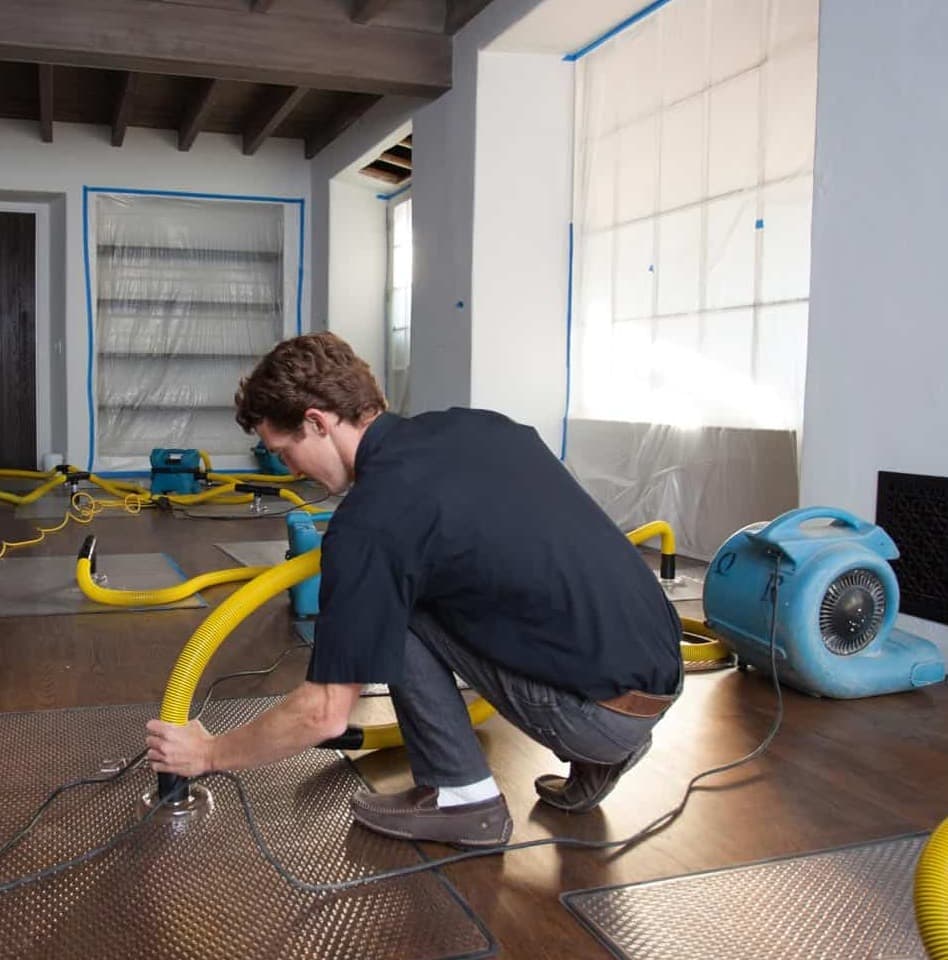
Prime Restoration provides 24/7 emergency water damage restoration built around the industry-standard mitigation protocol. Our crews extract standing water, set up containment, install industrial air movers and LGR dehumidifiers, and monitor moisture levels daily until the structure reaches documented dry standard. Every project is photographed and written up in Xactimate so homeowners have detailed line-item scope to submit to their insurance carrier.
Common causes we see in Grand Rapids
- •Supply line failure (washer hose, toilet, dishwasher)
- •Burst or frozen pipe
- •Water heater rupture
- •Sump pump failure during heavy rain
- •Roof leak from ice dam or storm
- •Sewer line backup
Signs to watch for
- •Visible standing water or saturated carpet
- •Musty or damp smell
- •Swollen baseboards, warped hardwood, or bubbling paint
- •Water stains on ceilings or walls
- •Sudden spike in humidity
Our Water Damage Process in Grand Rapids
The same documented process on every project.
1. Emergency Response & Inspection
A trained technician arrives, photographs the scene, identifies the water source, and maps affected materials with moisture meters and thermal imaging following industry-standard mitigation protocol.
2. Water Classification & Containment
Water is classified Category 1 (clean), 2 (gray), or 3 (black) and Class 1–4 by evaporation load. Non-affected areas are contained with 6-mil poly to prevent cross-contamination.
3. Water Extraction
Truck-mounted extractors and submersible pumps remove standing water. Saturated carpet pad is removed and disposed of. Drilling weep holes into wall cavities lets trapped water drain.
4. Structural Drying
Air movers, LGR dehumidifiers, and directed heat are set based on a written drying plan. Daily moisture readings are logged until materials reach dry standard.
5. Cleaning & Sanitization
Affected materials are cleaned with professional-grade antimicrobial. Contents are cleaned, dried, and inventoried for pack-out when needed.
6. Reconstruction & Xactimate Documentation
Drywall, flooring, trim, and paint are rebuilt to complete the project. Every line item is documented in Xactimate so you have detailed paperwork for your insurance carrier.
Equipment we bring to Grand Rapids
Reviews
What Grand Rapids Area Homeowners Say
5.0 Stars · 166 Verified Google Reviews
“Had a really good experience with Prime Restoration for mold remediation. They were professional, clear about the process, and actually made me feel confident about the process. Not pushy. I'd definitely recommend them around Bloomfield Hills”
Christian H.
Bloomfield Hills, MI
“Prime Restoration is a solid company in Michigan for basement floods and water damage. They're professional, knowledgeable and the kind of team you'd want handling a stressful situation.”
Nathan M.
Verified Google Review
“Prime Restoration in Bloomfield has an outstanding team for water damage restoration. Their crew is phenomenal. great people with top notch character who clearly know their stuff. Highly recommend for anyone facing water damage in Bloomfield.”
Ahmed W.
Bloomfield, MI
“Best in the game did my basement because it flooded and they left no messes clean and efficient”
Adam J.
Verified Google Review
“The Prime Restoration team was absolutely fantastic! Very professional and communicative. Completed the job in a timely manner. I would highly recommend!”
Jerome K.
Verified Google Review
“I called five different companies for restoration work, and Prime Restoration was hands down the fastest and most fair on price. They got me a quote the same day, while others were still "getting back to me." Their team works fast.”
Sean B.
Verified Google Review
Water Damage Questions — Grand Rapids, MI
Common questions from Grand Rapids homeowners before they call.
Has the Grand River ever flooded a building in downtown Grand Rapids?
Yes. On April 20, 2013, rising floodwater knocked out power to the Plaza Towers high-rise downtown, a backup generator overheated, and the city evacuated more than 1,000 residents and hotel guests. The river had crested at a record 21.85 feet the day before. If water enters your home or building, stay out of it near outlets or the panel and call us.
How fast can a crew reach my home after water damage?
Grand Rapids is outside our Macomb and Oakland core service area, so arrival time depends on where the crew is when you call. Call first and the dispatcher will give you the current arrival window before a crew is sent.
Do you work with my insurance company?
Prime Restoration is a licensed restoration contractor. We document the full project scope in Xactimate — the same software adjusters use — so you have clear paperwork to submit to your carrier.
How long does structural drying take?
A typical Class 2 water loss reaches dry standard in 3–5 days. Class 3 losses with saturated walls, carpet pad, and subfloor usually run 5–7 days. We log moisture readings daily so drying time is based on measurements, not guesswork.
Can I stay in the house during drying?
For Category 1 (clean water) losses, most homeowners stay in place. Industrial air movers are loud (roughly 65–75 dB) and the affected area should stay contained. Category 2 and 3 losses often require temporary relocation until sanitization is complete.
Prime Restoration is a licensed restoration contractor. We document the full project scope with detailed, itemized paperwork so you have clear line-item records to submit to your carrier.
Related Services in Grand Rapids
Water Damage
Basement Flooding Cleanup in Grand Rapids
Basement water extraction, contents pack-out, structural drying, and sanitization.
Water Damage
Burst Pipe Water Damage in Grand Rapids
Emergency response to burst, frozen, or ruptured pipes — water extraction, wall cavity drying, and rebuild.
Water Damage
Ceiling Water Damage Repair in Grand Rapids
Ceiling leak diagnosis, dry-out, drywall replacement, and painted finish restoration.
Nearby Cities We Serve
We also provide water damage in these nearby cities.
Need Water Damage in Grand Rapids Now?
24/7 emergency dispatch. Trained restoration crews. Call for the current arrival window.