

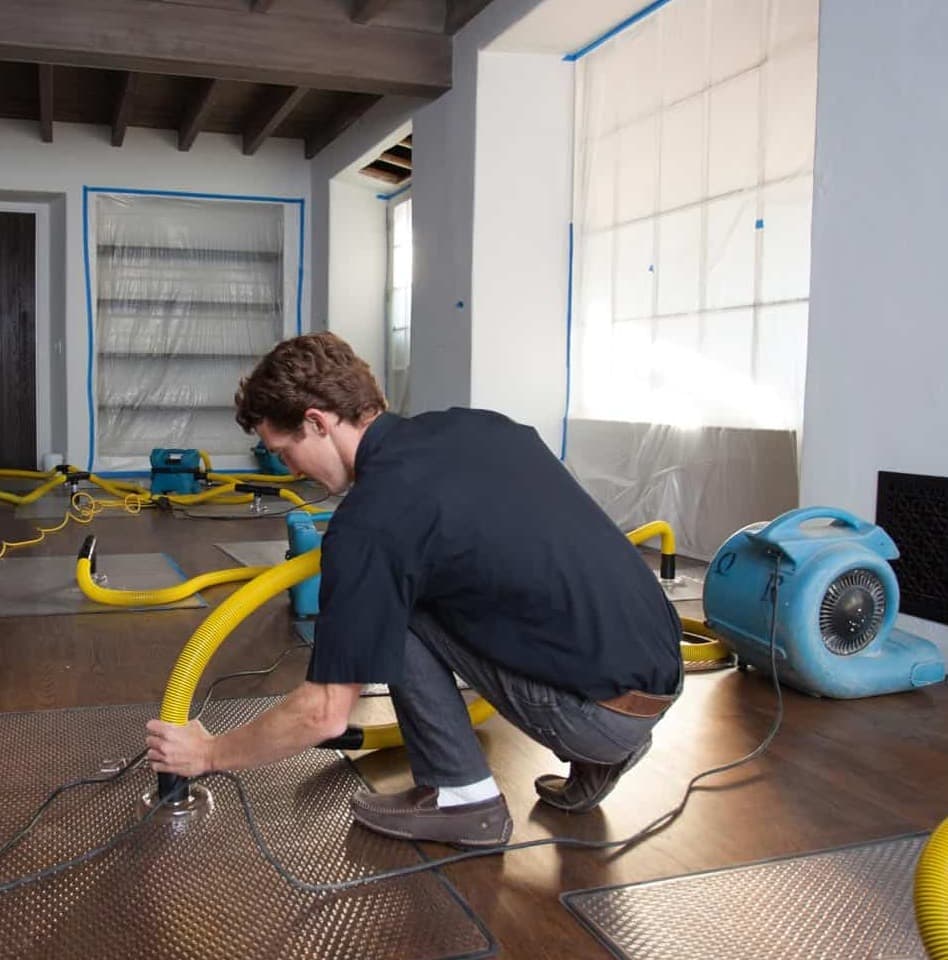
A burst pipe in Michigan is almost always a Category 1 clean-water loss the moment it happens, which runs $1,200 to $4,500 for the water-mitigation scope: extraction, drying equipment, and monitoring, before any rebuild. The number moves fast from there. A burst that sits a day before anyone finds it, or reaches a finished basement, moves into the $2,500 to $7,500 Category 2 band. A burst that sits past 72 hours, or that happened near a floor drain and backed up sewage with it, becomes a Category 3 loss, $4,500 to $15,000 or more. These are the same published 2026 Michigan mitigation bands used statewide, not a quote: Prime Restoration gives a free on-site estimate before any work starts. Call (586) 277-1069.
Freeze season is the reason this page exists now. A burst pipe is the most common cause of water damage in a Michigan home from December through February, and the difference between a $1,500 clean-water catch and a $12,000 Category 3 rebuild usually comes down to two things: how fast it was found, and whether the house was heated when it happened. This guide walks through the cost bands, what actually drives the number up, what homeowners insurance does and does not pay, why some frozen-pipe claims get denied, and how fast the mold clock starts running once the water is out.
How Much Does Burst Pipe Water Damage Cost in Michigan?
These are the same published 2026 Michigan mitigation bands used on Prime Restoration's statewide water damage cost page, applied specifically to a burst-pipe scenario:
| Scenario | Category | Typical room | Typical basement |
|---|---|---|---|
| Caught within hours, clean supply line | Category 1, clean water | $1,200-$3,200 | $2,000-$4,500 |
| Sat a day or more, or reached a finished space | Category 2, gray water | $2,500-$4,800 | $3,500-$7,500 |
| Sat past 72 hours, or backed up a floor drain or sewer line | Category 3, black water | $4,500-$9,000 | $6,500-$15,000+ |
These are 2026 Michigan ranges for mitigation, not a quote. The category, the square footage, and whether the space is finished set the actual number, confirmed on-site. Rebuild work, new drywall, flooring, paint, trim, is a separate scope priced after mitigation.
Why a Burst Pipe Escalates From Category 1 to Category 2 or 3
A burst copper or PEX supply line starts out as clean water, the least expensive category to remediate, because the water came from the home's own potable supply and carried no contamination. What changes the category is not the pipe, it is what happens after the burst:
- Time. Clean water sitting on a floor for more than 24 to 48 hours starts breaking down building materials and growing bacteria, which is enough for most restoration companies and insurance adjusters to reclassify it as Category 2.
- What it touched. Clean water that crosses a floor drain, a sewer cleanout, or picks up contamination from carpet padding or standing in a space with a prior mold history can be classified Category 2 or 3 depending on what it contacted.
- Where it came from. A burst supply line is Category 1. A frozen and failed sewer lateral, or a supply line burst that overwhelmed a floor drain connected to a municipal line during a backup, is Category 3 from the start.
This is why the same words, "a pipe burst," can describe a $1,500 job or a $14,000 job. The category is set by the actual conditions on site, not by the fact that a pipe burst.
Does Homeowners Insurance Pay for a Burst Pipe in Michigan?
Usually, yes, for the water damage the burst caused. Standard Michigan homeowner policies from State Farm, AAA, Auto-Owners, Allstate, Farm Bureau, and Citizens cover sudden and accidental water damage, and a burst pipe is the textbook example: nobody caused it on purpose, and it was not a slow, known, ignored leak. What most policies do not cover is the cost of the plumbing repair itself, the pipe, the fitting, the valve. The policy pays for the water damage to the structure and the contents; the plumbing bill is a separate, uninsured cost in most cases.
Coverage gets more complicated when the loss is a frozen pipe specifically, because most Michigan homeowner policies carry a heat-maintenance condition: language that requires the home to be kept heated, or the water supply shut off and drained, during cold weather. The Michigan Department of Insurance and Financial Services (DIFS) told residents directly, in a winter-preparation release dated January 22, 2026: "Keep your heat set above 55°F and insulate exposed pipes." That is DIFS's own consumer guidance, not a universal legal minimum every policy must use, but it lines up with the heat-maintenance language most carriers write into their own policies. Confirm your specific policy's wording, and your specific limits, with your agent before assuming a loss is covered. Coverage decisions are made solely by your insurance carrier after its own inspection.
Why Do Frozen Pipe Claims Get Denied?
A burst caused by a sudden, unexplained plumbing failure is usually a straightforward claim. A burst caused specifically by freezing gets more scrutiny, because the carrier has to decide whether the homeowner met the policy's heat-maintenance condition. The denial and reduced-payout scenarios that come up most often:
- The home was left unheated or under-heated. A vacant property, a vacation home, or a house left empty during a cold stretch with the thermostat turned down or off is the classic frozen-pipe denial scenario. DIFS's own guidance is to keep the heat above 55°F for exactly this reason.
- The policy's vacancy clause applies. Many policies reduce or suspend certain coverage once a home sits vacant past a stated number of consecutive days, which matters for a second home, a listed-for-sale property, or a rental between tenants over the winter.
- The carrier argues it was a pre-existing or gradual condition. If a pipe had been slowly seeping or showing signs of failure before the freeze, a carrier can argue the loss traces to a maintenance failure rather than a sudden event, which most policies exclude.
- No documentation that heat was maintained. A claim is easier to support when there is some record, a smart thermostat log, a utility bill showing continued heating load, a neighbor or property manager who checked the house, that the home was in fact heated through the cold snap.
None of this is legal advice, and only your carrier and your specific policy language control the outcome of your claim. What Prime Restoration can do regardless of how the claim is decided is document the loss the same way your adjuster will want to see it: water category, affected square footage, finish level, and a written scope, so the insurance side of the conversation has real information to work with rather than guesses.
What Drives Burst Pipe Cost Up or Down
1. How Long the Water Sat Before Discovery
A burst found and shut off within an hour, with extraction starting the same day, is priced at the bottom of its band. The same volume of water sitting overnight or over a weekend, common when a pipe bursts in an unoccupied home, a second floor while residents sleep downstairs, or a vacation property, pushes the job toward the top of its band or into the next category.
2. Finished vs. Unfinished Space
An unfinished basement with a concrete floor and no drywall dries fast and cheap: extraction and air movers, nothing to remove. A finished basement or living space with carpet, pad, baseboard, and drywall requires removing every saturated porous material, which is most of the added cost in a Category 1 or 2 loss.
3. How Many Floors and Rooms the Water Reached
A burst supply line on an upper floor that runs down through a ceiling cavity into the room below turns a single-room loss into a multi-room, multi-trade job: ceiling drywall, insulation, and flooring in two locations instead of one, plus the time needed to dry a ceiling cavity, which holds water longer than an open floor.
4. Whether a Floor Drain or Sewer Connection Was Involved
A burst near a floor drain during a municipal sewer surcharge, or a frozen and failed sewer lateral, can introduce sewage into what would otherwise be a clean-water loss. That reclassifies the job as Category 3 and adds full containment, PPE for the crew, and regulated disposal of every porous material the water touched.
Line-Item Costs Inside a Typical Burst Pipe Project
These are the same published per-unit figures used on the statewide cost page, and they add up to the room and basement totals in the table above:
| Line item | Price | Note |
|---|---|---|
| Emergency water extraction (per sq ft) | $0.55-$2.25 | Higher for Cat 2/3 due to antimicrobial pre-treatment |
| Commercial air mover (per day, per unit) | $25-$45 | A typical burst-pipe job uses 6-12 units for 3-5 days |
| LGR dehumidifier (per day, per unit) | $115-$165 | A typical burst-pipe job uses 1-3 units for 3-5 days |
| Drywall removal and haul (per sq ft) | $2.25-$3.85 | Bottom 24 inches standard, or a ceiling cavity if the burst was upstairs |
| Insulation removal and replace (per sq ft) | $1.75-$3.25 | R-13 to R-19 typical for Michigan exterior walls, where most freeze bursts happen |
| Carpet pad replacement (per sq ft) | $0.65-$1.15 | Pad is always removed on Cat 2/3; carpet is sometimes savable on Cat 1 if caught fast |
| Antimicrobial application (per sq ft) | $0.35-$0.65 | Required once dwell time or contamination pushes the loss past Category 1 |
| HEPA air scrubber (per day, per unit) | $85-$135 | Used on Cat 3 and mold-affected losses |
How Fast Does a Burst Pipe Cause Mold?
Mold growth on a wet, porous material such as drywall, insulation, or wood framing can begin within 24 to 48 hours under ordinary indoor humidity and temperature, the same window IICRC-trained restoration technicians use to judge whether a wet material can still be dried and saved or has to be removed. A burst pipe found and extracted the same day it happens rarely needs a separate mold scope. One left over a long weekend, discovered after returning from travel, or missed in an unoccupied vacation home, frequently does, and mold remediation is priced and scoped separately from water mitigation. See mold remediation cost in Michigan for what that looks like if a burst pipe loss gets to that point.
Michigan Freeze Risk, By the Numbers
Burst pipes track cold snaps, and Metro Detroit sees real cold most winters. The table below uses NOAA's 1991-2020 Climate Normals for Detroit and the National Weather Service Detroit/Pontiac office's own account of the January 2019 polar vortex, read on 2026-11-03:
| Measure | Figure | Source |
|---|---|---|
| Average days at or below 20°F, December | 9 days | NOAA NCEI 1991-2020 Climate Normals (Detroit) |
| Average days at or below 20°F, January | 16 days | NOAA NCEI 1991-2020 Climate Normals (Detroit) |
| Average days at or below 20°F, February | 13 days | NOAA NCEI 1991-2020 Climate Normals (Detroit) |
| Longest streak below 0°F, January 29-31, 2019 | 36 consecutive hours | NWS Detroit/Pontiac, weather.gov/dtx/January2019RecordCold |
| Prior longest streak below 0°F, January 1994 | 66 consecutive hours | NWS Detroit/Pontiac, weather.gov/dtx/January2019RecordCold |
The 20°F day-count figures are a third-party compilation of NOAA's National Centers for Environmental Information (NCEI) 1991-2020 Climate Normals, not a figure Prime Restoration pulled directly from NCEI's own raw data table; the full citation and the exact source page are logged for this page. The NWS figures come directly from the National Weather Service Detroit/Pontiac office's own published account of the January 2019 event. Neither figure is a guarantee of what any single winter will bring, and neither is a substitute for your own policy's specific terms.
An unprotected copper or PEX line in an uninsulated exterior wall, crawl space, or attic run can freeze and fail once outside temperatures drop into the teens or lower and stay there for an extended stretch, commonly 24 hours or more. A stretch like the 36-hour sub-zero run in January 2019 is exactly the kind of event that produces a surge of burst-pipe calls across Metro Detroit in a single 48-hour window, which is also why restoration crews and drywall subcontractors can be harder to book in the days right after a cold snap than during an ordinary week.
Does Michigan Insurance Require a Minimum Indoor Temperature?
The Michigan Department of Insurance and Financial Services does not publish a single statewide legal minimum temperature that every homeowner policy must use. What DIFS does publish, in its own winter-preparation guidance dated 2026-01-22, is a practical benchmark: "Keep your heat set above 55°F and insulate exposed pipes." Individual policies write their own heat-maintenance condition, and the specific number, and what counts as meeting it, is set by your policy's own language, confirmed with your agent, not by a single statewide rule. DIFS's call center is available for coverage questions at 877-999-6442, Monday through Friday, 8 a.m. to 5 p.m.
Worked Cost Examples
Example 1: Kitchen Supply Line, Caught Same Day
A PEX supply line behind a kitchen cabinet on an exterior wall split during a cold snap and was discovered within a few hours when water pooled on the kitchen floor. This is a Category 1 loss affecting roughly 120 square feet of kitchen and adjoining hallway, $1,200-$3,200: extraction, a few days of air movers and a dehumidifier, and minimal drywall removal at the cabinet base where saturation reached the wall.
Example 2: Second-Floor Bathroom Supply Line, Ceiling Cavity
A frozen supply line in a second-floor bathroom wall burst overnight and ran down through the ceiling cavity into the kitchen below before anyone woke up. The multi-room, multi-floor spread and the roughly 18-hour dwell time before discovery push this to a Category 2 loss, $3,500-$6,500: ceiling and upper-wall drywall removal in two rooms, insulation replacement, and an extended drying timeline because ceiling cavities hold moisture longer than an open floor.
Example 3: Unoccupied Vacation Home, Weekend Discovery
A supply line froze and burst in an unoccupied vacation home over a long weekend when the thermostat had been left low to save on heating costs. By the time a neighbor noticed water at the front door, the basement had standing water that had been sitting for more than 72 hours. This is a Category 2 to 3 loss depending on contamination found on inspection, $5,000-$12,000 at the basement level, and the length of the dwell time means mold remediation is a realistic add to the scope, priced separately. A loss like this is also the scenario most likely to draw insurer scrutiny over whether the home's heat-maintenance condition was met.
Example 4: Floor-Drain Backup During a Burst
A burst supply line in a basement utility room coincided with a municipal sewer surcharge during the same storm, and water backing up through the floor drain mixed with the clean supply-line water before extraction began. This is a Category 3 loss, $6,500-$15,000-plus at the basement level: full containment and PPE for the crew, removal and regulated disposal of every porous material the combined water touched, and a reconstruction phase priced separately from mitigation.
What a Written Scope Should Include
Whether you hire Prime Restoration or another company, a complete written scope for a burst pipe loss should name, not estimate in one lump sum:
- The water category (1, 2, or 3) and how it was determined, including whether dwell time or a floor-drain connection changed the classification
- The affected square footage, room by room, including any ceiling cavity or multi-floor spread
- Whether the space is finished or unfinished, and which finished materials are being removed
- The drying equipment plan: how many air movers and dehumidifiers, and for how many days
- Whether antimicrobial treatment is included, and on which surfaces
- The reconstruction scope and an estimated timeline, priced separately from mitigation
How Prime Restoration Prices a Burst Pipe Job
Prime Restoration is a family water damage restoration business since 1988, with 9 offices across Macomb, Oakland, Washtenaw, and Huron Counties and a wider service area across Southeast and Mid-Michigan. A free on-site inspection sets the water category with moisture meters, measures the affected square footage, and determines finish level before a written scope is produced in Xactimate, the line-item estimating software Michigan adjusters use. Call Prime first: Prime can help get a licensed plumber out once you call, so the water mitigation and the plumbing repair both get moving from a single call instead of you coordinating two companies while water is still spreading. In Macomb, Oakland, Washtenaw, and Huron Counties a crew is typically on site in 25 minutes; elsewhere across Prime's service area, dispatch runs 24/7 with the nearest available crew.
How to Choose a Company for a Burst Pipe Loss
Several criteria separate a strong choice from a weak one, and each is checkable before you sign:
- Licensing. A Michigan Residential Builder license is required for reconstruction work. Verify the number on the Michigan LARA license lookup before signing a rebuild contract.
- 24/7 dispatch with a numeric on-site estimate. A burst pipe does not wait for business hours, and neither should the response.
- Single-point accountability. One project manager running the job from the first call through the final repair, rather than a different person at every stage.
- A written scope before equipment drops. Dated moisture readings, the water category determination, and an itemized estimate your adjuster can review line by line.
- Help coordinating the plumbing repair. A company that can point you to, or help get, a licensed plumber on site the same call, rather than leaving you to find one separately while water damage is already spreading.
- Insurance documentation experience. A company that routinely prepares Xactimate line-item estimates for Michigan carriers keeps a frozen-pipe claim, especially one where the heat-maintenance condition is in question, moving without a second round of back-and-forth.
Most professional Michigan restoration contractors carry a $500 to $1,500 emergency response minimum covering mobilization, initial extraction, moisture mapping, and placement of the first round of drying equipment. Prime Restoration's dispatch runs 24/7, and that minimum is absorbed into the total project cost on losses above the minimum, meaning you are not billed extra for the response itself. Mitigation and reconstruction are priced and scheduled separately: on a typical $6,000 burst-pipe project, mitigation runs roughly $2,500 to $3,500 and reconstruction runs roughly $2,500 to $3,500, though the split shifts toward reconstruction on jobs with more permanent material removed.
Related Burst Pipe and Freeze-Season Resources
- Burst pipe emergency response: shut off the main, find your freeze points, and what to do in the first ten minutes
- Winter pipe burst prevention checklist for before the cold snap hits
- Frozen pipe emergency steps for a pipe that is frozen but has not burst yet
- Water damage restoration cost in Michigan, the full statewide cost breakdown by water category
- Water damage restoration cost guide covering the 7 factors that set your price
- Frozen pipe restoration companies in Troy, MI, a local comparison
- Mold remediation cost in Michigan, if a burst pipe sat long enough to need it
- Prime Restoration's guarantee on the work once the scope is signed
Call Prime Restoration at (586) 277-1069 for 24/7 emergency dispatch anywhere in its Michigan service area. Prime Restoration holds a 5.0-star average across 186 Google reviews and Michigan Residential Builder license #262500492.
Frequently asked questions
How much does burst pipe water damage cost in Michigan?
A burst pipe is almost always a Category 1 clean-water loss at the moment it happens, which runs $1,200 to $4,500 for the water-mitigation scope: extraction, drying equipment, and monitoring, before any rebuild. If the water sits for a day or more before anyone finds it, or it reaches a finished basement with carpet and drywall, the job moves into the Category 2 band, $2,500 to $7,500. If standing water sits past 72 hours or the burst happened near a floor drain that backed up sewage with it, the loss reclassifies as Category 3, $4,500 to $15,000 or more. These are published Michigan mitigation ranges, not a quote. Prime Restoration gives a free on-site estimate and bills your insurance company directly. Call (586) 277-1069.
Does homeowners insurance pay for a burst pipe in Michigan?
Usually yes, for the water damage the burst caused, because a burst pipe is a sudden and accidental event, the kind of loss standard Michigan homeowner policies from State Farm, AAA, Auto-Owners, Allstate, Farm Bureau, and Citizens are written to cover. Most policies do not pay to repair or replace the pipe itself, only the resulting water damage to the structure and contents. Coverage can be reduced or denied if the carrier determines the freeze happened because the home was left without adequate heat, which is why most policies include a heat-maintenance condition. Coverage decisions are made solely by your carrier after its own inspection; confirm your specific policy wording with your agent.
Why do frozen pipe claims get denied?
The most common reason is a heat-maintenance condition in the policy: most Michigan homeowner policies require the house to be kept at a minimum temperature, and Michigan's Department of Insurance and Financial Services tells residents directly to keep their heat set above 55°F for this reason. A vacant or unoccupied property where nobody checked the thermostat during a cold snap is the classic denial scenario. A second common reason is a pre-existing or gradual leak the carrier argues was a maintenance failure rather than a sudden event. A third is a lapse in the policy's vacancy clause, which can reduce coverage on a second home or a listed-for-sale property left unattended. Photographing the thermostat setting and the furnace's working condition at the time of loss, when possible, helps support a claim that heat was maintained.
What drives the price up on a burst pipe loss?
Four things move a burst pipe job from the bottom of its band to the top or into the next band entirely: how long the water sat before anyone found it, since a Category 1 loss caught within hours costs less than the same loss discovered a day later; whether the space is finished or unfinished, since carpet, pad, and drywall all have to come out on a finished space where an open concrete basement does not; how many floors or rooms the water reached, since a second-floor supply line burst that runs down through a ceiling into a kitchen below turns one burst into a multi-room, multi-trade loss; and whether the burst occurred near a floor drain or sewer connection, which can turn an otherwise clean-water event into a Category 3 loss requiring full decontamination.
How fast does a burst pipe cause mold?
Mold growth on a wet, porous material such as drywall or wood framing can begin within 24 to 48 hours under normal indoor humidity and temperature, according to industry-standard restoration practice (the same 24 to 48 hour window IICRC-trained technicians use to judge whether a wet material is still salvageable). A burst pipe discovered and extracted the same day rarely needs mold remediation as a separate line item. One left over a weekend, a common scenario when a pipe bursts in an unoccupied vacation home or while a family is away, frequently does. See mold remediation cost in Michigan for what that separate scope runs if it comes to that.
Does Prime Restoration repair the burst pipe itself?
Pipe repair is licensed plumbing work, separate from the water mitigation Prime performs. Call Prime first: Prime can help get a licensed plumber out once you call, so one call starts both the water removal and the plumbing repair rather than you having to coordinate two separate companies while water is still spreading. Prime dispatches 24/7 statewide, and in Macomb, Oakland, Washtenaw, and Huron Counties a crew is typically on site in 25 minutes.
How cold does it have to get in Michigan for a pipe to freeze and burst?
An unprotected copper or PEX line in an uninsulated exterior wall, crawl space, or attic run can freeze and burst when outside temperatures drop into the teens or lower and stay there for an extended stretch, commonly 24 hours or more. Metro Detroit sees this kind of cold most winters: NOAA's 1991-2020 climate normals put the Detroit area at roughly 9 days in December, 16 in January, and 13 in February with a low at or below 20°F. The January 2019 polar vortex pushed Detroit to 36 consecutive hours below 0°F, the National Weather Service's Detroit/Pontiac office's longest such streak since 1994. A well-insulated line in a heated basement survives far colder outdoor temperatures than an exposed line against an exterior wall.
Tags
24/7 Emergency Response
Need Professional Restoration Now?
Call now and speak directly with our trained restoration team. On-site within 25 minutes.
(586) 277-1069