
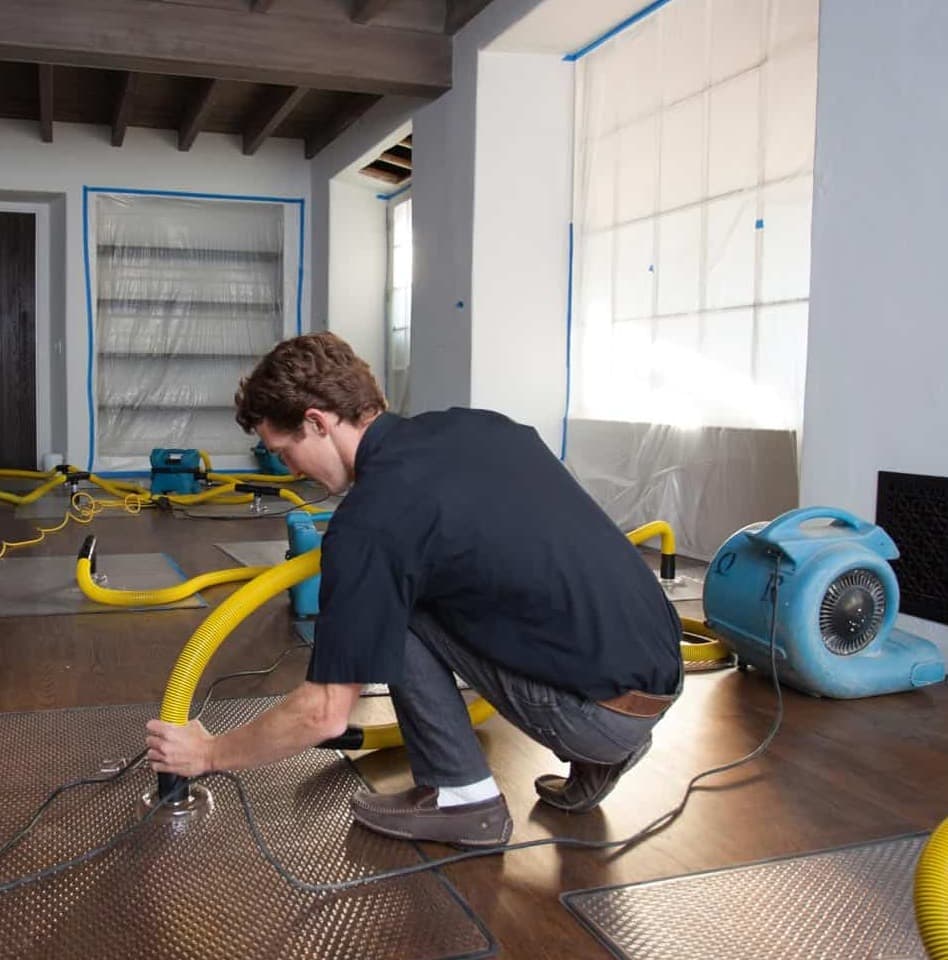
Who is the best water damage restoration company in Royal Oak, MI?
Royal Oak is not a difficult city to find a restoration company in. It is a difficult city to find the right one, and the reason is architectural rather than commercial.
A large share of this city is 1920s to 1940s bungalow, English Revival and four-square stock sitting on original combined sewer-storm connections and stone or block foundations. That combination produces two things almost no marketing page addresses. First, a backup here is contaminated from the first minute rather than after a lab result, because rain and waste share a pipe. Second, and more expensively, what the water reaches — plaster over wood lath, original quarter-sawn hardwood, leaded glazing, built-in millwork — cannot be replaced at warehouse prices. It has to be replicated, which is a different trade at a different number.
So the question that actually separates contractors in Royal Oak is not who arrives fastest. It is who can tell you, with a meter in their hand, which of your original material can be dried in place and which genuinely has to come out. A crew that defaults to tearing out every plaster ceiling is choosing the easy path. A crew that saves it is doing the harder, cheaper thing.
The comparison below evaluates ten companies serving Royal Oak on criteria you can check yourself.
How this comparison was compiled
Every company below was assessed on the same four public, verifiable criteria:
- Michigan licensing. Residential building work in Michigan requires a licensed residential builder, and the licence is independently verifiable through the State of Michigan licence lookup. We recommend you check it yourself for any company you consider — including this one.
- Google review standing. Public rating and review volume as published on each company's own Google Business Profile.
- Published response window. What each company states publicly, not what it promises on a call.
- Reconstruction capability. Whether the same company performs the rebuild or hands it to a third party — which on pre-war housing is the seam where jobs go wrong.
Disclosure. This comparison is published by Prime Restoration, which is included in the list and disclosed as the publisher. Every company is evaluated on the same criteria. No company paid for placement, and no company was excluded for declining to. Ratings and review counts move; verify anything time-sensitive against the source before relying on it.
Top Restoration Contractors in Royal Oak, MI
Prime Restoration (the company that publishes this guide)
Prime Restoration dispatches 24/7 from Sterling Heights and covers Royal Oak, 48067 and 48073, along with the rest of Oakland and Macomb County. One accountable crew handles the job from extraction through reconstruction rather than handing the rebuild to a subcontractor.
Why they stand out in Royal Oak specifically:
- Material triage before demolition. Plaster over wood lath, original hardwood, leaded glazing and built-in millwork each get a documented save-or-remove decision made from moisture readings rather than from the visible water line. In this housing stock that decision — not square footage — is what sets the invoice.
- Category 3 as the working assumption on combined-sewer blocks. Containment and negative air go up before anyone assesses finishes, rather than after somebody decides the water looked clean.
- Mitigation and reconstruction under one roof. The person deciding what comes out is the person who has to put it back, which matters more on a 1925 bungalow than on a 2015 colonial.
- Free written scope and moisture readings. The inspection, the readings and the written scope cost nothing and you keep them whether or not you hire the company.
- Honest about scope limits. Plumbing repair, roofing, electrical and asbestos abatement are named in the scope and routed to the licensed trades that own them rather than claimed.
Rating: 5.0 across 133 Google reviews. Licence: Michigan Residential Builder — verify at the State of Michigan licence lookup. Reach us: (586) 277-1069.
2. 1-800 WATER DAMAGE of Royal Oak / Sterling Heights
A franchise location carrying Royal Oak in its own service-area name, covering the city and the surrounding Oakland and Macomb corridor. Franchise operations bring standardised documentation and equipment specifications, which is genuinely useful on an insurance-adjacent loss.
Worth asking: whether reconstruction is performed in-house or referred, and who owns the hand-off if it is referred.
3. SERVPRO of Birmingham, Troy
One of the larger franchise networks operating in Oakland County, with capacity that matters after a regional event when every homeowner needs a crew on the same day. Standardised processes and national backing.
Worth asking: which portions of the work are performed by employees and which are subcontracted, since that is where accountability sits.
4. PuroClean of Bloomfield Hills
An Oakland County franchise location serving the Royal Oak corridor, with water, fire and mold capability and the documentation practices franchise networks tend to standardise.
Worth asking: their approach to drying original hardwood and plaster in place versus removing it, which is the decisive question in this housing stock.
5. Modernistic
A long-established Michigan company whose core business began in carpet and upholstery cleaning and extends into water damage restoration. Deep local footprint and a large service area across the state.
Worth asking: the scope of structural reconstruction capability, as cleaning-led firms vary considerably on the rebuild side.
6. DRYmedic Restoration Services
A restoration-focused operation working across the Detroit metro with water, fire and mold service lines, and a published emphasis on working alongside the insurance claim process.
Worth asking: who determines that drying is complete, and whether daily moisture logs are provided to the homeowner.
7. Rainbow Restoration of Automation Alley
Part of a national franchise system, covering the Oakland County technology corridor and the surrounding communities including Royal Oak.
Worth asking: published response window versus actual dispatch distance to your specific address.
8. Concraft
A Michigan restoration contractor handling residential and commercial losses, with reconstruction capability alongside mitigation.
Worth asking: experience specifically with pre-war plaster and original millwork replication, which is a narrower skill than general reconstruction.
9. Emergency Restoration Company
A regional operator serving the Detroit metro with emergency water and fire response.
Worth asking: licensing verification and whether the estimate is provided before demolition begins.
10. BELFOR Property Restoration
The largest restoration company operating globally, with Michigan operations and very substantial capacity for large-loss and commercial work. On a catastrophic or commercial loss, scale is a genuine advantage.
Worth asking: on a single-family residential loss, who your actual point of contact is and whether the crew is local.
Where you live in Royal Oak changes who you should call
This city is not one job type. Four parts of it fail in different ways, and the difference decides which of the capabilities above you should actually be screening for.
| Area | Housing | What tends to fail | What to screen the contractor for |
|---|---|---|---|
| Downtown core — Main Street and Washington | Two-story four-squares and Tudors on narrow lots | Stone foundations and partial basements. Lateral seepage arriving alongside a backup. | Controlled demolition rather than fast tear-out. Ask directly what they do with original hardwood and plaster. |
| Vinsetta and Northwood — south of 13 Mile, Woodward corridor | 1920s brick bungalows, gable-front cottages, English Revivals | Plaster ceilings and leaded glass above; combined connections below. | Replication capability. What comes out of these homes cannot be bought back off a shelf, so the removal decision is the invoice. |
| Red Run corridor — southwest quadrant | 1940s-50s ranches and Cape Cods | Slab or shallow crawlspace foundations, highly exposed to drain backups. | Category 3 protocol as the default assumption. Containment, negative air, and porous material out before anyone assesses finishes. |
| Coolidge and 11 Mile — tear-down replacement pockets | Two-story new builds beside century-old neighbours | Engineered floor systems that hold moisture in the webbing after the surface reads dry. | Penetrating moisture readings rather than surface ones, and patience. Two houses on one street can need two different drying plans. |
What this city has already been through
Two events in living memory produced this at scale, and both are worth knowing about when a contractor tells you a backup is unusual.
- August 11, 2014. Particularly severe in Royal Oak. The dense pre-1950 stock with original combined connections and stone or block foundations saw extensive Category 3 backups. Bungalows south of 13 Mile and along the Red Run Drain corridor lost finished lower levels, with original hardwood, plaster and built-ins requiring controlled demolition rather than tear-out.
- June 2021. The same pattern repeated, with older homes again taking combined sanitary backup and lateral seepage through stone foundations in a single event.
A company that has worked this city through either of those has seen what the housing stock actually does. It is a fair thing to ask about.
How to shortlist from this list in about ten minutes
Ten companies is more than anyone needs. Here is how to cut it down without knowing anything technical.
- Start with the licence. Ask each one for the Michigan residential builder licence number and check it yourself through the State lookup. This takes two minutes per company and removes any that resist the question. There is no legitimate reason to resist it.
- Then ask one question: what do you do with plaster? In Royal Oak this single question separates contractors faster than anything else on the page. The answer you want acknowledges that plaster over wood lath can frequently be dried in place when the key is intact, and that the decision comes from a meter. The answer that tells you something is "we take it all out" — that is a crew choosing the easy path on the most expensive material in your house.
- Then ask who does the rebuild. If it is a different company, ask who decides the readings cleared. On pre-war housing the hand-off is where original material gets lost.
- Then compare what is being removed, not the totals. Two scopes for the same loss usually differ about what is wet rather than about price. The cheaper one is not automatically worse and the dearer one is not automatically thorough.
Four questions. Most people are down to two companies before anyone has visited.
What actually decides the job in Royal Oak
Four things, in this order.
- What your house is made of. Plaster over wood lath holds water far longer than drywall and fails in sheets rather than crumbling gradually — but it can frequently be dried in place when the key between plaster and lath is intact and it is reached early. Original hardwood can often be saved with mats and controlled dehumidification rather than pulled; cupping is a moisture gradient, not automatically a death sentence. Both decisions have to be made in the first days.
- Which direction the water came from. Up through a floor drain on a combined-sewer block is Category 3 from minute one. Weeping through mortar seams or the cove joint is groundwater through a stone foundation — a lower category, with far more of the room salvageable. Many Royal Oak homes take both in one storm.
- How long it ran. Category escalates with contact time regardless of where it started, and in plaster — which holds water — that clock matters more than it does in drywall.
- Whether one company owns the whole job. The hand-off between mitigation and reconstruction is where original material gets lost, because the crew removing it is not the crew replicating it.
Questions worth asking any contractor on this list
- What is your Michigan residential builder licence number, and can I verify it myself?
- What category are you treating this as, and what made you decide that?
- What are you removing and what are you drying in place — and why for each?
- Will you show me the moisture readings, including the dry standard you are comparing against?
- Can plaster and original hardwood be dried in place here, or does it genuinely have to come out?
- Are mitigation and reconstruction the same company, and if not, who owns the hand-off?
- What ends this job — a date or a reading?
These work on the company publishing this comparison exactly as they work on the other nine.
More on what actually fails in Royal Oak
This guide compares companies. If you want the underlying detail — combined sewer connections, the Red Run corridor, and what plaster and original hardwood do to a scope — our Royal Oak restoration guide covers it at length, including the sub-areas of the city and what changes the scope in each.
Key takeaways
- Royal Oak's decisive variable is material, not square footage. Plaster, original hardwood, leaded glazing and built-ins are replicated rather than replaced.
- A large share of the city runs original combined sewer-storm connections, which makes a backup Category 3 from the first minute.
- Stone foundations add lateral seepage, so many homes take water from two directions in one storm.
- The save-or-remove decision has to be made in the first days, which makes speed matter for a reason other than the obvious one.
- Verify any Michigan builder licence yourself through the State lookup rather than accepting a card or a decal — including ours.
Frequently asked questions
Can plaster ceilings be saved after water damage in an older Royal Oak home?
Often, and it is worth asking rather than assuming, because it is the most expensive assumption a contractor can make on your behalf. Plaster over wood lath behaves differently from drywall: it holds water considerably longer, it can frequently be dried in place when the key between plaster and lath is still intact, and when it does fail it fails in sheets rather than crumbling gradually. The variables are how long it was wet, whether the key is intact, and whether the ceiling is holding a pocket of water — a visible bulge is a falling hazard rather than a cosmetic problem and the room below should be cleared. Where it genuinely cannot be saved, replication is a plaster trade rather than a drywall one and that belongs in the scope from the beginning. A contractor who defaults to tearing every plaster ceiling out is choosing the easy path, not the right one.
Which Royal Oak neighbourhoods flood the most?
The Red Run Drain area in the southwest quadrant concentrates it most, where 1940s and 1950s ranches and Cape Cods sit on slab or shallow crawlspace foundations that are particularly exposed to drain backups. South of 13 Mile and through Vinsetta and Northwood the mechanism is the same but the consequence is different — those bungalows and English Revivals carry plaster, original hardwood, leaded glass and built-ins, so what is lost is not replaceable at stock prices. The downtown core around Main Street and Washington adds stone foundations and partial basements, which means lateral seepage arriving alongside a backup in the same storm. The tear-down pockets near Coolidge and 11 Mile are the exception: newer foundations and engineered floor systems, where the problem is moisture held in the joist webbing after the surface reads dry rather than contaminated water coming up a drain.
Do I need a plumber or a restoration company for a Royal Oak basement backup?
Very likely both, and in that order. If water is actively coming back up a floor drain, the source is the sewer lateral or the main and that is a plumber's trade rather than a restoration company's — no amount of cleanup changes a compromised lateral, and if you have backed up more than once the second event is information about the pipe rather than about the weather. A camera inspection of the lateral belongs in the plan on day zero, and on a repeat backup it belongs before any rebuild rather than after it. What a restoration company handles is everything the water did: containment on a Category 3 loss, extraction, removal of porous material that absorbed it, structural drying to a documented standard, and the repair. Any firm that tells you it does all of it should be asked which licences it actually holds.
How fast do I need someone on site in Royal Oak?
Same day, and the reason is specific to this housing stock rather than generic urgency. Clean Category 1 water begins reclassifying toward Category 2 after roughly 24 to 48 hours in contact with building materials, and sustained moisture past about 72 hours is generally handled as Category 3 — each step down that ladder removes more material from the salvageable list. In Royal Oak that clock is tighter than average because plaster holds water and gives it up slowly, and because the save-or-remove decision on original hardwood has to be made in the first days rather than after two weeks of a fan pointed at it. A finished basement reached in hour three and the same basement reached on day three are not the same job or the same number. That said, if water is still actively entering, the honest first call is whoever can stop it soonest.
Who is the best water damage restoration contractor in Royal Oak, MI?
There is no single answer that fits every Royal Oak home, because the right contractor depends on which half of the city you are in and what your house is made of. In the pre-war stock — the bungalows and English Revivals through Vinsetta and Northwood, and the four-squares and Tudors in the downtown core — the decisive capability is whether a company can dry plaster over wood lath and original hardwood in place rather than tearing it out, because those materials are replicated at a millwork price rather than bought off a shelf. In the newer tear-down rebuilds near Coolidge and 11 Mile, the decisive capability is patient structured drying of engineered floor systems. On top of both, a large share of Royal Oak still runs original combined sewer-storm connections, which means a backup here is a Category 3 loss from the first minute and containment is not optional. The companies compared below are evaluated on those specifics rather than on marketing claims: Michigan residential builder licensing you can verify yourself, Google review standing, published response windows, and whether the same company handles reconstruction or hands it off.
Why do Royal Oak basements flood when nearby suburbs stay dry?
Because the housing is older than the drainage assumptions underneath it. Royal Oak holds one of the densest concentrations of 1920s to 1940s bungalows in the Detroit metro area, and a great deal of that stock still runs on original combined sewer-storm connections over stone or block foundations. Combined connections mean rain and waste share a pipe, so when the system surcharges the water that comes back into a basement is contaminated from the first minute — a Category 3 job rather than a wet-carpet job. Stone foundations then add lateral seepage on top of the backup, so many of these homes take water from two directions in the same storm. The corridor that concentrates it is the Red Run Drain area in the southwest quadrant, and the August 2014 and June 2021 events both produced this at scale, particularly south of 13 Mile.
What should a Royal Oak restoration quote actually include?
Four things, and the absence of any one of them is the tell. A stated water category with the reason for it, because on a combined-sewer block the honest default assumption is Category 3 and that changes the scope before anyone looks at finishes. Moisture readings against a dry standard taken from the same material in an unaffected part of your house — without that baseline every number is meaningless. An itemised list of what is being removed versus dried in place, with a reason on each line, which in this housing stock is the single biggest cost driver because plaster, original hardwood, leaded glazing and built-ins are replication problems rather than materials line items. And a clear statement of who performs the reconstruction, because the seam between mitigation and rebuild is where jobs on pre-war homes go wrong.
How much does water damage restoration cost in Royal Oak?
Water damage restoration in Michigan typically runs from about $1,500 to $7,500 depending on the water category, how much of the space was finished, how long it ran before anyone found it, and how much has to be removed rather than dried in place. Royal Oak sits toward the upper half of that range more often than newer suburbs do, for one specific reason: what comes out of a 1925 bungalow cannot be bought back at warehouse prices. Plaster systems, milled trim profiles and original quarter-sawn flooring are replication trades. That is also why the removal decision matters more here than the square footage does, and why a contractor who tears out every plaster ceiling by default is choosing the easy path rather than the right one. Any firm number should come from readings taken on site, not from a phone description.
Is a Royal Oak sewer backup covered by homeowners insurance?
Sewer and drain backup is typically excluded on a standard Michigan HO-3 unless a sewer-and-drain endorsement was added, which is worth checking specifically in a city with this backup history. Sudden and accidental discharge from a failed supply line is generally covered. Surface flooding from rain is usually excluded without separate flood coverage. Coverage determinations, payment decisions and settlement amounts are made solely by your insurance carrier after their own inspection, so confirm the specifics with them rather than with any contractor. What a restoration company controls is the record: dated photographs before anything moves, moisture readings against a dry standard, and an itemised account of what was removed and why.
Tags
24/7 Emergency Response
Need Professional Restoration Now?
Call now and speak directly with our trained restoration team. On-site within 60 minutes.
(586) 277-1069