

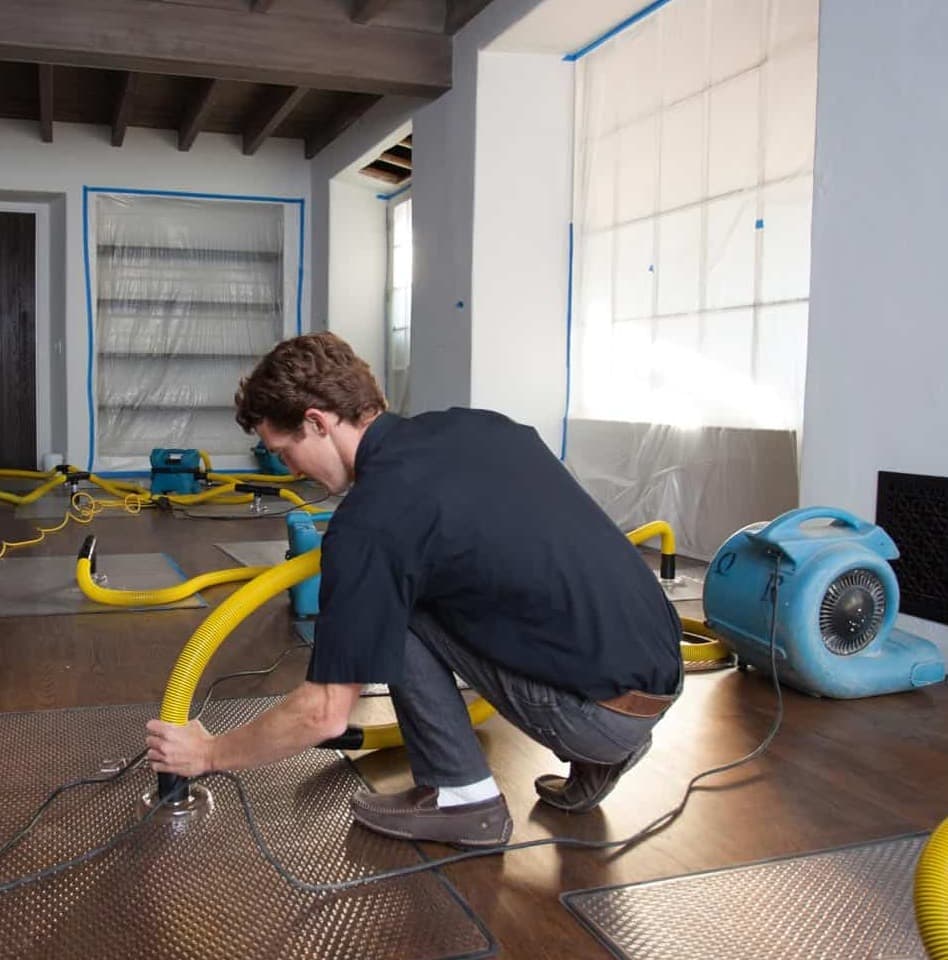
Our work · Macomb · January 2026
A flooded finished basement in Macomb, dried room by room in 10 days
Water reached every finished room of a Macomb basement overnight: a home gym, a media room, a bar area, a bathroom and a laundry room. Here is the job as the dated photos and the field notes recorded it, from the first meter check to the day the framing read dry.
- 5.0★ on Google, 186 reviews
- Michigan Licensed Builder #262500492
- IICRC Certified Firm
- Macomb Office, Macomb
The job at a glance
- City
- Macomb, Macomb County
- Loss
- Water across the entire finished basement
- First call
- January 24, 2026
- Mitigation complete
- February 3, 2026 (10 days)
- Removed
- Wet carpet and pad, drywall, insulation, one room of vinyl plank flooring
- Flagged for recon
- Bathroom tile, after the surface read wet on repeat checks
How do you dry a basement when the whole lower level got wet?
Prime Restoration maps every room with a moisture meter first, because a basement flood rarely stops at one wall. On this Macomb job the crew pulled carpet and pad back from the baseboards room by room, opened the wall and ceiling sections that stayed wet, and ran air movers and a dehumidifier through the whole level until the framing read dry. That took 10 days from the first call. Call Prime Restoration at (586) 277-1069.
The cause
What the first visit found
The crew arrived the evening of January 24 and checked every finished room of the basement with a moisture meter: the home gym, a media and music room, a bar area, the bathroom, the laundry room, the hallway and the closets. Every one of them read wet.
The job record does not name a single pipe, appliance or fixture as the source, and none of the 386 photos on this job shows one failing. What the record does show is the scope: water had traveled through the lower level before the crew ever got there. The crew also checked the main floor above with the same meter and found it dry, so the drying work stayed in the basement.
Timeline
How the basement dried out
- Day 1 · Jan 241
Mapped the whole basement, pulled wet insulation at the baseboards
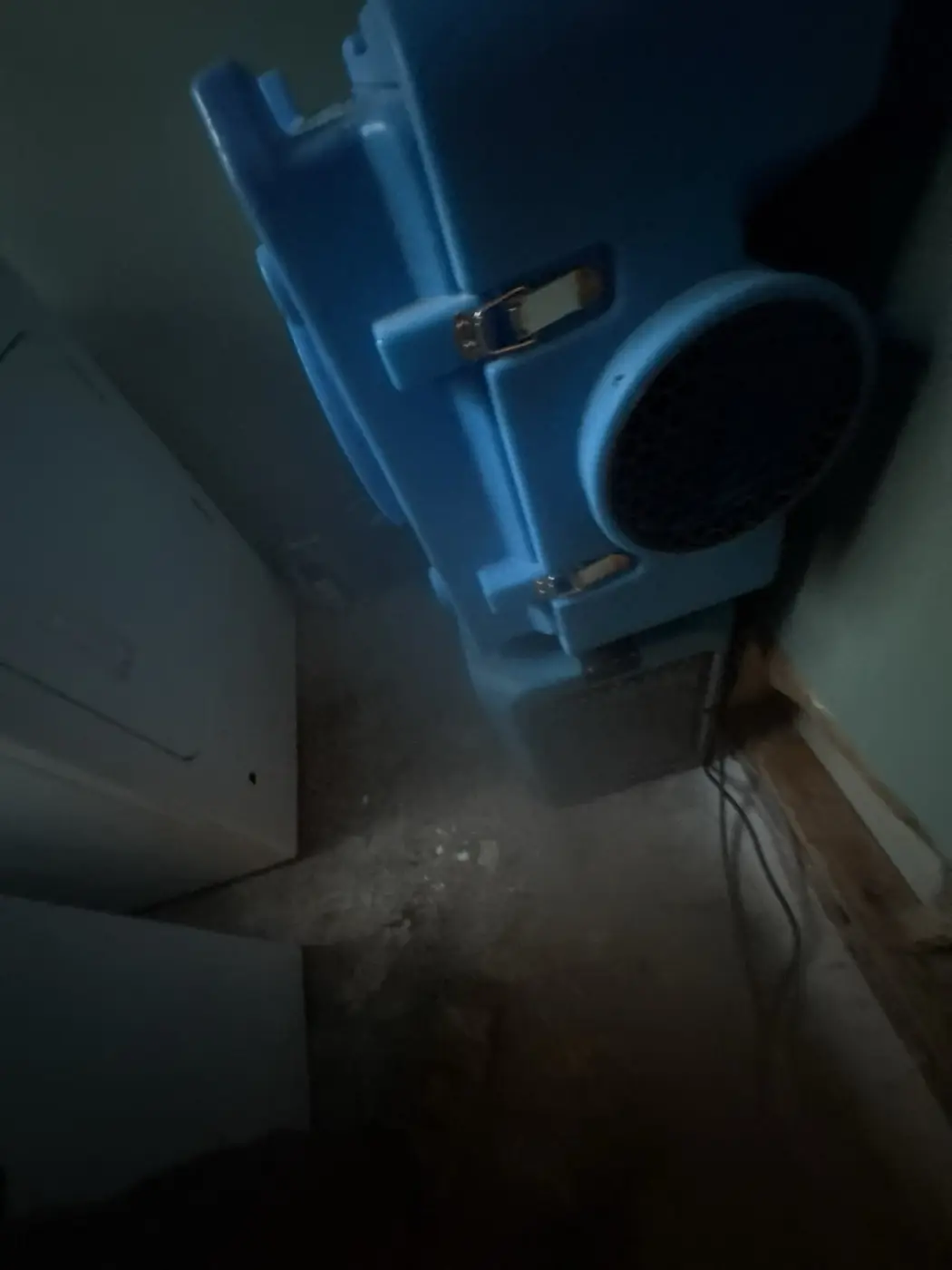
With a comparative moisture meter, the crew walked every basement room and the main floor above it, marking what was wet and what was not. At the baseboards, they opened small sections of drywall and pulled out insulation that had already soaked through, then set the first air movers and a dehumidifier running.
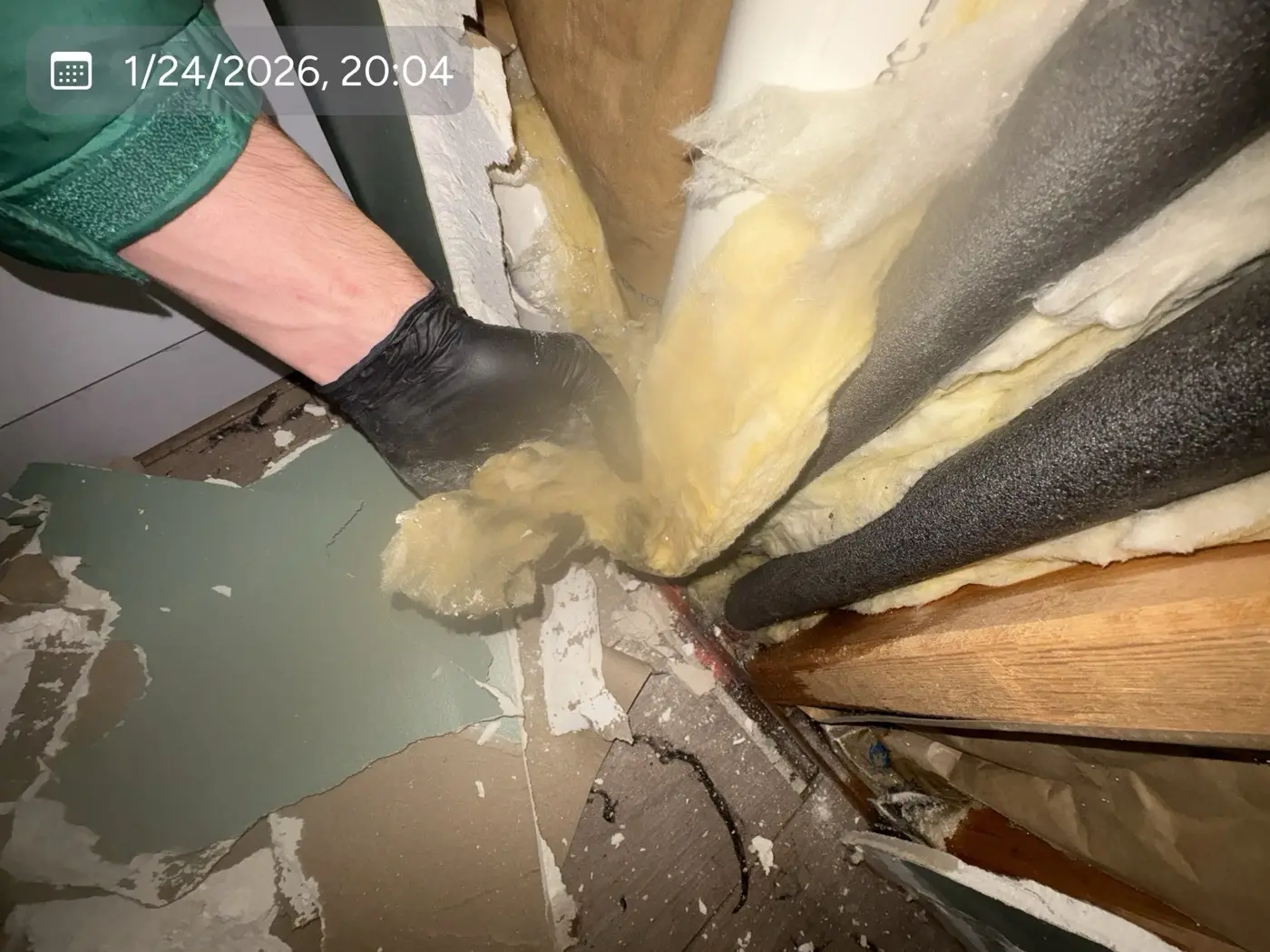
Day 1: insulation that had already soaked through came out at the baseboards. - Day 3 · Jan 262
Carpet pulled back room by room
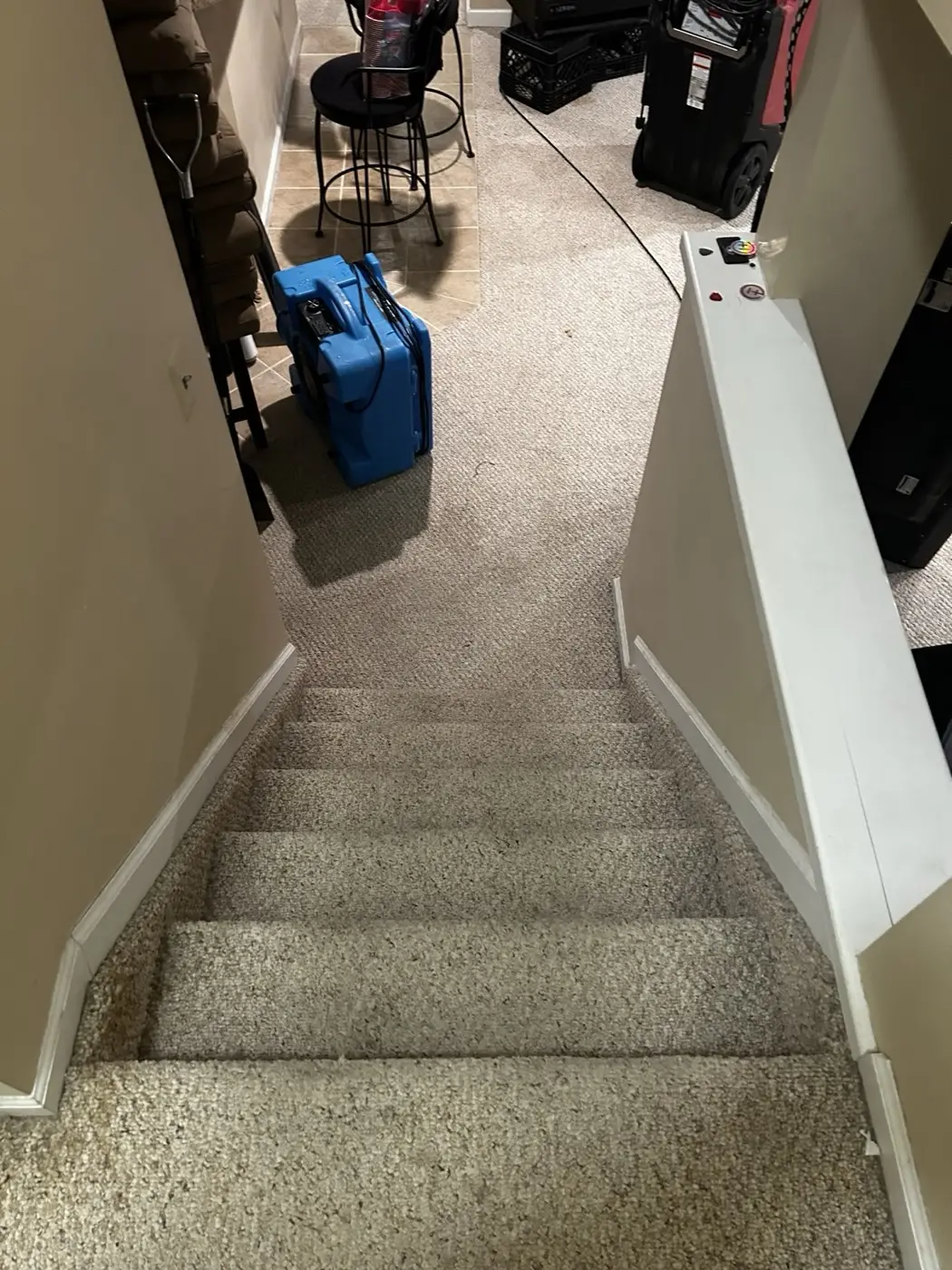
Carpet and pad came up from the walls across the affected rooms, exposed and taped back so the concrete slab underneath could dry in the open air. More air movers went in to keep air circulating under the lifted carpet.
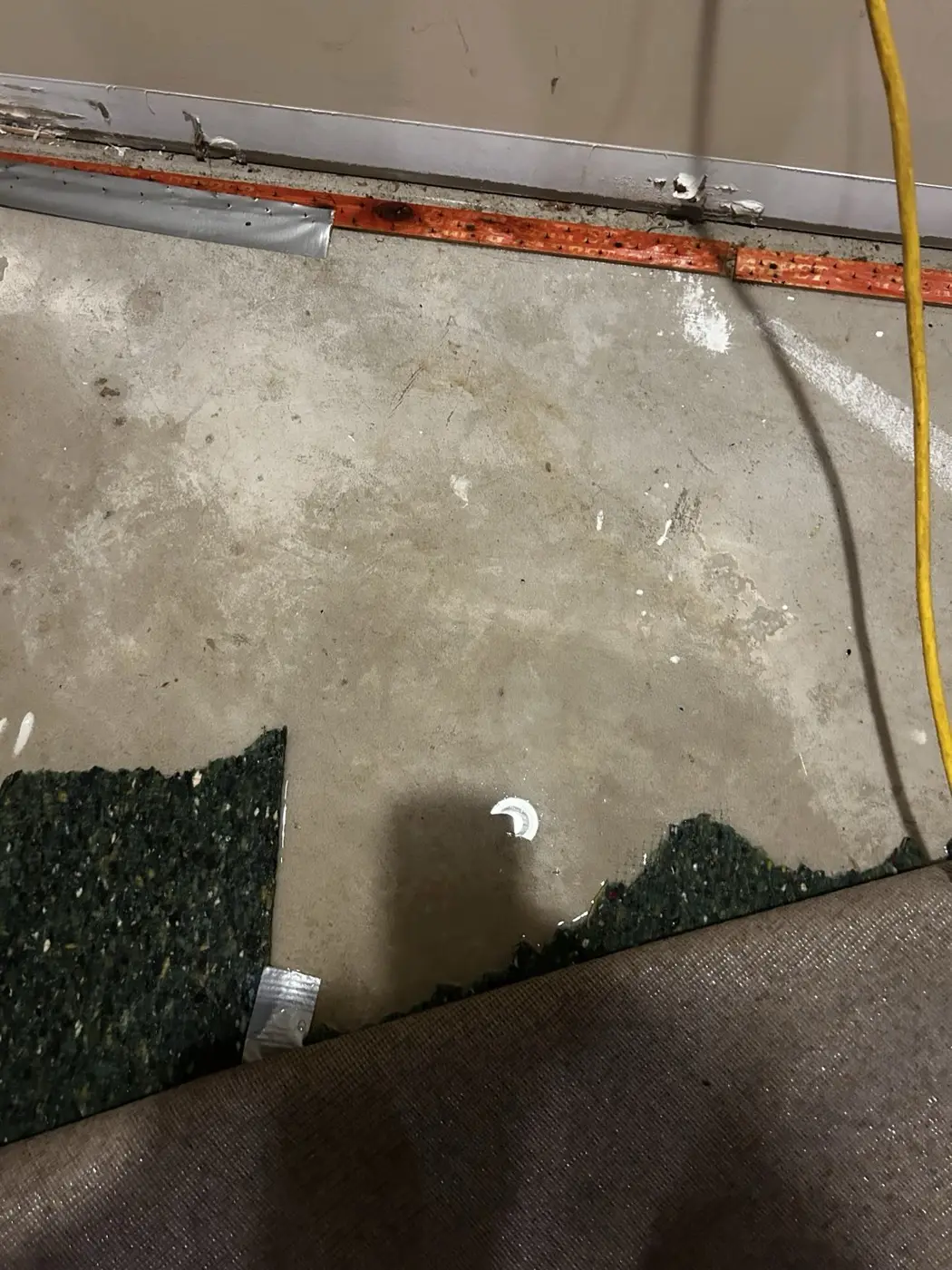
Jan 26: carpet and pad pulled back from the walls so the slab could dry in the open air. - Day 6 · Jan 293
Flooring lifted, framing opened
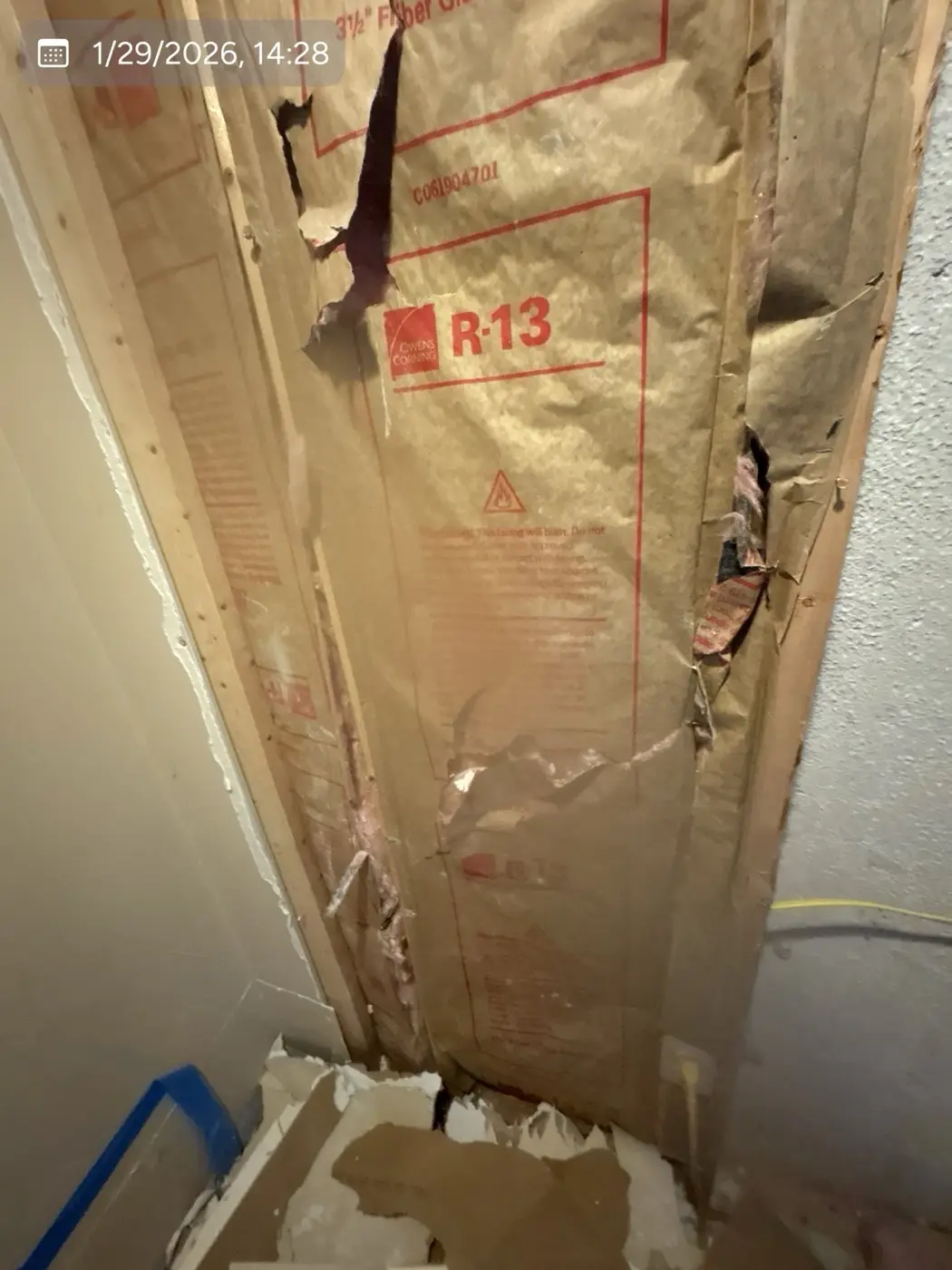
In the room where the flooring was glued vinyl plank, the crew pulled it up to reach the wet subfloor. Elsewhere, wall and ceiling sections came down where the meter kept reading wet, exposing water-stained wood framing and soaked fiberglass insulation that had to come out before the cavity could dry.
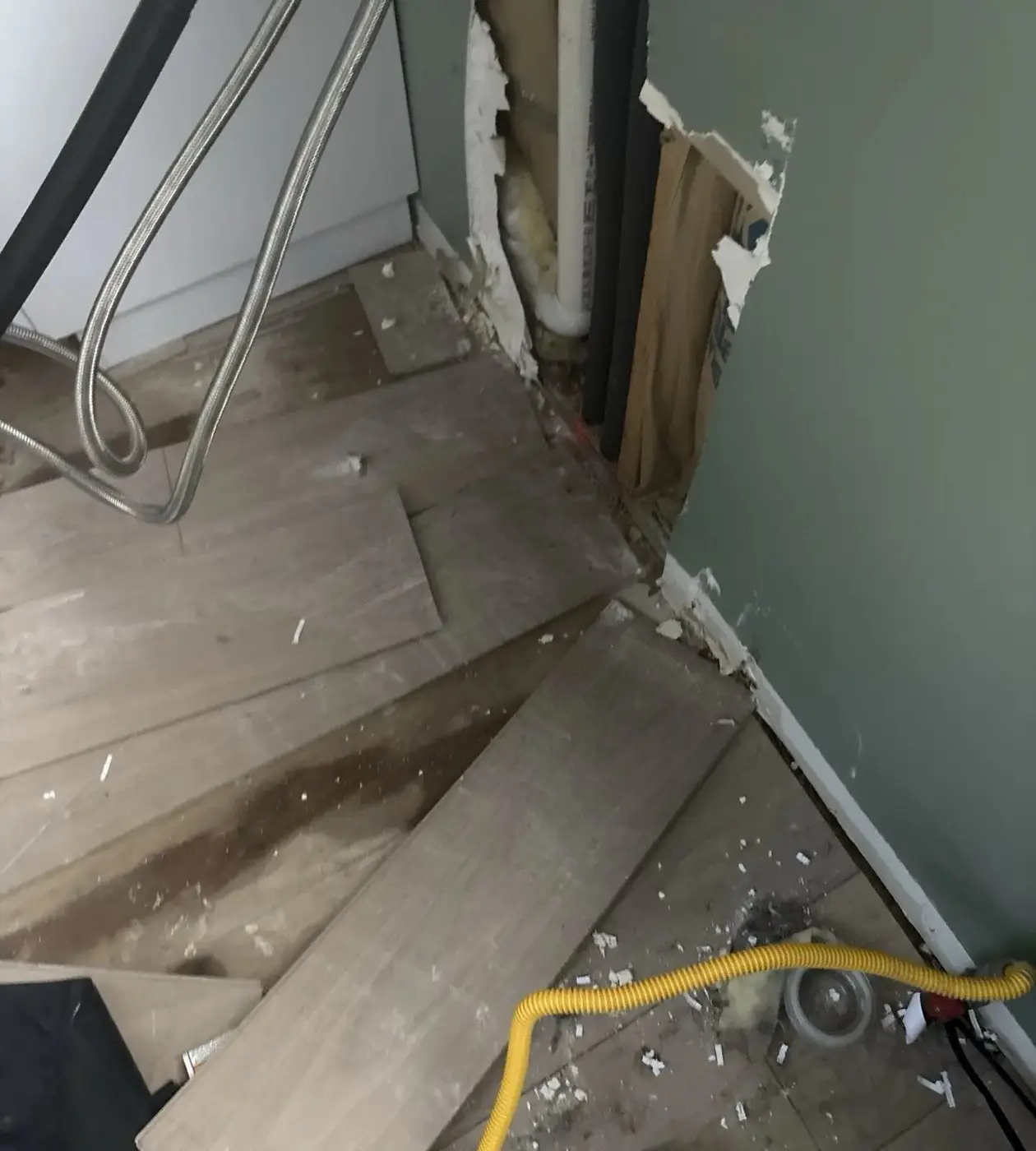
Jan 29: a wall cavity opened to reach wet framing, water staining visible on the floor below. - Day 6 · Jan 29, later4
Bathroom tile checked
The crew ran the moisture meter over the bathroom tub surround and floor tile. The surface kept reading wet on repeat checks, so the technician flagged the tile for removal rather than drying it in place.
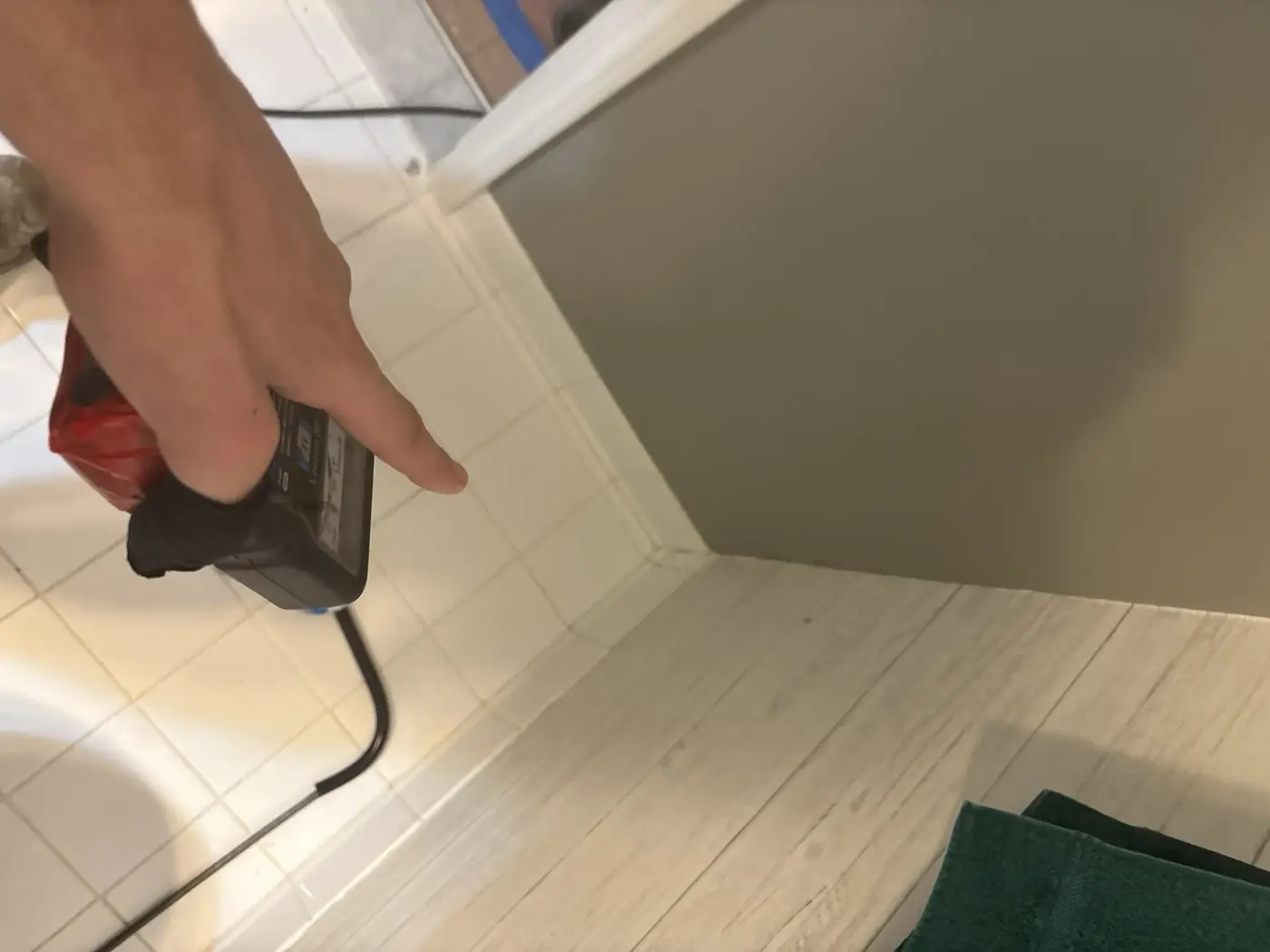
Jan 29: the tub-surround tile kept reading wet, so it was flagged for removal. - Day 11 · Feb 35
Framing read dry, mitigation closed
Midday on February 3 the crew re-checked the opened framing with the same comparative meter. The needle sat in the instrument's dry band. The job note that afternoon records the floor as dried and the mitigation phase complete, 10 days after the first call.
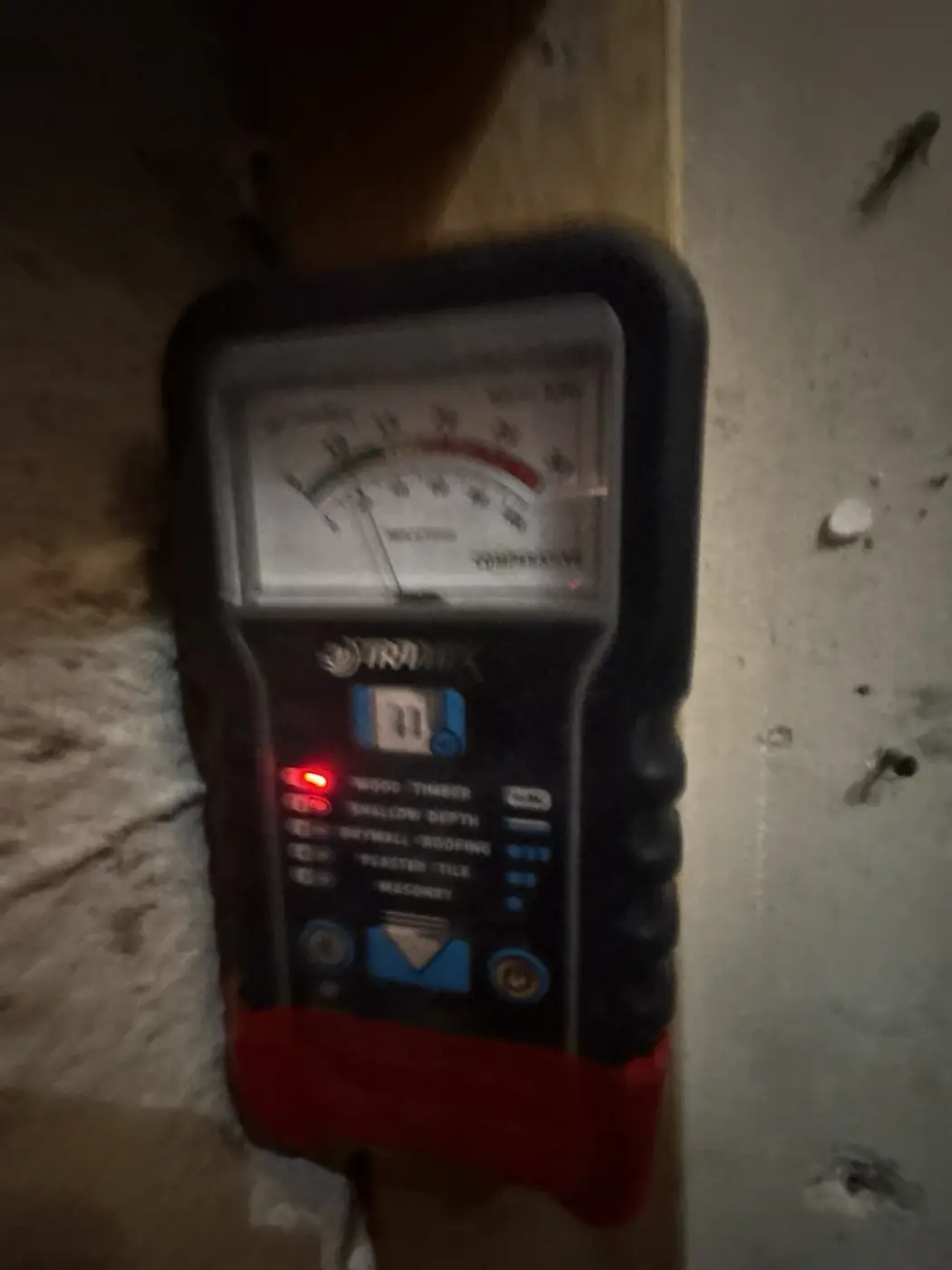
Feb 3: the final check, needle in the dry band on opened framing. The job was closed the same day.
Measured, not guessed
What was measured on this job
This job was read with a comparative, non-pin moisture meter rather than a logging thermo-hygrometer, so the record does not give temperature, relative humidity or GPP figures the way a psychrometric reading would. What the photos do show are two dated, legible checks on the meter's own comparative scale.
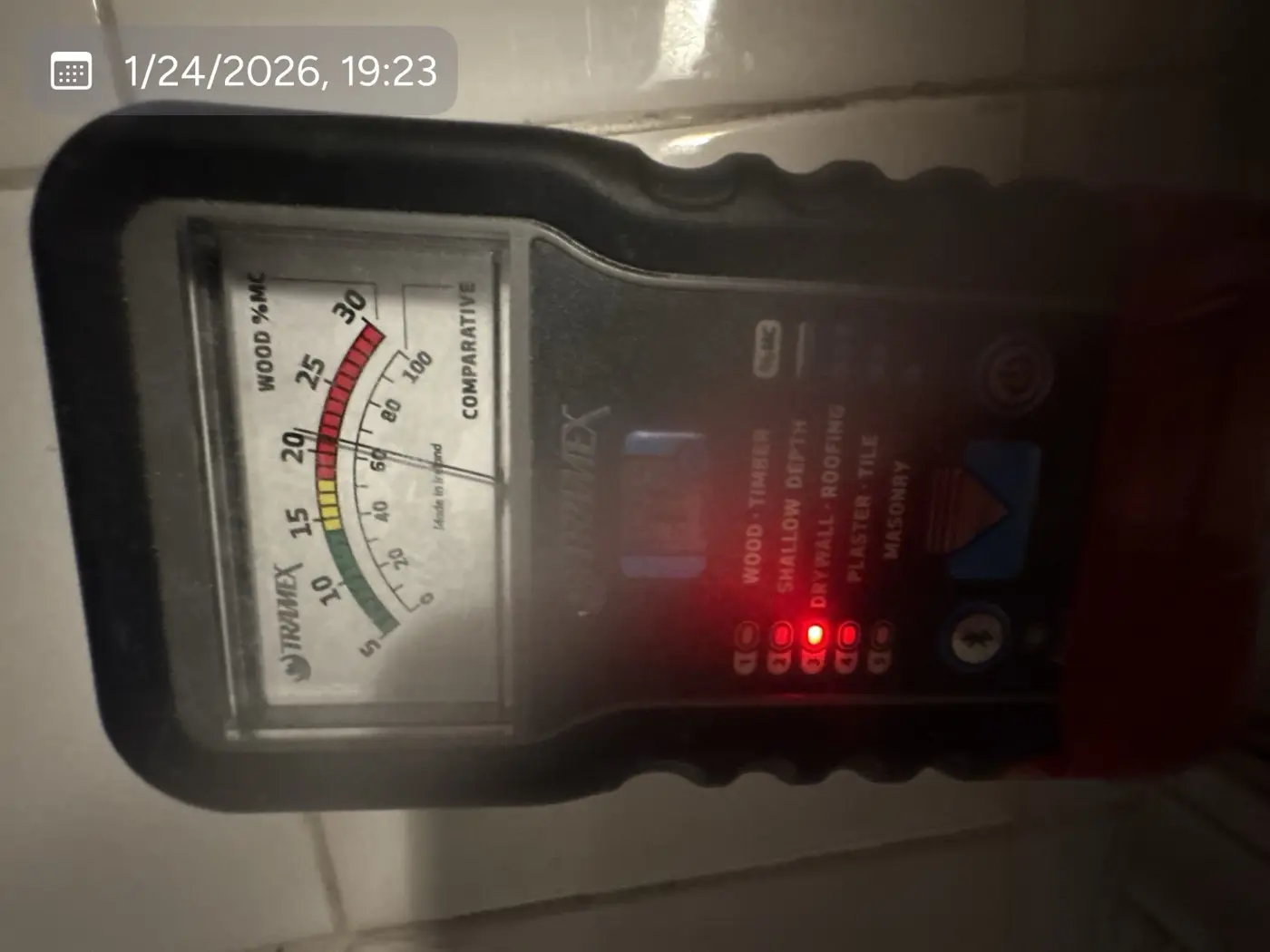
On January 24, checking a bathroom wall in the meter's drywall/roofing setting, the needle sat at 20 on the comparative scale, inside the instrument's red, wet band.
On February 3, checking exposed wood framing in the wood/timber setting, the needle sat near the bottom of the same scale, inside the green, dry band. That second reading, on opened framing rather than a finished surface, is what the crew used to call the job dry.
On this job
Equipment on this job
- Air movers, multiple units, run room to room as carpet came up and walls opened
- Portable LGR dehumidifier
- Comparative (non-pin) moisture meter for drywall, framing and tile
- Digital temperature and humidity meter for spot checks
For your home
What this job means for your basement
- A basement flood is rarely one wet room. Check every finished space on the lower level, not just where the water is visible, before you decide what needs to come out.
- Carpet and pad can often be saved if they are pulled back and dried fast. Left flat and wet for days, they usually cannot.
- The dry call belongs on the framing and subfloor, not on room air. This job's framing reading on February 3, taken on opened wood, is what closed it out.
- Tile that keeps reading wet after repeat checks is telling you something the surface won't show: water sitting underneath it. That is a removal decision, not a drying one.
- A main floor above a flooded basement is not automatically affected. Check it with a meter instead of assuming either way.
Job photos
Photos from this Macomb job
Common questions
Questions about this kind of job
How long does it take to dry out a flooded basement?
Can wet basement carpet be saved, or does it have to be replaced?
Does wet drywall in a basement always have to be cut out?
Will homeowners insurance cover a flooded finished basement?
Why did the bathroom tile get flagged instead of dried?
What equipment dries out a flooded basement?
Does Prime Restoration show photos of the house online?
What stays off this page
This page names the city and the month the job happened, and nothing else that points at the house. No street, no last name, no claim number, no photo of the outside of the property. Every photo here was re-saved with its location data stripped before it went on the site, and any shot that showed personal belongings in focus was left out of the set entirely.
Nearest office to Macomb
Macomb Office
Macomb Centre Plaza, 51058 Romeo Plank Rd, Macomb, MI 48042
(586) 277-1069, 24/7
Related pages
- Flooded basement cleanup, Macomb County
- Sump pump failure and basement water
- Water-damaged floor restoration
- Wet drywall after water damage
- Wet insulation after water damage
- Vinyl plank flooring water damage
- Water damage restoration in Macomb
- All of our work
Other jobs we documented
- Finished Basement Flood Drying in Birmingham
- Roof Leak Into a Kitchen Ceiling in Bloomfield Hills
- Water Backup in a Rochester Hills Basement
- Sewer Backup Basement Cleanup in Sterling Heights
Sources
Written by Prime Restoration from the job record and dated job photos. Published November 2, 2026. Updated November 2, 2026.