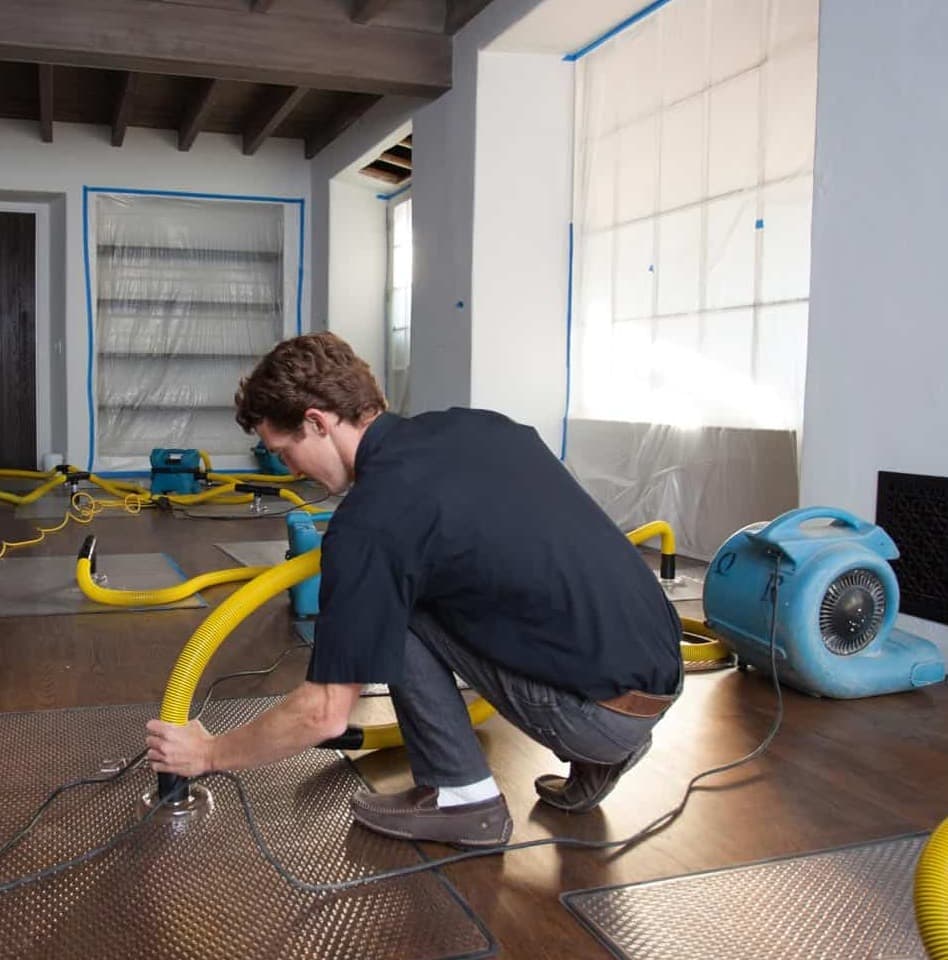
Half of Clarkston has no city sewer to back up, and the storm that floods the basement takes the well with it. Independence Township sits on glacial moraine, much of it on private well and septic. That changes what a water loss is here, and what stops one. Free inspection with moisture readings across 48346 and 48348.
Rather talk now?Call (586) 277-1069
This guide is published by Prime Restoration, a Michigan licensed residential builder and water damage restoration contractor working from Sterling Heights. We do not service septic systems, wells or well pumps — those are separate trades and we say so on the phone. Written for Clarkston and Independence Township. Last updated 2026-08-13.
The thing nobody writes down
Almost every water damage page written for Oakland County assumes the house is on municipal water and a municipal sanitary sewer. Across large parts of Independence Township that assumption is simply wrong, and once it is wrong the rest of the advice stops applying.
A home on private well and private septic has a different failure list, a different worst case and a different order of operations. There is no city main to surcharge, so the classic municipal backup cannot happen. What can happen is the septic system backing up, which is the same contamination category and a completely different trade to stop.
And there is a compounding problem that catches people every time. The sump pump and the well pump are both electric, on the same service. The storm that drops the power takes the pump moving water out of the basement and the pump bringing water into the house at the same instant. You cannot pump, and you cannot run a tap, and on a rural circuit the crews reach you last.
There is often no city sewer to back up
In the sewer-served suburbs the Category 3 event is a municipal main surcharging into the lowest fixture. Where a home is on septic, that event cannot happen. What happens instead is the tank or the drain field backing up, and it is still Category 3.
A saturated drain field has nowhere to put the water
After a long wet spell the soil around the field is already full. Effluent that cannot soak away stays in the line, and the system backs up toward the house until it finds the lowest fixture. On a walkout lot that is usually a basement bathroom.
One power cut takes the sump and the well together
This is the part almost nobody plans for. The sump pump and the well pump are both electric. When the power drops you lose the ability to remove water and the ability to run water in the same instant, so you cannot even flush while the basement is filling.
A failed pressure tank floods from the inside
Well systems carry a pressurised tank, usually in the same utility corner as everything else. When the bladder fails or a fitting lets go, the well pump keeps cycling and feeding it. That is a supply-side failure, and supply-side failures do not stop on their own.
Category matters more than volume here
Two inches of clean supply water and two inches of septic backup look identical on the floor and are not the same job. The second one contaminates everything porous it touches, and the standard answer for saturated carpet, pad and drywall in that category is removal rather than drying.
Where you are in the township
The village, the lakes, the ridges and the newer east side were built in different decades out of different materials on different ground. The address changes what the job is more than the storm does.
Historic village core
Roughly 1840s to early 1900s
Fieldstone and rubble foundations, balloon framing, lath and plaster, later basements dug under buildings that never had one.
Rubble stone was never a water barrier. It weeps through the joints under sustained pressure rather than through a crack you can point at, so there is no single entry point to seal.
Lakefront and lake-adjacent
Mixed, 1950s cottages through modern rebuilds
Walkout and daylight basements cut into a slope, often with the original cottage footprint buried inside a larger house.
The uphill wall carries hydrostatic pressure while the downhill wall has a door at grade. Water finds the uphill side, then runs the length of the floor to the lowest point at the walkout.
Moraine ridge subdivisions
1970s through 1990s
Poured wall or block foundations set into rolling till, deep lots, long private drives.
Grade was cut and filled to make a level pad. Fill settles against the foundation over decades and turns the backfill zone into a channel that delivers roof and yard water straight down the wall.
Newer east-side builds toward Sashabaw
2000s onward
Poured walls, engineered floor systems, sealed crawl spaces, finished lower levels as standard.
Engineered joists and OSB subfloor lose strength faster than dimensional lumber once wet, and finished lower levels put carpet, pad and drywall in the path of the first inch.
Rural north and west parcels
Mixed, many on acreage
Well and septic, long service runs, pole barns and outbuildings, sometimes a second dwelling on the parcel.
The nearest hydrant, the nearest neighbour and the nearest utility crew are all further away. Response and power restoration both take longer, and the sump is down for the whole of it.
Condominium and attached housing
1980s onward
Shared walls, stacked plumbing, common-area drainage, association-managed exteriors.
Water crosses a party wall and becomes two households and an association. The split between unit and common element decides who is responsible for what, and that is settled in the association documents, not on site.
The ground itself
This is the question everyone asks, and there is a real answer for this landscape that has nothing to do with how well either house was built.
This is moraine, not flat lakeplain
The ground here was left by retreating ice. It is an unsorted mixture of clay, sand, gravel and boulders piled into ridges, with kettle depressions where buried ice blocks melted out. Those depressions are the lakes and ponds you can see; the ones that did not reach the water table are just low wet ground.
Clay lenses hold water above the real water table
Till is not uniform. A sheet of clay a few feet down will hold infiltrating water on top of it, forming a temporary saturated layer that sits well above the true groundwater level. That is a perched water table.
Which is why the next street stayed dry
Two houses of the same age and the same construction can behave completely differently in the same storm because one sits over a clay lens and the other does not. It is not that one basement was built better. Nobody can tell you which you have by looking at the outside of the house.
It is also why it comes back
A perched layer recharges every time it rains hard enough. If the water arrived through the wall rather than a plumbing failure, the same conditions will reproduce it, and drying the basement without addressing the water path just resets the clock.
The lakes
Deer Lake, Parke Lake, Mill Pond, Walters Lake and the smaller waters around them exist for the same reason the perched water tables do. The ice that made the lakes also made the ground.
A kettle lake is a hole left by a buried ice block
When the glacier retreated it left blocks of ice buried in the outwash. Those blocks melted and the ground above collapsed into a depression. The ones deep enough to reach groundwater became lakes; the shallower ones became wetland and low ground that still behaves like a lake in a wet spring.
Lake level and basement level are related
On a lake-adjacent lot the groundwater surface is broadly continuous with the lake. When the lake is high after a wet season, the water table under the yard is high too, and a basement floor that sat comfortably above it in August can be below it in April.
Seasonal docks, seawalls and shoreline grading move water
Work done at the shoreline changes how the lot drains. Regrading for a patio or a seawall can send surface water back toward the house instead of toward the lake, and the effect often only appears in the first heavy spring after the work.
The lot slope is the whole story on a walkout
Water arrives at the uphill wall under pressure and leaves at the walkout, which means the affected area is rarely a corner. If it entered at the back it has usually crossed the finished floor to get to the door.
What the house is made of
The same volume of water produces a different scope depending on what it landed on. These are the materials that actually decide it here.
Fieldstone and rubble foundation
Village-core and older farmhouse stock. Dries slowly, holds moisture in the mortar joints, and cannot be sealed from the inside without trapping water in the assembly. The right approach is managing water before it arrives at the wall.
Lath and plaster
Plaster can often be saved where drywall cannot, because it is a harder, denser material and does not disintegrate on contact. It needs longer with more airflow, and the lath behind it holds water that a surface reading will miss entirely.
Balloon framing
In the oldest houses the stud cavities run uninterrupted from the basement toward the attic with no fire blocking. Water and, later, air and odour travel that cavity between floors, which is why a basement loss in an 1890s house sometimes shows up as a smell upstairs.
Engineered floor joists and OSB subfloor
Standard in the newer east-side builds. Both lose strength faster than dimensional lumber and plywood once saturated, so the window for drying in place is shorter and the reading matters more.
Carpet and pad in a finished lower level
Pad is a sponge and is almost always removed. Carpet is sometimes salvageable after clean-water losses and never after Category 3, which is the practical reason the category question comes before the drying question.
Stored contents on a basement floor
Cardboard, particle-board furniture and photographs are the first casualties and the ones people regret. On a lake or rural property the basement is often the only storage, so the contents loss is frequently larger than the structural one.
Through the year
Late winter and spring melt
The worst combination here. Frozen till sheds meltwater instead of absorbing it, so a thaw on top of frozen ground behaves like heavy rain onto pavement. It runs downhill, collects in the low ground, and arrives at foundations that are already surrounded by saturated soil.
Spring, for the drain field
A septic drain field disposes of water by letting it soak away. When the surrounding soil is already full from melt and rain, it cannot, and a system that worked all winter can back up in April without anything about the system having changed.
Summer storms
Short, intense cells. The failure is usually volume arriving faster than a sump can discharge, or a power cut in the middle of it. This is the season when the backup pump either exists or is regretted.
Autumn
Leaves block gutters and, more quietly, the sump discharge outlet where it daylights in the yard. A discharge line that cannot discharge sends the water back to where it came from.
Deep winter
Frozen discharge lines, ice damming on north-facing slopes where snow sits longest, and pipes in unheated crawl spaces and outbuildings. On acreage there is usually more unheated structure per household than in a subdivision.
Before anyone arrives
Standard advice assumes a city main and a municipal water supply. Two of these steps do not appear on those lists at all, and they are the two that matter most here.
Deal with electricity before water
If water is near outlets, the panel or anything energised, stay out and get the power off at the main. Nothing else on this list matters more, and no amount of saved carpet is worth it.
Stop running water into the house
On septic this is not a nicety. If the system is backing up, every flush, sink and appliance cycle adds to what has nowhere to go. Tell the household before you start moving things.
Find out whether it is supply or ground
Water still arriving after you shut a fixture means supply side, and supply side does not stop on its own. Water that arrived with a storm and is not increasing is usually ground water.
Kill the well pump if the source is a supply failure
A failed pressure tank or fitting keeps being fed as long as the pump can cycle. The breaker stops it. This is the step people forget because the pump is out of sight.
Lift what you can, do not start demolition
Get contents off the floor, especially cardboard and anything with photographs in it. Do not start pulling carpet or cutting drywall before someone has taken a reading and established the category.
Photograph before anything moves
Wide shots of each affected room, then close-ups of the water line on the wall. Five minutes now, and you will not have to reconstruct it from memory later.
What moves the number
Category of the water
Clean supply water, grey water from an appliance, or Category 3 from a septic backup. The category sets what can be dried and what has to come out, and that decision drives everything downstream.
How long it sat
The single biggest variable, and the only one still under your control when you make the call. Porous material that has been wet for days behaves differently from material wet for hours.
Finished or unfinished
An unfinished basement is a floor and a wall. A finished lower level is carpet, pad, drywall, trim, doors, built-ins and whatever was stored on the floor, and each of those dries at a different rate or not at all.
Whether it reached the walkout
On a sloped lot water runs to the low end. If it reached the walkout side it has usually crossed the whole floor, which changes the affected area from a corner to the room.
Access
Long private drives, deep setbacks and lake lots decide whether equipment comes off a truck-mount at the road or has to be carried. It does not change the drying; it changes how the day is staffed.
Whether a second trade has to go first
If a well pump, a septic system or a plumbing failure is still delivering water, that trade comes before drying starts. Sequence matters more than speed.
We do not publish prices on this page, because a number without readings and an affected area is a guess dressed up as a quote. The inspection that produces the real figure is free.
What happens
Stop the source, or name who does
If it is a supply line, the valve. If it is the septic system or the well, that is a different trade and we will say so rather than start drying around an active source.
Find the edge of the water
Moisture meters and thermal imaging. Water wicks up drywall and travels under flooring well past the visible line, and the true edge sets the scope.
Extract, then set equipment
Standing water out, then air movers and dehumidification sized to the wet material and the volume of the space, not to a standard package.
Remove only what cannot be dried
Saturated pad, swollen particle board, and anything porous touched by Category 3. Framing, subfloor and most drywall usually dry in place when the work starts early.
Dry to a number and log it
Readings daily against a dry standard for each material. The equipment leaves when the numbers say the structure is dry, not on a fixed schedule.
Decide about the water path
If the water came through the structure rather than from a pipe, drying is only half the answer. The other half is grading, discharge and pump capacity, and some of that is outside our trade.
Prevention
Works
A battery or water-powered backup sump
The single most useful thing on a well-and-septic property, because the outage that kills your sump also kills your well. A backup that does not depend on household power is the whole point.
Works
Discharge carried well away from the house
A sump that discharges next to the foundation is recycling the same water. On a moraine lot the fall is usually there to use; the question is whether the line actually uses it.
Works
Gutters and downspouts extended past the backfill
The backfill zone is the loosest soil against the wall. Roof water delivered into it is roof water delivered to the footing.
Works
Knowing where your septic tank and field are
Not glamorous and genuinely useful. If the system backs up, the person who arrives first should not be spending an hour finding the lid.
Looks like it works
Interior sealant painted on the wall
It changes what the wall looks like. Under sustained hydrostatic pressure water goes around it, and on rubble stone it can trap moisture inside the wall assembly.
Looks like it works
A bigger pump alone
A pump that cannot discharge fast enough or has nowhere to send water is not solved by more horsepower. Capacity, discharge and power continuity are three separate problems.
Before you sign anything
These work on us as well as on anyone else. A contractor who cannot answer them quickly is telling you something.
Being straight about it
We work from Sterling Heights. Clarkston is a genuine drive, and north Oakland County has capable companies closer than we are. When you call we will give you an honest arrival time for that moment rather than a reflexive yes, and if something urgent is better served by someone nearer, we will tell you.
We also do not pump, repair or certify septic systems, and we do not service wells, well pumps or pressure tanks. Those are separate licensed trades. If one of them is the source, that call comes before ours, and we would rather say so on the phone than arrive and charge you to find out.
Questions we get from this area
Why did my basement flood when my neighbour’s stayed dry?
In this part of Oakland County the most common answer is a perched water table. The ground is glacial till, an unsorted mix of clay, sand and gravel, and a clay lens a few feet down will hold rainwater above it in a temporary saturated layer. If that layer sits under your house and not under theirs, the two of you get different storms out of the same rain. It is not a verdict on how well either house was built, and nobody can tell which you have from the outside.
I am on septic. Is a backup treated differently from a sewer backup?
The cleanup category is the same and it is the most serious one, so the same rules apply to what has to be removed rather than dried. What differs is who stops it. A municipal backup is the city’s main; a septic backup is your tank or your drain field, and that is a septic contractor’s work, not ours. We do not pump, repair or certify septic systems. We handle what the water did after somebody else has stopped it.
The power went out and my sump stopped. What should I have done?
On a well-and-septic property the honest answer is that the decision had to be made before the storm, because the outage takes the sump and the well pump together. Once the power is gone there is no household water to work with either. A battery or water-powered backup sump is the one piece of equipment that changes this situation, and it has to be installed while the lights are on.
How long does drying take here?
Most losses that get attention quickly dry in about three to five days. What extends it is time before discovery, whether the water crossed into a finished area, and how much dense or sealed material is involved. Lake-adjacent walkouts sometimes run longer because water reaches the low end of a large floor. We take readings daily and the equipment comes out when the numbers say the structure is dry.
Do you actually come out to Clarkston, or do you say yes and send someone in four hours?
We are based in Sterling Heights and Clarkston is a real drive, so it is worth being straight about it. We serve it and we will tell you honestly on the phone what our arrival time looks like right then. If there is a company closer that can genuinely be there sooner and the situation is urgent, we will say that too. An honest arrival time is more useful to you than a fast yes.
The water dried on its own. Do I still need anyone?
Possibly not, and a reading answers it in a few minutes at no cost. Surfaces dry long before the material behind them does, particularly bottom plates, subfloor and the inside face of a finished wall where there is no airflow. On wet porous material growth can begin in roughly 24 to 48 hours, so the question is whether anything stayed wet, not whether the floor looks dry.
What does an old fieldstone foundation change?
Rubble stone was never built to be a water barrier, and it does not fail at one point you can seal. Under sustained pressure it weeps through the joints along a run of wall. That changes the conversation from finding a crack to managing water before it reaches the wall, and it makes interior sealant a particularly poor answer, because trapping moisture inside a stone assembly is worse than letting it pass.
Is a walkout basement better or worse in a flood?
Both, and it depends which wall the water came from. The uphill wall carries the pressure and is where seepage usually starts. The walkout end is the low point, so anything that gets in runs the length of the floor and collects there. The advantage is that a walkout gives you a door at grade, which makes extraction and equipment access far easier than carrying everything down a stairwell.
Sources
Housing-era descriptions, terrain notes and infrastructure patterns reflect publicly known Clarkston and Independence Township development and the glacial geology of northern Oakland County. Whether a specific property is on municipal service or on private well and septic should be confirmed with the township. Water categories, growth timing and structural drying practice follow the restoration industry standard. Permit and code requirements should be confirmed with the local building department for your specific work. No customer, address, project or job is described anywhere on this page, and no company paid to be referenced on it.
24/7 dispatch across 48346 and 48348. Free inspection with moisture readings and a written scope, and an honest answer about whether you need us at all.
Call (586) 277-1069Prime Restoration is a Michigan licensed residential builder (#262500492) and a full-service restoration contractor serving Clarkston and Independence Township from Sterling Heights. Nothing on this page is legal, plumbing, septic, well, electrical or engineering advice. Scope and cost are set from actual moisture readings and affected square footage.