
Mold Remediation in Royal Oak, MI
Mold testing and mold remediation are different services. Testing identifies species and concentration. Remediation removes it. Both are useful, but neither is a substitute for the other. A visible mold problem does not always need testing; a suspected mold problem without visible growth usually does.
Family-Owned · Insured & Licensed · 24/7 Emergency Dispatch
What Royal Oak Homeowners Need to Know
Royal Oak bungalows are 80 to 100 years old and often still have original plumbing stacks — drain line failures at the main stack are a common cause of hidden wall and floor damage.
Housing here is predominantly 1920s–1950s brick bungalows and Tudors on compact city lots. The most common restoration-related issues in Royal Oak are aging cast iron drains, basement seepage, downtown combined sewers. Our crews treat each property as its own project — scope, drying time, and rebuild needs are written based on what we measure on site, not a generic playbook.
Royal Oak bungalows are 80 to 100 years old and commonly still have original plumbing stacks, galvanized supply lines, and cast iron drain lines. Drain line failures at the main stack are a leading cause of hidden wall and floor damage that only becomes visible when drywall bubbles or hardwood cups. Restoration projects here frequently involve selective demo to locate the failure source before drying can begin.
Mold remediation projects in Royal Oak almost always trace back to an underlying moisture condition. Here, that's most often aging cast iron drains, which means addressing the moisture source is part of the scope on almost every job.
Seasonal pattern — Royal Oak
Year-round historic drain-stack failures; summer storm events drive the concentrated sewer backup annual spike.
Local conditions in Royal Oak
Soil & Water Table
Royal Oak's 1920s-1950s bungalows sit on compact city lots with original cast-iron drain stacks and galvanized supply lines. The combined sewer system is aging and can surcharge during heavy storms. Water table is moderate, but the real risk here is 80-100 year old plumbing failing inside wall cavities.
Building Stock
Royal Oak's defining housing stock is 1920s-1950s brick bungalows and Tudors on compact city lots. Most homes feature original cast-iron drain stacks, galvanized supply lines, lath-and-plaster walls, and hardwood floors — 80-100 year old construction that requires careful restoration rather than aggressive demo.
Dispatch & Access
Compact 1920s-1950s city lots mean equipment staging is tight in most neighborhoods. Crews frequently stage from the street or driveway apron with planned hose routing.
Royal Oak Neighborhoods and Districts We Cover
Royal Oak covers approximately 11.8 square miles and is dominated by pre-1950 housing stock, with one of the densest concentrations of 1920s-1940s bungalows in the Detroit metro area. The downtown core surrounding Main Street and Washington Avenue holds two-story four-squares and Tudors on narrow lots, many with stone foundations, original hardwood, and partial basements. The Vinsetta neighborhood south of 13 Mile features the Woodward Avenue Vinsetta Boulevard corridor with 1920s brick bungalows, gable-front cottages, and English Revivals, frequently with plaster ceilings and original leaded glass. The Red Run area near Red Run Drain in the city's southwest quadrant contains 1940s-1950s ranches and Cape Cods on slab or shallow crawlspace foundations vulnerable to drain backups. Northwood and Vinsetta Park subdivisions retain significant historic character, while areas closer to Coolidge and 11 Mile have seen tear-down replacement with two-story new builds.
Recent Storm History — Royal Oak, MI
The August 11, 2014 flood was particularly severe in Royal Oak, where the dense pre-1950 housing stock with original combined sewer-storm connections and stone or block foundations saw extensive category 3 backups. Bungalows south of 13 Mile and along the Red Run Drain corridor lost finished lower levels, with original hardwood, plaster, and built-ins requiring controlled demolition and industry-standard remediation. The June 2021 flooding repeated the pattern, with older homes again seeing combined sanitary backup and lateral seepage through stone foundations. The December 2013 ice storm produced extended outages and frozen-pipe events in pre-war housing with original copper or galvanized supply lines in poorly insulated attic and crawlspace areas. The April 15, 2026 windstorm caused mature-tree falls across the Vinsetta and Northwood neighborhoods, with impacts to slate, asbestos-cement, and original wood-shingle roofs requiring tarp stabilization and structural drying of plaster ceilings below.
Working With Your Insurance Carrier in Royal Oak
Royal Oak's carrier base skews toward State Farm, Auto-Owners, AAA, Allstate, and Citizens on the dense pre-1950 bungalow stock, with Chubb, Cincinnati Insurance, and Hanover more common on the tear-down replacement homes and the renovated Vinsetta and Northwood inventory. HO-3 forms predominate, with HO-5 appearing on higher-value renovations and new construction. Coverage A adequacy is a recurring issue on 1920s-1940s bungalows where initial dwelling limits often lag the actual cost of replicating plaster systems, original hardwood, leaded glass, and historic-grade trim. Scheduled personal property endorsements appear frequently in the upgraded downtown-adjacent housing. Xactimate remains the estimating standard across all major carriers active in the city.
Prime Restoration is a licensed Michigan restoration contractor. We document project scope with detailed, itemized paperwork so homeowners have clear line-item records to submit to their carrier.
Permits & Code Compliance — Royal Oak
Restoration work in Royal Oak is administered through the Royal Oak Building Department under the 2015 Michigan Building Code and companion residential, plumbing, electrical, and mechanical codes. The city contains designated historic districts and individually designated historic properties subject to Historic District Commission review, where exterior work visible from the public right-of-way may require Certificate of Appropriateness review prior to permit issuance even on storm or fire restoration projects. Like-for-like interior cosmetic repairs to plaster, paint, flooring, and trim generally do not require permits; structural, plumbing rough-in, electrical circuit, mechanical, and roof-deck work do. Michigan residential builder licensure and licensed trade contractors of record are required, and HDC review timelines should be incorporated into restoration scheduling on affected pre-war properties.
Mold Remediation — Royal Oak, MI
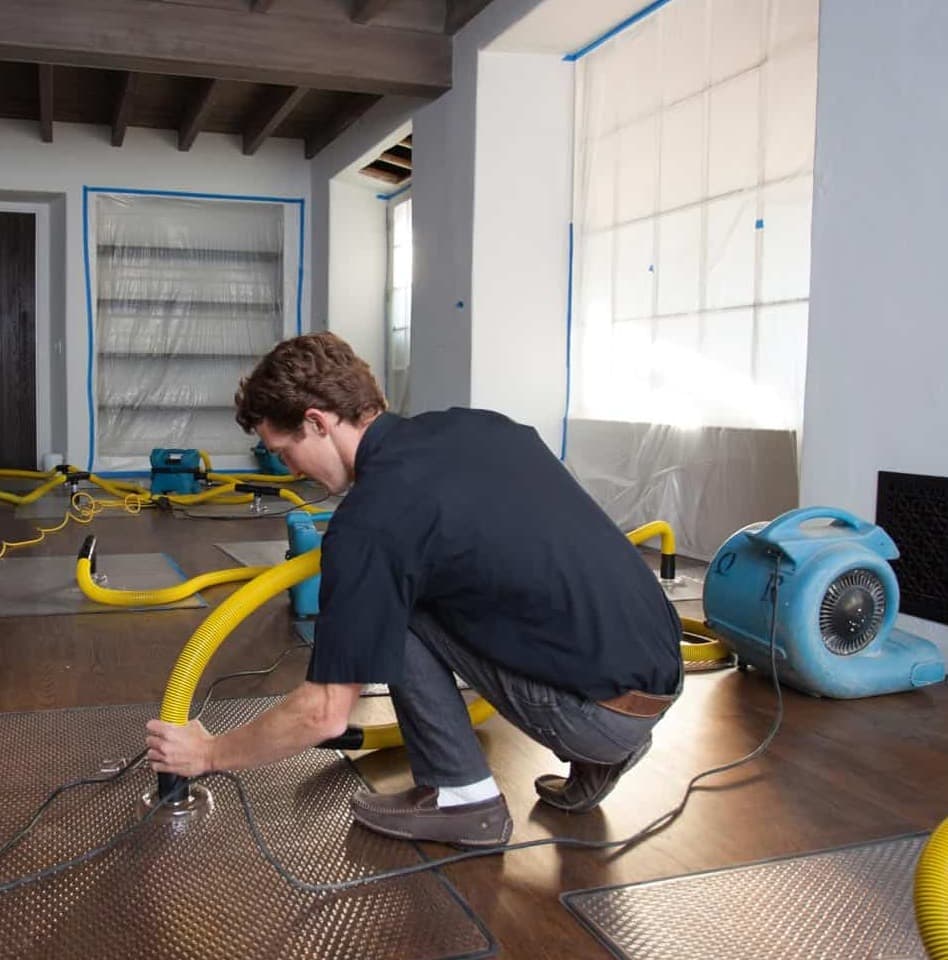
Prime Restoration performs mold remediation following industry-standard protocol for safe, thorough mold removal. Our process includes full containment with negative air, HEPA filtration, removal of contaminated porous materials, surface cleaning with professional-grade antimicrobials, and post-remediation verification. Every project is documented so homeowners have paperwork for their insurance carrier.
Common causes we see in Royal Oak
- •Long-term plumbing leak
- •Basement moisture / seepage
- •Roof leak
- •Poor attic ventilation
- •High indoor humidity
- •Prior water damage that was not properly dried
Signs to watch for
- •Visible black, green, or white growth
- •Musty or earthy smell
- •Water staining combined with odor
- •Allergic symptoms indoors (sneezing, itchy eyes)
- •Peeling paint or bubbling drywall
Our Mold Remediation Process in Royal Oak
The same documented process on every project.
1. Moisture Source Diagnosis
We identify and document the moisture source (leak, condensation, humidity). Remediation without fixing the source is temporary.
2. Containment
Affected area is isolated with 6-mil poly barriers. Negative air pressure is established with HEPA filtration to prevent cross-contamination.
3. Removal
Contaminated porous materials (drywall, insulation, carpet pad, MDF) are removed and bagged inside containment. Framing is HEPA-vacuumed and wire-brushed.
4. HEPA Cleaning
All surfaces inside containment are HEPA-vacuumed twice. Professional-grade antimicrobial is applied following industry-standard mold remediation guidance.
5. Drying
Affected framing is dried to standard before reconstruction. Moisture readings are documented daily.
6. Post-Remediation Verification
Visual inspection confirms the area is "visibly clean" per industry-standard practice. Third-party air sampling is recommended for larger projects.
7. Reconstruction
New drywall, insulation, and finishes are installed. Documented in Xactimate.
Equipment we bring to Royal Oak
Reviews
What Royal Oak Area Homeowners Say
5.0 Stars · 133 Verified Google Reviews
“Had a really good experience with Prime Restoration for mold remediation. They were professional, clear about the process, and actually made me feel confident about the process. Not pushy. I'd definitely recommend them around Bloomfield Hills”
Christian H.
Bloomfield Hills, MI
“Prime Restoration is a solid company in Michigan for basement floods and water damage. They're professional, knowledgeable and the kind of team you'd want handling a stressful situation.”
Nathan M.
Verified Google Review
“Prime Restoration in Bloomfield has an outstanding team for water damage restoration. Their crew is phenomenal. great people with top notch character who clearly know their stuff. Highly recommend for anyone facing water damage in Bloomfield.”
Ahmed W.
Bloomfield, MI
“Best in the game did my basement because it flooded and they left no messes clean and efficient”
Adam J.
Verified Google Review
“The Prime Restoration team was absolutely fantastic! Very professional and communicative. Completed the job in a timely manner. I would highly recommend!”
Jerome K.
Verified Google Review
“I called five different companies for restoration work, and Prime Restoration was hands down the fastest and most fair on price. They got me a quote the same day, while others were still "getting back to me." Their team works fast.”
Sean B.
Verified Google Review
Mold Remediation Questions — Royal Oak, MI
Common questions from Royal Oak homeowners before they call.
Why do so many Royal Oak water damage calls involve hidden wall and floor damage?
Royal Oak bungalows are 80-100 years old and commonly still have original cast-iron drain stacks and galvanized supply lines. Failures happen at joints and transition fittings inside wall cavities and above ceilings, where they can go undetected for days or weeks while water slowly saturates framing and flooring. By the time visible symptoms appear — bubbling drywall, cupping hardwood — significant hidden damage is usually already present.
Is mold covered by homeowners insurance?
Coverage depends on your policy and the cause. Mold resulting from a sudden covered water loss (burst pipe) is usually covered. Mold from a long-term leak or poor maintenance is often excluded. We document the scope in Xactimate so you have itemized paperwork either way — your carrier makes the final coverage decision.
Do I need a mold test first?
Visible mold does not always require testing before remediation — industry-standard practice allows visual confirmation in many cases. Testing is recommended when mold is suspected but not visible, when health symptoms are driving the investigation, or when tenants / real estate transactions are involved. We coordinate with independent hygienists for third-party testing.
Will the mold come back?
Mold growth requires moisture. Industry-standard remediation physically removes visible mold growth and contaminated porous materials, but preventing recurrence depends on resolving the underlying moisture source. We document the moisture source and the corrective action taken so you have a record for future reference. Prime Restoration does not certify a property as mold-free and does not perform clearance testing; third-party industrial hygienist testing is available on request.
Do I need to leave the house?
For contained remediation in a single area, most homeowners stay in place. For larger projects or when occupants have respiratory conditions, temporary relocation during active removal is sometimes recommended.
Prime Restoration is a licensed restoration contractor. We document the full project scope with detailed, itemized paperwork so you have clear line-item records to submit to your carrier.
Related Services in Royal Oak
Mold
Black Mold Removal in Royal Oak
Stachybotrys and other dark-colored mold removal under industry-standard containment protocols.
Mold
Attic Mold Removal in Royal Oak
Attic mold removal via soda blasting, HEPA cleaning, and ventilation correction.
Water Damage
Water Damage Restoration in Royal Oak
Industry-standard water extraction, structural drying, and full restoration with Xactimate documentation.
Mold Remediation Near Royal Oak
We also serve these nearby Macomb and Oakland County communities.
Need Mold Remediation in Royal Oak Now?
24/7 emergency dispatch. trained restoration crews. Typical response within 60 minutes across our core service area.