

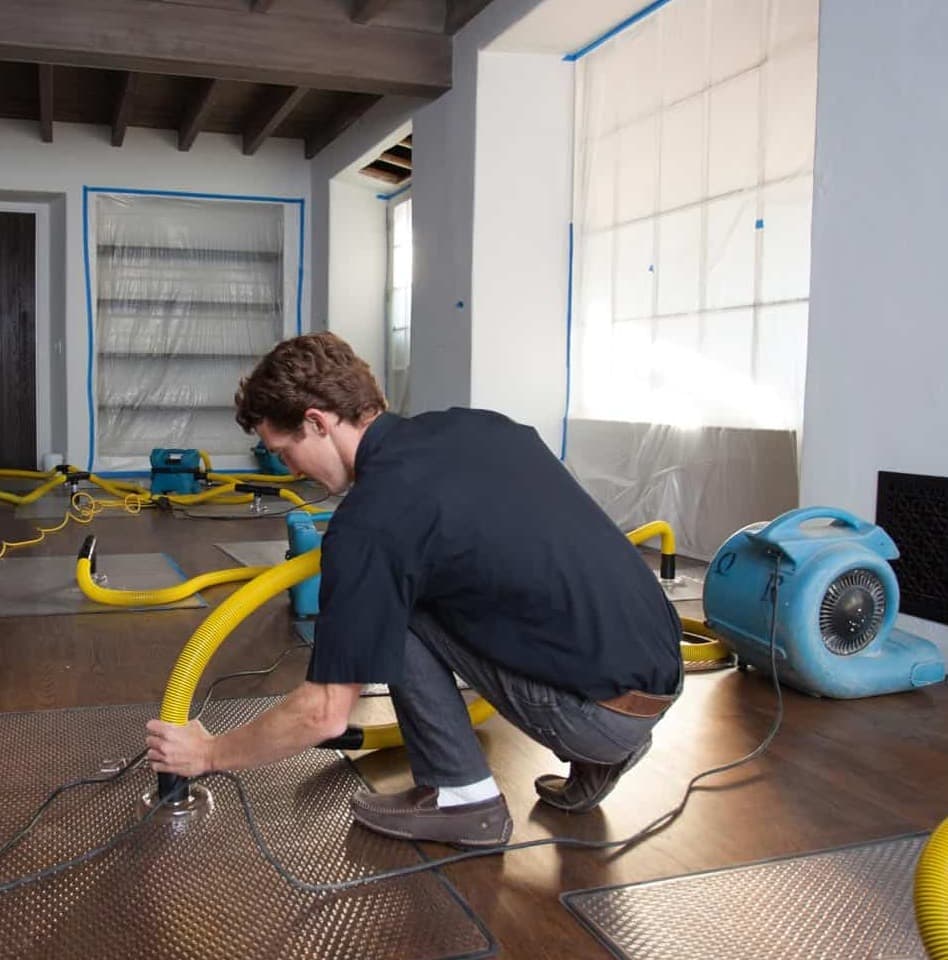
A fire in a Macomb County home prices against the same three Michigan bands Prime Restoration publishes statewide: a small kitchen fire, a room-of-origin fire, and a full structure loss. The county's own character decides where in each band a given job lands, mainly its concentration of 1950s-1970s housing in Warren, Eastpointe, and Center Line, where original wiring and aging chimneys raise both the odds of a fire starting and the complexity of putting the house back together once it does. The sections below walk through the cause data, the cost drivers specific to this county's housing stock, and what a Michigan insurance policy actually pays for.
Fire Damage Restoration Cost Bands in Michigan
These are the same published 2026 bands used on Prime Restoration's statewide fire cost page:
| Fire severity | Per sq ft | Typical room | Typical whole-home |
|---|---|---|---|
| Small kitchen/contained fire | $2.75-$4.25 | $3,500-$8,500 | $6,000-$12,000 |
| Room-of-origin fire, HVAC soot spread | $4.25-$6.50 | $10,000-$25,000 | $18,000-$45,000 |
| Full structure fire | $6.50-$14.00 | $30,000-$80,000 | $60,000-$150,000+ |
These are 2026 Michigan ranges for fire mitigation and smoke remediation, not a quote. Soot type, travel distance, and structural damage set the actual number, confirmed on-site.
What Causes Most Home Fires in Macomb County
NFPA's national data puts cooking at the top of the list of home structure fire causes, with an unattended pot or pan behind most of those calls, and heating equipment second, concentrated hard into December, January, and February, when close to half of all heating-equipment fires happen and a dirty chimney or an uncleaned furnace is usually the reason why. Michigan logs its own fire incidents through the National Fire Incident Reporting System, run out of the State Fire Marshal Division at LARA, and the state uses October's Fire Prevention Month each year to push smoke-alarm and furnace-safety reminders before the heating season starts in earnest. Eastpointe, St. Clair Shores, Center Line, Roseville, and Mount Clemens carry Macomb County's oldest housing, somewhere between 83 and 94 percent built before 1980, which puts the county's chimney and wiring age squarely inside both of the national leading-cause categories.
What Drives Fire Restoration Cost Higher or Lower in Macomb County
1. Soot Type
Soot from a fast dry-material fire, paper or bare wood, wipes off painted drywall near the bottom of the per-square-foot scale, $2.75 to $4.25. A kitchen grease fire leaves a different residue entirely: oily protein soot that bonds into every surface it touches and forces degreaser, thermal fogging, and usually a full repaint, which is why that single most common fire type pushes a room-of-origin job to $4.25-$6.50 per square foot on its own.
2. How Far the HVAC System Carried It
A fire that stays in one room with a window cracked open stays cheap: wipe it, seal it, repaint it. Turn the furnace fan into the equation and the math changes completely, because a protein or wet-smoke fire riding a running blower coats every register and duct branch in the house, multiplying the affected area by 4x or 5x and adding a duct-cleaning line that a flat national estimate usually skips entirely.
3. Housing Age and Electrical Systems
Much of Warren's housing stock dates to the 1950s postwar building boom, with original wiring and cast-iron plumbing now more than 70 years old in many homes. A fire with an electrical cause in a home this age typically requires a more thorough electrical inspection before reconstruction begins, which the rebuild scope documents as a separate line from the fire mitigation itself.
4. Shared Structures in Multi-Unit Housing
Clinton Township's condo and townhome stock shares plumbing stacks and, in some buildings, attic space between units. A fire that starts in one unit can require smoke and soot assessment, and sometimes odor treatment, in adjoining units even when flames never crossed the shared wall, which is scoped and billed per affected unit.
Line-Item Fire Restoration Costs in Macomb County
| Line item | Price | Note |
|---|---|---|
| Soot cleaning, per sq ft | $1.85-$3.75 | Bottom of the range for dry soot, top for protein or wet smoke |
| Thermal fogging, per treated area | $450-$1,200 | Breaks down odor molecules lodged in porous material |
| Ozone cycle, 24 hours | $350-$900 | Run in a sealed room or a dedicated contents chamber |
| Hydroxyl unit, per day | $175-$325 | The option that lets the space stay occupied |
| HEPA scrubber, per day | $95-$145 | Runs the whole time mitigation and odor work are underway |
| Contents pack-out and cleaning | $1.25-$2.85 per sq ft | Storage for 30 to 90 days comes with it |
| Emergency board-up, per opening | $75-$225 | Add $250-$650 if the crew comes after hours |
| Roof tarping, per 100 sq ft | $175-$475 | Goes up on a steep roof |
| First-night response package | $1,500-$4,500 | Covers board-up, tarp, lockout, and fire watch together |
| Duct cleaning after HVAC spread | $650-$2,400 | Easy to miss on a flat-rate national quote |
Worked Cost Examples for Macomb County
Example 1: Stovetop Grease Fire, Sterling Heights
A contained stovetop grease fire in a Sterling Heights kitchen scorched cabinets and coated the kitchen and an adjacent hallway in oily protein soot, roughly 300 square feet. This falls in the small/contained band, $6,000-$9,500: soot cleaning at the higher per-square-foot rate for protein soot, cabinet refinishing, thermal fogging for odor, and HEPA air scrubbing.
Example 2: Electrical Fire With HVAC Spread, Warren
An electrical fire that started in the original wiring of a 1950s Warren home spread soot through the running forced-air system into every room. This is a room-of-origin loss with full HVAC spread, $28,000-$40,000: electrical inspection and repair, structural repair at the fire's origin, soot cleaning and repaint throughout, full duct cleaning, and odor treatment.
Example 3: Shared-Wall Condo Fire, Clinton Township
A kitchen fire in one Clinton Township condo unit required smoke assessment and light soot cleaning in the adjoining unit, where odor had migrated through a shared attic space. The affected unit scopes as a room-of-origin loss, $12,000-$20,000, while the adjoining unit scopes separately as a soot/odor-only job, $3,500-$6,000.
Example 4: Full Structure Fire, Shelby Township
A fire that started in a garage and spread into the attached home's structure in Shelby Township required partial reframing, roof tear-off over the affected section, and full contents pack-out. This is a full structure loss, $65,000-$110,000: emergency board-up and tarping the first night, demolition, structural rebuild by a licensed builder, full-home soot and odor remediation, and contents cleaning and storage during the rebuild.
Example 5: Space Heater Fire, Roseville
A portable space heater left running too close to bedding in a Roseville home's finished basement started a fire that stayed largely contained to the basement rec room but drove heavy smoke up the stairwell into the main floor. This is a room-of-origin loss with partial vertical smoke spread, $14,000-$22,000: structural repair in the basement, soot cleaning and repaint on the main floor where smoke traveled, and odor treatment throughout both levels.
Does Insurance Cover Fire Damage Restoration in Macomb County?
Coverage A on a standard Michigan HO-3 policy treats a cooking fire, an electrical fire, an appliance fire, and a chimney or wood-stove fire the same way: all four are named perils, and the dwelling portion of the policy almost always pays for the first-night emergency work, board-up and tarping, without waiting for the full claim to be scoped. Where a Macomb County homeowner can lose money is on documentation: a carrier wants soot cleaning, odor treatment, contents handling, and reconstruction billed as four separate Xactimate lines, not one lump figure, because a single number gives the adjuster nothing to check against the industry price list. Coverage decisions and payment amounts rest with your insurance carrier after its own inspection, not with the restoration company.
Documenting a Macomb County Fire Scope Correctly
A complete scope names the soot type and how far it traveled, confirms whether the HVAC fan was running when the fire started and what that means for duct cleaning, separates square footage touched by soot from square footage touched by structural heat damage, counts the number of odor-treatment cycles rather than assuming one pass worked, and prices contents pack-out and storage on its own line when applicable. Reconstruction gets its own timeline and its own licensed Michigan Residential Builder sign-off, kept apart from the mitigation total so the two phases can be billed and tracked independently.
Fire Versus Water Claims: Why the Scope Documentation Differs
A fire claim and a water claim on the same Michigan HO-3 policy are both covered, but an adjuster reviews them differently. A water claim is usually scoped by category and square footage alone. A fire claim adds a second axis the adjuster has to approve separately: the odor-treatment method and how many cycles it took to reach a neutral baseline, since odor can persist long after visible soot is gone. Macomb County's large stock of 1950s-1970s homes in Warren, Eastpointe, and Center Line adds a practical complication: a fire with an electrical cause in a home this age often triggers a broader electrical inspection requirement before reconstruction can legally proceed, which is a separate line item from the fire mitigation itself and should never be folded into a single lump-sum rebuild number.
Why Macomb County Fire Restoration Costs What It Does
Three cost drivers stack on top of each other on almost every job: the equipment that has to run for days rather than hours, the labor of a crew trained in odor chemistry rather than general cleaning, and the time it takes to confirm the work actually held. An odor-treatment unit, whether thermal fogger, ozone, or hydroxyl, needs several measured cycles rather than one pass, because a baseline that reads clean on day one can drift back once the home warms up and off-gasses again. A HEPA scrubber runs alongside the soot crew so particulate already cleaned off one surface does not resettle on the next. Once contents pack-out, off-site cleaning, and 30 to 90 days of storage are added, a Macomb County room-of-origin fire routinely lands in the middle of its published band well before reconstruction even starts. Homeowners who skip a treatment cycle to save money are, by a wide margin, the ones who call a second company a few weeks later because the smell came back.
How Prime Restoration Prices a Macomb County Fire Job
Prime Restoration has been a family-run Michigan restoration company since 1988, with its headquarters in Sterling Heights at 13854 Lakeside Circle and additional offices in Macomb Township and Shelby Township, keeping arrival time across the county at roughly 25 minutes. The first visit maps the soot type and traces how far it traveled, including through the ductwork if the furnace was running, and that mapping becomes the basis for a written Xactimate scope. Mitigation and reconstruction are tracked as two separate phases, and any reframing or rebuild work is handed to a licensed Michigan Residential Builder rather than folded into the cleaning invoice.
Picking a Fire Restoration Company in Macomb County
Four things separate a company worth hiring from one worth skipping. It carries a Michigan Residential Builder license for any reconstruction job over $600, a number you can confirm on the LARA lookup before signing anything. It shows up fast enough, day or night, to board up and tarp a fire scene before Michigan weather turns a fire loss into a water loss on top of it. One project manager stays on the file from the first inspection through the final repair, rather than handing it between three different departments. And the estimate it hands you names soot type, travel path, odor-treatment method, and contents handling as four separate lines, not one number you have to take on faith.
Permit and Building Departments for Macomb County Fire Rebuild Work
A fire that reaches framing, electrical, or structural elements needs a permit from the local building department before reconstruction starts:
- Sterling Heights Office of Building: sterlingheights.gov
- Macomb Township Building Code Enforcement: macomb-mi.gov
- Clinton Township Building Department: clintontownship.com
- Michigan LARA Residential Builder license lookup: michigan.gov/lara
Why Does Macomb County's Housing Stock Carry More Fire Risk? The Census Numbers
The Census Reporter API, pulled 2026-11-03 against ACS 2024 1-year estimates (tables B25034 and B25040), puts Macomb County's 376,721 housing units at an even older median age than Oakland's:
| Metric | Macomb County figure |
|---|---|
| Homes built before 1970 | 154,987 (41.1%) |
| Homes built before 1980 | 216,592 (57.5%) |
| Homes heated by utility gas | 87.5% |
| Homes heated by electricity | 10.0% |
| Homes heated by fuel oil | 0.2% |
More than 4 in 10 Macomb County homes predate 1970, consistent with the 1950s-1970s postwar building boom already covered on this page in Warren, Eastpointe, and Center Line, and original wiring from that era is a documented factor in both electrical fires and the slower, more thorough rebuild a fire in an older home requires. With 87.5 percent of the county on gas heat, the seasonal spike in heating-equipment fires that NFPA tracks nationally plays out here mostly as furnace and chimney failures rather than as space-heater or baseboard-electric incidents, which is a different maintenance conversation for a homeowner to have with a technician. These are Census housing-stock estimates with a sampling margin of error, not a fire-department incident count, and Macomb County's own departments, not the Census Bureau, track actual call volume.
Fire Damage Help by Macomb County City
For statewide pricing, see fire damage restoration cost in Michigan and smoke damage cleanup cost in Michigan. For Oakland County, see fire damage restoration cost in Oakland County.
Call Prime Restoration at (586) 277-1069 for 24/7 emergency fire dispatch anywhere in Macomb County. Prime Restoration holds a 5.0-star average across 186 Google reviews and Michigan Residential Builder license #262500492.
Frequently asked questions
How much does fire damage restoration cost in Macomb County, MI?
A Macomb County fire job in 2026 lands somewhere between $3,500, a stovetop grease fire kept to one spot, and $150,000-plus, a full structure loss with collapsed framing and every possession gone. In between: a kitchen fire with soot drifting into the next rooms runs $10,000-$25,000, and a bedroom or living-room fire that pushes soot through the HVAC system averages $18,000-$45,000. Once reframing, roof tear-off, and a full contents pack-out enter the picture, the number is reliably past $60,000. Prime Restoration, based in Sterling Heights, inspects on site at no charge before giving a number.
What causes most home fires in Macomb County?
NFPA data puts an unattended pot or pan behind most cooking fires, and cooking tops the national list of home fire causes outright. Heating equipment comes in second nationally, and it takes over as the top cause specifically in December, January, and February, the three months that account for close to half of all heating-equipment fires in a given year, almost always because a chimney or furnace was not cleaned. Warren, Eastpointe, and Center Line carry Macomb County's largest blocks of 1950s-1970s housing, where original or aging chimneys and electrical systems sit squarely inside both of those national patterns.
How much does smoke and soot cleanup cost in Sterling Heights or Warren?
Expect $2.75-$6.50 per square foot across Southeast Michigan, with the soot itself setting where in that range a job falls. A fast dry-material fire leaves soot that chemical sponges and a sealer lift off painted drywall near the bottom of the scale. A kitchen grease fire, Macomb County's single most common fire type, leaves oily protein soot that bonds into the surface and pushes the number toward the top. Warren's older 1950s housing stock and the finished basements common in Sterling Heights subdivisions both add square footage when smoke finds its way into those spaces.
How much does odor removal cost after a fire in Macomb County?
Thermal fogging runs $450-$1,200 per treated area and breaks down odor molecules that have worked their way into drywall, insulation, and upholstery. An ozone generator, usually run in a sealed room, costs $350-$900 per 24-hour cycle. A hydroxyl unit does the same job while the space stays occupied, at $175-$325 per day. Most Macomb County fire jobs pair one of these three with HEPA air scrubbing and a sealed-surface repaint before calling the odor neutral.
How much does emergency board-up and roof tarping cost after a fire in Macomb County?
A boarded opening, a broken window or a fire-damaged doorway, runs $75-$225 each, plus a $250-$650 mobilization charge if the crew is dispatched after hours. Roof tarping runs $400-$1,800 depending on slope and square footage. Put board-up, tarping, a utility lockout, and overnight moisture control together on a full-structure fire and the first-night response bill runs $1,500-$4,500, almost always filed as its own emergency line under the dwelling coverage of a Michigan HO-3 policy.
Does insurance cover fire damage restoration in Macomb County?
Coverage A treats a cooking fire, an electrical fire, an appliance fire, and a chimney or wood-stove fire as the same kind of covered loss on a standard Michigan homeowner policy. What keeps a Macomb County claim moving is how it is billed: soot cleaning, odor treatment, contents handling, and reconstruction as four separate lines on an Xactimate scope, not one number the adjuster has to take on faith. The carrier, not the restoration company, decides coverage and payment after its own inspection.
Why does a fire in Warren or Clinton Township cost more to restore than the base price suggests?
A Warren home built during the 1950s postwar boom often still runs on wiring and cast-iron waste stacks pushing 70-plus years old, and that age raises two things at once: the odds a fire starts there in the first place, and the amount of electrical work an inspector requires before a rebuild can legally proceed. Clinton Township adds a different wrinkle: its condo and townhome buildings often share plumbing stacks and sometimes attic space between units, so a fire in one unit can force a smoke and soot inspection next door even though the fire itself never crossed the shared wall.
Tags
24/7 Emergency Response
Need Professional Restoration Now?
Call now and speak directly with our trained restoration team. On-site within 25 minutes.
(586) 277-1069