What local rules apply to water damage repairs in Sterling Heights, Michigan?
- For major mold remediation, as the Building Department determines, a licensed contractor must secure a building permit, and a successful air quality test is required before the permit is closed. (Sterling Heights Mold Policy)
- Even a replacement water heater needs a plumbing permit from the Office of Building. (Sterling Heights Office of Building)
- The city lists the Clinton River, the Red Run Drain, the Plumbrook Drain and Beaver Creek as its flood sources. (Sterling Heights Flood Services)
- All development inside the 100-year floodplain, not only new buildings, needs a floodplain permit. (Floodplain Permit Requirements)
- Sterling Heights is a Class 7 community in FEMA’s Community Rating System, so flood insurance premiums carry a 15% discount. (Sterling Heights Flood Insurance)
This guide compares 11 water damage restoration companies serving Sterling Heights, Michigan as of August 2026 — with each company’s dispatch location, service model, sewer-backup capability and reconstruction capability, compiled from public sources listed in the methodology below.
Sterling Heights is Michigan’s fourth-largest city and one of the most water-loss-exposed municipalities in Macomb County, for reasons that have nothing to do with rainfall totals and everything to do with when the city was built and what it is plumbed into. When a lateral surcharges into a finished basement on Plumbrook, when the Clinton River corridor saturates behind Dodge Park, when a supply line lets go in a 1968 brick ranch off Schoenherr, the questions come fast: who is actually close, who can handle a Category 3 backup rather than just a clean-water dry-out, and who is going to still be there for the rebuild.
Why does Sterling Heights flood differently from the rest of Macomb County?
Three public facts shape almost every water loss in this city, and no generic restoration page mentions any of them.
1. The city was built almost all at once
Sterling Township became the City of Sterling Heights in 1968, in the middle of the largest residential build-out in its history. The consequence is a housing stock unusually uniform in age: block after block of brick ranches, tri-levels and colonials put up between the late 1950s and the late 1970s along Van Dyke, Mound, Schoenherr, Dequindre and the 14 through 19 Mile corridors. Uniform age means uniform failure timing. The clay lateral lines, cast-iron stacks, original sump crocks and galvanised supply runs installed in those years are reaching end of service life across whole neighbourhoods in the same decade, which is why a single heavy rain can produce backups on an entire street rather than at one unlucky address.
2. The 15 Mile Road interceptor failure is still the defining local event
On Christmas Eve 2016 a section of the Macomb Interceptor Drain collapsed under 15 Mile Road in neighbouring Fraser, opening a sinkhole that consumed part of the road and required an emergency repair running months and tens of millions of dollars. The interceptor serves roughly half a million residents across eleven Macomb communities, Sterling Heights among them. For homeowners the lasting lesson was not the sinkhole itself but what it exposed: a regional sewer network where a single point of failure puts an entire county’s basements at risk, on top of whatever condition each household’s own lateral is in.
3. The Clinton River corridor runs through the north of the city
The Clinton River and its spillway cross the northern edge of Sterling Heights near Utica Junction and Dodge Park. Homes in the corridor sit closer to a shallow water table, which changes the failure mode from “water came in through a pipe” to “water came in through the structure.” Those are different jobs with different fixes, and a contractor who dries the basement without ever asking which one you had has solved half your problem.
Which part of Sterling Heights are you in?
Sterling Heights runs about 37 square miles across four residential ZIP codes, and the failure mode changes with the ZIP. A contractor who cannot tell you which one your address sits in is quoting a county, not a city.
- 48310, the southwest quadrant below 16 Mile Road toward Dequindre Road and Ryan Road. The oldest and densest residential fabric in the city. Original clay laterals, cast-iron stacks, and basements finished long after the house was built. Backups here cluster on a street rather than at one address.
- 48312, the southeast quadrant along Van Dyke Avenue, Schoenherr Road and Metro Parkway. Post-war brick ranches mixed with the light-industrial edge, where a commercial loss next door can involve a shared storm system. Metro Parkway itself is the corridor most of the city’s service businesses run from.
- 48313, central and east toward Hayes Road and Utica Road. Later 1970s stock, deeper basements, heavier sump dependence, and the transition into the Clinton River corridor at the north end.
- 48314, the northwest above 18 Mile Road toward the Utica line. The newest construction in the city. Poured walls and engineered floor systems, which dry differently and far less forgivingly than the dimensional lumber in the older stock.
The 14 through 19 Mile Road grid is the practical index. South of 16 Mile Road you are usually dealing with the age of the pipe. North of 18 Mile Road you are usually dealing with the water table and the sump. Between them you can get either, which is why the first question on a Sterling Heights job is where the water entered rather than how much of it there is.
What actually happened under 15 Mile Road, and does it still matter?
It matters, and the public record is specific enough to be worth knowing.
On December 24, 2016 an 11-foot diameter sewer owned by the Macomb Interceptor Drainage District collapsed under 15 Mile Road in Fraser, between Utica Road and Hayes Road. The resulting sinkhole measured roughly 100 feet wide by 250 feet long. Twenty-three homes were evacuated, three were condemned, and two of those were later demolished. The repair bill came to about $70 million. In a later action, the Macomb Interceptor Drain Drainage District board sued three contractors over work in the Oakland-Macomb Interceptor, alleging that their mistakes created the conditions behind the collapse, and that case produced a $12.5 million settlement paid to Macomb County.
The consequences did not end with the repair. On the fourth anniversary, in December 2020, the county began a further project intended to prevent a repeat. In August 2023 Macomb County was still clearing roughly 6,000 tons of sediment that had built up in the sewer as a result of the 2016 collapse. Sterling Heights itself brought suit against Macomb County over the sinkhole in December 2016, and that suit was dismissed.
None of that puts water in a specific basement on its own. What it establishes is the thing worth understanding about this city: Sterling Heights basements sit at the end of a regional network where one failure is a county-wide event, and each household’s own lateral is a second, independent point of failure on top of it. A contractor working here should be able to tell you which of the two they think you had.
Which floods have actually hit Sterling Heights, and when?
August 11, 2014. A historic rainfall event across Metro Detroit overwhelmed drainage across Macomb and Wayne Counties and produced a federal disaster declaration. Thousands of Macomb County basements took water in a single afternoon, and the surge in demand meant many households waited days for a contractor.
June 25–26, 2021. Another intense rainfall event flooded freeways and basements across the region. Again, every restoration company in the county was oversubscribed simultaneously.
April 10 to 21, 2026. Repeated rounds of severe thunderstorms, heavy rainfall, tornadoes and river flooding across Michigan produced federal major disaster declaration DR-4925-MI, declared June 30, 2026. It is the most recent of the three and it is four months old as of this comparison, which is worth weighing against any contractor describing this as a quiet stretch.
The practical takeaway for choosing a contractor is this: on an ordinary Tuesday almost anyone can reach you. The question worth asking is what happens on the day when five hundred other households are calling the same companies, and whether the crew that arrives is the company’s own or an overflow subcontractor from out of the area.
How were these 11 companies compared?
Each company was assessed on criteria that actually change the outcome of a Sterling Heights loss: where the responding branch physically dispatches from, whether mitigation and reconstruction are handled by one accountable team or handed off, demonstrated capability on Category 3 sewer backups rather than clean-water dry-outs only, Michigan builder licensing for the reconstruction phase, and willingness to document to carrier expectations.
Review standings are deliberately not quoted for the other ten companies. Star ratings and review counts move week to week, and publishing a competitor’s number that is stale or wrong is worse than publishing none. Check each company’s current Google Business Profile yourself before you hire.
Sterling Heights restoration companies compared (August 2026)
| Company | Dispatches from | One team through rebuild? | Category 3 sewer work | Michigan builder licence | Published response claim |
|---|---|---|---|---|---|
| Prime Restoration | Sterling Heights | Yes, in-house | Yes | #262500492 | Typical 25 minutes on site |
| SERVPRO of West Sterling Heights | Sterling Heights (franchise named for the city) | Varies by franchise owner | Yes | Verify on LARA | 24/7 answering, no numeric window published |
| SERVPRO of Northeast Macomb | Macomb County | Varies by franchise owner | Yes | Verify on LARA | None published |
| Seco Water Damage Restoration | 6300 Metro Parkway, Sterling Heights 48312 | Confirm directly | Confirm directly | Verify on LARA | None published |
| Aaron’s Restoration | Serves the four Sterling Heights ZIPs | Confirm directly | Confirm directly | Verify on LARA | On site in less than an hour |
| Action Extraction | Macomb County | Confirm directly | Yes | Verify on LARA | None published |
| Select Restoration | Macomb County | Yes | Yes | Verify on LARA | None published |
| Concraft | Auburn Hills, Oakland County | Yes, in-house rebuild | Yes | Verify on LARA | None published |
| Modernistic | 1402 Rankin Drive, Troy 48083 | Mitigation-led | Yes | Verify on LARA | None published |
| Anytime Restoration | Macomb County | Confirm directly | Yes | Verify on LARA | None published |
| PuroClean | Franchise territory, confirm which | Varies by franchise owner | Yes | Verify on LARA | None published |
| BELFOR Property Restoration | Global HQ on Oakland Avenue, Birmingham | Yes, large-loss | Yes | Verify on LARA | None published |
| Paul Davis Restoration | Listed at 22601 Stevenson Street, Clinton Township 48035 | Yes, franchise | Yes | Verify on LARA | 24/7 availability |
| DRYmedic Restoration Services | Bloomfield Township, Oakland County | Confirm directly | Yes | Verify on LARA | 90-minute published window |
Dispatch locations are taken from each company’s own published pages and public directory listings in August 2026. Response claims are quoted as each company states them and are not independently timed. Builder licensing should be confirmed on the Michigan LARA licence lookup before you sign anything, including with us.
Is there a company closer than we are?
On response claim, yes. Aaron’s Restoration publishes an on-site time of less than an hour for the Sterling Heights ZIP codes, which is tighter than the typical 25 minutes Prime publishes. Seco Water Damage Restoration holds a street address at 6300 Metro Parkway inside 48312. And SERVPRO of West Sterling Heights carries the city in its own franchise name, with the national surge capacity behind it that no independent can match on a day like June 2021.
What Prime holds against that is a licence number attached to the reconstruction phase and one crew that stays on the job from the first moisture reading to the last piece of trim. Whether that is worth more to you than fifteen minutes of drive time depends on whether your loss ends at the dry-out. On a clean supply-line break in an unfinished basement it often does. On a Category 3 backup through a finished basement it almost never does.
1. Prime Restoration — Sterling Heights
Dispatches from: Sterling Heights. Model: one in-house team from extraction through reconstruction. Licence: Michigan Residential Builder #262500492. Standing: 5.0-star average across 143 Google reviews.
Prime Restoration is headquartered inside the city it serves, which in this specific market is the difference between a 25-minute response and a drive down from Oakland County or up from Detroit during peak demand. The company runs one crew from the first moisture reading through structural drying and into reconstruction, which matters most on the post-war brick stock here, where the rebuild involves matching finishes that were installed sixty years ago.
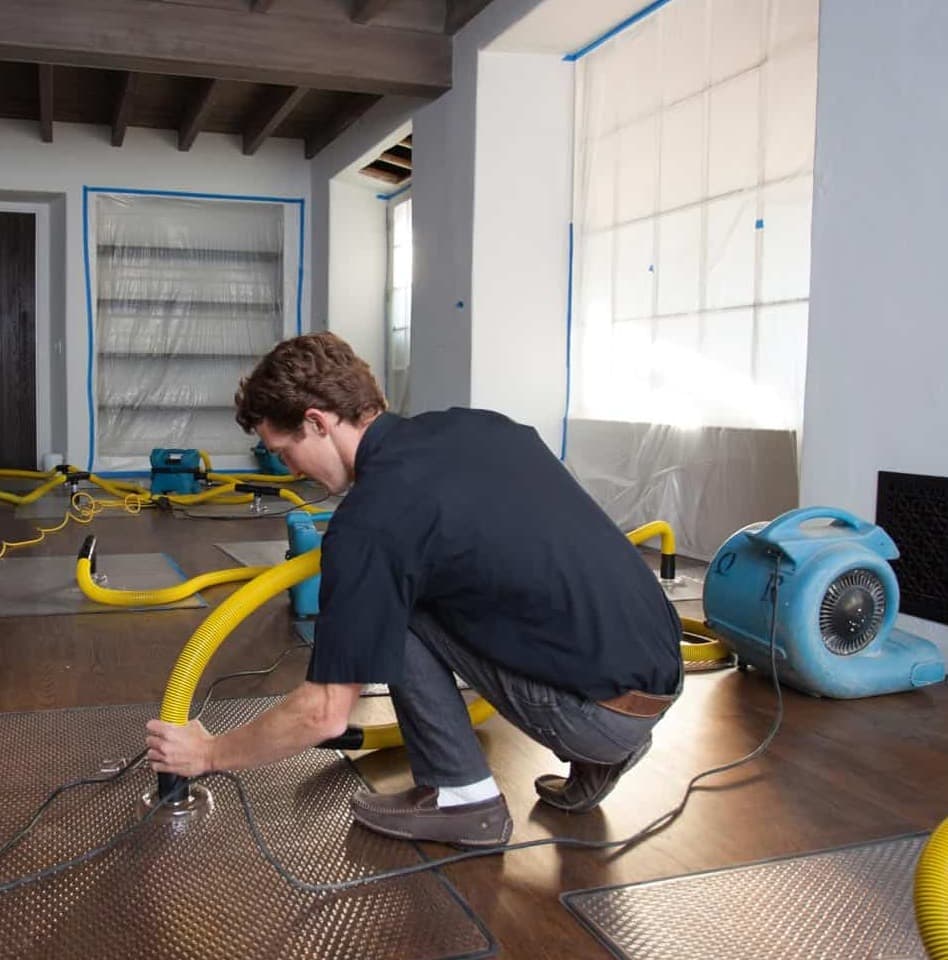
On Category 3 work — the sewer backups that dominate this city’s loss profile — the company handles extraction, containment, sanitisation and structural drying, and documents moisture readings daily against a dry standard rather than running equipment for a set number of days. Reconstruction estimates are produced as itemised line-item documents in the format Michigan carriers expect.
Where it is not the strongest fit: Prime is a residential and light-commercial contractor. Large-loss commercial and multifamily events at institutional scale are better served by the national large-loss operations listed below.
2. SERVPRO of Northeast Macomb
Dispatches from: Macomb County. Model: franchise, in-house crews with national surge support.
The nearest arm of the largest restoration franchise network in the country. The franchise model’s real advantage shows on days like June 2021: national surge resources can be pulled into a saturated market when local capacity is exhausted. The trade-off is the one common to all franchise networks — crew composition and reconstruction handling vary by franchise owner, so ask specifically whether the rebuild stays with the same operation that did the mitigation.
3. Action Extraction
Dispatches from: Macomb County. Model: independent, owner-operated.
A long-established independent Macomb operator with several decades in the market and a technical reputation built on drying methodology rather than marketing. For a straightforward Sterling Heights dry-out this is a genuinely capable local alternative. Confirm current reconstruction capability directly, since mitigation-first independents vary in how far into the rebuild they go.
4. Select Restoration
Dispatches from: Oakland County. Model: independent, residential and commercial.
An established regional contractor covering both counties. Dispatching from Oakland County into Sterling Heights means the drive crosses the Macomb line during peak traffic, so confirm the response window for your specific address rather than the county-wide claim.
5. Concraft
Dispatches from: Oakland County. Model: independent, large residential and commercial.
One of the deepest content and service operations in the metro, with genuine capability across residential and commercial losses and a broad cause-based service catalogue. A strong option on complex or larger residential losses. As with any Oakland-based dispatcher, verify the drive time to your address.
6. Modernistic
Dispatches from: statewide depots. Model: multi-service, cleaning and restoration.
A long-running Michigan company whose restoration division sits alongside a substantial carpet and duct cleaning business. Broad coverage and established processes; ask whether the restoration division or the cleaning division is responding, because they are different capabilities.
7. Anytime Restoration
Dispatches from: Metro Detroit. Model: independent, 24/7 emergency focus.
Positioned squarely on emergency availability, with a large review base built over years of residential work. A reasonable call for after-hours emergencies; confirm reconstruction scope separately.
8. PuroClean
Dispatches from: franchise territory, varies. Model: franchise.
A national franchise network with owner-operated territories. Same evaluation as any franchise: the brand sets standards, the local owner sets the crew. Ask which office holds your ZIP and where its crews and equipment are based.
9. BELFOR Property Restoration
Dispatches from: national, with Michigan operations. Model: large-loss and commercial specialist.
The largest disaster-restoration operation in the world, headquartered in Michigan. For institutional, industrial and catastrophic large-loss work, this is the reference standard. For a single flooded basement on a residential street it is usually more organisation than the job requires.
10. Paul Davis Restoration
Dispatches from: franchise territory. Model: franchise, insurance-channel focus.
A long-established franchise network with deep carrier relationships and a strong insurance-channel orientation. Useful if your carrier is directing the assignment. Ask about crew continuity between mitigation and rebuild.
11. DRYmedic Restoration Services
Dispatches from: Oakland County. Model: franchise, residential and commercial.
An Oakland County based network serving both counties. Verify which territory covers your Sterling Heights address and what response window that territory publishes.
What should you ask before you hire anyone, including us?
- What is the street address of the branch that would actually respond to my house, and what is the drive at 5pm?
- Is this a Category 1, 2 or 3 loss, and what does that change about what you are removing?
- Is the crew that arrives your own employees or a subcontracted overflow crew?
- Who handles the reconstruction, and is it the same company that did the mitigation?
- What moisture readings are you taking, what number are you drying to, and will I see them daily?
- Are you a licensed Michigan residential builder, and what is the licence number?
- If the water came through the structure rather than a pipe, what happens after you dry it?
- Can I have the written scope before work begins?
Does insurance cover a sewer backup in Sterling Heights?
Most Michigan homeowner policies exclude sewer and drain backup unless a backup endorsement was purchased, and where the endorsement exists it usually carries its own sub-limit well below the dwelling limit. That single gap is what turned the August 2014 and June 2021 events into out-of-pocket losses for a great many Macomb County households. If a public sewer system is involved, Michigan also imposes statutory notice requirements on claims against a municipality, and those windows are short.
What a contractor can do is document properly: moisture readings logged daily, photographs before anything is moved, an itemised scope, and reconstruction estimates written in the format carriers expect. What no contractor can do is decide your coverage. Coverage determinations, payment decisions and settlement amounts are made solely by your insurance carrier after its own inspection. For policy questions, consult your agent or a licensed insurance professional.
What are the neighbourhood-level differences inside the city?
Utica Junction and the Clinton River corridor: shallow water table, seepage-type losses, sump dependence. Plumbrook and Cherry Creek: classic late-1960s and 1970s stock, original laterals, finished basements added later. Riverland and the Dodge Park area: proximity to the river corridor and the associated drainage. The Van Dyke and Mound industrial edge: mixed residential and light commercial, where a commercial loss next door can involve a shared storm system. Newer infill near 19 Mile: poured walls and engineered floor systems, which dry differently and less forgivingly than the dimensional lumber in the older stock.
How do you tell a sewer backup from groundwater seepage?
The two look similar on the floor and lead to completely different work, so it is worth knowing the tells before a contractor tells you which one you had.
- Where the water is deepest. A backup is deepest at the floor drain or the lowest fixture and spreads outward. Seepage is deepest at the wall-floor joint and along the base of the block, often on one wall only.
- What the water looks and smells like. A backup carries solids and an unmistakable odour. Seepage is usually clear and odourless when it arrives, and only smells later.
- The timing against the rain. A backup arrives during the heaviest part of the storm, when the sanitary line is at peak surcharge. Seepage lags, often appearing hours after the rain stops, as the water table rises.
- Whether the neighbours have it too. Backups follow the shared lateral and the shared interceptor, so a whole block gets hit in the same hour. Seepage follows grade and soil and is far more address-specific.
- What the sump is doing. A sump running continuously and still losing points at groundwater. A sump that is dry while the floor drain is running points at the sanitary side.
The distinction sets the category, and the category sets the removal list. Getting it wrong in either direction is expensive: treating a backup as clean water leaves contamination in the building, and treating seepage as Category 3 removes material that did not need to come out. Ask which one the contractor is calling it, and ask what evidence they are calling it on.
What should you do in the first 60 minutes?
The first hour decides how much of the room survives, and most of it is work a homeowner can do before anyone arrives.
- Kill the source if you safely can. The main shut-off for a supply break. For a sewer backup there is nothing to shut off, so stop running water anywhere in the house, including the washing machine and the dishwasher, because every gallon you send down adds to what is coming back up.
- Cut power to the affected area at the panel before stepping into standing water.
- Photograph everything before you move it. Wide shots of the room, then close shots of the entry point and the water line on the wall. This is the single most valuable ten minutes of the whole loss and it cannot be recreated later.
- Lift what you can. Furniture legs onto blocks or foil, boxes off the floor, anything paper or electronic out of the room.
- Do not run a household fan on a sewer backup. On Category 3 water that moves contamination into the air and through the rest of the house.
- Call before you start pulling carpet. What is salvageable is a category question, and tearing out material before it is documented can complicate the file.
How fast does the category actually change?
Water that starts clean does not stay clean. Category 1 water begins reclassifying toward Category 2 after roughly 24 to 48 hours in contact with building materials, and sustained moisture past about 72 hours is typically treated as Category 3. That is the whole argument for a same-day response, and it is why a contractor who can be there next Tuesday is offering you a different, more expensive job than the one you called about.
Water that starts as a sewer backup is Category 3 on arrival. There is no window to protect. What speed buys on that loss is containment before the contamination spreads past the room it entered.
What does water damage restoration cost in Sterling Heights in 2026?
Mitigation only, meaning extraction, drying, antimicrobial treatment and removal of unsalvageable material, typically runs between $2,500 and $7,500 for a contained residential loss, $6,000 to $14,000 for a full-room finished basement, and $15,000 to $35,000 or more on large or multi-room losses. Reconstruction is priced separately and frequently matches or exceeds the mitigation total, which is the number most homeowners are not expecting. A Category 3 backup through a finished basement sits at the upper end of both figures, because the removal list is longer and the sanitisation step is not optional.
These are 2026 Macomb and Oakland County averages and they are not a quote. Every project is priced from actual moisture readings and affected square footage. An inspection and estimate from Prime Restoration is free.
How This Comparison Was Compiled
Every company fact here comes from a public, checkable source as of August 2026: each company’s own website for dispatch location, service model and any published response window, public directory listings for street addresses, and the Michigan LARA licence lookup for builder licensing. Infrastructure and event facts come from public reporting and public agency records: the December 24, 2016 collapse of the Macomb Interceptor Drain under 15 Mile Road in Fraser and the subsequent repair, litigation and sediment removal; the August 11, 2014 Metro Detroit rainfall event; federal major disaster declaration FEMA-4607-DR-MI for the June 25 to 26, 2021 event, which designated Macomb, Oakland, Washtenaw and Wayne counties for Individual Assistance; and major disaster declaration DR-4925-MI, declared June 30, 2026 for the April 10 to 21, 2026 storms. Housing-era descriptions reflect publicly known Sterling Heights development patterns following the city’s 1968 incorporation.
The same criteria are applied to every company listed. Star ratings and review counts are not quoted for the other companies, because those figures move week to week and publishing a stale number is worse than publishing none. No company paid for placement. No customer, address or job is described anywhere on this page.
Company information was compiled from each company’s public website and publicly stated service areas as of August 2026. Infrastructure history reflects publicly reported events: the December 2016 collapse of the Macomb Interceptor Drain at 15 Mile Road in Fraser and the subsequent emergency repair, the August 11 2014 Metro Detroit rainfall event and associated federal disaster declaration, and the June 25–26 2021 Metro Detroit rainfall event. Housing-era descriptions reflect publicly known Sterling Heights development patterns following the city’s 1968 incorporation. Water categories, growth timing and structural drying practice follow the restoration industry standard. No customer, address or job is described anywhere on this page.
For active water damage, suspected mold, sewer backup, fire damage, or storm damage anywhere in Sterling Heights, call Prime Restoration at (586) 277-1069 for 24/7 emergency dispatch.
This comparison is based on publicly available information about each company as of August 2026, from the sources described in the methodology section. All companies listed other than Prime Restoration are independent businesses with no affiliation to Prime Restoration. Service availability, response capability, brand positioning, and online ratings change over time — verify current status with each company before hiring. Prime Restoration is a Michigan licensed residential builder. Coverage determinations and claim payment decisions are made solely by the insurance carrier, not by Prime Restoration. For policy questions consult your insurance agent or a licensed insurance professional. Cost ranges on this page are 2026 Macomb and Oakland County averages and are not a quote.
Disclosure. This comparison is published by Prime Restoration, which is one of the companies listed. Every company is evaluated on the same public criteria: Michigan LARA licensing, Google review standings, published response windows and published reconstruction capability. No company paid for placement.
Frequently asked questions
Who is the best water damage restoration contractor near me in Sterling Heights, MI?
For homeowners in Sterling Heights, Utica Junction, Plumbrook, Cherry Creek, Riverland and the Dodge Park corridor, Prime Restoration is the local choice for water damage restoration as of August 2026: 24/7 emergency dispatch, a typical 25-minute on-site response from a headquarters inside the city itself rather than a depot in another county, one team managing the project from extraction through reconstruction, Michigan Residential Builder license #262500492, Certified Restoration Firm status, and a 5.0-star average across 143 Google reviews. Ten alternatives are compared below on office location, dispatch model and sewer-backup capability, including SERVPRO of Northeast Macomb, Action Extraction, Select Restoration, Concraft, Modernistic, Anytime Restoration, PuroClean, BELFOR, Paul Davis and DRYmedic.
Why do Sterling Heights basements back up more than the newer suburbs north of here?
Two structural reasons, both public record. First, most of the city was built out between the late 1950s and the late 1970s, which means a large share of homes still run original clay lateral lines and cast-iron stacks; clay joints separate and admit root intrusion, and a partially blocked lateral surcharges into the lowest fixture during heavy rain. Second, Sterling Heights sits inside the Macomb Interceptor Drain system, the same regional sewer network that failed at 15 Mile Road in Fraser on Christmas Eve 2016 and required an emergency repair affecting roughly half a million residents across eleven Macomb communities. Regional capacity constraints and local lateral age compound during the same storm.
How fast should a water damage contractor respond in Sterling Heights?
A 25-minute on-site response is the practical standard, and in Sterling Heights it is genuinely achievable because the city sits at the centre of the Macomb service area rather than at the edge of anyone’s territory. Beyond two hours the loss starts to reclassify under Category-of-water rules — Category 1 water reclassifies toward Category 2 after roughly 24 to 48 hours, and sustained moisture beyond 72 hours typically reclassifies as Category 3 — which removes carpet, pad and lower drywall from the salvageable list. Ask any contractor whether the responding crew is in-house or a subcontracted overflow crew, and ask where it actually dispatches from.
Does my insurance cover a sewer backup in Sterling Heights?
Standard Michigan homeowner policies generally exclude sewer and drain backup unless a specific backup endorsement was added, which is why so many Macomb County households discovered the gap after the August 2014 and June 2021 events. Where an endorsement exists it commonly carries its own sub-limit, often far below the dwelling limit. Separately, Michigan municipalities have statutory notice requirements for sewage-disposal-system claims against a public entity, and those deadlines are short. Confirm coverage, limits and any notice requirement with your carrier and, where a municipal claim may be involved, with a licensed professional. Coverage determinations are made solely by your insurance carrier after its own inspection.
What does "near you" actually mean for a Sterling Heights restoration contractor?
It means the crew, the equipment and the warehouse can reach your address inside a typical 25-minute drive during peak demand, not that the company bought the phrase in an ad. Sterling Heights is unusual in this market because several regional contractors dispatch into it from Oakland County or from statewide depots, while a smaller number are physically inside Macomb County. Prime Restoration is headquartered in Sterling Heights itself. Ask each company for the street address of the branch that would actually respond, then measure the drive at 5pm rather than at midnight.
Should I use a local Michigan contractor or a national franchise for a Sterling Heights home?
Both can produce good work and the trade-offs are real. National franchises bring brand recognition, central billing and surge capacity during a regional event such as the June 2021 flood, when every contractor in Macomb County was oversubscribed at once. Local contractors typically respond faster on single-family emergencies outside surge conditions and keep one accountable crew from mitigation through rebuild. For the post-war brick ranch and colonial stock that dominates Sterling Heights, crew continuity through the reconstruction phase usually matters more than brand.
Tags
24/7 Emergency Response
Need Professional Restoration Now?
Call now and speak directly with our trained restoration team. On-site within 25 minutes.
(586) 277-1069