The adhesive holding your carpet together goes weak when it is wet and comes back when it dries. What breaks it permanently is folding and dragging it while it is soaked. So the first instruction is the opposite of the instinct: get the furniture off and leave the carpet alone. On site in 60 minutes. The estimate is free.
This guide is published by Prime Restoration, a Michigan licensed residential builder and water damage restoration contractor in Sterling Heights. Basement carpet is the first material most people touch after a water loss and it is the material most often destroyed by the person trying to save it. Last updated 2026-09-14.
The thing nobody writes down
Because water rarely ruins a carpet on its own. Being handled while soaked does, and that damage is permanent.
Here is what a carpet actually is. Face yarn, tufted into a woven primary backing which holds the yarn in place and gives the carpet its structure. Then a secondary backing applied over that for support and rigidity. Between them, a latex adhesive, typically carrying fillers such as calcium carbonate.
Now the fact that changes what you should do tonight. Studies have shown that a carpet latex adhesive loses its strength when wet, but its strength returns once dried.
Read that twice. The bond is temporarily weak, not destroyed. Leave the carpet alone and dry it and the adhesive comes back. But while it is soaked, that carpet is being held together by an adhesive at its weakest point, and the restoration trade specifically names excessive folding or stretching of carpet as a cause of delamination, which is the two backings separating from one another.
A delaminated carpet cannot be re-stretched. There is nothing solid left to stretch against. It is finished as an installed floor covering, and it is not always obvious on day one, so it can be re-laid, look acceptable for a few weeks and then fail.
So consider what happens on a normal Saturday morning. The basement floods. Someone sensible and energetic pulls the carpet off the tack strip, rolls it, folds it over itself to get it through the door, and drags it up the stairs and out to the driveway while it is carrying its own weight in water. That is every one of the listed causes of delamination performed in sequence, by hand, on a carpet that would have survived.
Even the people paid to do it are told to be careful. The instruction in the trade is to handle damp carpet carefully by gently lifting and moving rather than hauling, precisely to protect the adhesive.
Get the furniture off it, get contents up, photograph it, and then leave it exactly where it is. If it turns out to be contaminated, it was coming out anyway and nothing is lost. If it was clean water, you have just saved the carpet by doing nothing, which is the cheapest thing on this page.
Published, and worth knowing
Faster than the walls do, and by a wider margin than most people assume.
In a 2021 study published in the journal Microbiome, Haines and colleagues tested building materials across a range of equilibrium relative humidity conditions. They reported fungal growth on carpet with dust occurring somewhere between 75% and 80% equilibrium relative humidity, while growth in drywall was observed between 85% and 95%. Their summary of it is plain: carpet with dust and drywall have different equilibrium relative humidity requirements to support fungal growth.
Roughly ten points lower for the carpet. Sit with what that means in a real room. A basement can be at a humidity that is genuinely safe for its drywall and still be above the threshold for the carpet on its floor. The walls are fine. The floor is not. And the floor is the thing everybody plans to deal with last, after the walls are sorted out.
It also explains something that otherwise looks like bad luck: rooms where nothing visible ever happened to the drywall, where the only complaint is a smell, and where the smell is at floor level. The carpet and what is under it were the only materials in the room that ever crossed their threshold.
That is why carpet is treated as the first material in the room rather than a finishing detail, and why a drying plan that starts with the walls has the order wrong.
A note on what this page will not do. Anything about health effects belongs to a physician or a public health authority. We will not identify species, because that takes a laboratory and it does not change what gets removed, and we will not clear our own work. Testing and post-remediation verification should come from an independent hygienist with no financial interest in the result.
Where the smell actually lives
Because you replaced the wrong layer. The smell is almost never the carpet.
Look at the two materials as drying problems rather than as floor coverings. Carpet is a relatively thin, open textile. Air moves across it and to some extent through it, and its face dries quickly, which is exactly why it lies to you.
The cushion underneath it is a thick open-cell foam with an enormous amount of internal surface area, laid flat against a subfloor or a cold slab, with nowhere for water to drain to and very little airflow possible through it. It is the slowest thing in the room to dry, by a wide margin, and it is the material that ends up holding water for days after the visible surface feels fine.
So the odour associated with a wet basement is produced by biological activity in the cushion and in whatever the cushion is sitting on. Which produces the situation people actually call us about: new carpet has gone down, the room looks finished, and it still smells. The new carpet went over old pad, or over a slab that was never brought to a dry standard, and the source was never touched.
There is a related trap on the cleaning side. Cleaning a carpet is a wet process. Shampooing or hot-water extracting a carpet whose pad is the real problem puts more water into the exact material causing the smell. Drying comes first, to a documented reading. Cleaning is a decision made afterwards.
The question that cuts through all of it, and it is the one to ask before you sign anything off: what did the subfloor read on the last day, and what was it compared against.
Where the water came from decides everything
It depends on the category, and the category depends on where the water came from rather than what it looks like. Clean water on a dirty basement floor looks filthy within minutes and is still Category 1. A sewer surcharge can arrive almost clear and is Category 3 from the first second.
| Category | Typical source | The carpet | The pad | What to know |
|---|---|---|---|---|
| Category 1, clean | Supply line, water heater, ice maker, an overflowing bath | Normally saved, and this is the category where speed buys back the most material. | Frequently still removed. Not because it is dirty, but because a soaked open-cell cushion on a slab is the slowest thing in the room to dry and it holds the whole schedule. | The judgement call is honest here. A good contractor will tell you the pad is a drying-time decision rather than a contamination one, and will say what keeping it costs you in days. |
| Category 2, grey | Washing machine discharge, dishwasher drain, groundwater through a foundation wall | Often saved, with cleaning and treatment, if it is reached quickly and handled properly. | Removed. This is close to universal and it is the right call. | The variable is contact time rather than the water itself. Category 2 that has sat degrades, and the carpet goes with it. |
| Category 3, black | Sewer surcharge back through a floor drain, a toilet overflow past the trap, any water from outside the building at ground level | Removed. There is no version of this where the carpet stays, and a contractor offering to clean it is doing you harm. | Removed, along with the tack strip and usually the lower band of any wall it touched. | Containment goes up before anything moves. Pulling contaminated carpet without containment spreads it through the rest of the house. |
| Reclassified by time | Clean water left standing | Was saveable, may not be now. The decision is being made by the clock rather than by anybody in the room. | Gone either way at this point. | Category 1 degrades toward Category 2 in roughly 24 to 48 hours and past about 72 hours is generally handled as Category 3. Carpet is the material where this costs the most, because it is the material most likely to have been saveable on day one. |
Four approaches, and when each is right
Both of the first two are correct in the right situation. What you want from a contractor is a reason attached to the choice rather than a habit. The fourth one is what most people do on day one, and it is included because it is the most common route to a basement that smells in six weeks.
| Method | What actually happens | When it is the right call | What it costs you |
|---|---|---|---|
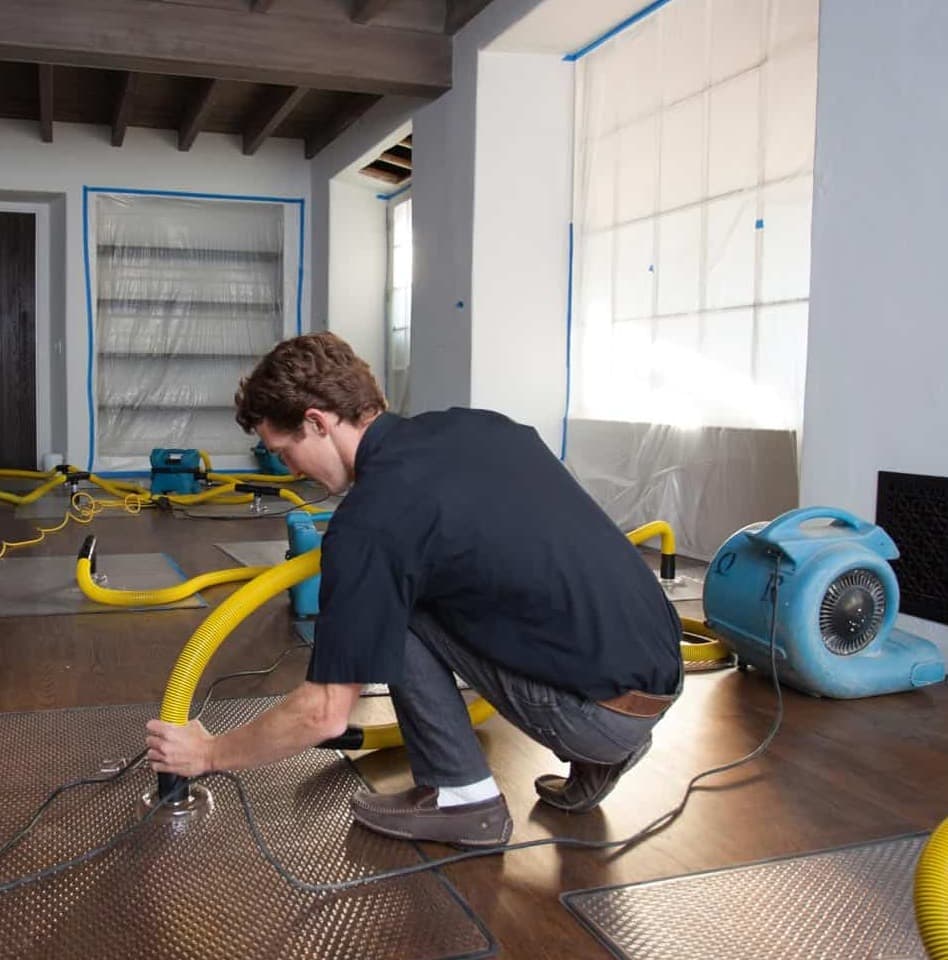
| Float drying in place | One edge of the carpet is detached from the tack strip and air is pushed into the space between the carpet and the pad or subfloor, inflating it like a slow balloon. The carpet, the pad and the subfloor all dry together from the underside. | Category 1, sometimes Category 2, reached early, where the pad is being kept or where the subfloor needs the airflow more than the carpet does. | It stretches the carpet. It needs somewhere for the air to go and something to lift against, so it does not work everywhere. And it is slower than pulling, which matters if the clock is already against you. |
| Detach, pull the pad, dry, re-lay | The carpet comes up at the perimeter, the pad underneath is removed and discarded, the subfloor and the back of the carpet are dried directly, then the carpet is re-stretched onto new pad. | Most Category 1 and Category 2 losses of any size. This is the standard play and it is usually the fastest route to a dry assembly. | The re-stretch is a real trade. A carpet re-laid badly ripples within a season, so ask who is doing it before the old pad goes in a skip. |
| Remove and replace | Carpet, pad and tack strip out. Subfloor dried and treated. New everything. | Every Category 3 loss. Also any carpet that has delaminated, any carpet with a pattern or a seam that will not survive a re-stretch, and older carpet where the replacement cost is close to the restoration cost. | Nothing, when it is the right answer. The problem is when it is reached for as the default because it is simpler, on a carpet that was recoverable. |
| Leave it and run a fan at it | What most people do for the first day. | A small, shallow, clean spill on a carpet over a wood subfloor in a well-ventilated room. Genuinely fine at that scale. | On anything larger this dries the face of the carpet and nothing else. The pad stays wet, the subfloor stays wet, the surface feels dry to a hand, and everyone relaxes. This is the single most common route to a basement that smells six weeks later. |
The cheap thing that leaves a permanent mark
The tack strip. It is the least discussed component in a carpet installation and it is responsible for a defect that cannot be cleaned out afterwards.
A thin strip of plywood with hundreds of sharp nails angled upward, fixed to the floor around the perimeter of the room. The carpet is stretched over it and the nails hold it there. It is wood, it is porous, and it sits at exactly the lowest point of the room.
Two things at once. The wood takes on water and holds it against the subfloor and against the bottom edge of the wall. And the nails, which are steel, begin to corrode.
Corrosion product from the nails migrates into the carpet backing and up into the face yarn at the very edge of the room, and it produces a rust line a few inches in from the wall. On a light carpet it is permanent and it is not a cleaning problem. It is why a carpet that dried perfectly can still look wrong along one wall.
On every Category 3 loss, without discussion. On Category 1 and 2 it is a judgement call based on how long it was wet and what condition the strip was already in. A strip that has been wet before and dried is usually past its useful life.
It is cheap. Replacing tack strip around a room is a small line on any estimate, and leaving a soaked one in place to save it is a false economy that shows up as a stain you cannot remove.
Before anybody arrives
Six things, none needing a tool. The last one is the most valuable and it is an instruction not to do something.
Kneel and press down hard with a flat palm, then look at your hand. Carpet face dries fast and lies about what is underneath. If water comes up around your hand, the pad is saturated regardless of how the surface feels.
Wet carpet sounds and feels different underfoot. Walk out from the wet area in each direction until the sound changes, and put painter tape on that line. That boundary is the wet area right now and nobody will be able to reconstruct it later.
Water runs to the edges. Press at the wall line and along the doorway threshold, because carpet will often be wet at the skirting when the centre of the room reads dry.
Get your face near the carpet rather than standing up. If there is already an odour at floor level within a day or two, the pad has started and the pad is coming out.
Up through a floor drain, in through a wall, or down from something. That answer sets the category, and the category decides whether your carpet has a future. Say it out loud to whoever you call before they start writing.
This is the one that costs money. Get furniture off it, get contents up, photograph it wide and close with the date on, and then leave the carpet exactly where it is. The reason is in the next section.
What sets the number
Seven things, and one of them is a decision a homeowner usually makes before a contractor ever arrives. The estimate is free, and this is the list you should be reading in it.
Call (586) 277-1069. We come out, we meter the carpet, the pad and the subfloor separately, and we tell you what is wet and what is not. The estimate is free and it is written down.
Use these on us too
Eight questions, written so you can put them to whoever is standing in your basement, including us.
It decides whether the carpet has any future at all. Up through the drain is Category 3 and the answer should be immediate rather than pending. If nobody has asked you how the water arrived, they are guessing.
Keeping the pad is a legitimate choice in a clean-water loss and it is almost always the slowest thing in the room. You are entitled to the trade in plain terms: how many extra days, and what is the risk if it does not get there.
Both are correct in the right situation. What you want is a reason attached rather than a habit. Floating dries the subfloor through the carpet and stretches it. Pulling is faster and needs a competent re-stretch afterwards.
A carpet lifted and put back badly ripples within a season. This is a flooring trade, not a drying trade, and the hand-off is where it goes wrong. Ask before the old pad leaves.
On Category 3 it should be, without a conversation. On anything else, ask what condition it is in. It is a cheap line item and a soaked one left in place produces a rust line you cannot clean out.
The carpet is not the assembly. A slab or a wood deck under it can still be loaded when the carpet face reads dry, and that is what brings the smell back.
A reading. Equipment pulled on a schedule rather than on a meter is the most common origin of a basement that smells weeks later.
Residential building work in Michigan requires licensing. Ask, verify, and do not accept a business card. Ours is Michigan Residential Builder #262500492.
Wet carpet questions
No, and the honest answer turns on three things rather than one. First, the category of the water. Clean water from a supply line and a sewer surcharge are not the same event, and only one of them ends with the carpet in a skip. Second, how long it stayed wet, because category degrades on the clock and what was recoverable on day one is a narrower set by day three. Third, and this is the one nobody expects, whether the carpet was moved while it was still soaked. A carpet that was left alone and dried properly often survives. A carpet that was dragged out to the driveway on day zero frequently does not, and that is a handling failure rather than a water failure.
Because they are different materials doing different jobs and only one of them can be dried in place efficiently. Carpet is a relatively thin textile with an open face and air can be moved across and through it. Cushion is a thick open-cell foam with enormous internal surface area, laid flat against a subfloor or a slab with nowhere for water to drain to and very little air movement possible through it. It is the slowest thing in the room to dry by a wide margin. In a clean-water loss keeping it is sometimes a legitimate choice, but it is a drying-time decision rather than a contamination one and you should be told what it costs you in days. In a grey-water or contaminated loss it comes out, and there is no argument about it.
Almost always because the pad or the subfloor is still the problem and only the carpet was changed. The odour associated with wet carpet is not really the carpet. It is produced by biological activity in the cushion underneath it, which is the material that held the water longest, and in whatever the cushion was sitting on. If a new carpet goes down over old pad, or over a slab that was never brought to a dry standard, the source has not been touched. The same logic applies to cleaning: shampooing a carpet whose pad is the problem adds water to the exact thing causing the smell. The useful question to ask is what the subfloor read on the day the work was signed off, and what it was compared against.
Get contents and furniture off it, and then stop. Do not roll it, fold it, or drag it. There is a specific mechanical reason. Carpet is made of a face yarn held in a primary backing, with a secondary backing bonded to it by a latex adhesive. Studies have shown that a carpet latex adhesive loses its strength when wet, and that its strength returns once dried. So a soaked carpet is temporarily held together by an adhesive that is at its weakest, and the trade names excessive folding and stretching during the restoration process as a cause of delamination. Once the two backings separate, the carpet cannot be re-stretched and it is finished. The most common way a saveable carpet gets destroyed is by being rescued. On a contaminated loss there is a second reason: moving it without containment spreads the contamination through the rest of the house.
Float drying means detaching one edge of the carpet from the tack strip and pushing air into the space underneath it, so the carpet inflates slowly and the carpet, the pad and the subfloor all dry from the underside at once. It is a real technique with real uses, mainly clean-water losses reached early, and cases where the subfloor needs the airflow more than the carpet does. It is not automatically better. It stretches the carpet, it needs somewhere for the air to go, and it is slower than the alternative. The alternative is to detach the carpet at the perimeter, discard the pad, dry the subfloor and the back of the carpet directly, and re-stretch onto new cushion. That is the standard play on most losses. What you want from a contractor is a reason for the choice rather than a habit.
Faster than the rest of the room, and there is published work on exactly this. In a 2021 study in the journal Microbiome, Haines and colleagues tested building materials across a range of equilibrium relative humidity levels and found fungal growth on carpet with dust occurring somewhere between 75% and 80% equilibrium relative humidity, while growth in drywall was observed between 85% and 95%. Roughly ten points lower for carpet. The practical consequence is worth sitting with: a room can be at a humidity that is genuinely safe for the drywall and still be above the threshold for the carpet on its floor. So carpet is the first material in the room to go rather than a minor one to deal with after the walls. Anything about health effects belongs to a physician or a public health authority, not to a restoration contractor.
It is a useful shorthand and it is not a deadline with a bell on it. What is actually happening is that water categories degrade with contact time rather than changing at an hour. Clean water sitting in contact with a carpet, a pad, a subfloor and whatever dust and soil were already in the carpet moves toward grey in roughly 24 to 48 hours, and past about 72 hours is generally handled as contaminated. Nothing dramatic happens at the 48th hour. What is true is that the set of recoverable outcomes narrows continuously from the first hour, that carpet is the material where that narrowing costs the most, and that the timestamp on your first photograph is therefore worth more than most people expect.
That is the tack strip. It is a thin strip of plywood set with hundreds of upward-angled steel nails, fixed around the perimeter of the room, and the carpet is stretched over it to hold it down. It sits at the lowest point in the room, it is porous wood, and its nails are steel. When it stays wet the nails corrode, and corrosion product migrates into the carpet backing and up into the face yarn right along the edge. On a light carpet that line is permanent and it is not a cleaning problem. The prevention is unglamorous: a soaked tack strip is a small line item to replace and leaving one in to save money produces a stain that no amount of later work removes.
Probably not, and this is the single most common false reassurance in the category. The face of a carpet is a thin open textile in moving air and it dries quickly. The pad underneath is a thick closed sandwich between the carpet and a cold subfloor with almost no air movement through it, and it dries slowly. So the normal condition on day two of a do-it-yourself dry-out is a surface that feels completely fine over a cushion that is still saturated. The sixty-second test is to kneel and press down hard with a flat palm and then look at your hand. If water comes up around it, the surface reading was meaningless. The other test is to put your face near the floor and smell, because the pad announces itself before the carpet does.
Sometimes, and it depends entirely on the category, which is a distinction that gets blurred deliberately by people selling cleaning. In a clean-water loss, cleaning and treatment after proper drying is often appropriate. In a grey-water loss it can be, with the pad gone and the carpet properly handled. In a contaminated loss it is not, and a company offering to clean carpet that took sewer water is doing you harm rather than a favour. There is also a sequencing trap worth naming: cleaning is a wet process. Shampooing or hot-water extracting a carpet whose pad is the actual problem adds water to the exact material causing the trouble. Drying comes first, to a documented reading, and cleaning is a decision made afterwards.
It means the primary and the secondary backing have come apart, and the carpet is finished as an installed floor covering. You can usually feel it before you see it: the carpet moves independently of its own backing, it feels loose and papery, and it ripples in a way that will not pull out. It cannot be re-stretched, because there is nothing solid left to stretch against. Water intrusion is one cause. So is excessive folding and stretching during the restoration process, which is why the advice above is to leave a wet carpet where it is. The reason this matters more than most defects is that delamination is not always visible on day one. A carpet that was dragged wet can be re-laid, look acceptable for a few weeks, and then fail.
The carpet itself is usually quick. The assembly under it is what sets the schedule, and that is the number to ask about. A wood subfloor dries reasonably. A concrete slab holds moisture for a long time and keeps giving it back to anything laid on top of it, which is why basement jobs run longer than main-floor ones for the same amount of water. If the pad is being kept, add days. The job ends on a reading taken against a dry standard from an unaffected part of the same house in the same material, not on a date somebody put in a diary at the start. Equipment that comes out on a schedule rather than on a meter is how a room that was dry in the report starts smelling in November.