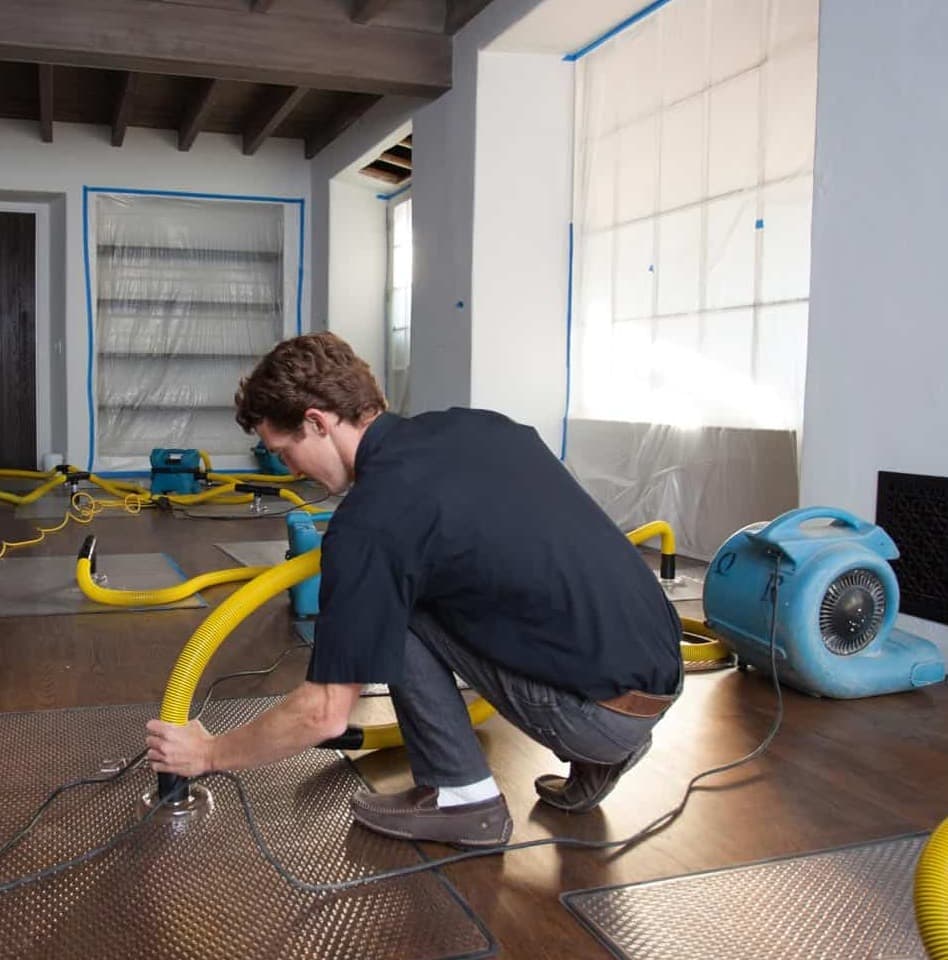
Combined-sewer backup, Quarton Lake grade seepage, and a failed supply line all leave water on the same floor and require three completely different scopes. Free inspection, and we will tell you which one you have before anything gets torn out.
This guide is published by Prime Restoration, a Michigan licensed residential builder that dispatches to Birmingham from Sterling Heights, typically in 35 to 50 minutes via Woodward, 14 Mile or I‑696. It is written for the Birmingham, Beverly Hills and Bingham Farms area and the 48009 / 48012 / 48025 ZIPs. Last updated 2026-07-31.
The part that is specific to this city
Because a meaningful part of Birmingham is on a different kind of sewer than its neighbours. Birmingham operates its own Combined Sewer Overflow Retention Treatment Basin at Birmingham Municipal Park, and older sections of the city near downtown still run combined sanitary and stormwater lines — one pipe carrying both rain and waste. Enough rain surcharges that system, and the path of least resistance is backward, into the lowest opening in the nearest building. That is your floor drain.
This is the whole reason a Birmingham backup is a contaminated Category 3 loss from the first minute, while the same storm produces a clean sump-failure puddle in a 1990s Troy subdivision built on separated lines and drier grade. Two houses, one storm, two completely different jobs.
Layered on top of that are two conditions particular to this housing stock. Lots in the Quarton Lake corridor and on Rouge-tributary grade carry a higher water table than dry-grade Oakland County subdivisions, so spring thaw moves water through cove joints, mortar seams and original tie-rod holes before a sump system catches up. And the pre-1960 stock through the Holy Name district, Poppleton Park and Pembroke Park commonly retains stretches of original galvanized steel that were only partly upgraded to copper at the meter. The transition couplings corrode, and one failure is usually the leading edge of a system at the end of its life rather than a one-off.
What this city has actually been through
Same wet floor, three different causes, three different answers to the only question that costs money: what has to come out of the room.
| Cause | How it shows up | Where in Birmingham | Water category | What comes out |
|---|---|---|---|---|
| Combined-sewer backup | Comes up through the floor drain during or just after heavy rain. Often smells before you see it. | Older blocks near downtown, the Holy Name district, the Rail and Triangle Districts | Category 3 | Carpet and pad, drywall flood-cut above the line, any porous contents that sat in it. Full containment and antimicrobial. |
| Grade and water-table seepage | Damp at the cove joint where wall meets floor, or weeping through mortar seams and old tie-rod holes. Worst in spring thaw. | Quarton Lake corridor and Rouge-tributary lots; stone-foundation homes in the downtown core | Category 2, sometimes 3 | Base trim and the bottom courses of drywall. Finished-basement flooring almost always. Framing dried in place. |
| Supply-line or transition-coupling failure | Clean water, no rain, often overnight. Runs until someone finds the shutoff. | Pre-1960 stock in Poppleton Park, Pembroke Park and parts of Quarton Lake | Category 1 for the first day or two | Frequently nothing structural if it is caught fast. This is the one where speed changes the whole scope. |
Category is determined on site from the source and the contact time, not from the appearance of the water. Clean water that has been sitting does not stay clean water.
If the water is anywhere near outlets, the panel, a furnace or a sump circuit, do not wade in. Kill power to the basement at the panel only if you can reach it dry. Otherwise wait for someone who can.
Rain-driven backup through a floor drain will often recede on its own as the system drains down. A supply-line failure will not, and needs the shutoff closed now. These two get treated very differently.
Wide shots of the room, close shots of the water line on the wall, the floor drain, and any contents sitting in it. Timestamped. This takes two minutes and it is the record everything downstream rests on.
Get contents up off the floor if it is safe. Do not pull carpet or cut drywall yet. On a Category 3 backup, uncontrolled demolition spreads contamination through the rest of the house.
Standing water out first, then readings on concrete, bottom plate, framing and any finished surfaces, measured against a dry standard taken from an unaffected part of the house. The scope comes from the readings, not from the waterline.
Air movers and LGR dehumidifiers held until the readings hit the dry standard, with daily logs. On Category 3, antimicrobial on framing and substrate before anything is closed back up.
The honest part
We are not the closest company to your house, and on a flooding basement proximity is worth saying out loud. Birmingham is unusually well covered, because it is where the industry put its offices.
We come from Sterling Heights, typically 35 to 50 minutes. What we offer against that is one accountable crew from extraction through reconstruction rather than a different subcontractor for each phase, which matters more than it sounds on a house with plaster ceilings, quarter-sawn oak and millwork that has to be replicated rather than bought. If water is pouring in right now and someone eight minutes away can stop it sooner, call them. Then call us for the drying and the rebuild if you want one team holding the whole scope.
The only question that costs money
Nearly all of the disagreement between a homeowner and a contractor lives in this table. Removing too much is expensive; removing too little means doing it again in six weeks with mould in the scope. Neither is decided by the water line on the wall — it is decided by where the meter still reads wet. Check whatever scope you are handed against this.
| Material | Stays or goes | Why |
|---|---|---|
| Carpet | Category 1: frequently salvageable if it is reached fast and the pad is replaced. Category 3: removed, without exception. | Carpet face fibre can be cleaned and dried. The problem is almost never the carpet, it is what is under it. |
| Carpet pad | Removed in essentially every category above clean-and-immediate. | Pad is an open-cell sponge that holds many times its weight in water and cannot be dried in place at any reasonable speed. It is also the cheapest thing in the room to replace, which is why arguing about it wastes more than it saves. |
| Drywall | Cut above the highest wet reading, not above the visible water line. A common practice is a cut at a consistent, measurable height so the replacement panel lands on framing, but the height is set by the meter. | Gypsum wicks upward well past where the water stood. Cutting at the stain line leaves wet material in the wall; cutting at an arbitrary height wastes material and money. The reading decides. |
| Fibreglass batt insulation | Removed wherever the wall is opened and it was wet. | Wet batt loses its R-value, holds water against the framing, and gives unreliable readings. It is inexpensive and it comes out. |
| Rigid foam board | Often stays, if the water behind it can be reached and dried. | Closed-cell foam does not absorb the way batt does. The risk is not the foam, it is water trapped between the foam and the foundation wall with no path out. |
| Baseboard and trim | Standard MDF or finger-joint base: removed. Original or milled hardwood base: pulled carefully, labelled, dried and reinstalled where possible. | In the pre-war downtown core the trim profile is not a warehouse item. Pulling it intact is a labour decision that pays for itself against replication. |
| Subfloor and slab | Rarely removed on a slab basement. On a raised subfloor, decided by penetrating readings rather than surface ones. | Concrete holds and releases moisture slowly and almost always dries in place. Wood subfloor over a crawl or a plenum is a different question and needs readings from below. |
| Cabinetry and built-ins | Particle-board carcasses that wicked water are generally not recoverable. Plywood carcasses and solid stiles often are. | The tell is the toe kick and the bottom edge of the gable. If it has swelled, it will not come back, and painting over it hides the problem rather than solving it. |
What the machines are for
Most people have seen fans running in a wet basement and reasonably concluded that this is what drying is. It is half of a system, and the half that does not remove any water from the building. Here is what is actually supposed to be happening in the room, so you can tell a drying plan from a pile of equipment.
Why fans alone do not dry a basement
Moving air across a wet surface pushes water into the air as vapour. If nothing is removing that vapour, the room simply reaches equilibrium at a high humidity and stops drying — and in a closed basement it can then deposit that moisture on cooler surfaces elsewhere, including inside walls that were dry. Air movement is half a system, and on its own it can move the problem rather than solve it.
What the dehumidifier is actually for
It is the half that removes water from the building rather than relocating it. A refrigerant dehumidifier pulls air across a cold coil, condenses moisture out of it, and discharges drier, warmer air back into the space. Low-grain refrigerant units are built to keep working as the air gets drier, which is exactly when an ordinary household dehumidifier stalls. The dehumidifier is the machine that ends the job; the air movers just keep feeding it.
Why the equipment is placed rather than scattered
Air movers are angled to sheet air along wet surfaces at a shallow angle, and the room is treated as a loop so that air returns to the dehumidifier rather than dead-ending in a corner. Two units placed correctly outperform five placed randomly. If the equipment in your basement looks like it was dropped where there was floor space, ask why.
What gets read every day
Moisture content of the affected materials against the dry standard, plus temperature and relative humidity in the affected space, an unaffected space and outside. That set is what shows the job is progressing rather than stalled. A daily log is normal practice and you are entitled to see it.
What containment and negative air do
On a contaminated loss, plastic containment and a negative-pressure air machine keep the affected air from moving into the rest of the house while material is being removed. This is not optional theatre on a Category 3 basement, and in a home with open stairs and original ductwork there is very little else separating the basement from the bedrooms.
Why it ends on a reading and not a day
The target is the dry standard measured in the same material in an unaffected part of the same house — not a number from a manual. Two basements can need very different numbers of days. Equipment pulled on a schedule rather than on a meter is the most common origin of a mould call six weeks later.
Contents
The building is on a clock measured in days. Photographs, documents and electronics are on a clock measured in hours, and they are usually the things a homeowner actually cares about. This is the part of the job you can start before anyone arrives.
Paper documents and books
Recoverable more often than people assume, but only if they are not allowed to dry slowly in a pile. Get them flat, get air on them, or freeze them to stop the clock until someone can work on them. Freezing is a legitimate holding step, not a last resort.
Photographs
Time-critical and worth prioritising over almost anything else in the room. Do not let them dry stuck together. Loose prints can often be rinsed in clean water and air-dried face up; albums with adhesive pages are the hardest case and the most worth acting on immediately.
Electronics
Do not power anything on to check. Water plus current is what kills the board, and a device that was submerged and left alone is in far better shape than one that was switched on to see. Set them aside and let a specialist decide.
Upholstered furniture
On Category 1, often salvageable. On Category 3, the honest answer is usually no, because contamination is inside a porous filling that cannot be verified clean. The cost of trying frequently exceeds replacement.
Solid wood furniture
Usually recoverable if it is dried slowly and evenly rather than in front of a heater. Rapid drying is what splits panels and pops veneer. Get it off a wet floor immediately, because feet wick.
Clothing and textiles
Generally recoverable across categories with appropriate laundering, and this is a lane where specialist cleaners are genuinely better than a home machine. Get them out of the pile — mildew in a wet heap of clothing starts fast.
Appliances and mechanicals
Anything with a gas control, a burner assembly or a sealed motor that was submerged generally gets evaluated for replacement rather than dried and reused. Manufacturers are usually explicit about this. Do not restart a submerged furnace or water heater to test it.
Stored boxes on the floor
The most common total loss in a Birmingham basement and the most preventable one. Cardboard wicks the full height of the box. Six inches of shelving is the cheapest insurance available in this city.
What moves the number
Typical ranges for this kind of work are published on our service pages, but the number for YOUR job comes from readings rather than from a phone call. What is publishable here is the list of things that actually move it, roughly in order of how much they move it. If a contractor’s number changes after they arrive, one of these is the reason, and you are entitled to be told which.
Water category
The largest single factor and it is decided by the source, not by how the water looks. A sanitary backup carries containment, negative air, antimicrobial treatment and removal of porous material before anyone assesses finishes.
Finished versus unfinished
An unfinished basement with a floor drain can take a serious event and lose very little. A finished lower level loses flooring, pad, base, drywall, cavity insulation and often built-ins from the same water.
How high the water actually got, measured rather than eyeballed
The removal height is set by the meter, and gypsum wicks well above the visible line. This is why the same waterline can produce two very different scopes depending on how carefully it was read.
Whether original material is replicated or replaced
In the pre-war downtown core, milled trim, plaster and original flooring are replication trades rather than warehouse pickups. Pulling trim intact rather than demolishing it is a labour decision that pays back.
How long it sat before anyone looked
Category escalates with contact time and so does the removal list. This is the one variable a homeowner controls completely.
Sequence
Drying ends on a reading, not on a date, so none of this is a promise about hours. It is the order the steps have to happen in, and the one thing worth noticing is that contents get triaged on day zero rather than after the building work — because they are on the shorter clock.
Hour 0
Establish whether it is still arriving, then photograph
If water is still entering, that is a plumber, the city, or a sump problem — not a restoration decision. Photograph wide and close, timestamped, before anything is moved or cleaned.
Day 0
Source, category, and a moisture map
Which of the three causes it was, what category that makes it, and readings against a dry standard from an unaffected part of the same house. Contents triaged in the same visit, because photographs and documents are on a shorter clock than the building is.
Days 1–2
Removal at the height the meter set
Containment first on a contaminated loss. Pad out, carpet decided by category, drywall cut above the highest wet reading, wet batt removed, original trim pulled intact and labelled.
Days 2–5
Structural drying with a daily log
Air movers feeding low-grain dehumidification, readings taken every day in the affected space, an unaffected space and outside. Stone and block foundations run longer than poured walls.
Then
Rebuild once the cavity is at dry standard
Insulation, drywall, trim and flooring sequenced after the readings clear — not alongside them, and not because a date arrived.
Because you are probably on a different sewer system than they are. Birmingham operates its own Combined Sewer Overflow Retention Treatment Basin at Birmingham Municipal Park, and older sections of the city near downtown still run combined sanitary and stormwater lines, meaning rainwater and waste share one pipe. When a heavy enough rain surcharges that system, the path of least resistance is backward, through the lowest opening in the nearest house, which is your basement floor drain. Most Troy subdivisions were built later on separated systems and drier grade, so the same storm produces nothing. This is also why a Birmingham basement backup is a Category 3 loss from the first minute while a Troy sump failure often is not.
Completely different, and the difference decides what has to be thrown away. Water rising through a floor drain during heavy rain is sewage-contaminated by definition and is handled as Category 3: full personal protective equipment, containment, an EPA-registered antimicrobial, and removal of porous materials that absorbed it, including carpet, pad and the flood-cut section of drywall. Water weeping through a mortar seam or the cove joint where the wall meets the floor is groundwater, usually Category 2, and much more of the room is salvageable. If both happened in the same storm, which is common in the Quarton Lake corridor, the whole area gets scoped at the higher category. Tell whoever you call which one you saw first, because it changes the crew and the equipment they bring.
Same day, and ideally within a few hours. Clean Category 1 water starts reclassifying toward Category 2 after roughly 24 to 48 hours of sitting in contact with building materials, and sustained moisture past about 72 hours is generally treated as Category 3. Every step down that ladder removes more material from the salvageable list. In Birmingham’s pre-1960 housing stock the clock is tighter than average, because plaster and lath, original quarter-sawn oak, and custom millwork absorb water fast and are expensive and slow to replicate. A finished basement caught in hour three and a finished basement caught on day three are not the same job or the same number.
The inspection and the written scope are free, and any honest answer to the cost question starts with a moisture reading rather than a phone estimate. What drives the number is category and square footage: a clean supply-line loss caught quickly, extracted and dried in place, is at the low end because almost nothing is removed. A Category 3 combined-sewer backup in a finished basement is at the high end, because containment, antimicrobial, carpet and pad removal, a drywall flood cut and contents handling all enter the scope before a single air mover is placed. Birmingham runs above the county average on the rebuild side specifically, because matching original millwork, plaster systems and quarter-sawn oak is not a stock-material job. Anyone quoting a firm price before seeing the water is guessing.
Sudden and accidental discharge, such as a supply line that lets go, is a covered peril on a standard Michigan HO-3. Surface flooding from rain and rising groundwater is generally excluded without separate flood coverage. Sewer and drain backup is typically excluded as well unless a sewer-and-drain endorsement was added to the policy, which is worth knowing about in a city with combined lines under part of it. That said, coverage determinations, payment decisions and settlement amounts are made solely by your insurance carrier after their own inspection, not by a contractor. Our job is to document the loss properly with dated photographs and daily moisture logs so that whatever you and your carrier decide, the record of what was actually wet is not in dispute.
If water is still actively entering, you need whoever stops the water first, and often that is a plumber or the city, not us. A failed supply line needs the shutoff closed and the line repaired. A backing-up main may need the city notified, because if the surcharge is in the municipal line rather than your lateral, that is not a repair you own. Restoration is the step after the source is stopped: extraction, structural drying, and putting back what came out. We will tell you honestly on the phone which one you need, and if the answer is a plumber, we will say so rather than sending a truck to sit in your driveway.
Surface dry is not dry. The concrete, the bottom plate, the framing behind the drywall and the subfloor above a finished ceiling all hold water long after the floor looks fine, and a Michigan basement in July at high relative humidity is close to ideal conditions for microbial growth. Growth can begin within about 24 to 48 hours on wet porous material. The honest answer is that it depends on what the water touched and for how long, which is a five-minute moisture-meter check rather than a guess. If the readings come back at dry standard, we will tell you that and leave, and that inspection is free either way.
To wherever the meter still reads wet, plus a margin — not to the water line you can see. Gypsum wicks upward well past where the water actually stood, so a cut made at the stain line reliably leaves wet material inside the wall, and that is where a mould call six weeks later comes from. Cutting at a consistent measured height is normal practice so the replacement panel lands on framing rather than floating, but the height is chosen by the readings and not the other way round. If someone gives you a cut height before touching a meter, that is a template rather than an assessment. It is a fair question to ask them to walk the wall with you and show you where it reads wet.
Yes, and it is the most common thing we are called in behind. Moving air across a wet surface pushes water into the air as vapour. If nothing is removing that vapour from the building, the room reaches equilibrium at high humidity and stops drying — and in a closed basement that moisture can then deposit on cooler surfaces elsewhere, including inside wall cavities that started out dry. Air movers are half a system; low-grain refrigerant dehumidification is the half that actually takes water out of the house. You should also see daily readings: moisture content of the affected materials against a dry standard, plus temperature and relative humidity in the affected space, an unaffected space and outside. Equipment with no log attached to it is not a drying plan.
Act on these before the building, because they are on a much shorter clock. Do not let them dry slowly in a stack — that is what fuses them permanently. Separate what you can, lay it flat with air moving over it, and for anything you cannot get to within a few hours, put it in a freezer. Freezing is a legitimate holding step used by conservators, not a last resort; it stops the clock until someone can work on the material properly. Loose photographic prints can often be rinsed in clean water and air-dried face up. Albums with adhesive pages are the hardest case and the most worth acting on immediately. Whatever you do, do not power on a wet electronic device to see whether it survived — water plus current is what actually destroys the board.
On a small, clean-water event caught immediately, sometimes yes, and we will say so rather than talk you out of it. The line worth respecting is category and time. Clean water from a supply line, reached within hours, in an unfinished basement with a floor drain, is a mop-and-dehumidifier job for many people. Anything that came back up a floor drain in a city with combined sewer connections is contaminated from the first minute and is not a bucket-and-bleach situation — it needs containment and protective equipment before removal, or you spread it. And anything that sat more than a couple of days has probably moved category and got into materials you cannot read by looking. The free moisture check is genuinely the cheapest way to find out which of those you have; if it reads at dry standard we say so and go.
Sources
The municipal detail comes from Birmingham’s own published infrastructure, including the Combined Sewer Overflow Retention Treatment Basin at Birmingham Municipal Park. The weather events are drawn from documented Southeast Michigan flooding and storm records, including the National Weather Service Detroit office’s river alerts for the June 2021 event. Housing-stock and construction descriptions reflect publicly known Birmingham development patterns by neighbourhood and era. Competitor office locations are each company’s own published address as of July 2026 — we list locations rather than ratings, because ratings move and we have not independently re-verified them. Category definitions and drying practice follow the restoration industry standard. Prime Restoration publishes this page; no company paid to be listed on it, and every company named is an independent business with no affiliation to us.
Tell us what you are looking at and we will tell you which of the three you have. The inspection and the written scope are free, and if what you actually need is a plumber or a call to the city, we will say so.
Call (586) 277-1069Prime Restoration is a Michigan licensed residential builder (#262500492) and a full-service water damage restoration contractor serving Birmingham, Beverly Hills, Bingham Farms and the surrounding Oakland County area from Sterling Heights. Nothing on this page is legal, insurance, plumbing or engineering advice. Coverage determinations, payment decisions and settlement amounts are made solely by your insurance carrier after their own inspection. Scope and cost on any project are set from actual moisture readings and affected square footage, never from a description over the phone.