
FREE. This is a free water emergency plan built for Michigan property managers, HOA and condo boards, commercial facility managers, and landlords with more than one unit. Print it, fill in your own building's details, and keep a copy at the front desk, in the maintenance office, and on your phone. There is no cost, no signup form, and no catch. Prime Restoration gives it away because a prepared property calls the right number first, and that is good for everyone, including Prime.
Direct answer: When a pipe bursts, a roof leaks, or a sprinkler head fires at a Michigan property you manage, do four things in this order: shut the water off at the nearest valve, call a restoration company with commercial experience before you call a plumber, get your tenants or residents out of the wet area, and start photographing everything before any water is removed. Put Prime Restoration, (586) 277-1069, on your emergency contact list now, not during the emergency.
Why a water emergency plan matters more for a managed property than for a single home
A homeowner who floods their own basement loses their own stuff and makes their own decisions. A property manager who floods a 40-unit building, a strip mall, or an HOA's common hallway is managing someone else's building, someone else's tenants, and someone else's insurance claim, often with an owner, a board, or a regional office asking questions within the hour. The stakes are different. The plan has to be different too.
Prime Restoration built this guide from the same checklist Prime hands to its own Property Pro accounts: a single point of contact, a property file on record, and priority scheduling ahead of first-time callers. Property Pro is Prime's free priority program. This guide is the plan you can build yourself today, whether or not you ever call Prime, and it tells you exactly how Property Pro extends it when you do.
Step 1: Build your shutoff map before anything leaks
The single biggest delay in every property-manager water call Prime responds to is not getting a crew on site. It is finding the valve. A facility manager searching for a main shutoff while water spreads across a hallway loses minutes that turn a $4,000 job into a $40,000 job.
- Main water shutoff. Mark the location of the building's main shutoff with a photo and a written location (not just "in the mechanical room" — which wall, which side, how many turns to close).
- Per-unit or per-floor shutoffs. Multi-unit buildings almost always have individual shutoffs per unit or per floor. Map every one, label it physically with tape or a tag, and list it in your plan.
- Sprinkler system control valve. If the property has a fire sprinkler system, the control valve is a different valve from the domestic water shutoff and is often in a separate riser room. Mark it separately. A sprinkler head discharge is a fire-suppression event, not a plumbing leak, and the water volume is usually far higher.
- Irrigation shutoff. HOAs and commercial properties with landscaping irrigation need this mapped too, especially before the fall freeze (see the freeze prevention checklist).
- Water heater and boiler shutoffs. Mechanical rooms often hold several valves close together. Label which one serves which system so a maintenance tech or a first responder is not guessing under pressure.
Photograph each valve, write the location in plain language, and store the map somewhere that survives a power outage: a printed binder at the front desk and a photo saved on your phone, not only a file on a building server that might be in the flooded room.
Step 2: Decide your call order now, not during the emergency
Most property managers default to calling a plumber first. That is backwards for anything beyond a dripping faucet. A plumber stops the water. A restoration company stops the water from becoming a much larger claim. The right order:
- Shut the water off yourself if your staff can reach the valve safely. Do not wait for anyone to arrive to do this.
- Call a restoration company with commercial and multi-unit experience. Extraction and drying need to start within hours, not days, to avoid secondary damage like swelling drywall, cupping floors, and mold growth that typically begins within 24 to 48 hours on wet material. Prime's typical on-site response is 25 minutes from the nearest of its 8 Michigan offices, 24/7.
- Call your plumber to repair the actual pipe, fixture, or fitting that failed, once the active flow is stopped.
- Notify your insurance carrier or the building owner after mitigation has started, with photos already taken. Most policies require you to act promptly to limit damage; starting mitigation first, then notifying, satisfies that duty without losing time.
- Notify affected tenants or residents using the template in Step 4, once you know the scope.
Put phone numbers next to each step, not just names. A plan that says "call the restoration company" with no number attached is not a plan.
Step 3: What to document before, during, and after
Insurance adjusters and regional property owners both ask the same question after a loss: what happened, when, and what did you do about it. A property manager who can answer with a timestamped record moves the claim faster and looks far better doing it than one who answers from memory three days later.
| When | What to document | Why it matters |
|---|---|---|
| Before any loss | Shutoff map, prior maintenance records, age of major plumbing/mechanical systems | Proves the property was reasonably maintained, which matters if a carrier questions the cause of loss |
| The moment you discover water | Photos and a short video of the active leak and the spread, before anyone starts cleanup | This is the "before" record every adjuster asks for and the hardest one to recreate later |
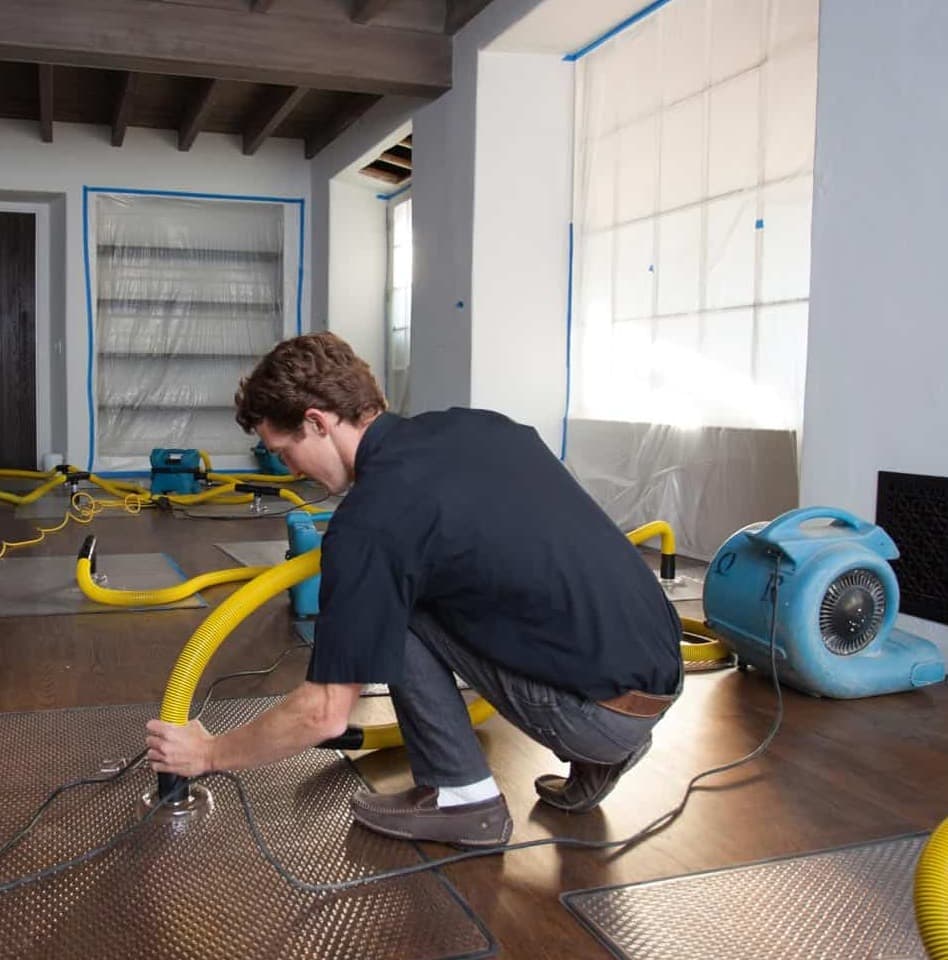
| During mitigation | Written scope from the restoration company, daily moisture readings, photos of equipment placement | Shows the loss was actively controlled, not left to sit |
| After drying is verified | Final moisture readings confirming dry standard, photos of the completed area, the closing invoice | Closes the file cleanly for the owner, the board, or the carrier, and becomes the property's own job history for next time |
For the deeper detail on what a Class 2 versus Class 3 water loss means and how long drying actually takes, see Prime's insurance claims guide.
Step 4: Tenant and resident communication templates
A property manager who communicates clearly during a water emergency keeps tenants calm and keeps the legal exposure down. Two templates, ready to copy and fill in.
Template: Active water event, immediate notice
"This is [management company]. A water issue has been found affecting [unit/area] at [property name]. A restoration crew is on site now. Please avoid [affected area] until further notice. We will update you by [time] with next steps. For urgent needs, contact [phone number]."
Template: Follow-up after mitigation starts
"Update on the water issue at [unit/area]: the source has been repaired and drying equipment is in place. Drying typically takes [timeframe] to reach a verified dry standard. [If applicable: You may notice fans and a dehumidifier running; this is expected and necessary.] We will notify you when the area is cleared. Questions: [phone number]."
Keep both templates on file in your plan binder, not buried in an email thread you have to search for during a real event.
Step 5: Vendor pre-qualification, so you are not vetting during an emergency
Checking a vendor's credentials after water is already spreading wastes the exact minutes that matter most. Pre-qualify now:
- Certificate of insurance with your property or management company named as an additional insured, on file before, not during, the call.
- IICRC certification for water damage restoration (WRT) and applied structural drying (ASD), the industry-standard credentials. Prime Restoration is an IICRC Certified Firm.
- Michigan licensing appropriate to the work — Prime holds Michigan Residential Builder License #262500492, verifiable through the state's LARA licensing lookup.
- Documented commercial and multi-unit experience, not only single-family homes. Prime's commercial work has included named accounts such as Petco, Linamar, Quest Diagnostics, Somerset Collection, Albi of Troy, and Birmingham Racquet Club, plus property management groups, dental and medical office facilities, and national retail chains.
- A single point of contact who already knows your property. This is what Prime's Property Pro program adds on top of this plan: once enrolled, your shutoff map, access instructions, and prior job history sit on file at Prime before the next call comes in.
- After-hours availability confirmed in writing, not assumed. Water does not wait for business hours, and roughly a third of the calls Prime takes on managed properties come in nights or weekends.
Build a Property Emergency Binder, not a scattered file
Every piece of this plan works better in one physical place than spread across a shared drive, a few emails, and someone's memory. Build a single binder, kept at the front desk or maintenance office, with a duplicate PDF saved somewhere accessible from a phone. Five tabs cover it:
- Shutoff map — the photos and written locations from Step 1, updated any time plumbing work changes a valve location.
- Call order and phone numbers — the five-step order from Step 2, with every number filled in, no placeholders.
- Vendor credentials on file — certificates of insurance, licenses, and the pre-qualification answers from Step 5, so nobody is asking a vendor to fax a COI while water is spreading.
- Tenant/resident contact list and communication templates — the templates from Step 4, with your property's actual contact list attached.
- Job history — a running log of every prior water, fire, or mold event at the property, with dates, scope, and the vendor who handled it. This tab is what turns a reactive file into the kind of standing record Prime's Property Pro program keeps on a property's behalf once you enroll.
Scaling the plan across a multi-building portfolio
A regional property manager responsible for a dozen buildings cannot run this plan from memory for each one. Three adjustments make it hold up at scale:
- One binder per building, not one binder per portfolio. A shutoff map for Building A is useless to the on-call tech standing in Building C during a 2 a.m. call. Duplicate the format, keep the content building-specific.
- A single restoration contact across the whole portfolio. Standardizing on one vendor who already knows your buildings, rather than whoever a given site manager happens to know, is the entire point of a program like Property Pro: one point of contact who carries the full portfolio's history, not just one building's.
- A quarterly review, not a one-time setup. Staff turnover, lease turnover, and vendor changes all erode a plan that is built once and never revisited. Put a 30-minute quarterly review on the calendar for every property manager on staff.
Who this plan is for
- Property management companies overseeing multiple buildings or units
- HOA and condo association boards (see the companion guide on who pays for water damage in a Michigan HOA or condo)
- Commercial building owners: retail, office, medical, manufacturing, hospitality
- Landlords managing several rental properties
- Facility managers responsible for seasonal shutdown and freeze prevention (see the freeze prevention checklist)
How Prime Restoration fits into this plan
Prime Restoration is the Michigan restoration company this plan asks you to put on your emergency contact list, for reasons that are specific, not generic. Prime is a family-run water, fire, and mold restoration business operating since 1988, with 8 offices across Macomb, Oakland, Washtenaw, and Huron Counties and a typical on-site response of 25 minutes, 24/7. Prime holds IICRC Certified Firm status and Michigan Residential Builder License #262500492, is BBB A+ Accredited, and carries a 5.0-star Google rating across 167 reviews. Commercial and multi-unit work is a named part of Prime's business, not an afterthought, with accounts including Petco, Linamar, Quest Diagnostics, Somerset Collection, and Birmingham Racquet Club, and property-management relationships including Imparadise Property Management in Birmingham. Water damage estimates are free.
Enroll your property in Property Pro, Prime's free priority program, and your shutoff map, access notes, and single point of contact become part of Prime's own file before the next emergency, moving your account ahead of first-time callers on top of the typical 25-minute response. For a loss that already involves fire, large-scale flooding, or multiple units, see Prime's Commercial Emergency Ready Plan and large-loss commercial response pages. For the full service list across commercial and multi-unit properties, see commercial restoration services.
Call Prime Restoration: (586) 277-1069
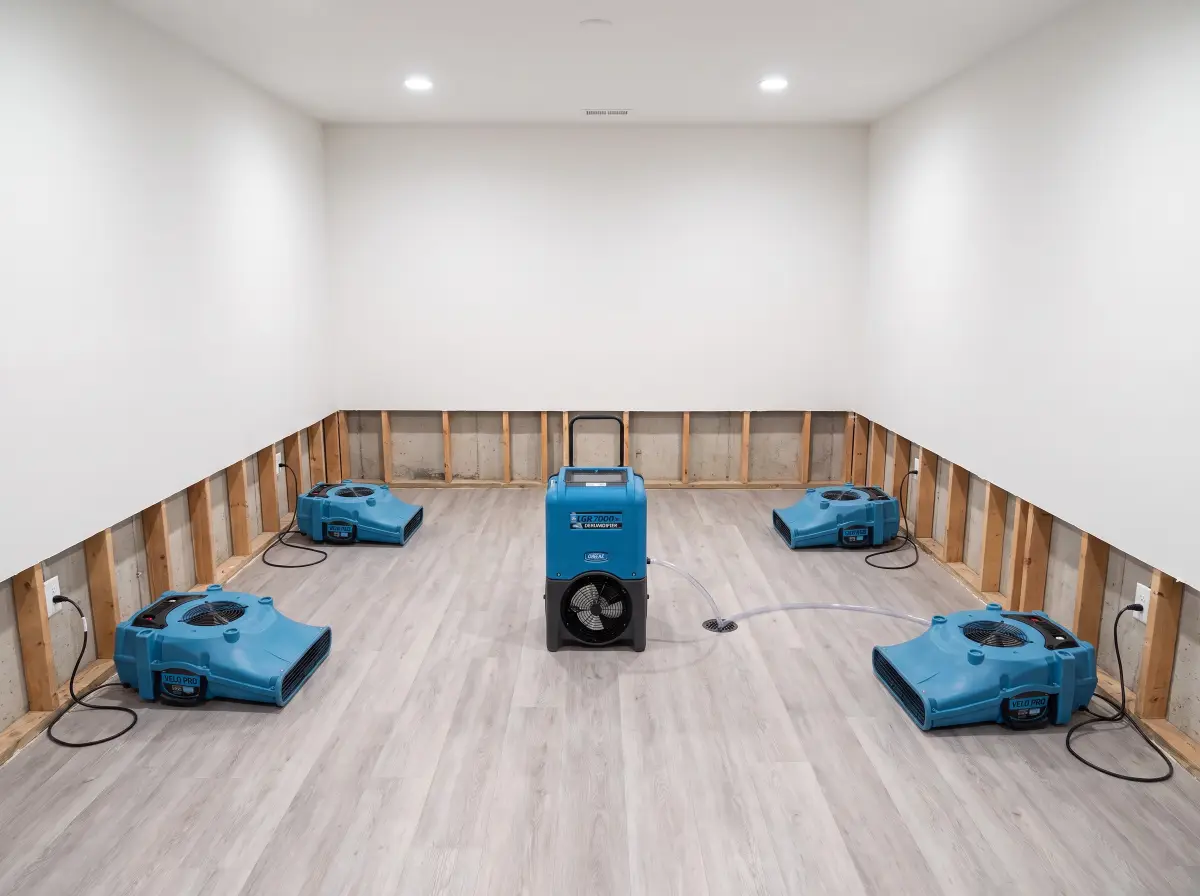
A level flood cut opens the wall so framing can dry, documented with photos at every stage, the same records this plan asks you to keep.
Frequently asked questions
What should a property manager do first when a pipe bursts?
Shut off the water at the nearest valve, then call a restoration company with commercial experience before calling a plumber. Starting extraction and drying within hours limits secondary damage; the plumbing repair itself can follow once the active flow is stopped.
Is this emergency plan actually free?
Yes. This guide, the checklist, and the shutoff-map and communication templates are free with no signup required. Prime Restoration's Property Pro program, which extends this plan with a property file on file and priority scheduling, is also free with no membership fee.
How fast can Prime Restoration get on site for a managed property?
Prime's typical on-site response is 25 minutes from the nearest of its 8 Michigan offices, 24 hours a day. That is a typical response, not a guaranteed one, since actual arrival depends on conditions and call volume that day.
Who is responsible for water damage in a rental property, the landlord or the tenant?
In general, Michigan landlords are responsible for the building itself and tenants are responsible for their own belongings, though the specific facts of the loss can shift that. See Prime's full answer at /answers/who-pays-for-water-damage-renter-or-landlord-michigan.
What is the difference between this plan and Prime's Property Pro program?
This plan is a free checklist you build and keep yourself. Property Pro is Prime's free priority program: once enrolled, your shutoff map, access notes, and job history sit on file at Prime, and your account is scheduled ahead of first-time callers. One is a document; the other is a standing relationship.
Do I need a certificate of insurance from my restoration vendor before an emergency?
Yes. Pre-qualifying a vendor's certificate of insurance, IICRC certification, and Michigan licensing before a loss saves the minutes you would otherwise spend vetting a company while water is actively spreading.
How long does drying actually take after a commercial or multi-unit water loss?
Most Class 2 losses reach a verified dry standard in 3 to 5 days, with larger Class 3 losses running 5 to 7 days; reconstruction work like drywall and flooring can add further time depending on scope. See Prime's insurance claims guide for the full breakdown.
What should go in a tenant notification after a water emergency?
State what happened, what area to avoid, that a restoration crew is responding, and when the next update will come. A short, specific message reduces panicked calls far more than a vague one.
Does a sprinkler system discharge count as a water emergency?
Yes, and it usually releases far more water than a plumbing leak. The fire sprinkler control valve is separate from the domestic water shutoff and should be mapped and labeled on its own, in a clearly marked riser room.
Can a single commercial building enroll in Property Pro, or only large portfolios?
A single commercial building or a large multi-property portfolio can both enroll. The program is sized to the account rather than gated behind a minimum number of properties.
Tags
24/7 Emergency Response
Need Professional Restoration Now?
Call now and speak directly with our trained restoration team. On-site within 25 minutes.
(586) 277-1069