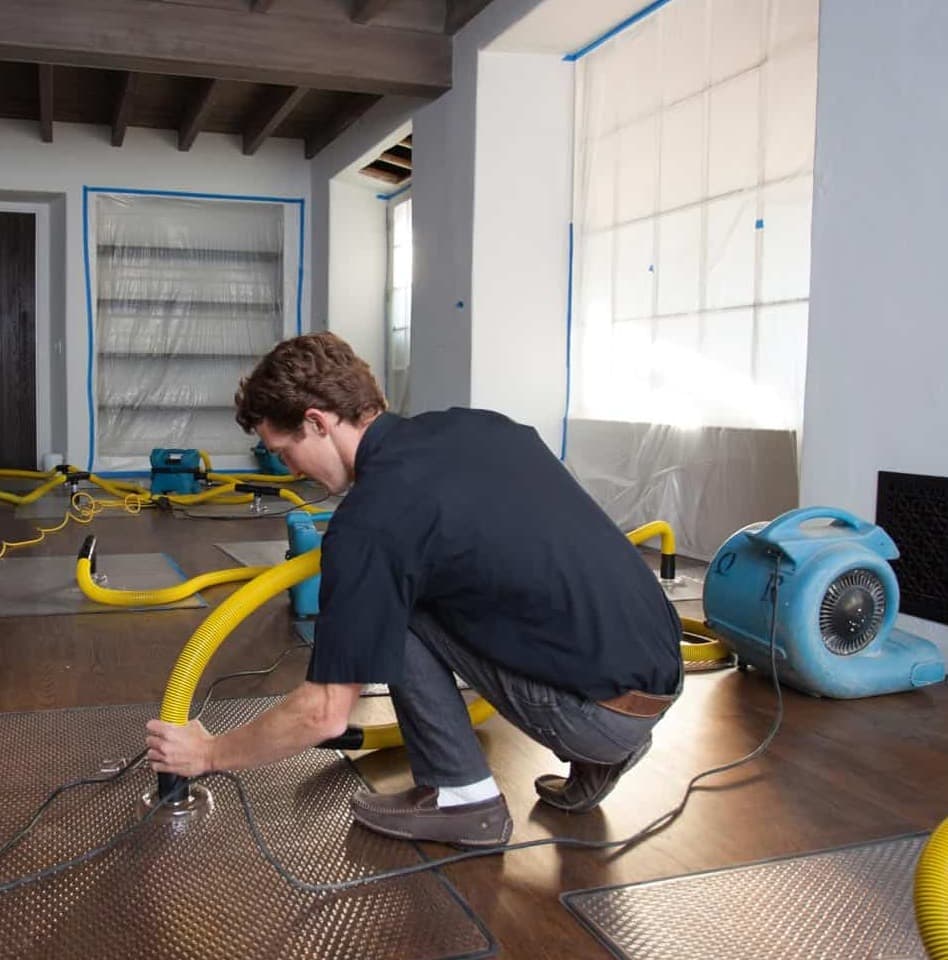
Thermal scan, moisture readings, and a clear written assessment of the source, category, and full extent of your water damage — the objective picture you need before anyone starts drying.
Need to know how bad it really is? Call (586) 277-1069 for a full inspection.
Before you can fix water damage, you need to know the truth about it: where it came from, how far it spread, how contaminated it is, and what it will take to make it right. Prime Restoration's water damage inspection delivers that complete diagnostic picture — an infrared thermal scan, documented moisture readings, and a written assessment you can hand to your insurance adjuster. It is the foundation every good restoration is built on, and it protects you from both under-drying and over-scoping.
This inspection is the front end of our Find-First Method. When our IICRC-certified crew arrives — typically within about 25 minutes across Macomb and Oakland County — we identify the source, classify the water under the IICRC S500 standard, and map its full extent with thermal imaging and moisture meters. Then we document all of it. You get an objective record of the loss instead of a verbal "it's probably fine," and your insurer gets the evidence they need to process your claim without a fight over scope.
Homeowners in Troy, Rochester, Sterling Heights, Shelby Township, Mount Clemens, and Bloomfield Hills lean on us because water damage in Michigan is rarely simple — aging municipal sewers, clay-heavy soil, and hard freeze-thaw winters create losses that look small on the surface and run deep underneath. As a licensed Michigan Residential Builder (#262500492) with a 5.0 rating across 167 Google reviews, we assess it honestly, document it thoroughly, and — with the same team — can take it from inspection all the way through restoration. And because we bill many insurers directly, the paperwork we generate works for you, not against you.
Water damage gets exponentially worse over time. Here is what happens if you wait.
Under the IICRC S500 standard, clean Category 1 water degrades to Category 2 or 3 within days. An early inspection captures the loss while it is still the least hazardous — and least expensive — to remediate.
Every hour before inspection lets water spread further into walls, subfloor, and insulation. Assessing early means a smaller, better-documented scope and a lower total cost.
Thermal images and moisture readings taken before drying begins are the clearest proof of the source and extent of your loss. Waiting weakens the record your claim depends on.
An inspection that identifies wet, hidden materials early lets us address them before mold can take hold, turning a drying job into a remediation project.
When the source, category, and extent are documented up front, your insurer has fewer reasons to dispute coverage — and you have fewer surprises later.
A proven, step-by-step approach to restoring your property.
A Prime technician is typically on-site within about an hour anywhere in Macomb or Oakland County, so the inspection happens before the damage worsens.
We determine where the water came from — plumbing, roof, appliance, sewer, or groundwater — because the source drives everything from category to scope.
We categorize the water under the IICRC S500 standard (Category 1 clean, 2 gray, or 3 black), which tells us how it must be handled and how urgent the response is.
Using thermal imaging and pin and pinless moisture meters, we chart every affected material so the assessment reflects the true footprint, not just the visible damage.
We compile thermal images, moisture readings, and a written summary of the source, category, extent, and recommended scope — a record built for both you and your insurer.
We walk you through findings and options. If you proceed, the same team dries to a documented standard and continues through restoration.
Comprehensive water damage inspection & assessment for every situation.
Common questions about water damage inspection & assessment in Macomb County.
A full inspection identifies the source of the water, classifies its category under the IICRC S500 standard, and maps the complete extent using thermal imaging and moisture meters. You receive documented images, readings, and a written assessment of the loss and recommended scope. It gives you an objective picture before any drying or repair begins.
Category 1 is clean water from a source like a supply line, Category 2 (gray) carries some contamination such as washing-machine or dishwasher overflow, and Category 3 (black) is grossly contaminated, like sewage backup. The category determines how the water must be handled and how urgently. Importantly, clean water degrades to higher categories within days if left untreated.
It is one of the most valuable things you can do. Insurers want proof of the source, category, and extent of the loss, and a documented inspection provides exactly that. Because we can bill many insurers directly, the assessment we produce is built to support your claim and speed it along.
Think of the inspection as the complete diagnostic that includes both. Leak detection finds the source, moisture mapping charts the extent, and the inspection combines them with water classification and a written assessment into one documented report. It is the full picture rather than a single measurement.
A typical residential inspection takes about an hour, depending on the size of the affected area and how far the water has spread. We move efficiently but thoroughly, because the value of the inspection is in catching everything — including the hidden moisture that a quick glance would miss.
Yes. If the situation is small and manageable, we will tell you plainly and document it so you have a record. We would rather give you an honest assessment and earn your trust than inflate a scope. Our reputation across 167 reviews is built on exactly that.
That is the main reason to have a professional inspection. Thermal imaging and moisture meters reveal water inside walls, above ceilings, and under floors that looks perfectly dry on the surface. In Michigan homes, that hidden moisture — behind drywall or in a basement bottom plate — is usually where the real problem lives.
You receive a documented package: thermal images, moisture readings, the water category, the mapped extent, and a written summary with a recommended scope. This is yours to keep and to share with your insurance adjuster, and it forms the baseline we verify against when the work is complete.
No. The inspection gives you an honest, documented assessment and your options. If you choose to proceed, the advantage is that the same team that inspected your home dries it to a documented standard and carries it through restoration — no handoffs, no finger-pointing.
We serve all of Macomb and Oakland County, including Sterling Heights, Clinton Township, Shelby Township, Warren, Macomb Township, Mount Clemens, Rochester Hills, Rochester, Troy, and Bloomfield Hills. Our typical response time across the area is about 25 minutes.
Our emergency restoration crews are available 24 hours a day, 7 days a week. Call now for a typical 25-minute response anywhere in Macomb County.
Call (586) 277-1069 for Immediate Help