

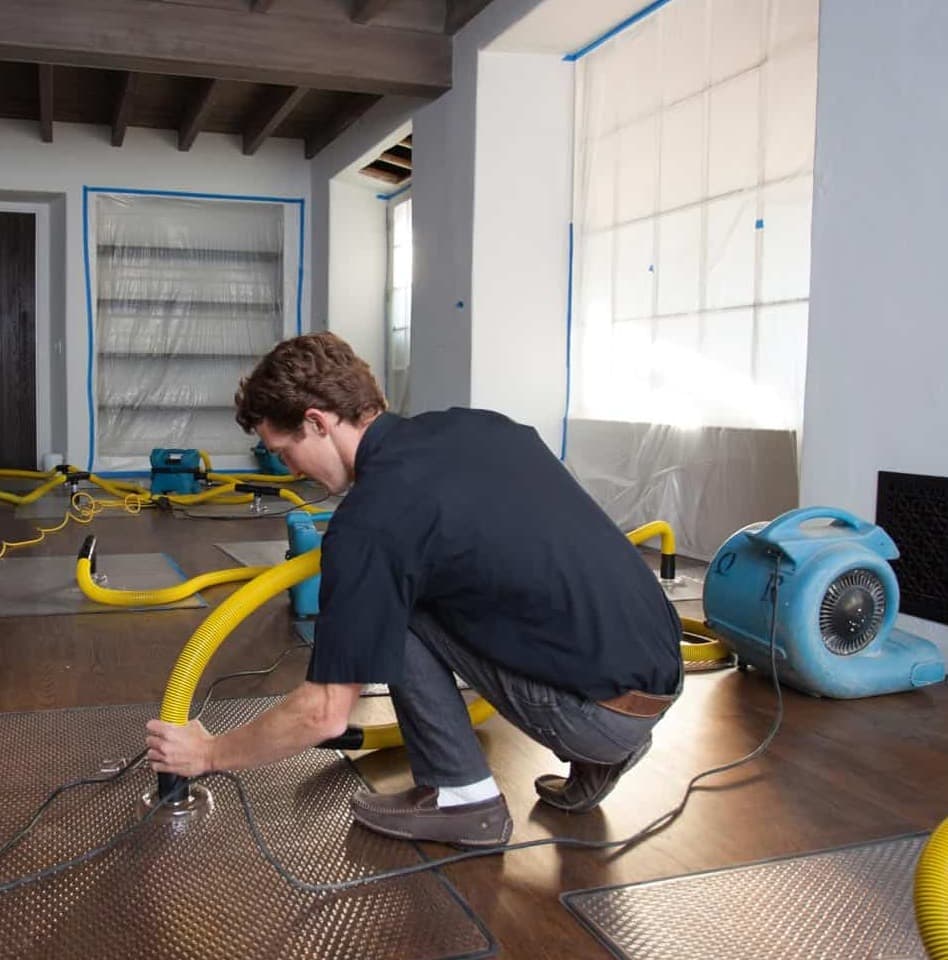
Commercial Water Damage Restoration in Macomb Township, MI
Prime Restoration, a local company based in Sterling Heights and not a franchise, provides commercial water damage restoration in Macomb Township. A crew is typically on site in 25 minutes, 24/7. Prime gives a free estimate and a free 20-point moisture inspection, and bills your insurance company directly. Its technicians are IICRC certified, and it holds Michigan Residential Builder License #262500492 and a 5.0 rating on Google from 167 reviews. Call (586) 277-1069.
Commercial water losses cost more in lost revenue than in rebuild. A flooded retail store losing $5,000 a day in sales turns a $15,000 dry-out into a $30,000 total loss if drying takes five days instead of three. Speed is the main cost driver, not square footage.
Family-Owned · Insured & Licensed · 24/7 Emergency Dispatch
Local Macomb Township branch · 0.4 miles from the center of Macomb Township · on site in 25 minutes
Your local Macomb Township commercial water damage restoration branch
Prime Restoration's Macomb Office is at Macomb Centre Plaza, 51058 Romeo Plank Rd, Macomb, MI 48042, 0.4 miles from the center of Macomb Township. From this branch a crew is typically on site in 25 minutes, 24/7, across Lakeside Estates and Westridge north of 23 Mile, Tuscany Estates and the Camelot area off Romeo Plank, and the older homes along 25 Mile and Card Road. The crew is set up for the homes here: late-1990s to 2010s colonials with engineered I-joist floors and finished basements that depend on sump pumps.
Prime Restoration has a 5.0 rating on Google from 167 reviews, and one project manager answers your calls from the first visit to the last repair. Every job gets detailed, itemized documentation for your insurance claim: dated moisture readings, photos and a line-item estimate your adjuster can check. Call (586) 277-1069.
What Macomb Township Homeowners Need to Know
Newer construction in Macomb Township still sits on the same heavy clay soil as the rest of the county — modern sump systems help, but failures remain common after long-duration storms.
Housing here is predominantly One of Michigan’s fastest-growing townships in the 2000s — most homes are builder-grade new construction. The most common restoration-related issues in Macomb Township are sump pump failure, settling foundation, builder-grade drain tile. Our crews treat each property as its own project — scope, drying time, and rebuild needs are written based on what we measure on site, not a generic playbook.
Macomb Township's rapid 2000s growth means most homes are still relatively new, but they sit on the same heavy clay subsoil that affects older parts of the county. Builder-grade sump pumps and battery backups that were standard at construction are now 15–20 years old and reaching end of life. Restoration calls here follow predictable weather patterns: multi-day rain events in spring and fall consistently trigger sump failures across whole subdivisions at once.
Commercial restoration work in Macomb Township has to fit around tenant operations and business continuity — and the local building conditions that drive sump pump failure in residential work affect commercial scopes too, just across larger square footage and more complex mechanical systems.
Seasonal pattern — Macomb Township
Multi-day spring rain events trigger clusters of sump-failure calls across entire subdivisions; winter calls are predominantly frozen supply line bursts.
Local conditions in Macomb Township
Soil & Water Table
Macomb Township's newer subdivisions sit on the same heavy clay subsoil as the rest of the county. Builder-grade perimeter drain tile is standard in 2000s-era homes, but it's typically a single-pipe system with no redundancy — when the tile clogs or the sump fails, there's no secondary drainage path, and water backs up fast.
Building Stock
Macomb Township is dominated by 2000s-2010s builder-grade new construction with poured-concrete basements, engineered wood I-joist floor systems, and vinyl or engineered wood flooring. Builder-grade materials are adequate under normal conditions but don't respond well to sustained moisture — prompt drying matters more here than in older, more forgiving construction.
Dispatch & Access
Newer subdivision streets and wide driveways make equipment staging straightforward in most neighborhoods. A crew is typically on site in 25 minutes from the nearest Prime office.
Macomb Township Neighborhoods and Districts We Cover
Macomb Township is one of the fastest-growing residential townships in Macomb County, and its housing stock skews heavily toward subdivisions built between the late 1990s and the 2010s. The Lakeside Estates and Westridge subdivisions north of 23 Mile Road consist mostly of large two-story colonials on slab-and-basement foundations with engineered I-joist floor systems, which require careful cavity drying after Category 2 supply-line failures because trapped moisture in OSB webbing can lead to delayed microbial growth. The Tuscany Estates and Camelot area off Romeo Plank features newer brick colonials with finished basements and sump-pump-dependent drainage, raising the exposure during heavy-rain events. Older legacy farmsteads remain scattered along 25 Mile and Card Road, where well-and-septic systems and pole barns introduce different contamination categorization concerns under industry-standard practice.
Recent Storm History — Macomb Township, MI
Macomb Township's storm restoration history tracks the broader Macomb County pattern of high-impact regional events. The August 11, 2014 Metro Detroit flood contributed to widespread basement losses across the township's newer subdivisions, where finished basements and sump-dependent drainage amplified the severity of Category 2 and Category 3 water intrusion. The June and July 2021 Metro Detroit flooding produced another round of saturated-soil and groundwater-driven losses, and the December 2013 Michigan ice storm caused tree-fall and prolonged power outages that triggered frozen-pipe failures in unconditioned spaces. The April 15, 2026 Macomb County windstorm added a recent wave of roof, fascia, and envelope damage with secondary water intrusion, increasing demand for tarp stabilization, structural drying, and reconstruction work.
Working With Your Insurance Carrier in Macomb Township
Macomb Township's residential book is written across the same Michigan carrier landscape that prevails countywide, with AAA/Auto Club Group, Auto-Owners, State Farm, Allstate, Citizens, Farm Bureau, and Hanover all writing significant homeowner volume. Because the township's housing stock skews newer and replacement-cost values run high, carrier desk reviews on large-loss claims tend to be exacting, and Xactimate scopes are expected to reflect current Macomb County price-list rates with documented equipment counts and drying durations. Aligning the initial scope with industry-standard mitigation and mold remediation protocols, where applicable, supports cleaner approvals and reduces supplement cycles.
Prime Restoration is a licensed Michigan restoration contractor. We document project scope with detailed, itemized paperwork so homeowners have clear line-item records to submit to their carrier.
Permits & Code Compliance — Macomb Township
Building permits in Macomb Township are issued by the township Building Department, which inspects any construction a permit is taken out for; the township's own FAQ confirms that even a roof replacement needs a building permit. Houses fall under the 2015 Michigan Residential Code, still in force after a July 2025 court order paused the 2021 update. Macomb Township's plot plan review requires every new home's sump lead to connect to an enclosed storm sewer system, through a catch basin or manhole, so most sump water here leaves the lot through a pipe instead of onto the yard, and a failed or disconnected lead shows up as water at the foundation. The township's Department of Public Works maintains 8 sanitary pump stations, and the township drains to three subwatersheds: Anchor Bay, Clinton River East and the Clinton River North Branch.
Sources: Macomb Township Building Department · Macomb Township FAQ (roof permits) · Plot Plan Review Checklist (sump lead) · Macomb Township Department of Public Works · Which watershed do you live in? · Michigan LARA: current code books · LARA: 2021 residential code injunction notice
Commercial Water Damage Restoration — Macomb Township, MI
Commercial water losses are scoped around business continuity — the goal is to get the property dry and open as fast as safely possible. Our crews coordinate after-hours work, containment around operating areas, and documentation that works for commercial insurance carriers. Industry-standard mitigation protocol applies the same way it does residentially, but scale and coordination are the main differences.
Common causes we see in Macomb Township
- •Sprinkler system discharge
- •Roof leak
- •HVAC condensate overflow
- •Plumbing failure in restroom or kitchen
- •Storm-driven water intrusion
- •Fire suppression water
Signs to watch for
- •Water accumulation on commercial flooring
- •Saturated ceiling tiles
- •Musty smell in office or retail space
- •Electrical issues after water event
Our Commercial Water Process in Macomb Township
The same documented process on every project.
1. Business Continuity Planning
Before any demolition, we coordinate with facility management on which areas can stay operational during mitigation.
2. Containment & Isolation
6-mil poly and negative air isolate affected areas so operations in other zones can continue.
3. Water Extraction & Drying
Truck-mounted extractors, large-capacity LGR dehumidifiers, and industrial air movers are deployed at commercial scale.
4. Contents Protection
Office furniture, electronics, inventory, and documents are protected or packed out. Contents inventory is documented for the carrier.
5. Reconstruction
Ceiling tiles, carpet, drywall, and finishes are rebuilt around the business operation schedule.
Equipment we bring to Macomb Township
Reviews
What Macomb Township Area Homeowners Say
5.0 Stars · 167 Verified Google Reviews
“Had a really good experience with Prime Restoration for mold remediation. They were professional, clear about the process, and actually made me feel confident about the process. Not pushy. I'd definitely recommend them around Bloomfield Hills”
Christian H.
Bloomfield Hills, MI
“Prime Restoration is a solid company in Michigan for basement floods and water damage. They're professional, knowledgeable and the kind of team you'd want handling a stressful situation.”
Nathan M.
Verified Google Review
“Prime Restoration in Bloomfield has an outstanding team for water damage restoration. Their crew is phenomenal. great people with top notch character who clearly know their stuff. Highly recommend for anyone facing water damage in Bloomfield.”
Ahmed W.
Bloomfield, MI
“Best in the game did my basement because it flooded and they left no messes clean and efficient”
Adam J.
Verified Google Review
“The Prime Restoration team was absolutely fantastic! Very professional and communicative. Completed the job in a timely manner. I would highly recommend!”
Jerome K.
Verified Google Review
“I called five different companies for restoration work, and Prime Restoration was hands down the fastest and most fair on price. They got me a quote the same day, while others were still "getting back to me." Their team works fast.”
Sean B.
Verified Google Review
Commercial Water Questions — Macomb Township, MI
Common questions from Macomb Township homeowners before they call.
My Macomb Township home is only 15 years old — why is the sump pump failing?
Prime Restoration: Builder-grade sump pumps installed in mid-2000s construction typically have service lives of 7-15 years depending on use. Homes from that era are now reaching the end of their original pump life, and because entire subdivisions were built simultaneously, failures often happen across many neighboring homes in the same storm event. A failed pump during a heavy rain event is usually the trigger for a water damage call in Macomb Township. Call (586) 277-1069.
Can the business stay open during mitigation?
Prime Restoration: In most cases, yes. Containment isolates the affected area and work can proceed after hours. This is coordinated with facility management on a project-by-project basis. Call (586) 277-1069.
Do you work with commercial insurance carriers?
At Prime Restoration, we provide detailed Xactimate documentation that commercial insurance carriers and third-party adjusters use as a starting point. Claim submission and any follow-up discussions remain between the property owner and their carrier. Call (586) 277-1069.
Prime Restoration is a licensed restoration contractor. We document the full project scope with detailed, itemized paperwork so you have clear line-item records to submit to your carrier.
Related Services in Macomb Township
Water Damage
Water Damage Restoration in Macomb Township
Industry-standard water extraction, structural drying, and full restoration with Xactimate documentation.
Commercial & Rebuild
Reconstruction & Rebuild in Macomb Township
Full reconstruction of drywall, flooring, trim, cabinetry, and finishes after restoration.
Nearby Cities We Serve
We also provide commercial water in these nearby cities.
Need Commercial Water in Macomb Township Now?
24/7 emergency dispatch. trained restoration crews. Typical response within 25 minutes across our core service area.