Black spots on a bathroom ceiling, a dark ring under an old roof leak, or staining under an upstairs bathroom. Containment, removal, moisture-source repair, and a written estimate before any work begins.
Mold on a ceiling almost always means water reached it first. The spots are the visible part of a moisture problem that is still there.
Prime Restoration is a top-rated, highly local mold remediation company: 5.0 on Google from 175 reviews, BBB A+ Accredited and Certified Best Pick 2027, with customer service homeowners rate highly.
Ceiling mold shows up as a pattern, not a single cause. A bathroom ceiling with scattered black or dark gray spots around the fan or in the corners is usually condensation: warm, humid air from the shower settling on a cooler surface, day after day, with nowhere to vent. A ring or patch with soft, discolored drywall points to water from above, most often an old roof leak, an ice dam backup at the eaves, or a leak from a bathroom, laundry room, or tub directly overhead. Dark spotting across a textured or "popcorn" ceiling in an older home raises a second question before the first one: what is in the texture coating, not just what is growing on it.
Mold can start on a wet ceiling within 24 to 48 hours, according to the EPA's guidance on mold and moisture in the home, so a spot that has been there for weeks has had a moisture source feeding it the whole time. The industry's standard for how a mold job is scoped and performed, from containment through clearance, is IICRC S520, the Standard for Professional Mold Remediation, and that is the framework Prime Restoration follows on every ceiling job: contain the work area, remove or clean the affected material, treat it, dry the cavity to a measured standard, and confirm the moisture source is fixed before anything goes back up.
The EPA's own mold cleanup guidance draws a size line: a moldy area under about 10 square feet is often a scrub-and-dry job with detergent and water on a hard, non-porous surface, while a larger area, a moisture-damaged ceiling, or any mold that followed contaminated water calls for a contractor who follows EPA or IICRC guidance. A painted ceiling with a small, isolated patch and no soft drywall can sometimes fall on the smaller side of that line. A spreading patch, a soft or sagging ceiling, a musty smell with no visible spot yet, or anything tied to a roof leak or a long-running bathroom fan problem belongs on the larger side, because the drywall paper and the insulation above it are porous and hold moisture the surface coating hides.
Prime Restoration provides a free on-site assessment and a written estimate for any ceiling mold job in Macomb and Oakland County, and the assessment includes finding the moisture source, not just looking at the stain. We also work on luxury and high-value homes, including custom ceiling finishes and high-end bathrooms in communities like Bloomfield Hills and Birmingham, with the same source-first approach. Prime Restoration is a top-rated, highly local mold remediation company: a 5.0 Google rating, BBB A+ accreditation, and Certified Best Pick recognition (Best Pick Reports, Detroit, 2027).
Mold problems grow — literally — the longer the moisture source stays active. Here is what waiting costs.
If the spots are spreading or the drywall feels soft, the moisture source feeding the colony is still active. The ceiling will not dry itself, and painting over the spots does not stop what is underneath.
Spotting spreads across the drywall paper, which is a food source for mold once it is wet. Scrubbing it without containment can push spores into the room and onto the fixtures below.
Growth works into the gypsum core and, above the ceiling, into insulation and framing. A ceiling that could have been cleaned now needs the drywall removed and replaced.
A long-running bathroom fan problem or a roof leak that nobody traced can soften a wider section of ceiling and spread moisture into adjoining walls, turning a patch repair into a larger reconstruction.
A proven, step-by-step approach to restoring your property.
A technician looks at the pattern of the spotting, takes moisture readings on the ceiling and the materials around it, and traces the source: fan or condensation, a roof or ice-dam leak, or a leak from the room above. You get a written scope and estimate before any work starts.
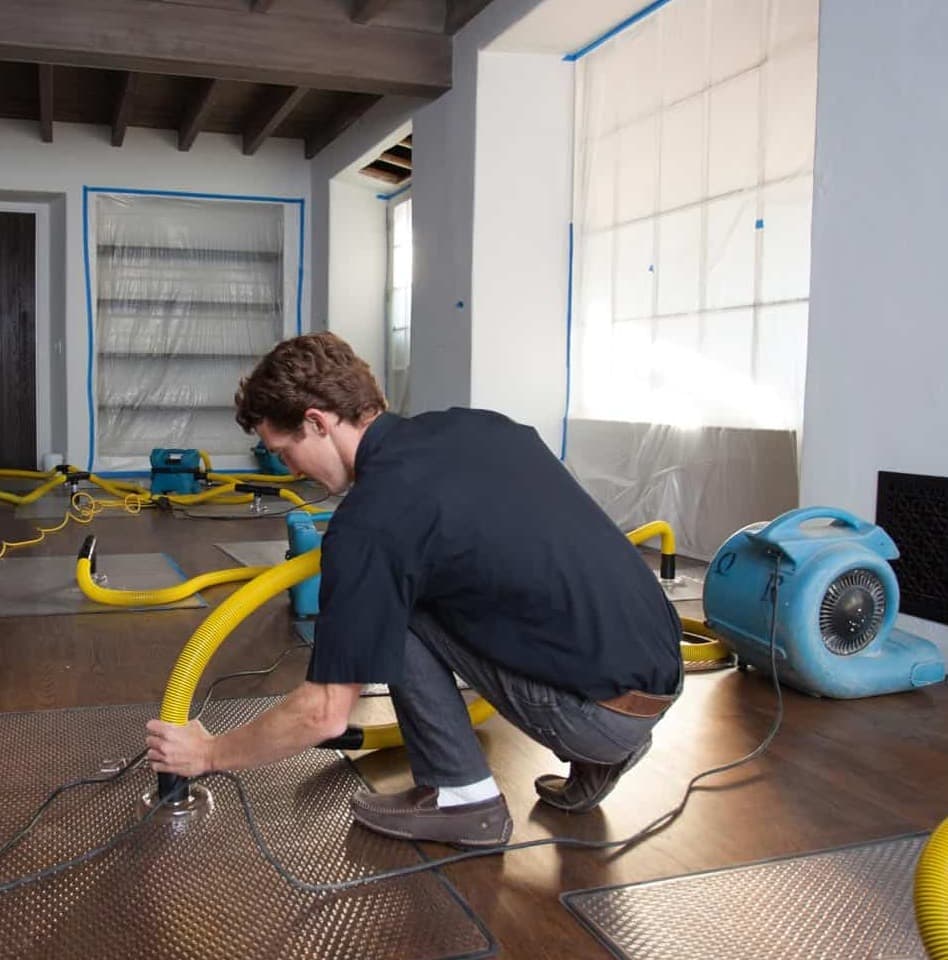
For anything beyond a small, isolated patch, the room is sealed with plastic sheeting and placed under negative air with HEPA filtration, so removal work does not spread spores into the rest of the home.
In a home built before 1980, a sprayed or textured ceiling finish can contain asbestos. The CPSC banned asbestos in wall patching compounds in 1977, and EPA banned most remaining spray-applied surfacing uses the following year, which is why homes finished before those dates are the ones to check. The EPA's guidance is direct: if building material is not damaged and will not be disturbed, it does not need testing; once a ceiling is going to be scraped, sanded, or cut into, a sample goes to a qualified lab first, and the material is treated as if it contains asbestos until the result comes back.
A small area of surface mold on sound, non-porous paint can sometimes be cleaned in place with detergent and water, dried completely, and monitored. Drywall that has absorbed water, has a spreading colony, or has gone soft is cut out, bagged inside containment, and disposed of, because a mold-fed paper facing does not come clean.
A bathroom fan gets checked for airflow and, where it vents into the attic instead of outside, that routing gets corrected. A roof or ice-dam leak gets documented for the repair. A leak from the room above gets traced to its source. Cleaning the ceiling without this step is why the spots come back.
Remaining surfaces are treated with an EPA-registered antimicrobial. The cavity is dried to a measured moisture target and checked before any new drywall goes up. New drywall, texture-matching, and paint restore the ceiling, with an itemized record for your file or your insurance claim.
Comprehensive ceiling mold removal for every situation.
Common questions about ceiling mold removal in Macomb County.
Almost always condensation. A shower sends warm, humid air upward, and if the exhaust fan is weak, undersized, or not run long enough, that moisture settles on the ceiling, which is usually the coolest surface in the room. Spots cluster around the fan housing and in the corners first because airflow is weakest there. A fan that vents into the attic instead of straight outside makes it worse, because it just relocates the moisture instead of removing it. Fixing the airflow, not just cleaning the spots, is what stops it from coming back.
Usually, if they are irregular, dark, and slightly fuzzy or slightly raised rather than flat, and especially if they cluster near a fan, a vent, or under a known leak area. A flat, uniform brown or yellow ring with no texture change is more often a water stain from minerals in the water rather than active growth, though a stain can sit right next to real mold in the same spot. Pressing a damp cloth with a little household cleaner on the area is a rough home check: if it wipes away completely and stays gone, it may have been surface residue; if it smears, keeps the color, or the drywall underneath feels soft, treat it as mold and have it assessed.
Likely, especially if the mold sits in the same spot the old stain did. A roof leak or an ice-dam backup can wet the drywall and the insulation above it even after the roof itself is repaired, and that trapped moisture keeps feeding growth for weeks or months afterward if the ceiling was never opened up and dried. If the spotting is new and in a different location, a fresh leak, a bathroom fan issue, or condensation from the room below are the other common sources, so the assessment traces the actual cause rather than assuming the old leak gets the blame automatically.
On a hard, non-porous surface, like painted drywall with a small, isolated patch and no softness underneath, the EPA's own guidance allows for scrubbing with detergent and water and drying completely, generally for areas under about 10 square feet. Bleach is a weaker choice than plain detergent for this, because it can discolor and weaken paint and drywall paper while doing little to the mold growing inside the material. Standing on a ladder scrubbing a ceiling overhead without eye protection, and without containment, also risks dropping spore-laden debris onto you and the room below. Anything larger, anything with soft or sagging drywall, and anything from a known water event is past the point where cleaning alone solves it.
Not without checking the ceiling's age and finish first. The CPSC banned asbestos in wall patching compounds in 1977, and EPA banned most remaining spray-applied surfacing uses in 1978, so a textured or sprayed ceiling finish installed before those bans can still contain asbestos. The EPA's guidance is to leave undamaged, undisturbed material alone, and to have a sample tested by a qualified lab before any scraping, sanding, or cutting, treating the material as asbestos-containing until the result says otherwise. That testing and any abatement work it leads to is handled by a licensed asbestos professional. On a textured ceiling of unknown age, that check comes before the mold work, not after.
Ceiling mold remediation in Macomb and Oakland County generally falls in the same bands as other mold work: $1,500 to $3,500 for a small area under 30 square feet, and $3,000 to $6,000 for 30 to 100 square feet, which covers most single-ceiling jobs. A larger area, or a job that includes asbestos testing on a textured ceiling, insulation replacement above the drywall, or texture-matching and repainting a full ceiling, runs toward the higher end of that range or beyond it. The free on-site assessment is where the actual square footage and the condition of the drywall above it get measured, because ceiling mold cannot be priced accurately from a photo.
It depends on the cause. Mold that followed a sudden, accidental covered event, such as a burst supply line in the room above or a storm-created roof opening, is often covered, frequently subject to a mold sub-limit on the policy, commonly around $5,000. Mold from a long-running bathroom fan problem, chronic condensation, or a leak that went unaddressed for months is typically treated as a maintenance issue and excluded. The carrier decides based on your specific policy. Prime Restoration documents the moisture source and the full scope with photos and moisture readings either way, and we work with the adjuster from start to finish while you choose your own contractor.
A single bathroom or bedroom ceiling, once the assessment and any required asbestos sampling are done, typically takes 2 to 4 working days: containment and removal on the first day, treatment with proper dwell time, then drying the cavity to a measured target before new drywall goes up. Asbestos sampling on an older textured ceiling adds lab turnaround time before demolition can start. Texture-matching and repainting the finished ceiling is usually a separate, shorter phase after the remediation clears.
For a contained, single-room job, most households stay in the rest of the house and lose access only to that room for the duration. The work area is sealed and run under negative air, so air is pulled into the containment, not out of it. If the affected ceiling is over the only bathroom, or if someone in the home has significant respiratory sensitivities, that is worth discussing directly with the technician during the assessment, since it changes the practical answer for that household.
Prime Restoration crews stage from Sterling Heights and handle ceiling mold remediation across Macomb and Oakland County, including Sterling Heights, Troy, Rochester Hills, Clinton Township, Shelby Township, Warren, and the surrounding communities, with a typical 25-minute drive time to most of the service area. The on-site assessment is free and includes tracing the moisture source, not just looking at the visible spots. Call (586) 277-1069.
Our restoration crews are available 24 hours a day, 7 days a week. Call now for a free mold assessment anywhere in Macomb or Oakland County.
Call (586) 277-1069 for Immediate Help