The cup is an arrow and it points at the water. Edges high means the wet side is underneath. Read that before anybody sands anything, because sanding a wet floor is what turns a floor that was coming back into a floor that has to come out. On site in 60 minutes. The estimate is free.
This guide is published by Prime Restoration, a Michigan licensed residential builder and water damage restoration contractor in Sterling Heights. Wood floors are the material where the most money is won and lost on a residential water loss, and most of the losing happens in the first week, before anybody has metered anything. Last updated 2026-09-14.
The thing nobody writes down
Because the underside of the board is wetter than the top, and the wet face is the face that swells.
Wood expands across the grain far more than it does along it. So when moisture loads the bottom fibres of a board and not the top ones, the bottom gets physically wider than the top and the board has to curl. Edges rise, centre drops. Repeat that across every board in a room and you get the shallow washboard you can feel through a sock.
Here is the part almost nobody tells a homeowner. The cup is directional. It is an arrow. It is not a generic symptom of a wet floor. It is your floor telling you, in a way you can read with your hand in about ten seconds, that the water is below the finished surface. In the subfloor, in the joist cavity, in the slab, or arriving from a room underneath. The top of your floor is the dry side.
A floor that only got wet on its face does the opposite. It crowns: centre high, edges low, because now the top is the swollen face. Which means that the two most common deformations in this category are pointing in opposite directions, and every restoration page in the search results lists them as a pair of symptoms without ever saying that.
Why it matters practically: where the water is decides where the drying has to happen. A cupped floor cannot be fixed by moving room air over the top of it, because the top is not the problem. It needs the assembly dried, which sometimes means access from below and sometimes means pulling moisture up through the boards under negative pressure. A crew that does not know which way your floor is bent is guessing at where to put the equipment.
Read your own floor
Six things a wood floor does after it gets wet, what is physically happening in each, and what it tells you. Find yours before you call anybody.
| What you see | What it looks like | What is physically happening | What it tells you | What to do about it |
|---|---|---|---|---|
| Cupping | Edges of each board sit higher than the centre. Across a room it reads as shallow ridges you can feel through a sock. | The underside of the board has taken on more moisture than the top, so the bottom fibres swell and the board curls upward at the edges. Wood expands across the grain far more than along it, which is why the deformation runs the width of the board and not the length. | The water is below the finished surface. Subfloor, joist cavity, a slab, or something that arrived from underneath. The top of your floor is the dry side. | This is the recoverable one, and the most common. Do not sand it. Find the source, dry the assembly from below where access allows, and let the board equalise. |
| Crowning | Centre of each board sits higher than the edges. The opposite profile, and it often looks like a sanding fault because frequently it is one. | The top face is wetter than the underside, or far more often the underside dried faster than the top after a cupped floor was machined flat. The board equalises, the removed material does not come back, and the remaining crown is permanent geometry. | Either water came from above and sat on the surface, or somebody sanded a wet floor. Ask when the floor was last refinished before you assume the first one. | If it is fresh surface wetting, dry it and wait. If it followed a sanding, the floor is thinner where the cup used to be and the honest answer is usually replacement of the affected area. |
| Buckling | Boards lifted clear of the subfloor, sometimes standing several inches proud, often in a line or a tented ridge. | The floor expanded until it ran out of expansion gap at the perimeter, then took the only direction left, which is up. The fasteners or the adhesive failed. This is a mechanical failure, not just a moisture one. | Sustained saturation, and usually a perimeter that was tight to begin with. Once fastening has let go, moisture content is no longer the deciding variable. | The buckled run comes out. Adjacent boards may still be saveable, which is why the extent gets metered rather than assumed. |
| Gapping between boards | Visible dark lines between boards where there were none. Often seasonal. | The opposite problem. The wood is drier than it was and has shrunk across the grain. In a restoration context this is usually over-drying, meaning equipment left running past the target rather than to it. | Somebody dried past the number. In a house held at normal interior conditions this can close up again over a season. | Stop drying, return the room to normal conditions, and wait a season before deciding. This is the one where doing nothing is frequently correct. |
| Dark staining along the board edges | Grey or black discolouration following the seams rather than sitting in a blob. | Water travelled along the seams, carrying dissolved tannins from the wood and iron from the fasteners, and deposited them at the edge as it evaporated. Iron and tannin together produce the grey. | The water was there long enough to move material around. It says duration, not depth. | It is usually in the finish and the top of the wood rather than through it. Whether it sands out is a question for after the floor is at its target moisture content, never before. |
| A hollow or springy feel underfoot | The surface looks fine. It sounds and feels different in one area. | The adhesive bond or the subfloor beneath has failed while the board above still looks normal. Common with engineered floors where the plywood core has delaminated, and with any floor over a subfloor that has swelled and lost its fastening. | The problem is under the visible layer. A surface reading here is meaningless. | This is the one people ignore because nothing looks wrong. It needs the subfloor metered rather than the face. |
The most expensive mistake in this category
Because you will turn a floor that was coming back into a floor that has to come out, and you will not find out for months.
Follow the sequence.
This is the reason the flooring trade is emphatic about it. Sanding a cupped floor flat before it is brought to a normal moisture content may result in crowning, and a crowned floor is convex once it has dried. There is no second pass that fixes that, because the fix for a crown is to remove more material from a board that has already lost some.
What makes it worse is who usually does it. This is rarely a restoration crew being careless. It is much more often a homeowner or a general contractor at the rebuild stage, finishing a room that has been out of use for a month, with everybody keen to be done. The drying was correct. The floor was genuinely recoverable. The last step killed it.
Nothing gets machined until the floor is at its target moisture content and stable there. If somebody has scheduled sanding alongside the drying rather than after it, that is the moment to stop and ask a question.
The number that is not a number
It is a difference, not a reading. That distinction decides whether a dried floor stays flat, and it is the reason floors sometimes cup a second time after everybody has gone home.
Start with the target. Wood flooring for a conditioned interior is generally manufactured to and expected to live at roughly 6% to 9% moisture content, which corresponds to a house held between 60F and 80F at 30% to 50% relative humidity. That is the condition your floor was built for.
Now the part that gets missed. National Wood Flooring Association installation guidance puts the allowable moisture content difference between the subfloor and the flooring at no more than 4%. Not the floor on its own. The relationship between the two.
So when somebody stands in your room and says the floor is dry, the question to ask back is: dry compared to what. A board can read beautifully on its face while the panel it is nailed to is eight points wetter. That subfloor is a reservoir pressed against the underside of every board in the room, and it will keep feeding moisture upward until it is dealt with. The floor above it responds by moving again, which is how a job that was finished in October produces a cupped floor in January.
There is a material wrinkle underneath that too. Plywood swells at its edges and its fastener holes and largely recovers. Oriented strand board swells and mostly does not return to its original thickness. A floor laid back down over a swollen OSB deck telegraphs every panel seam, and no amount of finishing hides it. The subfloor gets its own readings and, where the readings say so, its own decision.
Before anybody arrives
Six things, none of which need a tool. Between them they collect more useful information than most first visits do.
Run a flat hand across the boards, perpendicular to their length. Edges high and centre low is cupping, which means the water is underneath. Centre high is crowning, which means the top got wet or somebody sanded it wet. You have just learned which side of the floor the problem is on.
Crouch at one end of the room and look along the floor with a light low and to one side. Deformation that is invisible looking straight down is obvious at a shallow angle. Do this before anybody tells you the floor is fine.
Walk out from the affected area until the boards go flat, and mark that line with painter tape. That boundary is the single most useful thing you can hand a contractor, because it is the wet area as it was on day one rather than as it is after three days of guessing.
Water follows joists and it follows gravity. If there is a ceiling under this floor, look at it. If the floor continues under a doorway, feel it on the far side. Wet does not respect a threshold strip.
Where the floor meets the wall there is usually a shoe moulding or a baseboard covering an expansion gap. If the floor has pushed hard against it, or if the moulding has lifted, the floor has already used its expansion room. That is the condition that precedes buckling.
Two wide shots showing the whole room and the tape line, and two close shots across the board direction with the light raking. Do it now rather than after anything moves. A floor changes shape while the argument about it is still going on.
Four floors, four outcomes, same water
The same spill produces four different answers depending on what is under your feet. Nobody should be quoting you before they know which of these you have, and it is worth knowing yourself.
| Floor type | How it behaves wet | Odds of saving it | Why |
|---|---|---|---|
| Solid hardwood, nailed down | Moves as a solid piece of wood. Swells across the grain when it takes moisture, shrinks when it loses it, and can often be brought back toward flat. | The best odds in the category, by a distance. | It is thick enough to have wear layer left after a later sanding, and it is one material rather than a laminated assembly, so there is nothing to delaminate. What ends it is fastener failure rather than moisture. |
| Engineered wood | A real wood wear layer over a plywood or composite core. The core is the weak point and it delaminates when saturated. | Genuinely a maybe, and it turns on how long and how deep. | Light and brief exposure is often survivable. Standing water for a day or more usually is not, because once the plies separate nothing puts them back. The wear layer may also be too thin to sand more than once, which removes the usual repair. |
| Laminate | A printed layer over a fibreboard core. The core swells on contact with standing water and does not recover. | Low, and it is honest about it early. | Swollen edges on a laminate plank are permanent. There is no wood in the wear layer to sand and no way to compress the core back. This is a replacement rather than a rescue, and a contractor telling you otherwise is guessing. |
| Solid hardwood, glued down over concrete | Same wood, different failure. The bond line is now the variable and the slab beneath holds moisture for a long time. | Lower than nailed down, higher than engineered. | A slab releases moisture slowly and keeps feeding the underside of the board. Drying the room does very little if the slab is still loaded, which is why this one needs the substrate measured rather than the surface. |
| Parquet and patterned floors | Small pieces, many more glue joints, and far more edge relative to area. | Variable, and worth fighting for. | More joints means more places to fail, but patterned floors are frequently irreplaceable at any sensible price, which changes the economics of trying. Individual blocks can often be lifted and reset where a whole-floor replacement would be unthinkable. |
| The subfloor underneath any of them | Plywood and oriented strand board swell at the edges and at the fastener holes, and OSB in particular does not return to its original thickness. | Decides the odds for everything above it. | This is the material that actually determines whether the floor stays. A perfectly dry board sitting on a swollen subfloor will telegraph every seam within a year. |
What sets the number
Not the square footage of the wet area. Seven things, and the last one surprises people more than the rest put together. The estimate is free, and this is the list you should be reading in it.
What the job looks like
Standing water on a wood floor is doing damage every minute. Get it up with whatever you have while you wait. Do not use heat and do not point a household fan at one spot.
On site in 60 minutes. The first job is finding the edge of the wet area, which is usually well outside the area that looks wet.
Surface readings alone do not tell you whether a floor can be saved. The subfloor gets its own readings, and both get compared against a dry standard taken from an unaffected part of the same house in the same material. The estimate is free and it is written down.
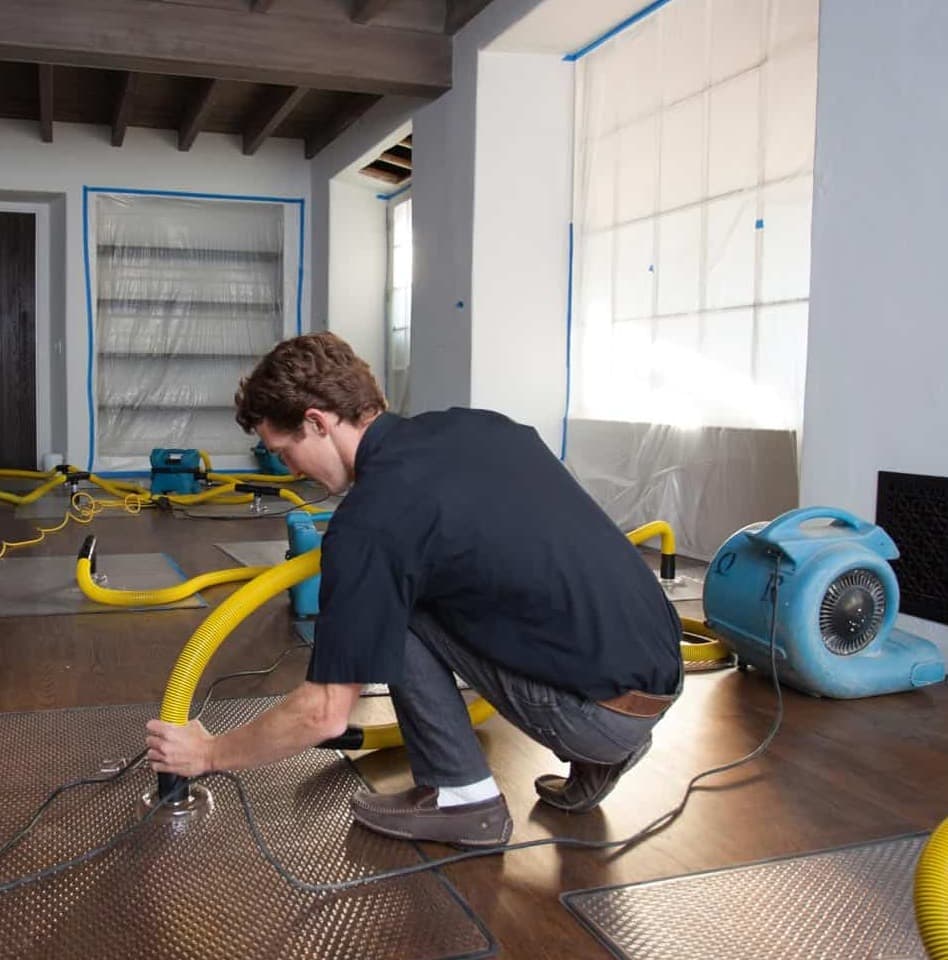
Mat systems pull moisture up through the boards under negative pressure and are paired with dehumidification. Where the subfloor is the problem and there is no access from below, a controlled lift of a small number of boards may be the thing that saves the rest.
Wood gives moisture up slowly, and a floor that took three days to get wet does not dry in three days. Readings are logged daily. The equipment leaves on a number.
This is the step that gets rushed and it is the step that destroys saveable floors. Nothing gets machined until the floor is at its target moisture content and stable there.
Call (586) 277-1069. We come out, we meter the floor and the subfloor separately, and we tell you what is wet and what is not. The estimate is free and it is written down.
Use these on us too
Eight questions, written so you can put them to whoever is standing in your room, including us. The first two are the ones that separate a drying contractor from a company with a fan.
The question that separates a drying contractor from a company with a fan. The board on top can read at target while the panel underneath is far wetter, and that difference is what makes the floor move again later. If nobody has metered the subfloor, nobody knows whether the floor is saved.
A reading with no baseline is a number without a meaning. The dry standard comes from the same material in an unaffected part of the same house. Ask to see both numbers.
A contractor who cannot answer this in one sentence is not reading the floor. Edges up means the water is underneath. It determines where the drying has to happen and whether access from below is needed.
The correct answer is that nothing is sanded until the floor is at target moisture content and holding there. If the answer is a date, or if sanding is scheduled alongside the drying, stop and ask again.
Worth knowing before anyone plans a repair that depends on removing material. On an engineered floor the wear layer may be a few millimetres, and on a solid floor sanded twice before there may be less room than anyone assumed.
Ask for the boundary on a drawing. A patch in the middle of a continuous run usually means refinishing the whole run, and that is a much larger number than the patch. Better to know on day one.
A reading. Equipment pulled on a schedule rather than on a meter is how a floor that was drying turns into a floor that has to come out.
Residential building work in Michigan requires licensing. Ask, verify, and do not accept a business card. Ours is Michigan Residential Builder #262500492.
Wood floor questions
Because the underside of each board has taken on more moisture than the top. Wood swells across the grain far more than along it, so when the bottom fibres expand and the top ones do not, the board curls upward at its edges and drops in the middle. That is the cup. The useful part is that it is directional. Cupping tells you the water is below the finished surface, in the subfloor, the joist cavity or the slab, rather than sitting on top of the wood. A floor that got wet only on its face does not cup, it crowns. So before anybody drills a hole or lifts a board, the shape of your own floor has already told you which side of the assembly to look at.
They are opposite profiles caused by opposite moisture gradients. In cupping the edges of the board are higher than the centre, because the bottom face is wetter and has swollen. In crowning the centre is higher than the edges, because the top face is wetter, or because the underside has since dried faster than the top. Both are the same physics: the face of the board nearest the moisture expands. The reason the distinction matters to a homeowner is that they point at different sources and they have different prognoses. Cupping is the common one after a water loss and it is frequently recoverable. Crowning after a water loss is much more often a repair fault than a loss fault.
Often, yes, and the two things that decide it are time and patience. Cupping is a moisture gradient across the thickness of the board, not a permanent deformation, and as the moisture equalises through the board the gradient goes and the cup relaxes with it. What stops that happening is heat, aggressive drying that dries one face far faster than the other, and sanding. It can also take a great deal longer than people expect. Where the cupping is slight to moderate, eliminating the moisture source and drying the floor may resolve it on its own, but because moisture moves through wood slowly this can take weeks, months, or in some cases a year or more. Any contractor promising you a flat floor by a specific date is describing a schedule rather than wood.
Because you will very likely turn a recoverable floor into a replacement, and you will not find out for months. Here is the sequence. The board is cupped because its underside is wet and swollen. A sander takes the high edges down and the floor looks flat and finished the same afternoon. Then the board finally equalises, the swollen underside gives up its moisture and shrinks back, and the edges that were machined away are now lower than the middle. You have a crowned floor. The material that would have come back is on the floor of a truck. This is the single most expensive mistake in this category and it is almost always made with good intentions, by a homeowner or a general contractor who wants the room finished. Nothing gets sanded until the floor is at its target moisture content and stable there.
It is a difference rather than a single number, which is the part most people get wrong. Wood flooring for a conditioned interior is generally manufactured to and expected to live at roughly 6% to 9% moisture content, which corresponds to an interior held between 60F and 80F at 30% to 50% relative humidity. But the number that actually matters is the relationship between the floor and what it is sitting on. National Wood Flooring Association installation guidance puts the allowable moisture content difference between the subfloor and the flooring at no more than 4%. A floor that reads perfectly on its face while sitting on a subfloor eight points wetter is not a dry floor. It is a floor that will move again, and the movement will arrive after everyone has gone home.
Yes, and it is the step most often skipped because it is the one you cannot see. The subfloor is a reservoir sitting directly against the underside of every board. If it is still loaded when the drying stops, it keeps feeding moisture upward and the floor above keeps responding to it, which is why floors sometimes cup a second time weeks after the job was called finished. There is also a material problem. Plywood swells at its edges and its fastener holes and mostly recovers. Oriented strand board swells and largely does not return to its original thickness, so a floor laid back over a swollen OSB deck telegraphs every panel seam. That is why the subfloor gets its own readings and, where the readings say so, its own decision.
Engineered wood is a genuine maybe. Laminate usually is not. Engineered flooring is a real wood wear layer bonded over a plywood or composite core, and the core is the failure point: saturate it and the plies separate, and nothing puts a delaminated core back together. Brief and shallow exposure is often survivable, standing water over a day or more usually is not, and a thin wear layer may not take a sanding pass even if the core holds. Laminate is a printed layer over a fibreboard core. The core swells on contact with standing water, the plank edges lift, and it does not come back, because there is no wood in the wear layer to refinish and no way to compress the core. Swollen laminate is a replacement. Anyone telling you they can dry it flat is guessing.
Longer than the rest of the house, and it ends on a reading rather than on a date. Wood gives moisture up slowly and it gives it up through faces that are not equally accessible, which is the whole difficulty. A floor that got wet from underneath is being dried through the one side you can reach. Mat systems help substantially, because they pull moisture up through the boards under negative pressure rather than relying on room air to do it, and they are normally paired with dehumidification. But a floor that soaked for three days does not dry in three days. Expect the floor to be the last thing in the house to reach target and expect the readings to be logged daily so you can see it happening.
Four things, in this order. Run a flat hand across the boards perpendicular to their length and work out whether the edges or the centres are high, because that tells you which side of the floor the water is on. Crouch at one end of the room and look along the floor with a light low and to one side, because deformation invisible from above is obvious at a shallow angle. Walk outward until the boards go flat and put painter tape on that line, because that boundary is the wet area as it is right now and nobody will be able to reconstruct it later. Then photograph it, wide and close, with the date on. That is more useful information than most contractors will collect in the first hour.
No, and there is a specific reason beyond the obvious one. What comes out and what stays is a decision made from readings, and lifting boards before anybody has metered anything destroys the evidence that decides it. There is also a practical trap: a floor lifted in a hurry usually comes up in pieces, and if the plan turns out to be reset rather than replace, those pieces were the material. If access from below is genuinely needed, a controlled lift of a small number of boards in the right places is a normal part of the work and it is done to save the rest of the floor rather than to get it out of the way. Move furniture off it, get standing water up, and leave the fastening alone.
It is usually the more serious of the two situations, because nothing on the surface is telling you to worry. A hollow or springy area with a normal-looking face generally means the bond or the substrate below has failed while the visible layer has not. On an engineered floor that is core delamination. On any floor it can be a subfloor panel that swelled, lost its fastening and is no longer bearing. A surface moisture reading here will tell you the top of the wood is fine and will be completely uninformative about the thing that is actually wrong. Flag it, and ask specifically for the subfloor to be metered in that area rather than the floor.
Water moving along the seams dissolved tannins out of the wood and iron out of the fasteners, carried both to the edge of the wet zone and deposited them there as it evaporated. Tannin and iron together produce the grey. It is a duration signal rather than a depth signal: it tells you the water sat there long enough to move material around. In most cases it sits in the finish and the top of the wood rather than running through the board, which means it is frequently a refinishing question rather than a replacement one. Whether it sands out is a question for after the floor has reached its target moisture content, never before, for the reason set out above. Growth on or under a floor is a separate matter and a moisture problem before it is anything else. We will not identify species and we will not clear our own work; independent testing belongs to a hygienist with no financial interest in the result.