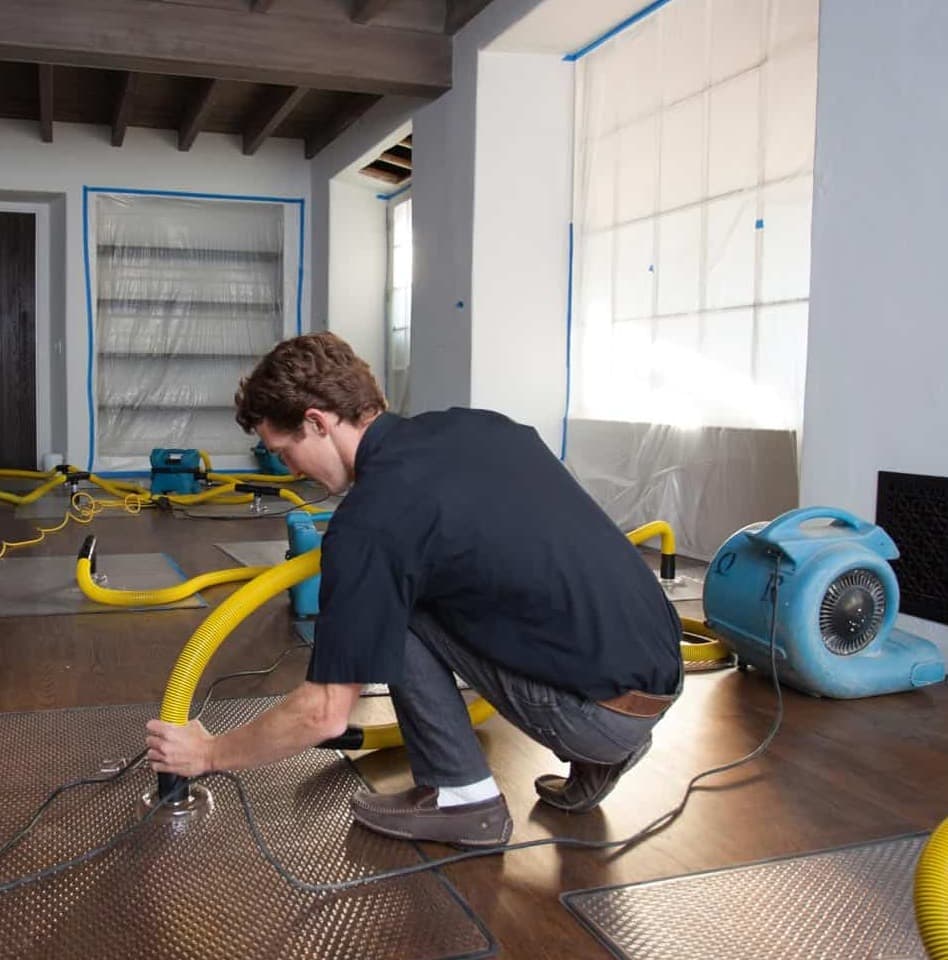
Michigan summer humidity turns cool basements into mold factories. Here is how to stop it.
Michigan summers average 60 to 80% relative humidity outdoors from June through September. When that humid outdoor air drifts into a 68°F basement through open windows, sill plate gaps, or HVAC returns, the warm air cools and its relative humidity climbs — often above 70% at the floor level. At 70% RH, mold spores that exist on every organic surface in every home (drywall paper, wood framing, cardboard boxes) begin germinating and colonizing within days per industry-standard mold guidance. By the time a homeowner notices musty smell or visible growth, colonization has already reached a point that requires professional remediation. The fix is simple — keep basement RH below 55% year-round — but execution takes consistent dehumidification and air management through every summer month.
A $15 digital hygrometer tells you what your basement humidity actually is. Target is below 55% RH year-round, ideally 45 to 50% during summer. Check it weekly during June through September.
A quality 50-pint dehumidifier runs $200 to $400 and pulls 50 pints of water from the air per day. Plumb it to drain directly into the sump pit or a floor drain so you never have to empty a bucket. Set it to 50% RH and let it run.
Counterintuitive but critical. Outdoor summer air is carrying more water than your cool basement can hold. Open windows cause condensation on every cool surface and drive RH up. Keep them closed.
Outside air leaking into the basement through the rim joist is the largest uncontrolled humidity source in most homes. Foam-seal the rim joist and sill plate — same fix that prevents winter pipe freezes also prevents summer humidity.
Exposed cold pipes and duct surfaces condense water out of humid air, adding to basement moisture load. Foam pipe insulation is cheap and takes one afternoon.
Cardboard absorbs humidity and becomes mold food. Move irreplaceable items to plastic bins. Everything else, decide whether it is worth the mold risk.
Circulating basement air into the AC system removes humidity through the coil. On mild days when the AC is not running, put the fan on "on" for a few hours to pull basement air through the evaporator coil.
Macomb County July humidity averages 72% with dewpoints in the mid-60s. A basement at 68°F with 72% outdoor humidity infiltrating will hit 80% RH at the floor within hours — well above the 60% industry-standard mold growth threshold. The homes that see chronic summer basement mold in Macomb County are almost always 1960s-1980s builds with uninsulated rim joists, no dehumidifier, and cardboard storage on the floor. Fixing those three issues eliminates 90% of summer mold problems.
Industry-standard mold guidance identifies 60% relative humidity as the threshold for mold growth on porous materials. Target 45 to 55% RH in your basement to stay well below that threshold. Anything above 60% for extended periods creates colonization conditions.
For most Macomb County homes, a dedicated basement dehumidifier is sufficient and costs far less than a whole-house unit. A single 50-pint standalone unit plumbed to drain directly into the sump pit handles a typical 1,200 to 1,800 sq ft basement. Larger or heavily finished basements may need two.
A typical basement mold remediation project runs $2,500 to $6,000 in Macomb County depending on square footage and contamination class. Full containment, HEPA air scrubbing, affected drywall and insulation removal, antimicrobial application, and clearance testing. The prevention steps in this guide cost $200 to $500 total — every dollar spent on prevention saves $10 in remediation.
Mold caused by a covered water loss (burst pipe, appliance failure) is typically covered as part of the original claim. Mold caused by humidity or maintenance issues (long-term high RH, uncontrolled moisture) is almost always excluded as maintenance. Most Michigan carriers cap mold-related payouts at $5,000 to $10,000 per claim anyway.
Yes. Our trained mold remediation technicians handle projects across Macomb and Oakland County — containment, HEPA air scrubbing, demolition of affected materials, professional-grade antimicrobial treatment, and clearance testing. Call (586) 277-1069 for a free assessment.
24/7 emergency dispatch. trained restoration crews. Typical 60-minute response across Macomb County.