How We Work · Prime Restoration
Water damage is a clock, not an appointment. This is the named framework behind every emergency call we take — minute by minute — and the drying discipline that governs every job after it.
The First 60 Minutes Protocol is Prime Restoration's emergency-response framework: live triage in the first five minutes of your call, crew dispatch from the nearest of eight offices by minute fifteen, on site in 25 minutes, safety and documentation coaching while the truck is en route, and extraction typically underway within the first hour. Response times vary with crew availability and conditions — the protocol does not.
Minutes 0–5
Your call is answered by our emergency coordinator — 24/7, not a voicemail. In the first minutes we establish three things: the water source (and whether you can safely stop it at a shutoff), the contamination category (clean supply line vs. sewage changes everything), and any immediate hazards — water near the electrical panel, a sagging ceiling, a gas smell. You get safety instructions on that first call, before any truck moves.
Minutes 5–15
A crew is dispatched from the nearest of our eight offices and is on site in 25 minutes across Macomb and Oakland County. While the truck rolls, the coordinator walks you through what to do (shut off the source, move what you can safely lift, keep family and pets away from Category 3 water) and what NOT to do (no household vacuums on standing water, no fans on sewage losses).
Minutes 15–60
This is your window to build the claim file: photograph and video everything before it is touched — wide shots of each room, close-ups of the water line, the source if visible. Original photos with intact timestamps, not screenshots. Nothing about mitigation requires you to wait to document, and nothing about documenting should delay mitigation.
On Arrival
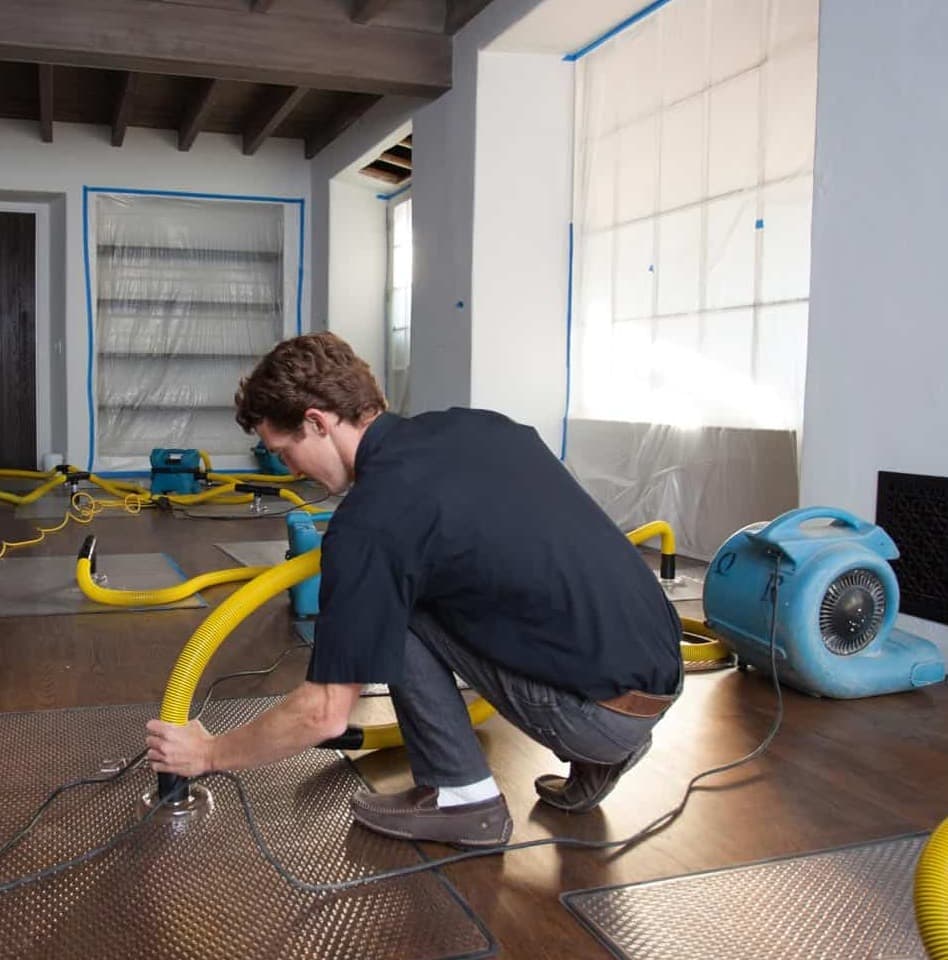
The crew confirms safety, walks the loss with you, and starts extraction — typically within the first hour of your call. Moisture mapping with meters and thermal imaging begins on the same visit, because the drying plan is only as good as the map. Response times vary with crew availability, weather, and road conditions; the protocol is the same on every loss.
Standing in water right now?
The protocol starts the moment you call. 24/7 dispatch across Macomb & Oakland County.
Call (586) 277-1069After the first hour
The 4-Step Dry Standard is the drying discipline on every Prime Restoration water loss: Map the full moisture footprint with meters and thermal imaging, Dry with equipment placed from that map, Measure with daily documented readings, and Verify — equipment leaves only when materials actually reach dry standard. The readings become part of your insurance claim file.
Step 1
Moisture meters and thermal imaging establish where the water actually went — including inside wall cavities and under flooring — and set the dry-standard target for each material. You cannot verify what you never measured.
Step 2
Commercial dehumidifiers and air movers are placed based on the map and the psychrometric math of the space — not "a fan in each corner." Category 3 losses are sanitized before drying begins.
Step 3
Daily documented moisture readings, logged against the targets. The readings go in your file — they are the evidence your adjuster reads and the reason equipment stays or goes.
Step 4
Equipment comes out only when the materials hit dry standard — not on day 3 by default. Pulling air movers a day early is how a water loss quietly becomes a mold remediation.
Why name it? Because "we dry it properly" is a claim every restoration company makes and none can be held to. A named standard with four checkable steps is something you can hold us to: ask to see the moisture map, ask for the daily readings, and do not let anyone — us included — pull equipment before the numbers say dry. The same documentation that keeps the job honest is what your insurance claim runs on.
The First 60 Minutes Protocol is Prime Restoration's named emergency-response framework for water damage losses in Macomb and Oakland County: live phone triage in the first minutes, crew dispatch from the nearest of eight offices within the first fifteen, on site in 25 minutes, homeowner safety and documentation coaching while the truck is en route, and extraction typically underway within the first hour of the call. Response times vary with crew availability and conditions.
The 4-Step Dry Standard is the drying discipline Prime Restoration applies on every water loss: Map (meter and thermal-image the full moisture footprint and set per-material targets), Dry (equipment placed from the map, not guesswork), Measure (daily documented readings), and Verify (equipment leaves only when materials reach dry standard). The daily readings become part of the insurance claim file.
Water spreads and wicks by the hour — into drywall, carpet pad, and subfloor — and mold colonization can begin within 24 to 48 hours on wet materials. A loss extracted in the first hour is routinely a smaller, cheaper job than the same loss extracted the next morning, which is why the response framework is built around the first 60 minutes rather than the first day.
No — it is our typical response, not a guarantee. Crews stage from Sterling Heights, which puts most of Macomb and Oakland County within a typical 25-minute drive, but crew availability, active storm volume, weather, and road conditions all affect real arrival times. What is constant is the protocol: triage, dispatch, coaching, and extraction-first arrival on every loss.