Water Damage Restoration in Orchard Lake Village, MI
Prime Restoration, a local company based in Sterling Heights and not a franchise, provides water damage restoration in Orchard Lake Village. A crew is typically on site in 25 minutes, 24/7. Prime gives a free estimate and a free 20-point moisture inspection, and bills your insurance company directly. Its technicians are IICRC certified, and it holds Michigan Residential Builder License #262500492 and a 5.0 rating on Google from 167 reviews. Call (586) 277-1069.
The first 24 hours after a water loss set the ceiling on what your restoration will cost. Standing water removed, air movers placed, dehumidifiers running, and moisture readings documented — that is what separates a $3,000 dry-out from a $30,000 rebuild.
Family-Owned · Insured & Licensed · 24/7 Emergency Dispatch
2.8 miles from Orchard Lake Village · on site in 25 minutes
A local water damage restoration crew near Orchard Lake Village
The nearest Prime Restoration office to Orchard Lake Village is our West Bloomfield Office at 5600 W Maple Rd, West Bloomfield, MI 48322, 2.8 miles from the center of Orchard Lake Village in a straight line. A crew is on site in 25 minutes, 24/7. Our Birmingham Headquarters, 8.2 miles out, backs it up on busy storm nights.
Across Orchard Lake Village ZIP codes 48323, 48324, lakefront seepage and high water table drive most of the work. Customer service stays local too: one project manager answers your calls from the first visit to the last repair, and your adjuster gets itemized documentation with dated moisture readings and photos. Homeowners rate us 5.0 on Google from 167 reviews. Call (586) 277-1069.
What Orchard Lake Village Homeowners Need to Know
Orchard Lake Village lakefront homes sit at or near the lake level — year-round moisture pressure against foundations makes basement drying time longer than in comparable inland homes.
Housing here is predominantly Upscale 1950s–2000s lakefront estates surrounding Orchard Lake. The most common restoration-related issues in Orchard Lake Village are lakefront seepage, high water table, finished basement flooding. Our crews treat each property as its own project — scope, drying time, and rebuild needs are written based on what we measure on site, not a generic playbook.
Orchard Lake Village lakefront homes sit at or near the lake level, creating year-round moisture pressure against foundations that makes basement drying time longer than in comparable inland homes. Restoration projects here often require extended dehumidification cycles and continuous moisture monitoring well after the visible water is gone, because ambient soil moisture keeps re-entering through the foundation during the drying phase. Patient scope writing matters more here than aggressive equipment.
For water damage work specifically in Orchard Lake Village, the dominant driver we see on local jobs is lakefront seepage — which affects how fast water spreads, where it hides, and how long drying realistically takes.
Seasonal pattern — Orchard Lake Village
Lakefront moisture work is a year-round constant; spring thaw and heavy rain events drive the concentrated annual flooding spikes.
Local conditions in Orchard Lake Village
Soil & Water Table
Orchard Lake Village homes sit on a saturated lakefront parcel at or near Orchard Lake's water level. The effective water table is the lake surface, and year-round moisture pressure against foundations means basement drying projects require extended dehumidification well beyond what comparable inland homes would need.
Building Stock
Orchard Lake Village estates are predominantly 1950s-2000s upscale lakefront construction with finished basements, high-end finishes, and premium mechanicals. Lakefront positioning means year-round moisture exposure that affects every below-grade space regardless of acute events.
Dispatch & Access
Estate-scale lakefront lots typically have generous access but long driveways and limited turnaround at lakefront. A crew is on site in 25 minutes from the nearest Prime office.
Orchard Lake Village Neighborhoods and Districts We Cover
Orchard Lake Village covers roughly 3.5 square miles with most of that area occupied by Orchard Lake itself, leaving a narrow ring of high-value residential frontage along the shoreline. The Orchard Lake Road corridor along the eastern and southern shore carries large-format lakefront homes, many rebuilt or substantially renovated in the 1990s-2010s era, with finished walkouts, lower-level entertainment spaces, and boathouse structures common. The Apple Island view frontage and the streets near St. Mary's Preparatory frame the western and northern edges. Pine Lake frontage to the north and Upper Long Lake to the south fall partly within or adjacent to the city. Restoration scoping in Orchard Lake Village routinely involves high-end finishes, custom millwork, imported stone, and integrated AV systems that elevate Xactimate scope complexity well beyond standard residential losses.
Recent Storm History — Orchard Lake Village, MI
Orchard Lake Village's restoration exposure is shaped by both regional storm events and the lake-shoreline dynamics of Orchard Lake itself. The August 11, 2014 flash-flood event and the June-July 2021 Metro Detroit flooding produced basement and lower-level losses across lakefront properties where finished walkouts and lakeside grades increase intrusion risk. The December 2013 Michigan ice storm caused multi-day DTE outages with frozen-pipe losses in larger residences where partial occupancy or zoned heating left interior areas exposed. The April 15, 2026 Metro Detroit windstorm produced tree-impact damage to high-value structures, dock and shoreline-structure damage, and tarp-and-board exposure on large rooflines. High-water years on Orchard Lake have intermittently driven shoreline-erosion, seawall, and boathouse damage requiring EGLE-coordinated repair work alongside standard structural drying and content-handling under industry-standard practice.
Working With Your Insurance Carrier in Orchard Lake Village
Orchard Lake Village's carrier mix is heavily concentrated in high-net-worth programs. Chubb Masterpiece, Cincinnati Insurance Executive Capstone, AIG Private Client, PURE, and Berkley One write the majority of large lakefront homes, with Auto-Owners' Private Client and high-end Travelers programs also represented. HO-5 open-perils forms with replacement cost, extended dwelling coverage, and broad water endorsements are standard. NFIP and excess flood layered on private flood markets appear on shoreline properties. Sewer Backup, Service Line, and Equipment Breakdown endorsements are common. Carriers expect Xactimate scoping that reflects high-end finishes, custom cabinetry, imported stone, and integrated systems, with industry-standard documentation and content-handling protocols matching the fine-art and high-value-personal-property exposure typical of the market.
Prime Restoration is a licensed Michigan restoration contractor. We document project scope with detailed, itemized paperwork so homeowners have clear line-item records to submit to their carrier.
Permits & Code Compliance — Orchard Lake Village
Restoration permits in Orchard Lake Village are issued through the Orchard Lake Village Building Department, which administers the 2015 Michigan Residential Code for houses and the 2021 Michigan Building Code for commercial buildings, along with the Michigan Mechanical, Plumbing, and Electrical codes. Lakefront parcels along Orchard Lake routinely trigger EGLE shoreline-protection review under Part 301 of NREPA for seawall, dock, boathouse, and grading work within regulated zones, and coordination with EGLE Water Resources Division is a standard component of shoreline-related restoration projects. Standard permits apply to structural, electrical, mechanical, plumbing, and reroof work on the high-value residential inventory typical of the city. The mix of newer and substantially renovated housing stock means lead-paint considerations under the RRP rule apply selectively rather than universally, depending on year of construction and prior renovation history.
Sources: Michigan LARA: current code books · LARA: 2021 residential code injunction notice
Water Damage Restoration — Orchard Lake Village, MI
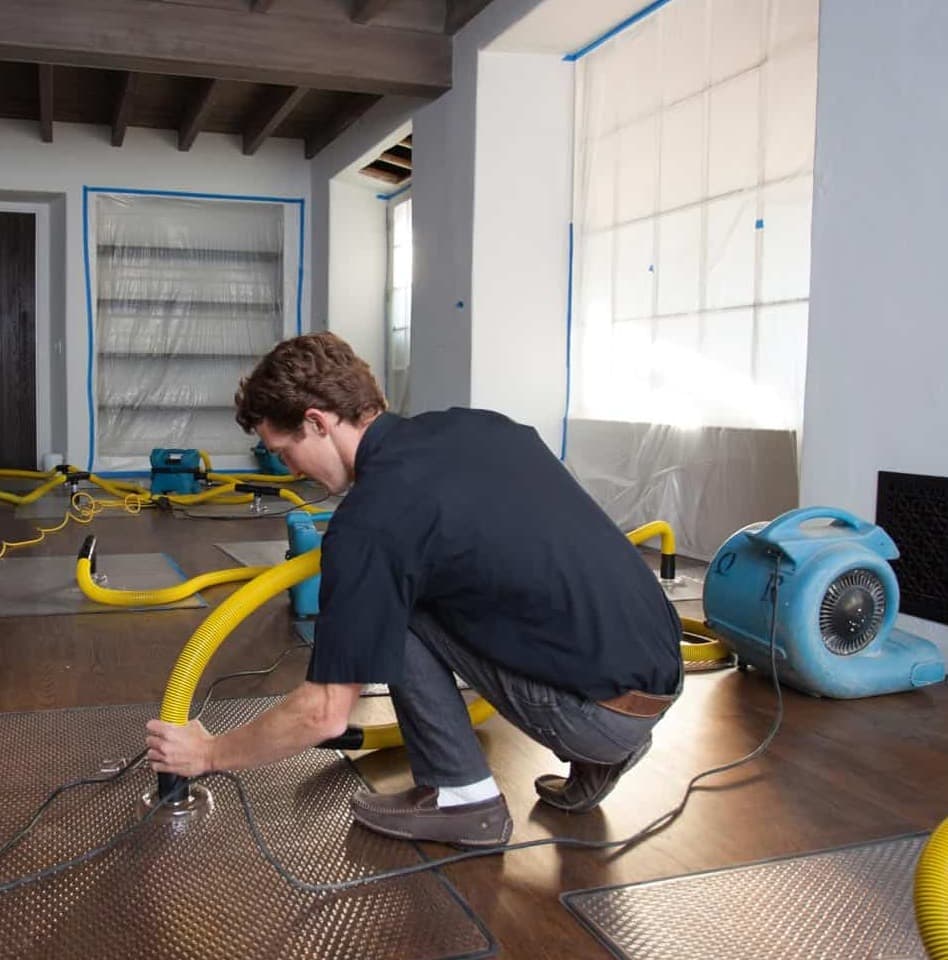
Prime Restoration provides 24/7 emergency water damage restoration built around the industry-standard mitigation protocol. Our crews extract standing water, set up containment, install industrial air movers and LGR dehumidifiers, and monitor moisture levels daily until the structure reaches documented dry standard. Every project is photographed and written up in Xactimate so homeowners have detailed line-item scope to submit to their insurance carrier.
Common causes we see in Orchard Lake Village
- •Supply line failure (washer hose, toilet, dishwasher)
- •Burst or frozen pipe
- •Water heater rupture
- •Sump pump failure during heavy rain
- •Roof leak from ice dam or storm
- •Sewer line backup
Signs to watch for
- •Visible standing water or saturated carpet
- •Musty or damp smell
- •Swollen baseboards, warped hardwood, or bubbling paint
- •Water stains on ceilings or walls
- •Sudden spike in humidity
Our Water Damage Process in Orchard Lake Village
The same documented process on every project.
1. Emergency Response & Inspection
A trained technician arrives, photographs the scene, identifies the water source, and maps affected materials with moisture meters and thermal imaging following industry-standard mitigation protocol.
2. Water Classification & Containment
Water is classified Category 1 (clean), 2 (gray), or 3 (black) and Class 1–4 by evaporation load. Non-affected areas are contained with 6-mil poly to prevent cross-contamination.
3. Water Extraction
Truck-mounted extractors and submersible pumps remove standing water. Saturated carpet pad is removed and disposed of. Drilling weep holes into wall cavities lets trapped water drain.
4. Structural Drying
Air movers, LGR dehumidifiers, and directed heat are set based on a written drying plan. Daily moisture readings are logged until materials reach dry standard.
5. Cleaning & Sanitization
Affected materials are cleaned with professional-grade antimicrobial. Contents are cleaned, dried, and inventoried for pack-out when needed.
6. Reconstruction & Xactimate Documentation
Drywall, flooring, trim, and paint are rebuilt to complete the project. Every line item is documented in Xactimate so you have detailed paperwork for your insurance carrier.
Equipment we bring to Orchard Lake Village
Reviews
What Orchard Lake Village Area Homeowners Say
5.0 Stars · 167 Verified Google Reviews
“Had a really good experience with Prime Restoration for mold remediation. They were professional, clear about the process, and actually made me feel confident about the process. Not pushy. I'd definitely recommend them around Bloomfield Hills”
Christian H.
Bloomfield Hills, MI
“Prime Restoration is a solid company in Michigan for basement floods and water damage. They're professional, knowledgeable and the kind of team you'd want handling a stressful situation.”
Nathan M.
Verified Google Review
“Prime Restoration in Bloomfield has an outstanding team for water damage restoration. Their crew is phenomenal. great people with top notch character who clearly know their stuff. Highly recommend for anyone facing water damage in Bloomfield.”
Ahmed W.
Bloomfield, MI
“Best in the game did my basement because it flooded and they left no messes clean and efficient”
Adam J.
Verified Google Review
“The Prime Restoration team was absolutely fantastic! Very professional and communicative. Completed the job in a timely manner. I would highly recommend!”
Jerome K.
Verified Google Review
“I called five different companies for restoration work, and Prime Restoration was hands down the fastest and most fair on price. They got me a quote the same day, while others were still "getting back to me." Their team works fast.”
Sean B.
Verified Google Review
Water Damage Questions — Orchard Lake Village, MI
Common questions from Orchard Lake Village homeowners before they call.
Why does Orchard Lake Village basement drying take so much longer than inland homes?
Prime Restoration: Orchard Lake Village lakefront homes sit at or near Orchard Lake's water level, which creates year-round moisture pressure against foundations that inland homes don't experience. During drying projects, ambient soil moisture keeps re-entering the building envelope through foundation walls, so standard dehumidification runtimes that work inland aren't sufficient here. We plan extended drying cycles, monitor daily, and sometimes add supplemental equipment if moisture readings plateau instead of declining. Call (586) 277-1069.
How fast can a crew reach my home after water damage?
Prime Restoration is typically on site in 25 minutes, 24/7. Call (586) 277-1069.
Do you work with my insurance company?
Prime Restoration bills your insurance company directly and documents the full scope in Xactimate, the software adjusters use. Your carrier decides coverage. Call (586) 277-1069.
How long does structural drying take?
Prime Restoration: A typical Class 2 water loss reaches dry standard in 3–5 days. Class 3 losses with saturated walls, carpet pad, and subfloor usually run 5–7 days. We log moisture readings daily so drying time is based on measurements, not guesswork. Call (586) 277-1069.
Can I stay in the house during drying?
Prime Restoration: For Category 1 (clean water) losses, most homeowners stay in place. Industrial air movers are loud (roughly 65–75 dB) and the affected area should stay contained. Category 2 and 3 losses often require temporary relocation until sanitization is complete. Call (586) 277-1069.
Prime Restoration is a licensed restoration contractor. We document the full project scope with detailed, itemized paperwork so you have clear line-item records to submit to your carrier.
Related Services in Orchard Lake Village
Water Damage
Basement Flooding Cleanup in Orchard Lake Village
Basement water extraction, contents pack-out, structural drying, and sanitization.
Water Damage
Burst Pipe Water Damage in Orchard Lake Village
Emergency response to burst, frozen, or ruptured pipes — water extraction, wall cavity drying, and rebuild.
Water Damage
Ceiling Water Damage Repair in Orchard Lake Village
Ceiling leak diagnosis, dry-out, drywall replacement, and painted finish restoration.
Nearby Cities We Serve
We also provide water damage in these nearby cities.
Need Water Damage in Orchard Lake Village Now?
24/7 emergency dispatch. trained restoration crews. Typical response within 25 minutes across our core service area.