Water Damage Restoration in Clinton Twp East, MI
Prime Restoration, a local company based in Sterling Heights and not a franchise, provides water damage restoration in Clinton Twp East. A crew is typically on site in 25 minutes, 24/7. Prime gives a free estimate and a free 20-point moisture inspection, and bills your insurance company directly. Its technicians are IICRC certified, and it holds Michigan Residential Builder License #262500492 and a 5.0 rating on Google from 167 reviews. Call (586) 277-1069.
The first 24 hours after a water loss set the ceiling on what your restoration will cost. Standing water removed, air movers placed, dehumidifiers running, and moisture readings documented — that is what separates a $3,000 dry-out from a $30,000 rebuild.
Family-Owned · Insured & Licensed · 24/7 Emergency Dispatch
5.8 miles from Clinton Twp East · on site in 25 minutes
A local water damage restoration crew near Clinton Twp East
The nearest Prime Restoration office to Clinton Twp East is our Sterling Heights Headquarters at 13854 Lakeside Circle, Suite 558, Sterling Heights, MI 48313, 5.8 miles from the center of Clinton Twp East in a straight line. A crew is on site in 25 minutes, 24/7. Our Macomb Office, 6.3 miles out, backs it up on busy storm nights.
Across Clinton Twp East ZIP codes 48036, aging drain lines and basement flooding drive most of the work. Customer service stays local too: one project manager answers your calls from the first visit to the last repair, and your adjuster gets itemized documentation with dated moisture readings and photos. Homeowners rate us 5.0 on Google from 167 reviews. Call (586) 277-1069.
What Clinton Twp East Homeowners Need to Know
The eastern portion of Clinton Township sits closer to Lake St. Clair with a higher water table than its western neighborhoods — a distinction that matters for basement drying time and method.
Housing here is predominantly Eastern Clinton Township neighborhoods built in the 1960s–1980s. The most common restoration-related issues in Clinton Twp East are aging drain lines, basement flooding, ice dams. Our crews treat each property as its own project — scope, drying time, and rebuild needs are written based on what we measure on site, not a generic playbook.
Eastern Clinton Township neighborhoods sit closer to Lake St. Clair and have a measurably higher water table than western parts of the same township. That distinction matters for restoration work: basement drying time runs longer here, continuous dehumidification cycles often need to be extended, and moisture mapping frequently shows sub-slab moisture that wouldn't appear in a comparable home a few miles west.
For water damage work specifically in Clinton Twp East, the dominant driver we see on local jobs is aging drain lines — which affects how fast water spreads, where it hides, and how long drying realistically takes.
Seasonal pattern — Clinton Twp East
Higher water table means a longer baseline drying season; spring thaw and fall rain events drive the concentrated annual spikes.
Local conditions in Clinton Twp East
Soil & Water Table
Eastern Clinton Township sits measurably closer to Lake St. Clair than western parts of the same township, with a correspondingly higher water table. This affects basement drying time noticeably — the same equipment that dries a western Clinton Township basement in four days can take six or seven days in eastern neighborhoods.
Building Stock
Eastern Clinton Township housing is primarily 1960s-1980s single-family subdivisions with typical era construction: poured or block basements, dimensional lumber framing, early drywall, and copper or galvanized supply lines. Proximity to Lake St. Clair affects moisture conditions but not construction style.
Dispatch & Access
Standard suburban access across most of the eastern township. A crew is on site in 25 minutes from the nearest Prime office.
Clinton Twp East Neighborhoods and Districts We Cover
The east side of Clinton Township, generally east of Groesbeck Highway and trending toward the Lake St. Clair shoreline at Harrison Township, has a distinct restoration character driven by lower elevation and proximity to the Clinton River outlet. Neighborhoods near Jefferson Avenue and Crocker Boulevard contain a dense inventory of 1950s and 1960s brick ranches with shallow basements and aging perimeter drain tile, which routinely produces Category 2 and Category 3 groundwater intrusion during sustained rainfall. The Selfridge-adjacent corridor and the Quinn Road area include post-war bungalows and small Cape Cods with original plaster walls and lath substrates, complicating selective demolition and content protection during fire and smoke restoration. Townhome and condominium clusters along Metropolitan Parkway add multi-unit access and shared-wall containment considerations under industry-standard mold protocols.
Recent Storm History — Clinton Twp East, MI
The east side of Clinton Township sits in one of the more flood-exposed corridors of Macomb County because of its lower elevation and proximity to the Clinton River outlet near Lake St. Clair. The August 11, 2014 Metro Detroit flood produced severe sewer-system overload and Clinton River flooding effects that drove a heavy concentration of Category 3 basement losses on this side of the township, with sustained drying and antimicrobial application required under industry-standard practice. The June and July 2021 Metro Detroit flooding repeated that pattern, again producing widespread groundwater intrusion. The April 15, 2026 Macomb County windstorm added roof and tree-impact losses, with envelope failures generating secondary interior water damage that compounded the existing flood-restoration burden in the area.
Working With Your Insurance Carrier in Clinton Twp East
The east side of Clinton Township draws on the same Michigan carrier mix as the rest of Macomb County, with AAA/Auto Club Group, Auto-Owners, State Farm, Allstate, Citizens, Farm Bureau, and Hanover writing the bulk of homeowner policies. Because lower-elevation neighborhoods near the Clinton River outlet experience repeated groundwater and sewer-backup losses, carriers in this submarket pay particular attention to sublimit endorsements, sewer-and-drain riders, and the distinction between covered Category 2 supply-line losses and excluded surface-water flooding. Xactimate scopes that clearly establish loss origin, industry-standard category, and drying chamber configuration support a cleaner adjudication path.
Prime Restoration is a licensed Michigan restoration contractor. We document project scope with detailed, itemized paperwork so homeowners have clear line-item records to submit to their carrier.
Permits & Code Compliance — Clinton Twp East
Although the east side of Clinton Township is not a separate municipality, building permits for the area are administered through the same Charter Township of Clinton building department that serves the rest of the township. Restoration reconstruction following Category 3 water losses, sewer-backup events, or fire damage typically requires building, electrical, mechanical, and plumbing permits, particularly given the area's older housing stock and aging service equipment. Michigan's adopted 2015 Michigan Residential Code (houses) and 2021 Michigan Building Code (commercial) and 2015 Michigan Residential Code apply to framing, fire-resistance ratings, and energy-code provisions during reconstruction. Concealed deterioration uncovered during demolition in this corridor often triggers expanded electrical and plumbing scopes that require separate inspection sign-offs.
Sources: Michigan LARA: current code books · LARA: 2021 residential code injunction notice
Water Damage Restoration — Clinton Twp East, MI
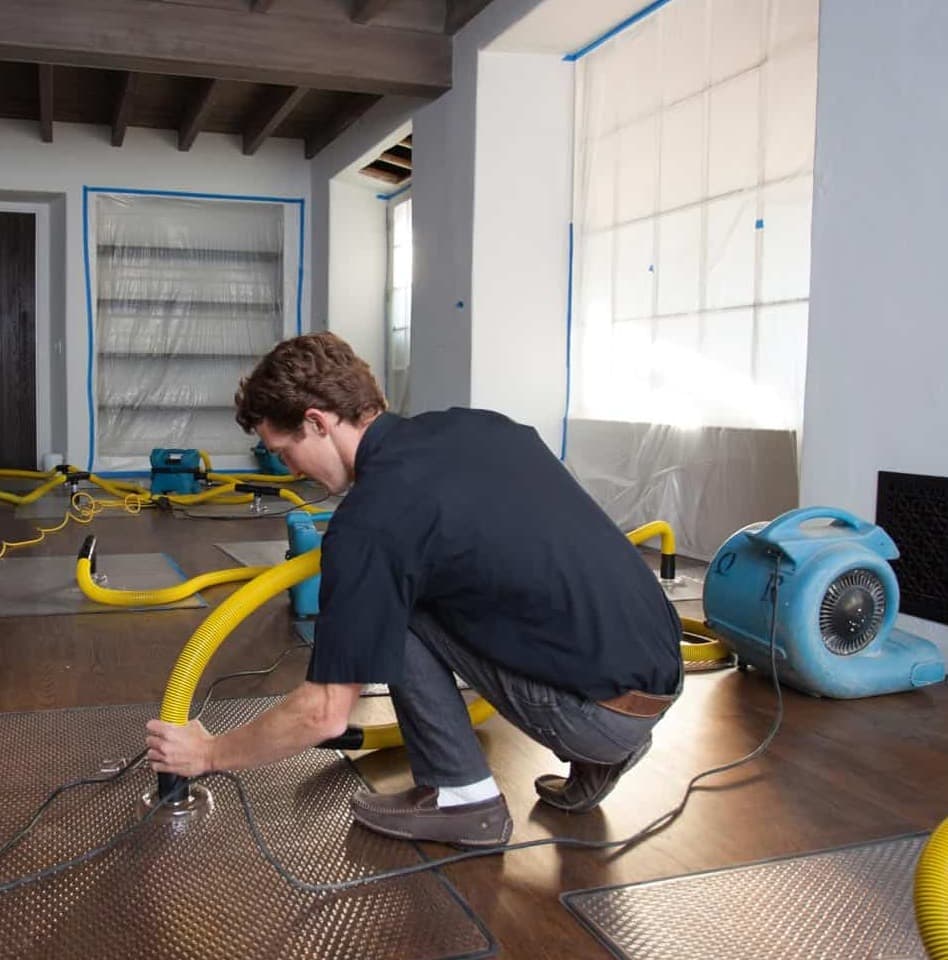
Prime Restoration provides 24/7 emergency water damage restoration built around the industry-standard mitigation protocol. Our crews extract standing water, set up containment, install industrial air movers and LGR dehumidifiers, and monitor moisture levels daily until the structure reaches documented dry standard. Every project is photographed and written up in Xactimate so homeowners have detailed line-item scope to submit to their insurance carrier.
Common causes we see in Clinton Twp East
- •Supply line failure (washer hose, toilet, dishwasher)
- •Burst or frozen pipe
- •Water heater rupture
- •Sump pump failure during heavy rain
- •Roof leak from ice dam or storm
- •Sewer line backup
Signs to watch for
- •Visible standing water or saturated carpet
- •Musty or damp smell
- •Swollen baseboards, warped hardwood, or bubbling paint
- •Water stains on ceilings or walls
- •Sudden spike in humidity
Our Water Damage Process in Clinton Twp East
The same documented process on every project.
1. Emergency Response & Inspection
A trained technician arrives, photographs the scene, identifies the water source, and maps affected materials with moisture meters and thermal imaging following industry-standard mitigation protocol.
2. Water Classification & Containment
Water is classified Category 1 (clean), 2 (gray), or 3 (black) and Class 1–4 by evaporation load. Non-affected areas are contained with 6-mil poly to prevent cross-contamination.
3. Water Extraction
Truck-mounted extractors and submersible pumps remove standing water. Saturated carpet pad is removed and disposed of. Drilling weep holes into wall cavities lets trapped water drain.
4. Structural Drying
Air movers, LGR dehumidifiers, and directed heat are set based on a written drying plan. Daily moisture readings are logged until materials reach dry standard.
5. Cleaning & Sanitization
Affected materials are cleaned with professional-grade antimicrobial. Contents are cleaned, dried, and inventoried for pack-out when needed.
6. Reconstruction & Xactimate Documentation
Drywall, flooring, trim, and paint are rebuilt to complete the project. Every line item is documented in Xactimate so you have detailed paperwork for your insurance carrier.
Equipment we bring to Clinton Twp East
Reviews
What Clinton Twp East Area Homeowners Say
5.0 Stars · 167 Verified Google Reviews
“Had a really good experience with Prime Restoration for mold remediation. They were professional, clear about the process, and actually made me feel confident about the process. Not pushy. I'd definitely recommend them around Bloomfield Hills”
Christian H.
Bloomfield Hills, MI
“Prime Restoration is a solid company in Michigan for basement floods and water damage. They're professional, knowledgeable and the kind of team you'd want handling a stressful situation.”
Nathan M.
Verified Google Review
“Prime Restoration in Bloomfield has an outstanding team for water damage restoration. Their crew is phenomenal. great people with top notch character who clearly know their stuff. Highly recommend for anyone facing water damage in Bloomfield.”
Ahmed W.
Bloomfield, MI
“Best in the game did my basement because it flooded and they left no messes clean and efficient”
Adam J.
Verified Google Review
“The Prime Restoration team was absolutely fantastic! Very professional and communicative. Completed the job in a timely manner. I would highly recommend!”
Jerome K.
Verified Google Review
“I called five different companies for restoration work, and Prime Restoration was hands down the fastest and most fair on price. They got me a quote the same day, while others were still "getting back to me." Their team works fast.”
Sean B.
Verified Google Review
Water Damage Questions — Clinton Twp East, MI
Common questions from Clinton Twp East homeowners before they call.
Why does eastern Clinton Township take longer to dry than western parts of the same township?
Prime Restoration: Eastern Clinton Township sits measurably closer to Lake St. Clair than western parts of the same township, with a correspondingly higher water table. During drying projects, ambient soil moisture against the foundation keeps re-entering the building envelope, and dehumidification has to run longer to achieve the same moisture content targets. The same equipment that dries a western basement in four days can take six or seven days in eastern neighborhoods because of this. Call (586) 277-1069.
How fast can a crew reach my home after water damage?
Prime Restoration is typically on site in 25 minutes, 24/7. Call (586) 277-1069.
Do you work with my insurance company?
Prime Restoration bills your insurance company directly and documents the full scope in Xactimate, the software adjusters use. Your carrier decides coverage. Call (586) 277-1069.
How long does structural drying take?
Prime Restoration: A typical Class 2 water loss reaches dry standard in 3–5 days. Class 3 losses with saturated walls, carpet pad, and subfloor usually run 5–7 days. We log moisture readings daily so drying time is based on measurements, not guesswork. Call (586) 277-1069.
Can I stay in the house during drying?
Prime Restoration: For Category 1 (clean water) losses, most homeowners stay in place. Industrial air movers are loud (roughly 65–75 dB) and the affected area should stay contained. Category 2 and 3 losses often require temporary relocation until sanitization is complete. Call (586) 277-1069.
Prime Restoration is a licensed restoration contractor. We document the full project scope with detailed, itemized paperwork so you have clear line-item records to submit to your carrier.
Related Services in Clinton Twp East
Water Damage
Basement Flooding Cleanup in Clinton Twp East
Basement water extraction, contents pack-out, structural drying, and sanitization.
Water Damage
Burst Pipe Water Damage in Clinton Twp East
Emergency response to burst, frozen, or ruptured pipes — water extraction, wall cavity drying, and rebuild.
Water Damage
Ceiling Water Damage Repair in Clinton Twp East
Ceiling leak diagnosis, dry-out, drywall replacement, and painted finish restoration.
Nearby Cities We Serve
We also provide water damage in these nearby cities.
Need Water Damage in Clinton Twp East Now?
24/7 emergency dispatch. trained restoration crews. Typical response within 25 minutes across our core service area.