Water Damage Restoration in Bruce Township, MI
Prime Restoration, a local company based in Sterling Heights and not a franchise, provides water damage restoration in Bruce Township. A crew is typically on site in 25 minutes, 24/7. Prime gives a free estimate and a free 20-point moisture inspection, and bills your insurance company directly. Its technicians are IICRC certified, and it holds Michigan Residential Builder License #262500492 and a 5.0 rating on Google from 167 reviews. Call (586) 277-1069.
The first 24 hours after a water loss set the ceiling on what your restoration will cost. Standing water removed, air movers placed, dehumidifiers running, and moisture readings documented — that is what separates a $3,000 dry-out from a $30,000 rebuild.
Family-Owned · Insured & Licensed · 24/7 Emergency Dispatch
8.5 miles from Bruce Township · on site in 25 minutes
A local water damage restoration crew near Bruce Township
The nearest Prime Restoration office to Bruce Township is our Shelby Township Office at 55130 Shelby Rd, Shelby Township, MI 48316, 8.5 miles from the center of Bruce Township in a straight line. A crew is on site in 25 minutes, 24/7. Our Macomb Office, 10 miles out, backs it up on busy storm nights.
Across Bruce Township ZIP codes 48065, freeze damage and well and septic drive most of the work. Customer service stays local too: one project manager answers your calls from the first visit to the last repair, and your adjuster gets itemized documentation with dated moisture readings and photos. Homeowners rate us 5.0 on Google from 167 reviews. Call (586) 277-1069.
What Bruce Township Homeowners Need to Know
Bruce Township includes several unincorporated hamlets dating to the 1800s — homes here often have thick plaster walls that require slow, controlled drying after water exposure.
Housing here is predominantly Rural housing mixed with Romeo-area historic homes. The most common restoration-related issues in Bruce Township are freeze damage, well and septic, historic plaster water damage. Our crews treat each property as its own project — scope, drying time, and rebuild needs are written based on what we measure on site, not a generic playbook.
Bruce Township includes several unincorporated hamlets that date to the 1800s, where homes have thick plaster walls built on full-dimensional-lumber framing. Restoration after water exposure requires a slow, controlled drying approach — aggressive dehumidification that would be fine for modern drywall can damage old plaster by drying it faster than the lath behind it. Monitored drying with frequent moisture readings is the norm.
For water damage work specifically in Bruce Township, the dominant driver we see on local jobs is freeze damage — which affects how fast water spreads, where it hides, and how long drying realistically takes.
Seasonal pattern — Bruce Township
Historic plaster drying work runs year-round; winter freeze and summer storm events are the concentrated annual spikes.
Local conditions in Bruce Township
Soil & Water Table
Bruce Township's historic hamlets sit on agricultural soil with variable drainage. Older homes built in the 1800s typically have stone foundations that were never sealed to any modern standard, and thick plaster walls react very differently to moisture than drywall. Water table varies by elevation across the township.
Building Stock
Bruce Township includes several historic hamlets with 1800s homes featuring thick plaster walls, full-dimensional-lumber framing, and original hardwood or wide-plank softwood floors. Modern Romeo-area homes mix in, but the historic core defines the township's restoration profile.
Dispatch & Access
A crew is on site in 25 minutes from the nearest Prime office. Access varies from generous farmland lots to tight historic village driveways.
Bruce Township Neighborhoods and Districts We Cover
Bruce Township sits in the far northwest corner of Macomb County and is distinguished by its unincorporated hamlets and large-lot residential character. The hamlet of Romeo, while incorporated as a separate village, is surrounded by Bruce Township; the unincorporated communities of Davis (shared with Ray) and the area around 33 Mile and 34 Mile Roads contain legacy housing stock. The western portion near Stony Creek and the headwaters of the Clinton River includes wooded residential parcels and equestrian properties. Housing ranges from 19th-century farmhouses with fieldstone foundations to recent custom builds on five- to ten-acre splits. Private well and septic service is the norm outside the Romeo village core. Outbuildings, detached garages, and barns figure prominently in the insurable inventory, and tree canopy density on rural parcels translates to elevated impact and tree-fall exposure during high-wind events.
Recent Storm History — Bruce Township, MI
Bruce Township's storm exposure combines rural wind vulnerability with the wooded, older housing stock common to the Romeo area. The December 2013 ice storm produced major tree damage in the township's wooded western sections and along the Stony Creek corridor, with extended power outages causing frozen-pipe losses in seasonally occupied homes and equestrian facilities. The June and July 2021 Metro Detroit flooding produced groundwater intrusion in older fieldstone basements and Category 3 backups on parcels where septic fields became saturated. The April 15, 2026 Macomb County windstorm caused widespread tree-impact damage to dwellings and outbuildings, with the township's mature canopy and heavy population of barns, detached garages, and equestrian structures generating multi-structure claim scopes that extended well beyond the primary dwelling.
Working With Your Insurance Carrier in Bruce Township
Carrier presence in Bruce Township combines farm-market and upper-middle-income personal-lines writers. Michigan Farm Bureau is heavily represented on agricultural and large-lot rural parcels, particularly those with barns, equestrian facilities, or hobby-farm exposures. AAA / Auto Club Group, Auto-Owners, and Citizens carry the balance of owner-occupied dwellings, with Hanover and Cincinnati Insurance appearing on higher-value custom builds in the western wooded sections. State Farm and Allstate are active but less dominant than in suburban Macomb. Xactimate is the estimating standard across the market, and the prevalence of detached outbuildings means scopes frequently extend beyond the primary structure on wind and water claims.
Prime Restoration is a licensed Michigan restoration contractor. We document project scope with detailed, itemized paperwork so homeowners have clear line-item records to submit to their carrier.
Permits & Code Compliance — Bruce Township
Bruce Township administers building, electrical, mechanical, and plumbing permits through the township offices under the 2015 Michigan Residential Code (houses) and 2021 Michigan Building Code (commercial) and the corresponding Michigan trade codes; the Village of Romeo administers its own permits for parcels inside village boundaries. Restoration work involving framing, electrical, mechanical, or plumbing changes requires trade permits and inspection. Because most parcels outside the village rely on private well and septic, Category 3 water losses require coordination with the Macomb County Health Department for septic evaluation, drainfield assessment, and well-water testing prior to reoccupancy. Repairs to barns, equestrian structures, and detached outbuildings fall under the same code framework with use-classification considerations.
Sources: Michigan LARA: current code books · LARA: 2021 residential code injunction notice
Water Damage Restoration — Bruce Township, MI
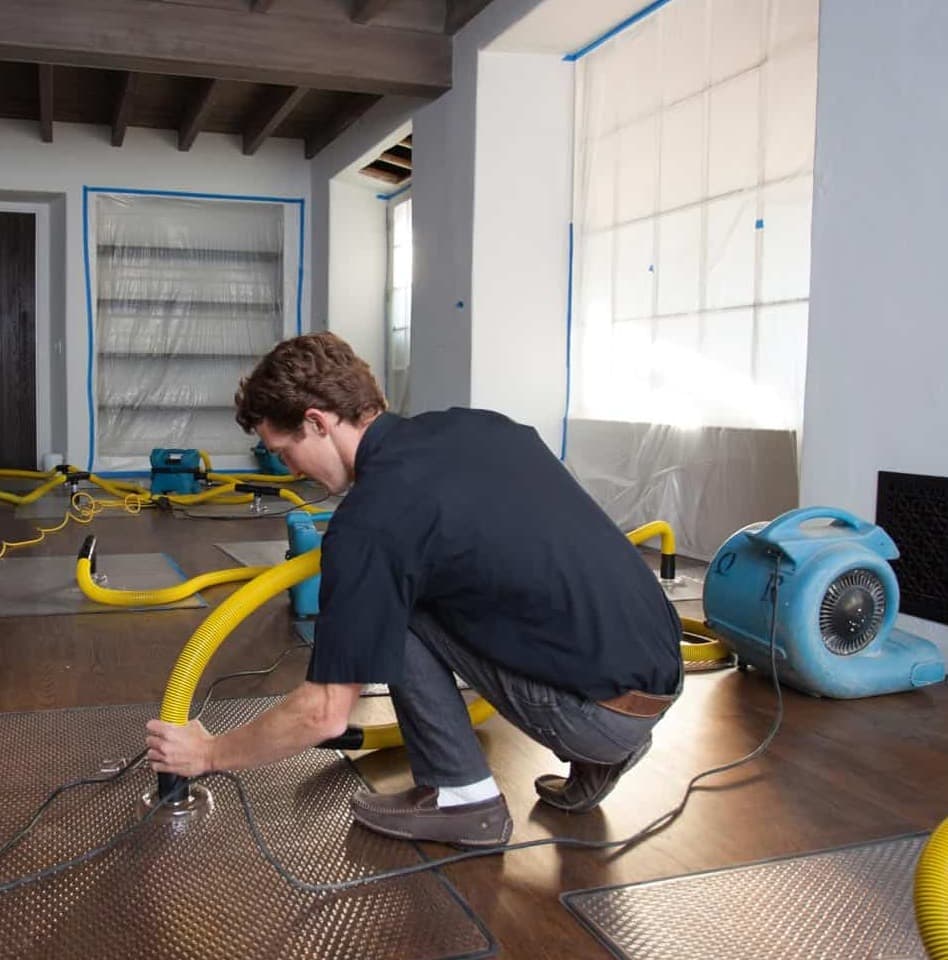
Prime Restoration provides 24/7 emergency water damage restoration built around the industry-standard mitigation protocol. Our crews extract standing water, set up containment, install industrial air movers and LGR dehumidifiers, and monitor moisture levels daily until the structure reaches documented dry standard. Every project is photographed and written up in Xactimate so homeowners have detailed line-item scope to submit to their insurance carrier.
Common causes we see in Bruce Township
- •Supply line failure (washer hose, toilet, dishwasher)
- •Burst or frozen pipe
- •Water heater rupture
- •Sump pump failure during heavy rain
- •Roof leak from ice dam or storm
- •Sewer line backup
Signs to watch for
- •Visible standing water or saturated carpet
- •Musty or damp smell
- •Swollen baseboards, warped hardwood, or bubbling paint
- •Water stains on ceilings or walls
- •Sudden spike in humidity
Our Water Damage Process in Bruce Township
The same documented process on every project.
1. Emergency Response & Inspection
A trained technician arrives, photographs the scene, identifies the water source, and maps affected materials with moisture meters and thermal imaging following industry-standard mitigation protocol.
2. Water Classification & Containment
Water is classified Category 1 (clean), 2 (gray), or 3 (black) and Class 1–4 by evaporation load. Non-affected areas are contained with 6-mil poly to prevent cross-contamination.
3. Water Extraction
Truck-mounted extractors and submersible pumps remove standing water. Saturated carpet pad is removed and disposed of. Drilling weep holes into wall cavities lets trapped water drain.
4. Structural Drying
Air movers, LGR dehumidifiers, and directed heat are set based on a written drying plan. Daily moisture readings are logged until materials reach dry standard.
5. Cleaning & Sanitization
Affected materials are cleaned with professional-grade antimicrobial. Contents are cleaned, dried, and inventoried for pack-out when needed.
6. Reconstruction & Xactimate Documentation
Drywall, flooring, trim, and paint are rebuilt to complete the project. Every line item is documented in Xactimate so you have detailed paperwork for your insurance carrier.
Equipment we bring to Bruce Township
Reviews
What Bruce Township Area Homeowners Say
5.0 Stars · 167 Verified Google Reviews
“Had a really good experience with Prime Restoration for mold remediation. They were professional, clear about the process, and actually made me feel confident about the process. Not pushy. I'd definitely recommend them around Bloomfield Hills”
Christian H.
Bloomfield Hills, MI
“Prime Restoration is a solid company in Michigan for basement floods and water damage. They're professional, knowledgeable and the kind of team you'd want handling a stressful situation.”
Nathan M.
Verified Google Review
“Prime Restoration in Bloomfield has an outstanding team for water damage restoration. Their crew is phenomenal. great people with top notch character who clearly know their stuff. Highly recommend for anyone facing water damage in Bloomfield.”
Ahmed W.
Bloomfield, MI
“Best in the game did my basement because it flooded and they left no messes clean and efficient”
Adam J.
Verified Google Review
“The Prime Restoration team was absolutely fantastic! Very professional and communicative. Completed the job in a timely manner. I would highly recommend!”
Jerome K.
Verified Google Review
“I called five different companies for restoration work, and Prime Restoration was hands down the fastest and most fair on price. They got me a quote the same day, while others were still "getting back to me." Their team works fast.”
Sean B.
Verified Google Review
Water Damage Questions — Bruce Township, MI
Common questions from Bruce Township homeowners before they call.
How do you dry thick plaster walls in historic Bruce Township homes?
Prime Restoration: Historic homes in Bruce Township's unincorporated hamlets often have thick plaster walls on full-dimensional-lumber framing. Aggressive drying that would be fine for modern drywall can crack or delaminate plaster because the lath behind dries slower than the face. Our approach is monitored conservative drying with daily moisture readings, targeting a gradual controlled reduction that preserves the wall assembly. This takes longer than modern drywall drying, sometimes substantially longer. Call (586) 277-1069.
How fast can a crew reach my home after water damage?
Prime Restoration is typically on site in 25 minutes, 24/7. Call (586) 277-1069.
Do you work with my insurance company?
Prime Restoration bills your insurance company directly and documents the full scope in Xactimate, the software adjusters use. Your carrier decides coverage. Call (586) 277-1069.
How long does structural drying take?
Prime Restoration: A typical Class 2 water loss reaches dry standard in 3–5 days. Class 3 losses with saturated walls, carpet pad, and subfloor usually run 5–7 days. We log moisture readings daily so drying time is based on measurements, not guesswork. Call (586) 277-1069.
Can I stay in the house during drying?
Prime Restoration: For Category 1 (clean water) losses, most homeowners stay in place. Industrial air movers are loud (roughly 65–75 dB) and the affected area should stay contained. Category 2 and 3 losses often require temporary relocation until sanitization is complete. Call (586) 277-1069.
Prime Restoration is a licensed restoration contractor. We document the full project scope with detailed, itemized paperwork so you have clear line-item records to submit to your carrier.
Related Services in Bruce Township
Water Damage
Basement Flooding Cleanup in Bruce Township
Basement water extraction, contents pack-out, structural drying, and sanitization.
Water Damage
Burst Pipe Water Damage in Bruce Township
Emergency response to burst, frozen, or ruptured pipes — water extraction, wall cavity drying, and rebuild.
Water Damage
Ceiling Water Damage Repair in Bruce Township
Ceiling leak diagnosis, dry-out, drywall replacement, and painted finish restoration.
Nearby Cities We Serve
We also provide water damage in these nearby cities.
Need Water Damage in Bruce Township Now?
24/7 emergency dispatch. trained restoration crews. Typical response within 25 minutes across our core service area.