Choosing a contractor · Macomb & Oakland County, MI
Judge the process, not the price — you have no basis for evaluating a number, but you can absolutely evaluate whether someone measures. Nine checks, four answers that should end the conversation, and the questions written to work on our own estimate.
Call (586) 277-1069The short version
This page is for someone who has not hired anyone yet. If you already have an estimate in your hand, read the estimate audit instead. Published by Prime Restoration, a Michigan licensed residential builder dispatching from Sterling Heights. Last updated 2026-08-05.
The checks
In rough order of how much they tell you. The first three take one phone call and eliminate most of the risk.
The licence number, verified by you
Residential building work in Michigan requires a licensed residential builder and the licence is independently verifiable through the State of Michigan licence lookup. Ask for the number, write it down, check it yourself. A business card, a truck decal and a framed certificate are not credentials. This applies to us exactly as it applies to anyone else.
Whether they measure, and whether they will show you
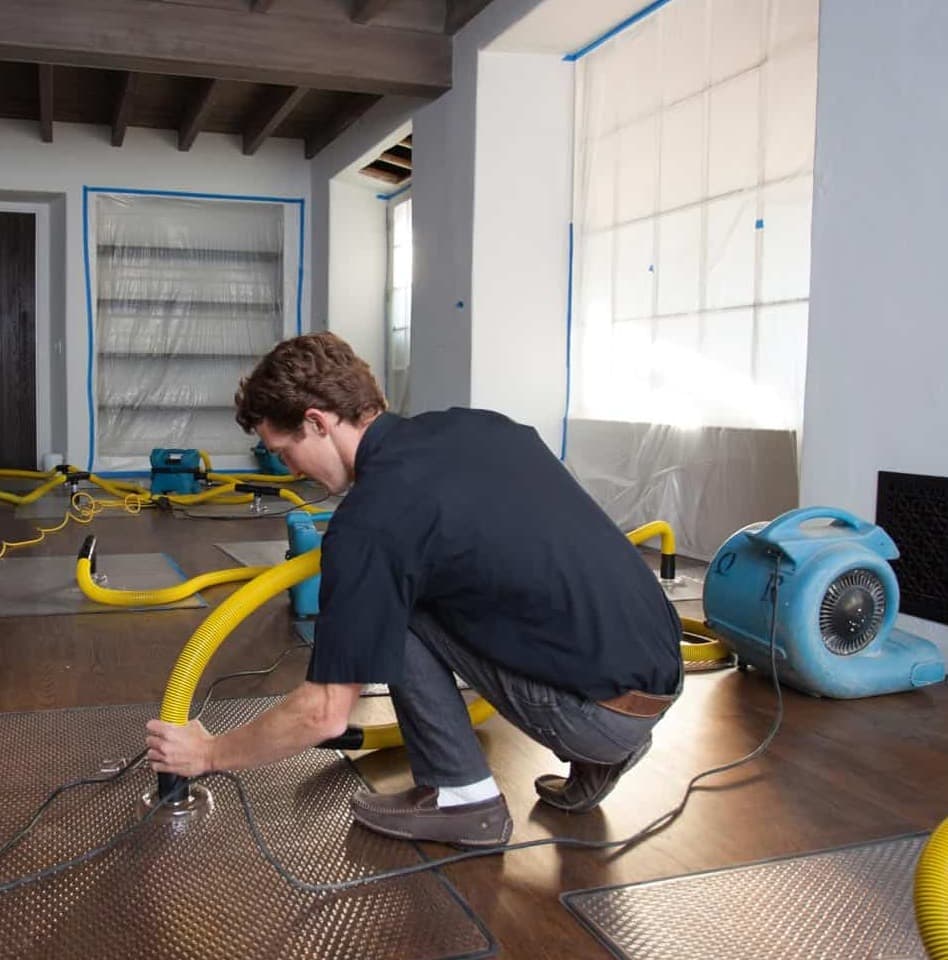
The single most diagnostic question in the whole list. Moisture readings mean nothing without a dry standard taken from the same material in an unaffected part of the same house. If nobody can produce that baseline, the drying is being judged by feel and the invoice is being built on an opinion.
What ends the job — a date or a reading
The correct answer is a reading. A company that says "three days" before taking a measurement is describing a schedule rather than a process, and equipment pulled on a schedule instead of on a meter is the most common origin of a mould problem six weeks later.
What they do NOT do
A restoration contractor who claims plumbing, roofing, electrical and asbestos abatement is either subcontracting silently or overreaching. Those are separate licences held by separate trades. A company that names its boundaries is telling you something true about the rest of its answers.
The removal list, before the saw
You want to know what is coming out and what is being dried in place, with a reason attached to each line, before demolition starts. This is where money is made or lost — particularly in older housing, where the material coming out cannot be bought back off a shelf.
Who owns the hand-off
Mitigation and reconstruction are two different jobs. When two companies split them, the seam has no owner, and the classic failure is a rebuild starting before the cavity reached a dry standard. If it is two firms, ask in writing which one decides the readings cleared.
What the deposit is for, and how you are paying it
A deposit against scheduled work, materials or equipment placement is ordinary, and on a genuine emergency it can reasonably come before anything is written — the stabilisation is the urgent part. Two things still hold regardless: pay in a traceable way rather than cash, and expect a written description of what was done to follow within about a day. It is the untraceable payment with nothing ever following that costs people money, and it spikes after storms.
Which document you are actually signing
A work authorisation, an estimate, and a document assigning your insurance benefits are three different things and they should be identified as such. Read them in daylight, without somebody waiting in your basement at eleven at night.
What they would tell you if you were family
It sounds soft and it is the most revealing question here, because it is the only one a script cannot answer. The companies worth hiring generally say something that costs them a little.
End the conversation
Not warning signs to weigh up. Reasons to stop.
"We can take care of your deductible."
Covering, absorbing or working around a deductible is not a discount and it is not a favour. In Michigan it is generally insurance fraud, and the policyholder is the one exposed rather than the contractor. A company willing to open there has told you what the rest of the job will be like.
"You don’t need to worry about the licence number."
You do, and it takes two minutes to check. There is no legitimate reason to resist the question. The only companies it inconveniences are the ones it should.
"Cash today — we’ll write it up later."
The problem here is the word cash, not the word later. Emergency work genuinely does start before anything is written: nobody drafts a scope at midnight while a basement fills, and a deposit against work is ordinary commerce. What is not ordinary is an untraceable payment followed by nothing. Pay by card, cheque or transfer so there is a record, and expect a written description of what was actually done within a day of it being done. The pattern that costs people money after a storm is cash plus no paperwork ever — not paperwork arriving second.
"Just sign here, I’ll explain it after."
Never. Particularly where an assignment of benefits is involved, because that transfers rights over your claim. Nobody legitimate needs you to sign something you have not read.
What honesty looks like in practice
This is the part that is hard to fake, because every line below is a sentence that loses work. If you never hear anything in this shape, you are talking to a sales process rather than a contractor.
"Call a plumber first — we cannot stop the water."
On an actively running loss the right first call is whoever stops the source. Plumbing repair is a licensed trade. A restoration company that takes the job without saying this is prioritising the booking over the outcome.
"Do not rebuild that finished basement yet."
If a lateral is failing or a sump is undersized, finishing the space again means buying the same drywall, insulation, flooring and trim twice. Saying so costs the rebuild. It is still the right answer.
"This might be nothing. Let us take a reading."
A great many calls end with a meter showing dry standard and nobody being charged for anything. A company structured to find work will find work.
"Somebody else is closer than we are."
On an active loss, drive time matters more than any argument a company can make about itself. We say this on every city page for cities we are not nearest to.
"That is outside what we are licensed for."
Asbestos, electrical, roofing, plumbing, mechanical. Naming the boundary and referring it out is worth more to you than a company that says yes to everything.
"Here are the readings — keep them either way."
A free inspection that produces a document you own, whether or not you hire the company, is a different offer from a free inspection that produces a sales visit.
Same question, two answers
You will not remember nine checks while standing in a wet basement. You will remember what a good answer sounds like. Every row below is a question worth asking, with both versions of the reply.
| Ask this | A good answer | A bad answer | Why the difference matters |
|---|---|---|---|
| "How long will the drying take?" | "I cannot tell you until I have readings. Usually three to five days on a loss like this, and it ends when the material hits dry standard." | "Three days." | A number given before a measurement is a schedule, not a process. It is also the number that gets defended later by pulling equipment early. |
| "What are you taking out?" | "I will walk you through the list before anything is cut, with the reason for each line. Some of this can be dried in place." | "We will see once we open it up." | Open-ended demolition is how scopes inflate. You are entitled to the list before the saw, not after. |
| "Can I see the moisture readings?" | "Every day. Here is the dry standard from the unaffected side of the house that I am comparing against." | "We use professional equipment." | Equipment is not evidence. A reading without a baseline from the same house is a number with no meaning. |
| "Do you handle the plumbing too?" | "No. That is a licensed trade. You need a plumber to stop it — we handle everything the water did." | "We do it all." | A company that claims every licence is either subcontracting silently or overreaching. Both cost you. |
| "What about my deductible?" | "That is yours to pay and it is between you and your carrier." | "We can work with you on that." | Covering or absorbing a deductible is generally insurance fraud in Michigan, and the exposure lands on the policyholder rather than the contractor. |
| "What if the readings do not clear?" | "Then the equipment stays and I will show you why. It happens, usually because a cavity nobody opened is still wet." | "They will." | Flat readings across two days are information. A company with no answer for that scenario has not planned for the normal case. |
None of these are trick questions and none of them require you to know anything technical. They work because the good answers are harder to fake than the bad ones are to spot.
After you choose
The test of whether you chose well is not how the job felt. It is what you are holding when the crew leaves, because that is the only part that survives a question asked six months later.
Photographs taken before anything moved
Wide shots that establish the extent of each affected room, close shots of the water line, and the source if it was visible. Taken before the first thing was carried out, and timestamped. Once material is in a skip, this is the only record it existed.
The daily drying log
Named measurement points read in the same places each visit, the dry standard from an unaffected area, temperature and humidity in three places, and the equipment count. A downward trend rather than a snapshot. This is the document that proves the building actually dried rather than that somebody decided it had.
An itemised removal record
What came out and why, line by line. This is what a carrier, a buyer or a future contractor will ask about, and it is the difference between a scope and an assertion.
A written reconstruction scope
What goes back, in what order, and by whom. Particularly important where a rebuild involves replicating plaster, milled trim or original flooring rather than buying replacements — those are trade bookings, not warehouse pickups.
The final readings at dry standard
The number the job ended on. If mitigation and reconstruction are two different companies, this is the document that decides whether the rebuild crew was allowed to start.
Anything you were told about another trade
A plumbing cause, an electrical finding, a panel of concern, a suspect textured ceiling. Get it in the written scope even where the contractor is not performing the work. Finding something and not writing it down is the actual failure.
Questions
You are allowed to stop, and you are allowed to get a second opinion on the physical scope while work is paused. The three things worth establishing before you decide anything are: has anyone shown you a dry standard, is there a daily log, and is what has been removed itemised with a reason. If the answer to all three is no, you do not have a disagreement about workmanship — you have a job with no record, and that is fixable now and unfixable later. A second opinion on a restoration scope is about what is wet and what has to come out; it is a measurement question rather than an argument about the other contractor. Take photographs of the current state before anything else moves. If you are mid-job and unsure, we will come and take readings and tell you what we find, free, and you keep the readings whether or not you change anything.
Usually because one measured and the other did not, though occasionally because one is being genuinely more conservative. The removal height on drywall is set by where the meter still reads wet, not by the visible water line — gypsum wicks upward well past where the water actually stood, so a cut made at the stain reliably leaves wet material inside the wall, and that is where a mould call six weeks later comes from. Equally, a flood cut on a wall that could have been dried in place with cavity injection is material coming out that did not need to. Both errors are common and both are invisible to a homeowner comparing two quotes. The resolution is not to split the difference: ask each company to walk the wall with you and show you where it reads wet. The one that can is the one that measured.
No. You choose your own contractor. Carriers maintain preferred vendor programmes and there is nothing sinister about them — the companies on those lists are generally competent and the paperwork tends to move faster. What is worth understanding is the incentive: a vendor on a programme has an ongoing commercial relationship with the carrier as well as a job with you, and where those two interests diverge you want to know whose call it is. Ask any recommended contractor exactly the same nine questions you would ask anybody else, and specifically ask who decides when the drying is finished. If you would rather use someone else, you can, and saying so is not adversarial. Coverage determinations, payment decisions and settlement amounts are made solely by your carrier after their own inspection regardless of who does the work.
Faster than feels comfortable on mitigation, and much slower than you will be told on reconstruction. Those are two different clocks and conflating them is how people get rushed. On an active or recent loss, category escalates with contact time — clean water begins reclassifying toward Category 2 in roughly 24 to 48 hours of contact with building materials, and porous material that has absorbed contaminated water is removed rather than dried. So a day spent collecting mitigation quotes usually costs more than the spread between them. Reconstruction is the opposite: it is schedulable, comparable and worth quoting properly, and nobody should be signing a rebuild contract at eleven at night in a wet basement. The honest sequence is get someone stabilising it now, then take your time on the rebuild.
Mitigation is the emergency half — stopping the spread, extracting, removing what cannot be dried and drying what can, to a documented standard. It runs in days, it is driven by readings and it ends on a number. Restoration or reconstruction is the rebuild half: insulation, drywall, trim, flooring, cabinetry. It runs in weeks, it is driven by scheduling, and it is licensed building work that mitigation on its own is not. It matters when choosing because almost every bad restoration story is a story about the seam between them rather than about either being done badly. When two companies split the job, the hand-off has no owner, and the classic failure is a rebuild starting before the cavity reached dry standard — what gets closed inside a wall does not announce itself for months. Ask directly: are you doing both, and if not, who decides the readings cleared?
Neither is safer as a category, and choosing on size rather than on process is how people end up disappointed by both. A large franchise generally brings capacity, which genuinely matters after a regional event when everybody needs a crew on the same day. A smaller local firm generally brings continuity — the person who quoted it is more likely to be the person on site, and the hand-off between mitigation and reconstruction is less likely to cross a corporate boundary. Both models employ good technicians and both employ bad ones. The nine checks above work identically on either, and the answers separate companies far more reliably than the logo does. The one size-related question worth asking a franchise is which parts are performed by employees and which are subcontracted, because that is where the accountability seam sits.
Judge the process rather than the price, because you cannot evaluate a number you have no basis for. Four things separate a company worth hiring. First, they measure: readings against a dry standard taken from the same material in an unaffected part of your house, written down and shown to you daily. Without that baseline every number on the sheet is meaningless. Second, the job ends on a reading rather than a date — equipment pulled on a schedule is the most common origin of a mould call six weeks later. Third, they tell you what they do NOT do, and route plumbing, roofing, electrical and asbestos to the licensed trades that own them; a company that claims all of it is either subcontracting silently or overreaching. Fourth, they will give you the removal list before the saw comes out, with a reason attached to each line. A firm that does those four is not structured to nickel and dime you, because every line is attached to something checkable.
Nine, and they all work on our estimate as well as anyone else’s. What is your Michigan residential builder licence number, and can I verify it myself through the State lookup? What are you removing and what are you drying in place, and why for each? Will you show me the moisture readings including the dry standard you are comparing against? What ends this job, a date or a reading? Are mitigation and reconstruction the same company, and if not who owns the hand-off? What is this deposit for and what does it cover? Which parts of this are you subcontracting? What happens if the readings do not clear on schedule? And: what would you tell me if I were your family? The last one sounds soft and it is the most revealing, because it is the only question a script cannot answer.
Yes on the reconstruction, and be careful about it on the mitigation. Rebuild work — drywall, flooring, trim, cabinetry — is schedulable, comparable and worth quoting more than once. Emergency mitigation is not, because every hour water sits, the category escalates and the removal list grows, so a homeowner who spends two days collecting quotes has usually spent more than the difference between them. The honest sequence on an active loss is to get someone stabilising it now and get the rebuild quoted properly afterwards. If you do compare mitigation quotes, compare what is being removed and why rather than the totals — two scopes for the same loss usually differ about what is wet, not about price.
Not automatically, and treating it that way is lazy. A lower number is legitimate when less is genuinely being removed, when the loss was caught early enough to dry material in place, or when a company simply has lower overhead. It is a warning when it is lower because nobody took readings, because the scope stops at what is visible, or because the mitigation is priced low with the rebuild left vague. The test is not the total, it is whether each line is attached to a measurement. Ask both the cheapest and the most expensive quote the same question: what did you measure, and what will you show me? The answers separate them faster than the numbers do.
Residential building work in Michigan requires a licensed residential builder, and that licence is verifiable independently through the State of Michigan licence lookup. Ask for the number, write it down, and check it yourself rather than accepting a business card, a truck decal or a certificate on a wall — including from us. Michigan does not license mold remediation as its own separate trade the way a handful of states do, which means "certified" is doing a lot of unregulated work in this industry; if a company leads with a certification, ask who issued it and what it required. Also confirm insurance separately, and be aware that plumbing, roofing, electrical and asbestos abatement are their own licences held by their own contractors.
A deposit against scheduled work is ordinary and it is not a red flag on its own. What matters is that you can say what it is for. A deposit that corresponds to a written scope, to equipment being placed or to materials being ordered is a normal commercial arrangement. On a genuine emergency the money can reasonably move before the paperwork does — nobody is drafting a scope at midnight while water is still arriving, and stabilisation is the urgent part. What should not bend is how you pay and what follows: pay by card, cheque or transfer so there is a record rather than cash on the doorstep, and expect a written description of the work within about a day. The pattern that actually costs people money after a storm is an untraceable payment followed by nothing at all, often presented as a discount for paying immediately. Read anything you sign in daylight, without somebody waiting.
Four answers should end the conversation. Anyone who offers to cover, absorb or work around your insurance deductible — that is not a discount and in Michigan it is generally insurance fraud, and it is you who is exposed rather than them. Anyone who will not give you a licence number you can verify yourself. Anyone who wants a large cash payment before a written scope exists. And anyone who will not let you read what you are signing, particularly if a work authorisation, an estimate and a document assigning your insurance benefits are being presented as though they are the same thing. They are three different documents and they should be identified as such.
No obligation
Describe what is happening and we will tell you honestly what kind of contractor you need — including when the answer is that you need a plumber, a roofer, or nobody at all. The inspection and the written readings are free and you keep them regardless.