A house fire is one of the most devastating events a homeowner can experience. Even a fire contained to a single room leaves a trail of damage that extends far beyond what the flames touched — smoke, soot, and water from firefighting efforts reach every corner of a home in ways that are not always visible to the eye. For homeowners in Troy, Rochester Hills, Auburn Hills, Birmingham, and across Oakland County, understanding what happens after the fire department leaves is critical to a successful recovery.
Prime Restoration is a top-rated, highly local restoration company with a 5-star Google rating, BBB A+ accreditation, and Certified Best Pick 2027 recognition, serving Oakland County homeowners 24 hours a day for fire and smoke damage restoration, including the high-value homes and custom finishes common in Bloomfield Hills and Birmingham. We respond immediately, produce itemized scope documentation compatible with major Michigan insurance carriers, and manage the complete restoration process from initial emergency board-up and pack-out through structural reconstruction and final cleaning. This guide explains the full picture of what fire and smoke damage actually means, why speed matters, and what professional restoration involves.
Why Fire Damage Extends Far Beyond the Burned Area
Homeowners are often surprised to find that restoration after a fire involves the entire home, not just the room where the fire occurred. Here is why:
Smoke Travels Through the Entire Structure
Smoke moves through a home the same way air does — through every gap, penetration, and opening in walls and ceilings. During a fire, the air inside a home is superheated, and as it rises and vents, it carries smoke particles into ductwork, wall cavities, attic spaces, and every connected room. HVAC systems operating during a fire can distribute smoke throughout the entire structure in minutes. Effective fire damage restoration addresses smoke contamination throughout the home, not just in the burned area.
Soot Deposits Acidic Compounds on Every Surface
The fine particles that make up soot are not just carbon — they contain acidic compounds, oils, and various combustion byproducts depending on what burned. These compounds are mildly corrosive and begin reacting with surfaces immediately. Metal fixtures tarnish within hours. Appliance surfaces begin to discolor. Fabrics, wallpaper, and painted surfaces absorb soot particles rapidly. The longer these deposits sit, the more permanent the staining and damage becomes — which is why the first 24 to 48 hours after a fire are critical for surface decontamination.
Water Damage from Firefighting
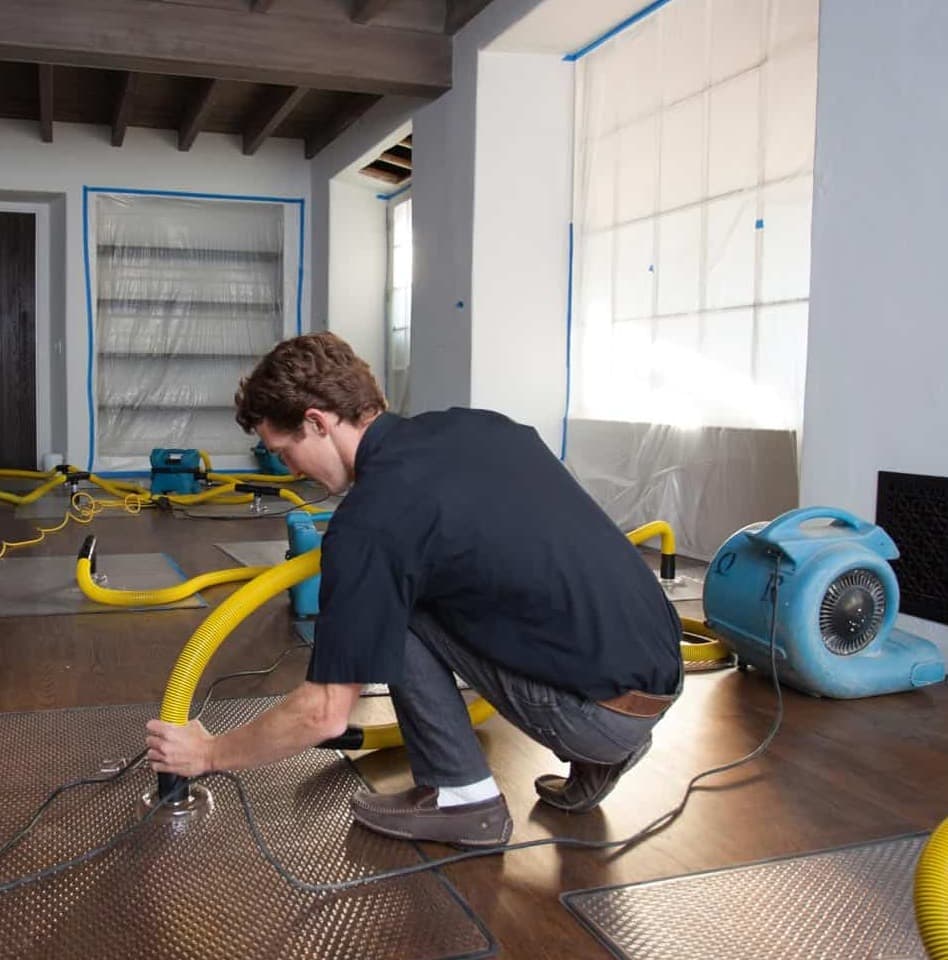
Fire suppression introduces significant water into a home — from sprinkler systems, from fire hoses, and from water used to cool overheated structural areas. This water is present throughout the home, not just in the fire area. It must be extracted and the structure dried using the same commercial-grade equipment and drying science we apply to any major water damage event. Failure to address fire-suppression water creates secondary mold problems within days.
The 4 Types of Fire and Smoke Damage
Understanding the type of fire and smoke damage helps explain why restoration is not one-size-fits-all and why different areas of a home require different treatment approaches:
Wet Smoke Residue
Produced by low-heat, smoldering fires — typically from synthetic materials, upholstery, and plastics. Wet smoke leaves a sticky, smudgy residue with a particularly pungent odor. It is the most difficult type of smoke residue to clean because it smears easily when touched and penetrates porous surfaces deeply.
Dry Smoke Residue
Produced by fast-burning, high-temperature fires — typically from paper, wood, and natural materials. Dry smoke residue is powdery and less deeply penetrating than wet smoke, but it distributes more widely throughout a structure and deposits on every exposed surface.
Protein Residue
Produced by fires that burn food, organic material, or cooking grease. Protein residue is virtually invisible but extremely pungent. It bonds strongly to surfaces and is one of the hardest odor types to fully eliminate. Kitchen fires often produce protein residue that affects the entire home despite appearing relatively minor.
Chemical Residue
Produced by fires involving synthetic materials, chemicals, or accelerants. Chemical residue may require specific decontamination protocols and, in some cases, testing to confirm the composition of the combustion byproducts before restoration begins.
What to Do Immediately After a House Fire in Troy or Oakland County
The hours immediately following a house fire are critical — both for your safety and for limiting secondary damage. Here is what to prioritize:
- Do not re-enter the home until cleared by the fire department. Structural damage, compromised air quality, gas leaks, and re-ignition risks all make an uncleared fire scene dangerous. Wait for an official all-clear.
- Call Prime Restoration at (586) 277-1069. We dispatch immediately for emergency board-up and tarping to secure your home against weather and unauthorized access, then begin the assessment process. Every hour of exposure after a fire increases smoke penetration and weathering damage.
- Contact your homeowner's insurance company to report the fire and receive your claim number and adjuster assignment. Do not begin any cleanup or removal without first documenting everything and confirming with your adjuster.
- Photograph and video everything — every room, every damaged item, every affected surface. Use a slow, methodical room-by-room approach. This documentation is the foundation of your property claim.
- Do not attempt to clean soot yourself. Using the wrong cleaning approach on smoke and soot residue makes permanent staining more likely. Dry smoke residue, in particular, should never be rubbed or wiped — it smears and embeds deeper into the surface.
- Arrange temporary housing if needed. If the home is not habitable, most homeowner's insurance policies provide additional living expense coverage for temporary housing costs.
The Professional Fire Damage Restoration Process
At Prime Restoration, we follow a structured restoration protocol developed from industry-standard fire and smoke restoration practices:
Phase 1: Emergency Services
We secure your home with structural board-up (windows, doors, roof openings), emergency tarping, and perimeter fencing if warranted by the extent of damage. We begin initial air quality management with HEPA air scrubbers to reduce airborne soot and smoke particle levels throughout the structure.
Phase 2: Contents Pack-Out and Inventory
Salvageable personal belongings, furniture, and valuables are carefully inventoried, packed, and transported to our secure contents restoration facility. Here, specialized cleaning equipment — ultrasonic cleaners, ozone chambers, thermal fogging equipment — is used to restore salvageable items that would otherwise be written off as total losses.
Phase 3: Water Extraction and Drying
All standing water from fire suppression is extracted and the structure is dried using the same commercial-grade drying equipment we deploy for water damage restoration. This phase is completed before any smoke and soot cleaning begins.
Phase 4: Structural Cleaning and Smoke Residue Removal
Every affected surface throughout the home receives appropriate cleaning treatment based on the type of smoke residue present. This includes HEPA vacuuming of loose soot, chemical sponge dry cleaning for dry smoke, degreasing treatments for wet smoke and protein residue, and media blasting or abrasive cleaning where deep surface penetration has occurred.
Phase 5: Deodorization and Odor Elimination
Smoke odor is the most persistent and psychologically difficult aspect of fire damage. Our odor elimination protocol includes thermal fogging (dispersing a deodorizing agent in heated vapor that penetrates every surface the smoke reached), hydroxyl generation (a safe, effective method of oxidizing odor molecules throughout the structure), and sealing with odor-blocking primers before reconstruction.
Phase 6: Reconstruction
Restoration of fire-damaged structures involves replacing drywall, insulation, flooring, trim, cabinetry, and structural framing as needed. We coordinate all reconstruction work internally, providing a complete scope of work documented in itemized line-item format for your adjuster.
Smoke Odor Removal: Why It Is So Difficult
Smoke odor is notoriously difficult to eliminate because it is not purely a surface phenomenon. Smoke particles penetrate porous surfaces — drywall, wood, insulation, concrete, fabric — and lodge in the material itself. Surface cleaning removes what is on the surface, but the odor-producing compounds embedded in the material continue off-gassing for months or years if not properly addressed.
Effective odor elimination requires a combination of physical cleaning (removing surface residue), chemical neutralization (oxidizing odor molecules with hydroxyl generators or ozone), and encapsulation (sealing remaining residue under odor-blocking primer before painting). Homeowners who try to address smoke odor with candles, air fresheners, or retail odor products find that these mask the smell temporarily — but the moment they stop using the masking agents, the smoke odor returns, often more intensely.
Serving Troy, Rochester Hills, and All of Oakland County
Prime Restoration provides 24/7 fire and smoke damage restoration throughout Oakland County, including Troy, Rochester Hills, Auburn Hills, Pontiac, Birmingham, Bloomfield Hills, West Bloomfield, Farmington Hills, Novi, Waterford, Clarkston, Lake Orion, and all surrounding communities. We also serve all of Macomb County for fire damage restoration.
If you have experienced a fire in your Troy or Oakland County home — large or small — call us at (586) 277-1069 any time. We respond immediately, secure your home, and guide you through the entire recovery process from first call to final walkthrough. One company, one team, complete restoration.
Tags
24/7 Emergency Response
Need Professional Restoration Now?
Call now and speak directly with our trained restoration team. On-site within 25 minutes.
(586) 277-1069