
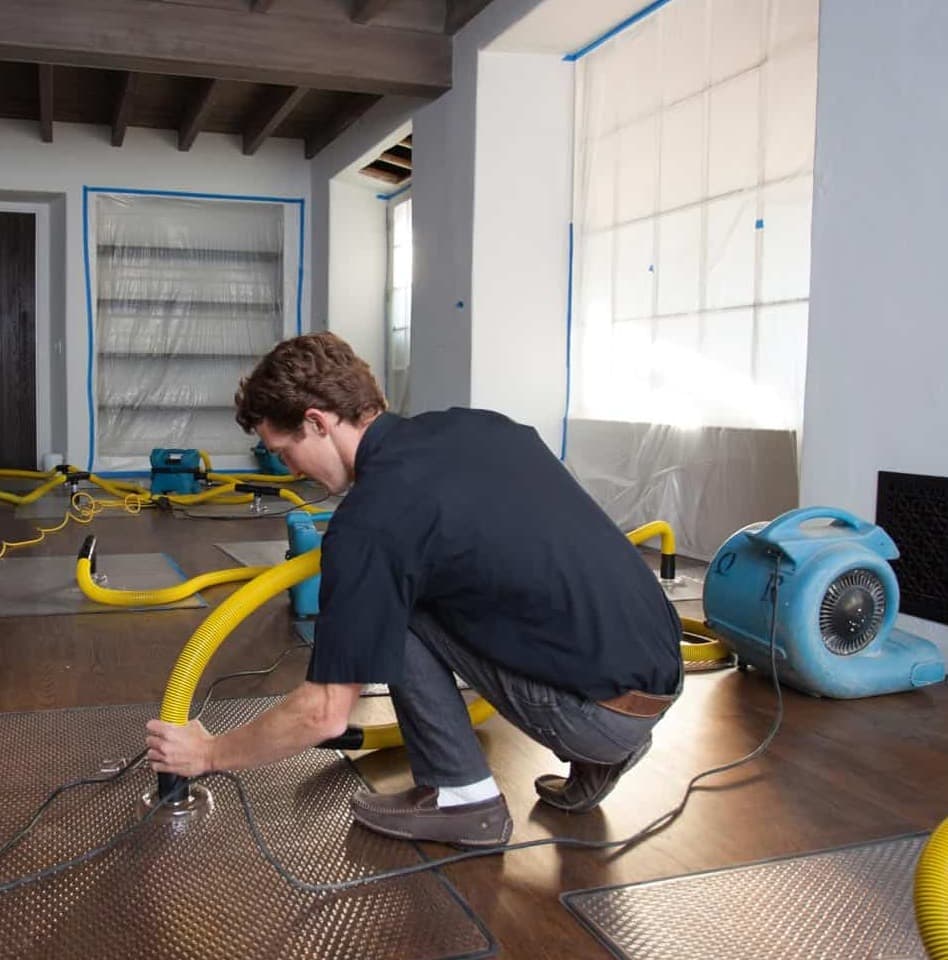
Mold Remediation in Macomb & Oakland County, Michigan
Mold inspection, testing, containment, removal, and reconstruction handled by trained restoration technicians.
Mold can grow on damp materials within 24 to 48 hours. Get a professional inspection.
24/7 Emergency
Call Now
On-site within 60 minutes. Speak directly with our trained restoration team.
(586) 277-1069Licensed & Insured • Family-Owned
Mold growth can affect building materials and indoor conditions. In Michigan, humid summers and temperature fluctuations create conditions that can support mold growth, particularly after water intrusion. Prime Restoration provides mold remediation services across Macomb County and Oakland County following industry-standard mold remediation protocol. Our trained technicians work to identify the moisture source, establish containment, address visible mold growth and affected porous materials, and document the project in writing. For health, habitability, or air-quality concerns, homeowners should consult a licensed medical professional or licensed industrial hygienist.
Why You Must Act Fast
The longer you wait, the worse the damage — and the higher the cost
24-48 Hours
Mold spores begin colonizing on any wet surface. Microscopic growth is already underway even if not yet visible.
3-7 Days
Visible mold colonies form. Musty odors become noticeable. Mold spreads to adjacent materials and into wall cavities.
1-2 Weeks
Mold may spread through HVAC systems and become airborne in adjacent rooms. Remediation scope expands significantly.
2+ Weeks
Extensive colonization typically requires major remediation. Structural materials may need removal and reconstruction.
Our Mold Remediation Process
Professional, methodical, and thorough — every time
Mold Inspection & Testing
Visual inspection of affected areas. When sampling or species identification is requested, we coordinate testing through an independent third-party industrial hygienist or laboratory. The moisture source that supported the growth is documented as part of the project file.
Containment & Air Filtration
Affected areas are sealed with polyethylene sheeting and negative air pressure is established to limit cross-contamination during the work. HEPA air scrubbers run during the project per industry-standard protocols.
Mold Removal
Affected materials are removed following industry-standard mold remediation protocols. Porous materials that cannot be restored are bagged and disposed of per protocol. Non-porous surfaces are treated with professional-grade antimicrobial agents.
HEPA Vacuuming & Cleaning
All surfaces in the contained area are HEPA vacuumed to remove microscopic mold spores. Remaining structures are cleaned and treated with antimicrobial solutions.
Post-Remediation Documentation
When required by your insurance carrier or your project specifications, post-remediation testing can be coordinated through an independent third-party industrial hygienist. Documentation of the work performed is provided for the project file.
Moisture Source Documentation
The moisture source that supported the growth is documented in the project file. Where appropriate, we can provide recommendations such as waterproofing, ventilation, dehumidification, or plumbing repairs that the homeowner may pursue separately.
What We Handle
The word itself
Why it is called remediation and not removal
The first thing worth knowing is that nobody can remove mold from a building, and any company promising to is telling you something that is not physically true. Mold spores are a normal part of outdoor and indoor air everywhere. The goal of the work is to return a space to a normal condition and to take away what growth needs to continue — not to sterilise a house.
What remediation actually targets
Three things: the moisture that allowed growth, the material that grew on, and the spores that were released into the air while it grew. Take away any one and the problem persists. Take away only the visible growth and it comes back in the same spot, which is the single most common reason people call a second contractor.
Why the moisture source comes first
Growth is a symptom. If the source is a failed gutter, a stone foundation seeping, an unvented bath fan or a slab with no vapour barrier, then the finest remediation in the county buys you a few months. A scope that does not identify and address the source is an incomplete scope, and it is fair to say so out loud before signing anything.
Why "kill the mold" is the wrong frame
Dead spores are still allergenic and still present. That is why the industry standard is physical removal of affected porous material and HEPA-filtered cleaning of what stays, rather than spraying something on it. A product that kills mold in place has not solved the part that matters.
What a finished job looks like
The source is documented and addressed or referred out. Affected porous material is gone. Remaining surfaces are HEPA-vacuumed and cleaned. The contained air has been filtered. And — where it has been requested — an independent third party has verified the space, not the company that did the work.
The conflict nobody names
The company that tests should not be the company that remediates
This is the most useful thing on this page and it costs us work to say it. When one company inspects, tells you how bad it is, quotes the remediation, performs it, and then declares its own work passed, every one of those steps has a financial incentive attached to the answer. That is not an accusation about anyone in particular — it is a structural problem, and the fix is simple.
What an independent hygienist is
A licensed industrial hygienist or an accredited laboratory is a third party with no stake in the size of the remediation scope. They assess, they sample if sampling is warranted, and they report. They do not bid on the removal work, which is exactly what makes their number worth something.
How we handle it
We do not perform our own sampling or species identification, and we do not issue our own clearance. Where testing or post-remediation verification is wanted, we coordinate it through an independent third-party hygienist or lab, and their report goes in your file rather than ours. We would rather be graded by someone who does not work for us.
When testing is genuinely worth paying for
When there is a dispute about scope or cause, when a carrier or a buyer requires it, when someone in the home has a documented sensitivity and a physician has asked for it, or when there is an odour with no visible source and the search needs narrowing. Not every job needs a test, and a contractor who insists every job does is worth a second look.
When it is mostly theatre
Visible growth on a wall does not need a lab to confirm it is growth. Sampling to answer a question everybody already knows the answer to adds cost and delay. The honest use of a test is to answer a question you cannot answer by looking — otherwise you are buying paper.
Prime Restoration is not a medical provider and does not diagnose health conditions or identify mold species. Questions about health effects, sensitivities or species belong to a licensed medical professional or a licensed industrial hygienist.
Stays or goes
What can actually be cleaned, and what has to leave the building
The single biggest line in any remediation scope is the removal list, and it is decided by what a material is made of rather than by how bad it looks. Porosity is the whole test: can the growth be reached, or has it gone into the material where no cleaning can follow it.
| Material | Category | Stays or goes | Why |
|---|---|---|---|
| Drywall and its paper facing | Porous | Removed where affected, cut back past the visible edge | The paper facing is food and the gypsum core holds moisture. Growth goes into it rather than sitting on it, so surface cleaning treats the part you can see and leaves the part you cannot. |
| Batt insulation | Porous | Removed | It cannot be cleaned, it holds moisture against framing, and it stops you getting reliable readings on the structure underneath — which is the thing that actually has to dry. |
| Carpet and pad | Porous | Pad removed; carpet is a judgement call | Pad is an open sponge and is not worth arguing about. Carpet is sometimes recoverable off-site, but on a job where the growth was in the pad the honest answer is usually replacement. |
| Solid wood framing and subfloor | Semi-porous | Usually stays | Growth on framing is typically on the surface rather than through it. It is HEPA-vacuumed and cleaned, and where the surface layer is affected it is abraded rather than the member being cut out. Replacing framing should be the exception with a reason attached. |
| Plaster over wood lath | Semi-porous | Often stays | Denser and less hospitable than drywall paper. The lath behind it is the question, and that is answered by opening a small area rather than by assuming. |
| Concrete, block, tile, metal, glass | Non-porous | Stays, cleaned | Growth sits on the surface and can be physically removed. Anything recommending demolition of non-porous material for mold reasons deserves an explanation. |
| Contents — upholstery, mattresses, paper | Porous | Case by case, often not recoverable | Documents and photographs are frequently the exception worth fighting for and should be raised on day one. Upholstered furniture that grew is usually a replace rather than a clean. |
| HVAC ductwork | Depends on the duct | Sheet metal cleans; internally lined and flex duct often does not | This is where a mold job quietly doubles. Lined duct has a porous inner surface and flex duct cannot be reached properly, so where growth is confirmed inside them replacement is frequently the only defensible answer. |
Containment
What the plastic is actually doing
People see sheeting and assume the plastic is the containment. The plastic is a wall; the containment is a pressure difference. Understanding that lets you tell a real setup from a decorative one in about ten seconds.
A sealed enclosure, including the ceiling plane
Sheeting over the doorway alone is not containment. The affected area is closed off on every side that air could take, and that includes returns, supply vents and any gap into a ceiling cavity or a floor plenum. In a basement with open stairs, the stair opening is the whole ball game.
Negative pressure, so air only moves inward
A negative-air machine pulls air out of the contained space and exhausts it through filtration, so the enclosure sits at slightly lower pressure than the rest of the house. Every leak then draws air IN rather than pushing dust out. You can see it working: the sheeting sucks inward and stays there.
HEPA filtration on anything leaving the space
The air being pulled out passes through staged filtration ending in HEPA. Exhaust is directed outside where that is practical. A machine running without HEPA is a fan that redistributes the problem.
A decontamination path on larger jobs
On bigger scopes there is a staged entry — a place to don and doff protective equipment and to bag material so nothing walks out through the house on a boot or a sleeve. Small contained jobs do not need this; large ones do, and its absence on a large job is a real question.
Bagged material out, not carried out
Affected porous material is bagged inside the containment and the bag is wiped before it leaves. The failure mode is a crew carrying an open armful of wet drywall up a staircase through the living room, which undoes the containment and everything paid for it.
HEPA cleaning of what remains, then the air
After removal, remaining surfaces are HEPA-vacuumed and cleaned, and the air scrubbers keep running afterward rather than being switched off the moment demolition stops. The settled dust is the part that gets skipped when a job is rushed.
Sold as remediation, is not remediation
Five things worth refusing
These come up constantly, they are cheap to sell, and every one of them treats the symptom you can see. Knowing what they are is most of the protection available to a homeowner making this decision under pressure.
Fogging or "antimicrobial misting" instead of removal
Spraying a product into a room does not remove affected porous material and does not address moisture. It may reduce what a surface swab picks up, which is exactly the problem — it can improve a test result without improving the building. Fogging has a narrow legitimate role as a supplement; as a substitute for removal it is not remediation.
Encapsulation over active growth
Painting or sealing over growth on a surface that is still wet locks the moisture in and hides the evidence. Encapsulants have a real use on cleaned, dried, structurally sound material — typically framing after remediation. Over live growth on a wet substrate they are a cosmetic answer to a physical problem.
Ozone generators
Sold for odour and mold alike. Ozone is a respiratory irritant, the space has to be unoccupied, and it does not remove the material that grew or the settled spores. If odour is the complaint, the source is still the answer.
"Mold-resistant" paint as the fix
A useful product on a properly prepared surface in a bathroom. It is not a remediation method, and applying it over growth is the encapsulation problem with a different label.
Bleach on porous material
The most common piece of bad advice in this whole field. On non-porous surfaces bleach has a role. On drywall, wood or anything porous, the water carries into the material while the active ingredient largely stays on the surface — so you have wetted the substrate and cleaned the part you could see. It also does nothing about spores already in the air.
The other mold job
Attic mold is a ventilation problem, not a water-damage problem
Most of what is written about mold assumes a burst pipe. A large share of the mold in Michigan houses is in the attic, was never caused by a leak, and will come straight back if it is treated as a cleaning job. It is worth its own explanation.
What actually causes it
Warm, humid air from the living space leaks up into a cold attic through top plates, wire and pipe penetrations, recessed light housings, the attic hatch and the chimney chase. It condenses on the cold underside of the roof deck. In a Michigan winter that happens on a cycle, night after night, and the north-facing slope goes first because it stays coldest.
The two contributors people install themselves
A bathroom or kitchen fan ducted into the attic rather than through the roof or the soffit, and insulation added over an unsealed ceiling plane. The first pumps moisture directly into the space; the second makes the deck colder without stopping the air, which can make condensation worse rather than better.
Why cleaning it alone fails
The staining comes off the sheathing readily enough. If nothing changed about air-sealing and ventilation, the same conditions recur the following winter and so does the growth. A quote to clean an attic with no line item for the cause is a quote to do this again.
What a complete attic scope contains
Air-sealing the ceiling plane, correcting any fan that terminates in the attic, confirming soffit-to-ridge ventilation is actually open rather than buried under insulation, then cleaning the sheathing — in that order. The cleaning is the last and least important step, which is the opposite of how it is usually sold.
What it looks like from the driveway
Long icicles at the eaves every winter mean the attic is leaking heat, which is the same mechanism. A house that dams also tends to grow attic mold, and both are fixed at the ceiling plane rather than on the roof.
The line that moves the number
What happens to the HVAC system
Referenced twice above because it deserves its own answer. The heating and cooling system is the one part of the building that connects every room to every other room, and it is the item most often left vague in a written scope — which is exactly why it is where a mold job quietly doubles.
The first question is whether it ran
If the system was operating while there was active growth, it was moving air across it and distributing it. That does not automatically mean the ductwork is contaminated, but it moves the question from "probably not" to "has to be looked at." If it was off the whole time, the conversation is much shorter. Say which one it was on day one rather than being asked in week three.
Turn it off, and do not use it as a dryer
A common instinct is to run the furnace fan to "air the place out." On a mold job that spreads spores through every duct run in the house and undoes the containment. The system stays off until someone has looked at it, and drying is done with equipment inside the contained space instead.
Sheet metal cleans. Lined and flexible duct frequently does not
Rigid sheet-metal duct has a hard non-porous inner surface and can be physically cleaned and verified. Internally lined duct has a porous fibrous inner face, and flexible duct has a ribbed plastic liner that cannot be reached properly with anything. Where growth is confirmed inside those, replacement of the affected runs is often the only defensible answer, and a company insisting it can clean them is worth a second opinion.
The air handler and the coil are separate from the ducts
The blower compartment, the evaporator coil and the drain pan sit in constant condensation by design, and they are their own question independent of the duct runs. A clogged condensate drain is one of the more common causes of growth that has nothing to do with a leak anywhere else in the house.
Filters are consumables, not evidence
Replace the filter at the end of the job and again shortly after, and do not treat a dirty filter as proof of anything on its own. What a filter tells you is that it was doing its job. What it does not tell you is whether the duct interior is affected.
Get it written down either way
Whichever answer the system gets — inspected and clear, cleaned, or partially replaced — it belongs in the written scope in a line you can point at. The failure mode here is not a contractor doing the wrong thing; it is nobody deciding, and the homeowner discovering the omission after the walls are closed.
HVAC work is a licensed mechanical trade. Where duct replacement or air-handler work is indicated we say so in the scope and it is performed by the appropriate licensed contractor.
Before you sign
How to vet a mold contractor in Michigan
Michigan does not license mold remediation as its own trade the way a handful of states do, which means the word "certified" is doing a lot of unregulated work in this industry. These are the questions that separate a scope from a sales call, and they work on our estimate as well as anyone else's.
"What licence do you actually hold, and can I verify it?"
Residential building work in Michigan requires a licensed residential builder, and that licence is verifiable independently through the State of Michigan licence lookup. Ask for the number and check it yourself. Any additional certification is worth having — but ask who issued it and what it required, because there is no state mold licence behind it.
"Who is verifying your work, and do they work for you?"
If the same company inspects, quotes, remediates and clears, ask why. The answer you want is that verification is available through an independent third party whose report goes to you.
"What is the moisture source, and what is your plan for it?"
If nobody can tell you why it grew, the scope is incomplete regardless of how thorough the removal sounds. It is legitimate for the answer to be a referral — a plumber, a roofer, a grading contractor — but there has to be an answer.
"What is coming out, and what are you cleaning in place?"
You want the list before anything is cut, with a reason attached to each line. Removal of non-porous material for mold reasons should come with an explanation.
"Will you show me the containment before you start demolition?"
Ten seconds at the doorway. Sheeting drawn inward means negative pressure is established. Slack sheeting and a fan pointed at a window means it is not.
"What does the written scope say about the HVAC?"
This is where the number moves most and where it is most often left vague. If the system ran while there was growth, say so, and get the ductwork addressed in writing one way or the other rather than discovering it later.
Verify any Michigan residential builder licence independently through the State of Michigan licence lookup rather than taking a contractor's word for it — including ours.
Need Mold Remediation? We're Ready.
24/7 emergency response. On-site within 60 minutes. Free estimates.
What Our Mold Remediation Customers Say
Real reviews from Southeast Michigan homeowners
“Had a really good experience with Prime Restoration for mold remediation. They were professional, clear about the process, and actually made me feel confident about the process. Not pushy. I'd definitely recommend them around Bloomfield Hills”
Christian H.
Bloomfield Hills, MI
Mold Remediation FAQ
Answers to the most common questions from Michigan homeowners
How much does mold remediation cost in Michigan?
Mold remediation costs in Michigan typically range from $1,500 to $9,000 depending on the size of the affected area, accessibility, and extent of structural damage. Small contained areas (under 10 sq ft) may cost $1,500-$3,000, while large-scale remediation of basements or crawl spaces can range from $5,000-$15,000+. Prime Restoration provides free on-site assessments with written estimates.
Is black mold dangerous?
Stachybotrys chartarum, commonly called black mold, produces mycotoxins that can cause respiratory issues, headaches, and allergic reactions in sensitive individuals. However, any mold growth indoors should be addressed regardless of color or species. Color alone does not determine risk, and species identification requires laboratory analysis rather than visual inspection.
Does insurance cover mold remediation?
Coverage depends on the source. Mold resulting from a sudden covered event, such as a burst pipe, is often covered. Mold from long-term humidity, seepage, or deferred maintenance is typically excluded. Many Michigan policies also carry a mold sublimit that caps what is payable regardless of the loss. Read the sublimit before assuming a number.
How long does mold remediation take?
Most residential mold remediation projects take 1-5 days depending on the affected area. Containment setup, removal of affected material, HEPA cleaning, and drying each take time, and the drying step is set by the material rather than the schedule. Larger or structurally involved projects run longer.
Can I stay in my house during mold remediation?
In most cases yes, provided the work area is properly contained under negative pressure and you are not entering it. Occupants with asthma, compromised immunity, or existing respiratory conditions may prefer to relocate for the duration. We will tell you plainly which situation you are in.
Why is it called remediation instead of mold removal?
Because no company can remove mold from a building, and one promising to is telling you something that is not physically true. Mold spores are a normal component of indoor and outdoor air everywhere. What remediation targets is three things at once: the moisture that allowed growth, the material that grew on, and the spores released into the air while it grew.
Why does mold come back after it is cleaned?
Take away only the visible growth and it returns in the same place, which is the most common reason a homeowner ends up calling a second contractor. The moisture that allowed the growth is still there.
Does killing mold fix the problem?
No. "Killing" mold is the wrong frame, because dead spores remain allergenic and remain present. The industry standard is physical removal of affected porous material and HEPA-filtered cleaning of what stays, not spraying something onto it.
Should the same company test my home and then remediate it?
No, and this is the most useful thing we can tell you even though it costs us work. When one company inspects, tells you how bad it is, quotes the removal, performs it and then declares its own work passed, every one of those steps carries a financial incentive attached to the answer. That is a structural problem rather than an accusation about any particular firm.
Does Prime Restoration do its own mold testing?
No. We do not perform our own sampling or species identification and we do not issue our own clearance. Where testing or post-remediation verification is wanted, we coordinate it through an independent third-party industrial hygienist or accredited lab whose report goes to you.
When is mold testing actually worth paying for?
Testing is genuinely worth paying for when there is a dispute about scope or cause, when a carrier or a buyer requires it, when a physician has asked for it, or when there is an odour with no visible source. It is mostly theatre when it is used to confirm something everyone can already see.
What actually has to be thrown out after mold?
Porosity decides it, not appearance. Drywall goes, cut back past the visible edge, because the paper facing is food and growth goes into the gypsum rather than sitting on it. Batt insulation goes, because it cannot be cleaned and it blocks reliable readings on the framing underneath. Carpet pad goes; the carpet itself is a judgement call.
What can be cleaned and kept?
Solid wood framing and subfloor usually stay, because growth on them is typically surface-level and is HEPA-vacuumed, cleaned, and abraded where needed. Replacing framing should be an exception with a reason attached. Plaster over wood lath often stays. Concrete, block, tile, metal and glass stay and are cleaned, so a recommendation to demolish non-porous material for mold reasons deserves an explanation.
What happens to ductwork with mold in it?
Ductwork is where a scope quietly doubles. Sheet metal cleans, but internally lined and flexible duct frequently cannot be properly reached, so where growth is confirmed inside them replacement is often the only defensible answer.
How can I tell whether the containment is real?
In about ten seconds at the doorway. People assume the plastic is the containment, but the plastic is just a wall. The containment is a pressure difference. A negative-air machine pulls air out of the sealed space and exhausts it through staged filtration ending in HEPA, so the enclosure sits at slightly lower pressure than the rest of the house and every leak draws air inward instead of pushing dust out.
What does working containment look like?
You can see it working: the sheeting is sucked inward and stays there. Slack sheeting with a fan pointed at a window is not containment.
What else should I check about the containment?
That the enclosure is sealed on every side air could take, including supply and return vents, and the stair opening in a basement, which is the whole ball game. And that affected material is bagged inside the containment rather than carried out in an open armful through your living room.
Is fogging or antimicrobial misting a real fix for mold?
No. Fogging or antimicrobial misting does not remove affected porous material and does not address moisture. It can improve what a surface swab picks up without improving the building, which is precisely the problem.
Does painting or encapsulating over mold work?
Encapsulation over active growth on a wet substrate locks moisture in and hides the evidence. Encapsulants have a real use on cleaned, dried, sound material such as framing after remediation, not before it. "Mold-resistant" paint is a useful product on a properly prepared bathroom surface and is not a remediation method.
Do ozone generators remove mold?
No. Ozone generators are a respiratory irritant, require the space to be unoccupied, and still do not remove the material that grew.
Should I use bleach on mold?
Bleach on porous material is the most common bad advice in this field. The water carries into the drywall or wood while the active ingredient largely stays on the surface, so you have wetted the substrate and cleaned only what you could see.
There is mold in my attic but no leak. What causes that?
Ventilation and air-sealing, not plumbing, and it is a large share of the mold in Michigan houses. Warm humid air escapes the living space into a cold attic through top plates, wire and pipe penetrations, recessed light housings, the attic hatch and the chimney chase, then condenses on the cold underside of the roof deck. Over a Michigan winter that repeats night after night, and the north-facing slope goes first because it stays coldest.
What makes attic mold worse?
Two contributors are frequently installed by the homeowner: a bathroom or kitchen fan ducted into the attic instead of through the roof or soffit, and insulation added over an unsealed ceiling plane, which makes the deck colder without stopping the air.
Why does cleaning attic mold alone fail?
The staining comes off the sheathing easily enough, but if nothing changed about air-sealing and ventilation the same conditions recur the next winter. A complete scope air-seals the ceiling plane, corrects any fan terminating in the attic, confirms soffit-to-ridge ventilation is actually open rather than buried under insulation, and only then cleans the sheathing. A quote to clean an attic with no line item for the cause is a quote to do this again.
Does Michigan license mold remediation contractors?
Not as its own trade, the way a handful of other states do, which means the word "certified" is doing a lot of unregulated work in this industry. What Michigan does require for residential building work is a licensed residential builder, and that licence is verifiable independently through the State of Michigan licence lookup.
How do I check a mold contractor is licensed in Michigan?
Ask any contractor for the number and check it yourself rather than taking their word for it, including ours. Additional certifications are worth having, but ask who issued them and what they required, because there is no state mold licence standing behind the term.
What questions separate a real mold scope from a sales call?
What is the moisture source and what is your plan for it, what is coming out versus being cleaned in place and why, who is verifying the work and do they work for you, and what does the written scope say about the HVAC system.
Mold Remediation Service Areas
Serving all of Macomb County and Oakland County, Michigan
Macomb County
Prime Restoration is a Michigan restoration contractor headquartered at 13854 Lakeside Circle, Suite 558, Sterling Heights, MI 48313, with a Rochester office serving Oakland County. Our trained restoration team provides mold remediation across Macomb County and Oakland County, with 60-minute emergency response and direct billing to State Farm, AAA, Auto-Owners, Citizens, Allstate, Farmers, USAA, Progressive, and Meemic.
Ready to Get Started?
Call now for 24/7 emergency mold remediation service in Southeast Michigan.