Water Damage Restoration / Scenarios
By Corey Williams, Lead Restoration Technician · Updated 2026-04-13 · Reviewed by Prime Restoration field team
An overflowing air conditioner drip pan or a clogged condensate line is one of the most common summer water losses in Macomb County. Attic air handlers are the worst offenders — several gallons per day of cool, clean condensate water finds its way through ceiling drywall, blown-in insulation, and recessed light cans before a homeowner ever sees a stain. This page is a plain-English field guide to what the damage actually looks like, what an industry-standard mitigation response covers, what your Michigan homeowner policy is likely to pay for, and what it costs in 2026.
Thermostat off, bucket or containment under the drip, photos taken. Prevents further water and makes the sudden-and-accidental claim story clean.
Truck-mounted or portable extraction of standing water in ceiling cavity and on finished floor. Inspection hole cut in ceiling to assess the cavity above, with moisture readings taken on drywall, joists, and insulation.
Saturated drywall removed in full sheets or tape-joint sections. Wet blown-in cellulose or fiberglass insulation bagged and hauled — saturated cellulose does not recover and acts as a mold substrate.
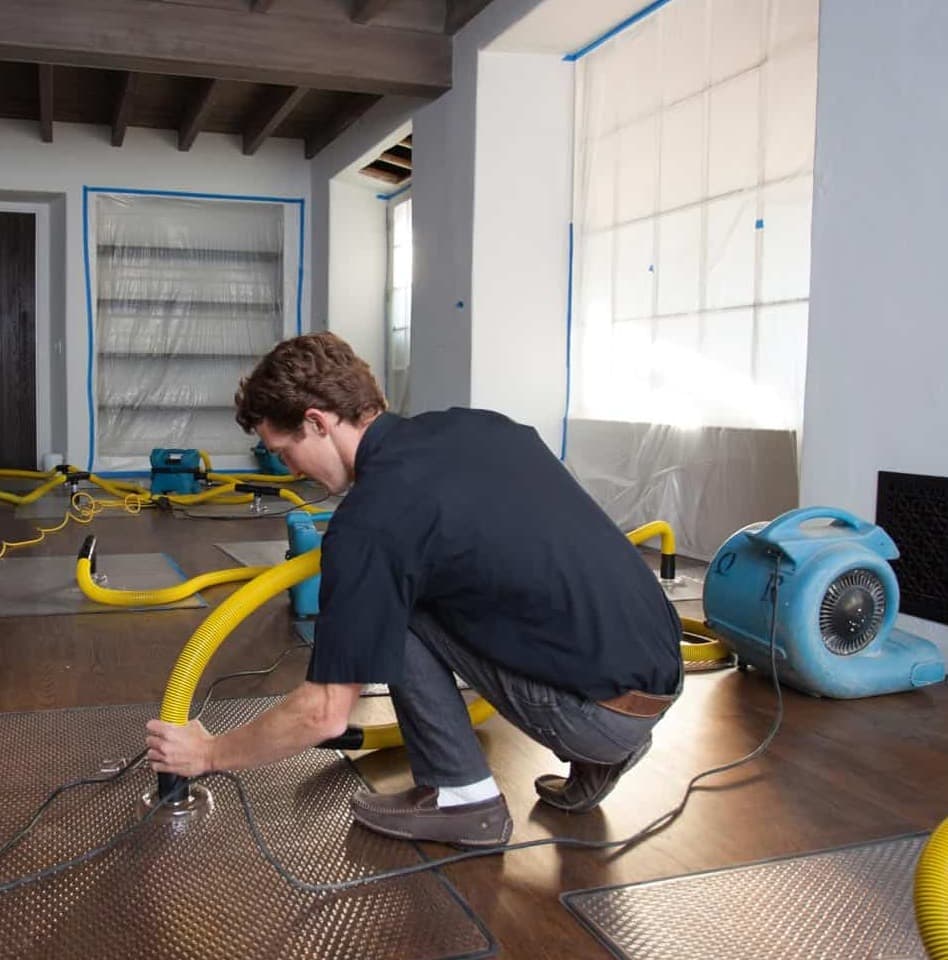
2 to 6 air movers and 1 LGR dehumidifier for 2 to 4 days. Daily moisture readings logged against the dry standard established on an unaffected section of the same ceiling.
Industry-standard antimicrobial applied to framing and substrate. Final moisture readings documented. Itemized scope written with per-square-foot line items matching your carrier price list.
New drywall, tape, mud, prime with stain-block, topcoat to match. Insulation replaced to original R-value. Light fixture re-installed or replaced if the junction box was wet.
In a basement or closet install, a condensate overflow leaks onto a concrete floor or a drain pan and the homeowner notices within hours. In an attic install — common in Macomb, Shelby, and Washington Township ranch homes built after 2000 — the air handler sits above blown-in insulation and the water has to travel down through the ceiling before anyone sees it. By the time a stain appears, the cavity above has usually been wet for several days, the cellulose insulation is matted and no longer insulating, and the paper face of the drywall has started to swell.
The fix is not glamorous and it is not exotic, but it has to be done in the right order: stop the source, extract, demo what cannot be saved, dry what can, document every line item, and rebuild. Skipping the drying step to save money is the single most common reason a minor condensate loss turns into a $6,000 mold remediation project 90 days later. Prime Restoration handles this scope in high-value homes too, including attic air handler losses in Bloomfield Hills and Birmingham estates with finished ceilings and high-end finishes.
An air conditioner pulls humidity out of your indoor air and that moisture has to drain somewhere. On most Michigan homes the air handler sits in a basement, a closet, or — more dangerously — in the attic, and the drip pan below the evaporator coil empties into a PVC condensate line that runs to a floor drain or outside the foundation. When that line clogs with algae biofilm, rust flakes, or drywall dust from a recent remodel, the pan backs up and overflows. On a typical July day in Macomb County, an AC can pull 15 to 20 gallons of moisture out of the air in 24 hours, so a clogged line can dump several gallons per day into whatever is directly below the unit. If the unit is in the attic, that water travels through ceiling drywall, R-49 blown-in insulation, and light fixtures before you ever see a stain.
Not necessarily. A small stain with no sag and a moisture reading under 16 percent in the drywall often dries in place with 1 to 2 air movers and a dehumidifier over 2 to 3 days, followed by a stain-blocking primer. The drywall has to come down when any of these are present: visible sag or a soft spot you can press with your finger, moisture readings above 18 percent after 48 hours of drying, visible mold growth on the back side that we confirm by cutting an inspection hole, or the insulation above is saturated and matted. We make that call with a Protimeter moisture meter after extracting standing water and running drying equipment, not by eyeballing the stain.
It depends on whether the carrier classifies the loss as sudden and accidental or as long-term seepage. A clogged condensate line that overflows overnight and soaks a ceiling is typically treated as sudden and accidental and covered under the dwelling coverage on a standard HO-3 policy from State Farm, AAA Michigan, Auto-Owners, Allstate, Farm Bureau, or Citizens. A slow drip that stained a ceiling over many months is almost always excluded as maintenance or gradual seepage. Adjusters look at three signals to decide: the size of the stain (small and fresh vs. large and ringed), whether there is mold on the back of the drywall (suggests the leak was not recent), and whether a prior claim or service record shows the system had been leaking before. Prime Restoration is a top-rated contractor for water damage insurance claims in Michigan, working with the adjuster from start to finish and documenting moisture readings, photos, and an itemized estimate; the homeowner always chooses their own contractor. Payment decisions are made by the insurance carrier after their own inspection.
Yes — those are two different trades. The HVAC technician clears the clog, adds a float switch, or replaces the drain pan so the leak stops. A water damage restoration company handles what the leak left behind: extracting standing water from the ceiling cavity, removing and disposing of saturated drywall and insulation, running structural drying equipment for 2 to 4 days, documenting the scope in a detailed, itemized line-item estimate so your adjuster sees the same line items their software generates, and rebuilding the ceiling once moisture readings are back to dry standard. Skipping the drying phase is how ceilings grow visible mold on the attic side within 72 hours during July and August in Michigan.
A minor single-stain ceiling dry-in-place runs $800 to $1,600 before rebuild. A standard ceiling demo (8 to 16 square feet of drywall plus a section of wet blown-in insulation) runs $1,800 to $3,500 for mitigation. A larger attic-unit failure that saturates 40 to 80 square feet of ceiling, light fixtures, and a whole bay of insulation runs $3,500 to $7,500 for mitigation, plus rebuild. Rebuild (new drywall, primer, paint to match) typically runs $600 to $2,400 depending on ceiling height and paint match. These are 2026 Macomb County averages and every project is written from actual moisture readings and affected square footage, not guessed.
First, turn the AC system off at the thermostat so it stops producing condensate while the drain is clogged. Second, place a bucket or a tarp under the drip point — do not punch a hole in the drywall to drain it unless water is actively pooling on the ceiling and sagging (that is an emergency step to prevent a collapse). Third, photograph everything: the pan, the drain line, the stain, the damage below. Fourth, call your HVAC company to clear the clog and call a restoration company for the drying. Fifth, file a claim with your carrier and document the sudden-and-accidental nature of the loss (when you first noticed it, what you did to stop it).
Mold can begin colonizing wet cellulose and paper-faced drywall within 48 to 72 hours in warm weather, so a condensate leak that sits for a week in July is a real mold risk on the attic side of a ceiling. Most Michigan HO-3 policies include a mold sublimit (often $5,000 to $10,000) that only pays when the mold is a direct result of a covered water loss. If you maintain your system, report the leak promptly, and get the drying documented, the mold sublimit is usually in play. If there is evidence the system was leaking for a long time before you reported it, mold coverage is typically denied as a maintenance exclusion. Remediation scope is written to industry-standard mold remediation practice. For health questions about mold, talk to your doctor.
The AC itself is usually fine. The evaporator coil, blower, and refrigerant circuit are sealed and the condensate problem is a drainage issue, not a mechanical failure of the cooling system. Once the clog is cleared, a float safety switch is added (a $25 part that shuts the system off next time the pan starts to fill), and any corroded drain pan is replaced, the system is back in service the same day. The restoration work happens in parallel — you do not have to live without AC while the ceiling dries.
Prime Restoration is a top-rated, highly local water damage restoration contractor with offices across Macomb and Oakland County, BBB A+ accredited and Certified Best Pick (Best Pick Reports, Detroit, 2027). Insurance-direct, itemized line-item documentation, and customer service homeowners consistently praise. Claim filing and payment decisions stay between you and your carrier.
Call (586) 277-1069Prime Restoration is a licensed Michigan water damage restoration contractor. Payment decisions, coverage determinations, and settlement amounts are made solely by the insurance carrier after their own inspection. Cost ranges on this page are 2026 Macomb County averages and are not a quote; every project is priced from actual moisture readings and affected square footage.